

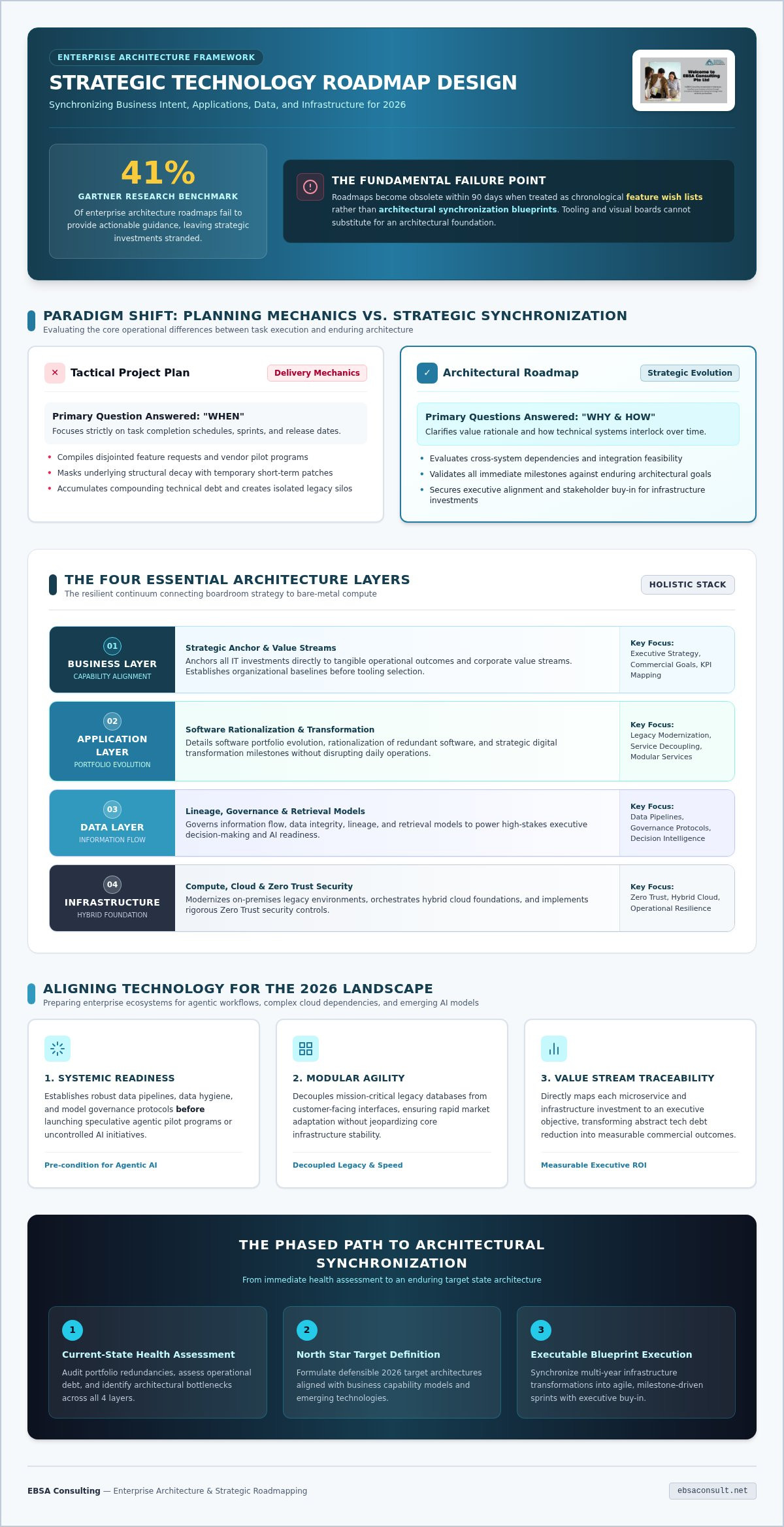
According to Gartner, 41% of enterprise architecture roadmaps fail to provide actionable guidance for business leaders, leaving high-stakes investments stranded before they yield measurable returns. If your organization struggles with planning documents that become obsolete within three months, you aren't alone. When technical debt stalls innovation and engineering sprints decouple from business KPIs, the issue rarely stems from your delivery tooling. Instead, it exposes a fundamental flaw in strategic technology roadmap design: treating roadmaps as chronological feature wish lists rather than visualizations of architectural synchronization.
You shouldn't have to choose between immediate operational speed and long-term architectural integrity. In this guide, you will master the architectural approach to technology roadmapping that firmly aligns long-term business vision with technical execution, earning stakeholder buy-in for vital infrastructure platforms along the way. We examine the four essential architecture layers required for modern resilience and unpack a practical 2026 framework designed to keep your technical strategy defensible, agile, and aligned.
Key Takeaways
- Move from reactive feature scheduling to capability-driven planning, ensuring every technology investment directly advances core organizational value streams.
- Discover how disciplined strategic technology roadmap design synchronizes business intent, application portfolios, governance, and infrastructure into an executable blueprint.
- Understand why visual boards and backlog management tools cannot replace an architectural foundation when addressing complex operational debt.
- Implement a structured, phased path from current-state health assessments to a defensible North Star target architecture.
- Secure executive alignment and stakeholder buy-in for multi-year infrastructure transformations while maintaining day-to-day organizational agility.
Beyond the Feature List: Why Strategic Technology Roadmap Design Fails Without Architecture
True strategic technology roadmap design functions as a multi-year blueprint for organizational evolution, not a release schedule. Too many enterprise leaders fall into the trap of assembling a digital "wish list" consisting of disjointed executive requests, departmental software pilots, and uncoordinated upgrades. When roadmaps merely compile feature requests, they decouple execution from fundamental operational logic. Engaging in enterprise architecture consulting provides the structural foundation required to validate every milestone against long-term operational needs. Without this discipline, organizations accumulate compounding technical debt, strand capital on redundant tools, and find themselves rewriting their plans every quarter.
The Distinction Between Project Plans and Strategic Roadmaps
Project plans govern delivery mechanics by answering "When" specific tasks finish. In contrast, strategic roadmaps clarify "Why" an investment matters and "How" systems interlock over time to support business growth. Tactical fixes address immediate friction, but they often mask underlying structural decay. Through targeted solution architecture design, teams evaluate technical dependencies, validate integration feasibility, and ensure short-term operational improvements actively advance enduring architectural goals rather than creating isolated legacy silos.
Aligning Technology with the 2026 Business Landscape
Architectural alignment is the synchronization of business capabilities with technical services to guarantee that every system investment directly propels executive strategy.
Modern enterprises face rapid shifts driven by agentic workflows, complex cloud dependencies, and emerging AI models. Preparing your roadmap for these technologies requires disciplined structure rather than speculative spending:
- Systemic Readiness: Establishing robust data pipelines and model governance protocols before launching speculative agentic pilot programs.
- Modular Agility: Leveraging enterprise architecture for innovation to decouple critical legacy databases from customer-facing interfaces, ensuring volatile market trends don't compromise core stability.
- Value Stream Traceability: Mapping each technical service directly to an executive objective, turning abstract modernization targets into measurable commercial outcomes.
When strategic technology roadmap design anchors itself in sound architecture, innovation becomes a repeatable competency instead of an expensive gamble.
The Four Essential Layers of a Resilient Technology Roadmap
Most planning frameworks treat roadmapping as a superficial canvas exercise, dividing work into generic swimlanes like timelines, teams, or software vendors. Effective strategic technology roadmap design rejects this cosmetic view. To drive lasting business impact, an executive roadmap must synchronize four interconnected architecture layers, creating a resilient continuum from boardroom strategy to bare-metal compute:
- The Business Layer: Anchors IT investments to tangible operational outcomes and corporate value streams.
- The Application Layer: Details software portfolio evolution, rationalization efforts, and critical digital transformation roadmap milestones.
- The Data Layer: Governs information flow, lineage, and retrieval models to power executive decision-making.
- The Infrastructure Layer: Modernizes legacy environments, hybrid cloud foundations, and Zero Trust security controls.
Layer 1: Business Capability Alignment
Long before selecting platforms, leadership teams need to understand what the organization must accomplish. Professional business architecture services establish this baseline by decomposing company strategy into discrete, measurable capabilities. Instead of funding isolated requests, leaders identify critical-to-growth capabilities, such as omnichannel order orchestration or automated claims underwriting. This focus directs capital toward services that yield the highest operational efficiency while retiring redundant systems that drain resources.
Layer 2 & 3: Harmonizing Applications and Data
Unchecked software acquisitions inevitably trigger portfolio sprawl, inflated license fees, and complex integration dependencies. Successful modernization demands aggressive rationalization, systematically retiring overlapping tools to clear room for unified platforms. Concurrently, your data layer must guarantee that high-fidelity information reaches analytical engines and frontline operators without manual intervention.
Data silos represent the greatest barrier to architectural agility, fragmenting operational context and starving modern analytics of reliable inputs.
By mapping information pipelines directly against application workflows, enterprise architects ensure your operational ecosystem feeds executive dashboards with unified, governed intelligence. Modernizing these underlying structures requires a methodical approach, and partnering with experienced architecture practitioners at EBSA Consulting helps enterprise leaders design multi-layered blueprints that balance technical resilience with measurable commercial speed.
Comparing Roadmapping Approaches: Tool-Centric vs. Architecture-Led
Workday Enterprise Insights noted in August 2025 that only 48% of enterprise digital transformations meet or exceed their outcome targets. This systemic shortfall happens when organizations mistake collaboration software like Jira or Miro for strategic governance. These platforms excel at tracking discrete sprints, but they remain execution environments rather than architectural frameworks. When teams mistake backlog tracking for strategic technology roadmap design, they manage activity rather than systemic change. An architecture-led methodology models business capabilities, data flows, and infrastructure constraints first, securing long-term operational resilience before teams write their first line of code.
For expanding organizations, implementing enterprise architecture for mid-sized firms prevents the classic complexity trap of adopting piecemeal software to solve localized problems. Rather than funding isolated projects that run over budget, an architecture-led roadmap unifies capital allocation behind vetted, high-value capabilities.
The Risk of Tool-Driven Roadmapping
Focusing purely on feature backlogs and customer feedback without reviewing technical feasibility creates unmanageable architectural drag. When SaaS tools dictate priorities, teams prioritize cosmetic interface requests while neglecting foundational systems.
- Infrastructural Fragility: Rushing application features forward while ignoring the core role of enterprise architect in legacy modernization leaves unstable backend databases vulnerable to outages.
- Vendor Entrapment: Designing workflows around specific tool settings forces your enterprise strategy to conform to external software constraints rather than business objectives.
- Sunk Capital: Delivering low-impact enhancements burns engineering bandwidth that should otherwise fund systemic structural improvements.
The Strategic Benefits of Architectural Design
A rigorous architecture-led model grounds executive decision-making in technical realities. By embedding a standardized solution architecture design process, technology leaders design predictable scaling trajectories that align every deployment with enterprise standards. Clear dependencies reassure executive sponsors, demonstrating why certain infrastructure investments must precede consumer-facing features. When macroeconomic pressures or regulatory shifts demand an operational pivot, modular architecture lets you reconfigure underlying components without dismantling your entire technical baseline. Strategic technology roadmap design turns architectural discipline into your most reliable driver of enterprise agility.
A Step-by-Step Guide to Designing Your 2026 Technology Roadmap
Effective roadmapping doesn't begin with a project backlog. Conventional roadmapping advice often suggests opening a software board and organizing outstanding developer tickets, but this simply canonizes existing technical debt into your future operating model. Disciplined strategic technology roadmap design follows a phased architectural methodology that anchors technology choices directly to business outcomes:
- Phase 1: Current State Assessment (The Health Check): Catalog existing systems, application interfaces, and underlying infrastructure to identify operational bottlenecks.
- Phase 2: Defining the North Star (Target Architecture): Model an optimized target operating state that accommodates regulatory standards, modular data pipelines, and executive revenue goals.
- Phase 3: Gap Analysis and Initiative Identification: Pinpoint exact capability deficiencies between current limitations and target designs.
- Phase 4: Prioritization: Rank work packages by evaluating commercial return against infrastructural feasibility.
- Phase 5: Visualization and Stakeholder Communication: Translate architectural sequences into tailored views for executive boards, operations teams, and engineering leads.
Phase 1 & 2: Assessment and Visioning
Rigorous health checks reveal where legacy platforms quietly throttle innovation. By documenting integration debts, data synchronization issues, and end-of-life runtimes, architects establish an unvarnished baseline. From there, defining your 2026 North Star isn't an abstract blue-sky workshop. Instead, this future vision uses disciplined solution architecture to validate that planned advancements remain technically viable, economically defensible, and resilient against unforeseen market disruption.
Phase 3 & 4: The Strategic Bridge
Capability mapping bridges current infrastructural limitations and your target operating state. Rather than treating legacy systems as sudden lift-and-shift candidates, architects carve complex modernizations into manageable transition stages, decoupling shared databases and deploying microservices sequentially. Balancing day-to-day business pressure against long-term operational health requires an objective evaluation matrix.
A resilient prioritization matrix systematically weights urgent operational requests against architecturally significant transformations to stop short-term demands from monopolizing technical capacity.
This balanced scoring mechanism prevents urgent front-end enhancements from crowding out core modernization milestones. For enterprise leaders seeking to translate this structured approach into an executable framework, you can schedule an enterprise architecture consulting session with EBSA Consulting to evaluate your ecosystem and construct a resilient roadmap tailored to your organizational goals.
Reshaping Your Future: How EBSA Consulting Synchronizes Strategy and Infrastructure
Transforming an ambitious executive strategy into operational reality requires more than isolated platform purchases. EBSA Consulting acts as a dedicated strategic guide for organizations across Singapore, constructing the overarching blueprint before specific tools are selected. By establishing a close partnership with executive leadership and technical teams, we bridge high-level corporate vision with underlying technical infrastructure. Our collaborative engagements ensure that your strategic technology roadmap design reflects operational realities while carving out an orderly path toward sustained enterprise growth.
Our Architecture-First Methodology
Our consulting practice grounds roadmap development in established industry frameworks, including The TOGAF Standard, 10th Edition, ensuring long-term structural stability. Because EBSA Consulting maintains strict vendor neutrality and does not sell off-the-shelf software products or managed IT support, our strategic advice remains completely objective. We focus on untangling systemic friction through structured thinking:
- Targeted Business Architecture: Defining operational capabilities to ensure technology investments directly support measurable corporate KPIs.
- Rigorous Solution Architecture: Validating technical dependencies and integration feasibility before teams initiate expensive delivery cycles.
- Objective Governance: Partnering with executive sponsors to translate multi-tiered architectural complexity into transparent, defensible roadmaps.
Ready to Architect Your Digital Agility?
Relying on disconnected spreadsheets and reactive task boards leaves organizations vulnerable to missed deadlines, fractured data, and compounding technical debt. A professionally engineered roadmap replaces chaotic delivery sprints with synchronized capability milestones, giving stakeholders the confidence to fund vital infrastructure upgrades. When technical strategy aligns with business purpose, your organization achieves true operational agility.
Move beyond static planning tools and elevate your strategic technology roadmap design into a dynamic operating framework. Discover how EBSA Consulting's Enterprise Architecture Consulting, Business Architecture Services, and Solution Architecture Design bring structural harmony to complex digital transformations. Connect with our advisory team to begin architecting a defensible foundation built for long-term resilience.
Synchronizing Architectural Vision with Lasting Business Value
A durable technology roadmap doesn't merely record software release schedules; it orchestrates the steady evolution of your entire business ecosystem. By transitioning from reactive task backlogs to a capability-driven model across business, application, data, and infrastructure layers, organizations eliminate technical debt before it stalls innovation. Mastering strategic technology roadmap design ensures that your infrastructure investments continuously support high-level corporate objectives while maintaining the agility needed to pivot when markets shift.
Building this structural harmony requires deliberate alignment rather than chance. As Singapore-based enterprise architecture specialists, EBSA Consulting pairs comprehensive business architecture services with disciplined solution architecture design. We partner closely with executive leadership to turn complex organizational requirements into clear, executable technical blueprints. Reshape your organization with EBSA Consulting to establish a resilient foundation that accelerates growth and safeguards your long-term vision.
Frequently Asked Questions
What is the primary goal of a strategic technology roadmap?
The primary goal is to synchronize an organization's multi-year technical investments directly with corporate capabilities and revenue targets. Rather than simply scheduling software features, strategic technology roadmap design creates a coherent blueprint connecting business, application, data, and infrastructure layers. This ensures engineering capacity addresses strategic goals, prevents fragmented capital expenditure, and provides clear visibility for executive decision-makers steering long-term modernization efforts.
How often should an enterprise technology roadmap be updated?
An enterprise technology roadmap requires formal quarterly reviews alongside continuous operational checkpoints. While the architectural North Star and multi-year trajectory remain relatively stable over three to five years, quarterly assessments let leadership adjust transition states based on shifting regulatory demands, vendor updates, or business priorities. Treating your roadmap as an evolving architecture rather than a static document prevents planning obsolescence and preserves ongoing cross-departmental alignment.
What is the difference between a product roadmap and a technology roadmap?
A product roadmap details user-facing features and market deliverables, whereas a technology roadmap defines the foundational architecture and systems required to support those capabilities. Product roadmaps address customer interactions, commercial release dates, and functional enhancements. In contrast, technology roadmaps focus on backend system stability, data governance frameworks, cloud topology, and architectural technical debt, supplying the essential foundation that makes product delivery possible.
How do you handle legacy systems in a modern technology roadmap design?
Legacy platforms should be managed through phased encapsulation and gradual capability migration rather than abrupt, disruptive replacements. Effective strategic technology roadmap design maps the explicit dependencies of legacy systems, isolating core database records through APIs and microservices. Architects establish transitional target states that systematically decouple critical business logic. This staged approach modernizes technical foundations incrementally, mitigating operational downtime and protecting capital investments while keeping routine business services fully active.
What role does the Enterprise Architect play in roadmap design?
An Enterprise Architect acts as the strategic orchestrator who translates high-level business goals into viable technical blueprints. They establish structural governance, identify dependencies across application ecosystems, and ensure that data architecture complies with external regulatory standards. By partnering with senior stakeholders and delivery teams, the Enterprise Architect prevents costly duplicate investments, rationalizes software portfolios, and validates that each technical project actively moves the organization closer to its target state.
How can we ensure our technology roadmap stays aligned with business goals?
You ensure lasting alignment by mapping every technical initiative directly to specific business capabilities and executive key performance indicators. When leadership establishes explicit traceability between system upgrades and commercial outcomes, technology teams don't pursue disconnected engineering preferences. Conducting joint quarterly architectural reviews between department heads and enterprise architects also guarantees that changes in corporate strategy immediately cascade down to the application and infrastructure layers.
Can a mid-sized firm benefit from strategic technology roadmapping?
Mid-sized firms gain immense value from structured roadmapping by preventing application sprawl and scaling without unsustainable organizational complexity. Without dedicated architectural planning, growing firms frequently accumulate disconnected SaaS applications and redundant tools that drain limited budgets. A formal roadmap design establishes clear architectural guardrails early. This structure enables mid-sized enterprises across Singapore to allocate capital efficiently, modernize infrastructure predictably, and expand their technical footprint without incurring paralyzing technical debt.
What are the most common mistakes in technology roadmap design?
The most common mistake is confusing tactical task backlogs or tool boards with a cohesive architectural strategy. Organizations often focus strictly on arbitrary delivery dates and cosmetic software features while ignoring foundational data models, integration constraints, and infrastructure prerequisites. Other frequent pitfalls include failing to engage business stakeholders early, underestimating legacy migration dependencies, and treating the roadmap as a rigid, one-time document rather than an adaptable, capability-driven governance model.


