

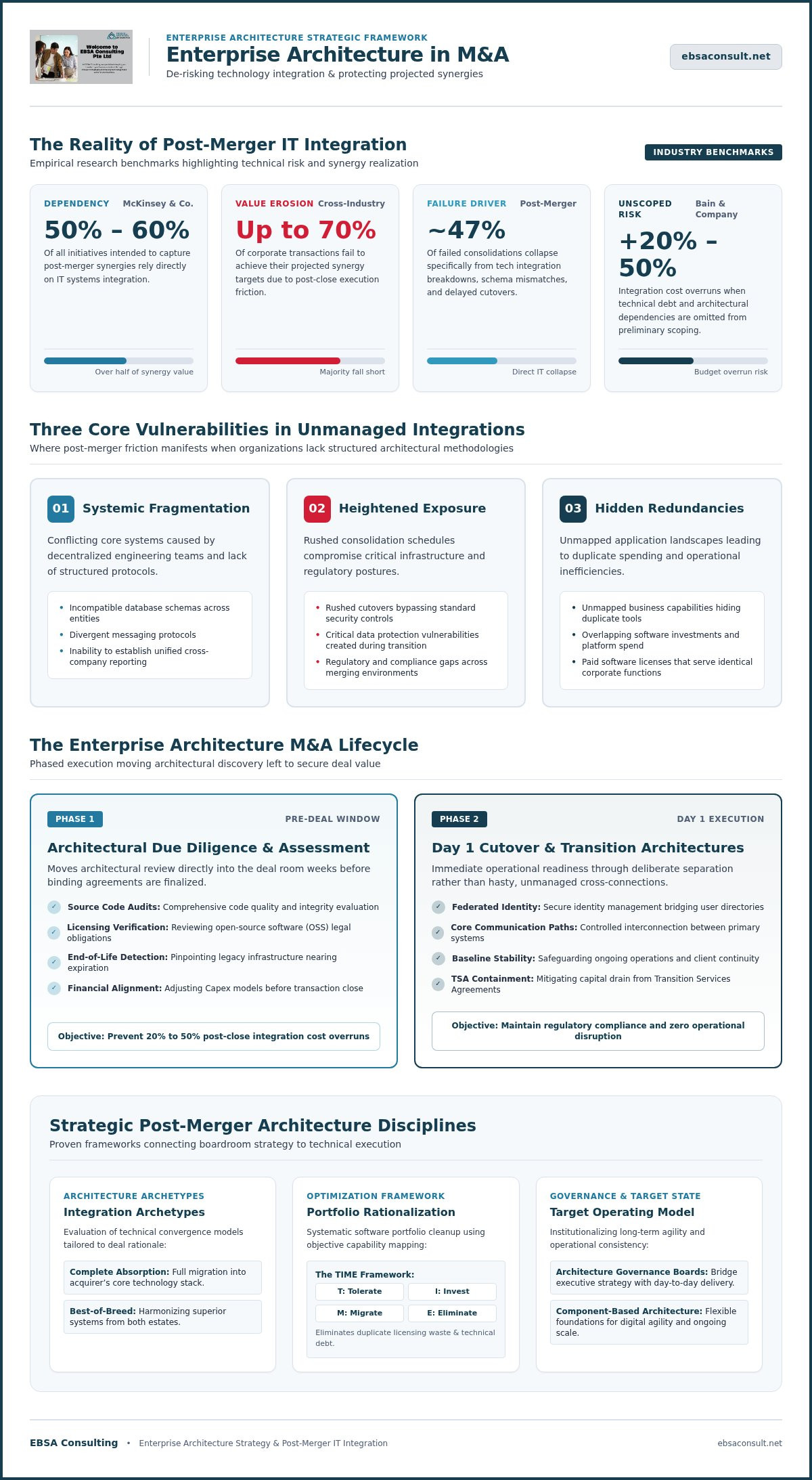
According to McKinsey & Company, between 50% and 60% of all initiatives intended to capture post-merger synergies rely directly on IT systems integration, yet up to 70% of transactions fail to achieve their projected synergy targets. When post-close execution collides with hidden technical debt, projected value quickly erodes. Applying enterprise architecture for mergers bridges the divide between executive vision and operational reality, transforming high-risk consolidations into structured, predictable success.
You likely recognize the underlying tension: siloed engineering teams debate platform choices, costly transition services agreements drain capital, and hasty cutovers risk severe operational disruption. Managing these multifaceted dependencies requires more than ad-hoc project plans; it demands architectural rigor and clear strategic direction.
In this guide, discover how enterprise architecture mitigates technical risk, accelerates systems integration, and secures deal value across corporate mergers. You'll examine practical frameworks to rapidly baseline dual IT estates, formulate an actionable target operating model, and eliminate redundant software portfolios to unlock lasting operational efficiency.
Key Takeaways
- Discover how enterprise architecture for mergers protects projected deal synergies by uncovering hidden technical debt and architectural risks during preliminary diligence.
- Establish Day 1 baseline stability through structured discovery frameworks that maintain operational continuity and regulatory compliance across merging organizations.
- Evaluate core integration archetypes, from complete absorption to best-of-breed harmonization, to align technical estates directly with strategic business objectives.
- Rationalize redundant application portfolios using objective business capability mapping and the TIME framework to eliminate licensing waste.
- Formulate a resilient target operating model supported by architectural governance boards that bridge executive strategy with technical execution.
The Strategic Role of Enterprise Architecture in Mergers and Acquisitions
Every corporate transaction begins with ambitious financial modeling, yet real value realization hinges entirely on technological convergence. Enterprise architecture serves as the structural blueprint that links executive deal rationale with tangible IT execution. While financial analysts evaluate balance sheets, architects examine operational foundations, identifying how data flows, software applications, and network infrastructures interact across both businesses. For firms preparing an acquisition or corporate divestment, taking time to explore Salg av bedrift through experienced M&A advisors helps ensure commercial strategy and operational readiness are aligned from the outset.
Industry data reveals that approximately 47% of failed post-merger consolidations collapse specifically because of technology integration breakdowns, data schema mismatches, and delayed cutovers. Without proactive governance, unmanaged complexity quickly stalls project momentum. Rigorous architectural oversight helps organizations avert these missteps by addressing unrecorded technical debt early, curbing duplicate platform spending, and protecting operational continuity across both entities.
Why Mergers Suffer from Architectural Misalignment
When organizations rush into integrations without structured methodologies, technology estates fragment rapidly. Local teams make decentralized software decisions, creating conflicting core systems that resist consolidation. Post-merger friction typically manifests across three vulnerable areas:
- Systemic Fragmentation: Incompatible database schemas and divergent messaging protocols prevent unified cross-company reporting.
- Heightened Exposure: Rushed cutovers bypass security controls, introducing critical data protection vulnerabilities and compliance gaps during infrastructure transitions.
- Hidden Operational Redundancies: Unmapped business capabilities conceal overlapping software investments, resulting in paid licenses that serve duplicate corporate functions.
Connecting Business Strategy to Technological Infrastructure
Enterprise architects operate as strategic advisors who translate boardroom synergy targets into functional system designs. Rather than evaluating software tools in isolation, they analyze systems through comprehensive enterprise architecture frameworks that harmonize business capabilities, data governance, and underlying infrastructure. This discipline ensures that early decisions support long-term flexibility instead of creating new layers of rigidity.
Sustainable value capture requires balancing immediate business continuity with the resilience needed to support subsequent corporate growth. Discover how enterprise architecture for innovation supports post-merger market responsiveness by creating flexible, component-based architectures. By prioritizing capability mapping over arbitrary tool selection, establishing enterprise architecture for mergers preserves deal momentum and delivers a stable platform for ongoing scale.
The Enterprise Architecture M&A Lifecycle: From Diligence to Harmonization
Successful technology consolidations don't begin on Day 1; they originate weeks before binding legal agreements are signed. Bain & Company notes that initial post-merger integration cost projections are overrun by 20% to 50% when architectural dependencies and technical debt aren't uncovered during preliminary scoping. Applying enterprise architecture for mergers across a phased lifecycle transforms ambiguous IT landscapes into predictable transformation stages.
Phase 1: Architectural Due Diligence and Pre-Deal Assessment
Rigorous pre-close discovery moves architectural review "left" into the deal room. Independent teams audit source code quality, open-source software licensing obligations, and legacy infrastructure nearing end-of-life support. Identifying whether proprietary systems carry severe technical debt enables dealmakers to adjust financial models and transition capital expenditure projections before transaction closing. Founder-led organizations preparing for such transitions can discover Founded Partners to access specialized transaction and advisory services that help leadership navigate diligence and deal execution with confidence.
Phase 2: Day 1 Cutover and Transition Architectures
Immediate operational readiness requires deliberate separation rather than unmanaged cross-connection. Teams establish federated identity and core communication paths while maintaining rigorous network segmentation to contain cybersecurity risks. Grounded in MIT CISR research on enterprise architecture, establishing an operational backbone and well-defined interim architectures decouples shared dependencies. This deliberate design lets organizations minimize costly Transition Services Agreements (TSAs) without threatening real-time revenue streams.
Phase 3: Long-Term Harmonization and Target Roadmapping
Lasting synergy value takes root during multi-year transformation trajectories. Architects execute phased migrations that eliminate legacy core platforms while modernizing underlying capabilities into modular services. Integration leaders can review our guide on strategic technology roadmap design to establish ordered execution gates across applications, data models, and business units.
Executing these complex transitions requires vendor-neutral oversight across every milestone. Partnering with seasoned practitioners for enterprise architecture consulting provides the structured governance and objective analysis needed to safeguard your long-term integration journey.
Evaluating Post-Merger IT Integration Archetypes and Strategies
Every acquisition requires an integration strategy tailored to its core strategic purpose. Rather than forcing a uniform approach across every business unit, leadership teams must assess structural archetypes to govern systems consolidation. Enterprise architecture for mergers clarifies these choices, establishing an objective framework to weigh functional requirements against architectural risk.
Four primary archetypes dictate how organizations manage combined technology estates:
- Absorption (Takeover): The acquired entity completely retires its existing systems, migrating all workloads onto the acquirer's established platforms. This approach moves rapidly and eliminates redundant tooling, but it demands strict operational conformity.
- Symbiosis (Best of Breed): Both organizations compare domain-specific systems, selecting the superior application in each category, such as retaining one company's ERP while deploying the other's CRM. This retains top capabilities but creates complex integration and data reconciliation overhead.
- Preservation (Coexistence): The target firm maintains autonomous systems, connecting with the parent enterprise through high-level reporting interfaces and shared identity governance. Common in diversified holding models, it avoids immediate operational disruption while tolerating parallel technology costs.
- Transformation (Greenfield): The merger serves as a catalyst to decommission legacy estates across both businesses, transitioning operations directly to an updated, cloud-native architecture. While delivering the highest long-term agility, it carries the largest capital commitment and delivery risk.
Selecting the Right Strategic Integration Archetype
Choosing an archetype requires evaluating business models alongside technical capacity. High-volume, commoditized operations benefit from rapid absorption, whereas acquisitions intended to secure proprietary intellectual property require preservation or symbiosis to safeguard distinct competitive advantages. Growing businesses must also examine delivery bandwidth before initiating multi-platform migrations. Mid-sized acquirers should explore enterprise architecture for mid-sized firms to prevent organizational strain and avoid overextending engineering resources.
Analyzing Trade-offs: Speed, Cost, Risk, and Autonomy
Each archetype presents distinct operational trade-offs that directly affect synergy realization:
- Absorption accelerates run-rate cost reductions and simplifies operational models, though aggressive execution can trigger key personnel attrition and disrupt customer touchpoints.
- Symbiosis preserves high-performing business capabilities and encourages organizational buy-in, yet prolonged platform selection debates frequently stall project velocity.
- Preservation protects short-term revenue continuity and requires minimal initial restructuring, but perpetuating duplicated licensing fees and split data models restricts enterprise scalability.
Strategic architects evaluate these dimensions objectively, ensuring the selected technical path directly reflects executive deal goals.
Application Portfolio Rationalization and Technical Debt Elimination
Combining two software estates inevitably creates redundant platforms, overlapping SaaS subscriptions, and conflicting database instances. According to the Deloitte Global Technology Leadership Study, technical debt consumes between 21% and 40% of an enterprise's overall IT budget. Left unchecked after an acquisition, this drag compounds rapidly. Applying structured enterprise architecture for mergers gives integration teams an objective framework to triage application portfolios, eliminate licensing redundancies, and cut run-rate operational costs by 15% to 30%.
Mapping Overlapping Business Capabilities
Effective rationalization doesn't begin with software feature comparisons. It starts by constructing a unified business capability model that spans both enterprises. Grounding systems assessments in business architecture prevents subjective debates between competing internal teams. Architects systematically evaluate platforms across two strategic dimensions:
- Functional Fit: Measuring how completely the software fulfills operational requirements, supports core user workflows, and preserves transaction throughput across essential business units.
- Technical Health: Assessing architectural maintainability, source code stability, interface modularity, and vendor support status for each underlying platform.
Plotting applications against these criteria identifies functional overlaps across enterprise resource planning, customer relationship management, and billing engines. This transparent baseline removes organizational politics from consolidation discussions.
Executing the Rationalization Decision Matrix
Once capabilities are mapped, integration leaders categorize assets using Gartner's TIME framework:
- Tolerate: Retain systems with high technical stability but limited strategic value, maintaining them with minimal ongoing investment.
- Invest: Direct capital toward high-performing platforms that deliver superior functionality and modern, clean architectures.
- Migrate: Shift business workflows away from aging legacy systems toward standard strategic platforms to simplify support overhead.
- Eliminate: Decommission duplicate applications and obsolete infrastructure, executing disciplined data archiving to harvest instant license savings.
Target application states should align directly with an overarching digital transformation roadmap, ensuring near-term synergy captures reinforce your modern technology footprint. Systematic portfolio triage curbs sprawl while preventing fragile point-to-point connections from introducing post-close operational risk.
Uncovering duplicate software licenses and reducing systemic friction requires structured methodologies. Engage our business architecture services to baseline your application landscape, eliminate operational redundancies, and protect projected merger deal value.
Structuring the Target Operating Model with Strategic Architecture Consulting
Establishing an actionable Target Operating Model (TOM) transforms high-level corporate strategies into unified day-to-day operations. Too often, mergers stall because a deep operational chasm opens between executive capability models and down-to-the-metal solution designs. Solution architects build isolated systems, while business strategists draft organizational charts that ignore technical realities. Structuring enterprise architecture for mergers provides the vital translation layer that unites these efforts, ensuring every infrastructure investment reinforces business performance.
Designing a Scalable Architecture Governance Framework
Sustainable post-merger execution demands transparent decision structures. Integrating organizations must establish a joint Architecture Review Board (ARB) containing senior technical architects, security officers, and business leaders from both sides. This cross-entity governance council serves three core functions:
- Enforcing Standards: Adjudicating system selections against predefined architectural principles to maintain interface interoperability.
- Controlling Exceptions: Managing formal deviation paths to prevent decentralized business units from standing up shadow IT during transition phases.
- Tracking Synergy Gates: Linking architecture milestones directly to quarterly financial targets, verifying cost takeout before contracts renew.
Why Independent Architectural Advisory Secures M&A Value
Internal engineering groups naturally favor the legacy platforms they know best, leading to prolonged debates over target-state tooling. Engaging external strategic advisors introduces objective, vendor-neutral evaluation that sidesteps corporate politics. Independent specialists assess application estates solely through capability alignment and operational risk, breaking deadlocks and accelerating consensus across divergent engineering cultures.
Specialized advisors also arrive with proven reference architectures and capability mapping templates, compressing discovery timelines from months into weeks. Selecting experienced strategic enterprise architecture consulting provides the structured methodologies required to design end-state solution blueprints and modernize legacy workloads without operational disruption.
Partnering with EBSA Consulting connects your leadership team with seasoned practitioners across enterprise architecture, business architecture services, and solution architecture design. This collaborative guidance bridges strategic vision with execution, safeguarding deal momentum and anchoring long-term organizational agility.
Securing Post-Merger Value Through Strategic Architectural Alignment
Executing a successful corporate transaction requires more than ambitious financial targets; it demands deliberate technical synchronization. By implementing enterprise architecture for mergers, organizations transform complex integrations into disciplined, measurable transformation roadmaps. Unifying dual IT landscapes around shared business capabilities removes subjective bias, uncovers hidden technical debt before deal closing, and protects revenue continuity during critical cutover windows.
Sustainable growth begins with disciplined governance and proven capability models. Moving from disconnected application portfolios to a streamlined target operating model ensures your technology investments directly reinforce long-term corporate agility.
Accelerate your post-merger technology integration with EBSA Consulting. Our team provides vendor-neutral strategic guidance bridging business architecture with solution design, deploying proven frameworks to systematically eliminate technical debt and consolidate complex IT portfolios. With structured architectural oversight, your newly unified organization can navigate consolidation with confidence and achieve lasting operational excellence.
Frequently Asked Questions
What is the primary role of enterprise architecture during corporate mergers?
The primary role of enterprise architecture for mergers is connecting strategic corporate intent with technical execution across combined IT environments. Enterprise architecture establishes a unified business capability blueprint, mapping data flows, software portfolios, and infrastructure to eliminate duplicate software spending. This structured guidance helps leadership select suitable target operating models, ensuring projected post-merger synergies materialize without disrupting daily operations.
When should enterprise architects become involved in the M&A process?
Enterprise architects should engage during pre-deal due diligence, well before closing or signing definitive agreements. Shifting architectural assessment into the preliminary deal room allows teams to inspect software health, licensing liabilities, and system dependencies before purchase terms finalize. Early involvement prevents unexpected capital expenditure surprises and informs valuation discussions, ensuring that post-close integration roadmaps begin on an accurate technical foundation.
How does enterprise architecture identify hidden technical debt before deal closing?
Architects uncover hidden technical debt by conducting structured audits of codebase maintainability, interface coupling, and infrastructure support lifecycles. They evaluate legacy software stability, unpatched open-source components, and fragile point-to-point integrations that don't appear on standard financial balance sheets. Utilizing enterprise architecture for mergers during diligence translates these latent engineering risks into quantifiable remediation estimates, protecting buyers from sudden post-close stabilization costs.
What is the difference between absorption and symbiosis integration strategies?
Absorption completely migrates target company operations onto the acquirer's existing IT platforms, whereas symbiosis adopts best-of-breed systems from both organizations. Absorption maximizes rapid operational expense reductions and standardizes organizational tooling, though it demands strict operational conformity. Symbiosis preserves differentiated capabilities from both entities by selecting the superior tool in each domain, but it requires deeper architectural orchestration and complex data reconciliation.
How can enterprise architecture accelerate the exit from Transition Services Agreements (TSAs)?
Enterprise architecture accelerates TSA exits by designing modular interim architectures that decouple systems cleanly without requiring immediate, complete rebuilds. By introducing API gateway layers, data proxies, and federated identity services, architects isolate acquired business functions from the seller's hosting infrastructure. This targeted decoupling enables teams to decommission contracted transition services ahead of schedule, eliminating penalty fees and recurring operational expenses.
Why do project management offices (PMOs) need enterprise architecture support during integrations?
PMOs manage project schedules, resource allocations, and task milestones, but they lack the structural framework to evaluate cross-system technical dependencies. Enterprise architecture provides the architectural blueprint that informs the PMO's critical execution path. Architects evaluate sequencing logic, assess interface dependencies, and prevent conflicting design decisions between workstreams, ensuring integration managers coordinate delivery around an enduring target operating model rather than isolated functional checklists.


