

A change can be strategically sound and still miss the mark if it is not connected to the outcomes the organization needs. Business architecture for organizational change links business goals to the capabilities, value streams, people, processes, information, and technology required to achieve them. It also helps reveal which parts of the organization a proposed change may affect.
That connection matters because transformation is more than a technology decision or a redesigned process. It reshapes how work gets done and how value reaches customers, employees, and partners. A shared view of the organization gives leaders and teams a clearer basis for discussing priorities, dependencies, and trade-offs.
This article explains how business architecture translates strategy into change plans, surfaces impacts across processes and information flows, and helps communicate a shared vision. It also shows how monitoring outcomes and adapting initiatives can keep change aligned with evolving business needs. The result is a more coherent way to connect today’s decisions with the organization’s longer-term goals.
Key Takeaways
- Map capabilities and value streams to connect strategic priorities with the work that delivers value.
- Assess how proposed changes affect people, processes, information flows and supporting technology across business boundaries.
- Build shared understanding by explaining the change’s purpose and tailoring communication to the teams it affects.
- Track outcomes, gather feedback and adapt initiatives as customer needs and business conditions evolve.
- Use architecture decisions to clarify priorities, guide investment choices and keep transformation aligned with organizational goals.
Organizational and social influences on enterprise architecture
Organizational transformation changes how an enterprise creates value and works with customers, employees, suppliers, or investors. Architecture connects these shifts to organizational capabilities and the people who enable them.
For organizations in Singapore, consider applicable sector requirements, data-handling rules, procurement conditions, and public-sector architecture guidance where relevant. Map each consideration to the affected capability and its accountable owner, since requirements depend on the organization’s activities and the scope of the change.
A business architecture framework brings together capabilities, value streams, organizational structure, processes, information, and technology. Capabilities describe what the enterprise must be able to do; value streams show how coordinated capabilities deliver value to customers, partners, and employees.
To develop architecture for change, define the intended outcomes and map current capabilities and value streams. Identify affected people, processes, information, and technology, then compare the current state with the desired state. Use the gaps to shape a transformation roadmap.
Enterprise architecture transformation also depends on culture, leadership commitment, and stakeholder understanding. An enterprise architecture case study used interviews lasting approximately 57 minutes each, conducted between October 2011 and January 2012. Interviews can help surface how employees understand architectural decisions, though the timing alone doesn’t establish transformation outcomes.
Modular capabilities support composable enterprise design, allowing organizations to reshape how they combine resources and work. For example, a customer-service capability may depend on trained staff, defined processes, information, and technology. Mapping these dependencies can reveal where a proposed change requires coordination across business units.
Change Management in Enterprise Architecture
Change management within enterprise architecture coordinates changes to people, processes, and technology as the organization moves toward a desired state. It matters because a design that overlooks adoption can leave teams unclear about new responsibilities or workflows.
For example, when a new capability changes customer-service work, explain its purpose, identify affected teams, and plan relevant training and support. Early stakeholder input can also surface concerns that architecture diagrams alone may not reveal.
Implementation Roles, Skills, and Challenges
Implementation roles connect strategic decisions with operational knowledge. Executives provide direction, business architects relate capabilities and value streams, and project managers, IT staff, end users, and external partners contribute perspectives on the work affected.
Useful skills include systems thinking, facilitation, process analysis, and clear communication. Common challenges include limited leadership commitment, low stakeholder awareness, resistance, and organizational complexity. Addressing these factors keeps business architecture for organizational change connected to daily work and strategic intent.
Assessing change impacts on processes and information flows
A proposed change rarely stays within one team or system. To understand its reach, trace the work from its starting point to its outcome, including business functions, organizational boundaries, information exchanges, and supporting tools. This end-to-end view helps identify dependencies a department-by-department review may miss.
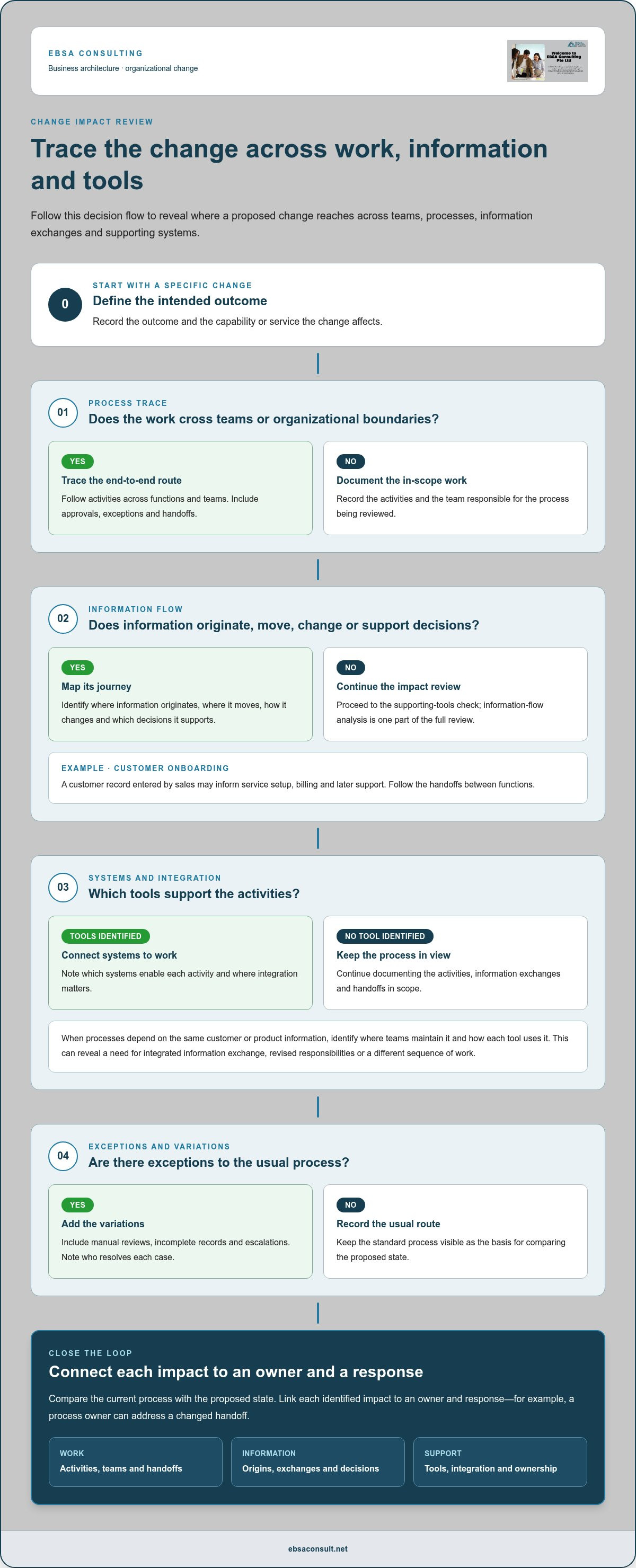
Start with a specific change, such as introducing a new customer onboarding process. Map each activity, the responsible team, the information used, and the system supporting the work. Then follow the handoffs between functions. For example, a customer record entered by sales may inform service setup, billing, and later support.
Use a consistent impact review to compare the current process with the proposed state:
- Define the change. Record its intended outcome and the capability or service it affects.
- Trace the process. Follow activities across teams, including approvals, exceptions, and handoffs.
- Map information flows. Identify where information originates, moves, changes, and supports decisions.
- Connect supporting tools. Note which systems enable each activity and where integration matters.
Next, examine the relationships among capabilities, processes, and information. If a service team needs accurate order status, assess how that information travels from order entry through fulfilment. A delay or inconsistent record can affect several connected activities, even when the change appears limited to one application.
Include exceptions in the assessment. A process map showing only the usual route may overlook manual reviews, incomplete records, or escalations. For example, a revised approval workflow could change who resolves a missing-data case. Recording these variations helps teams understand the operational impact before implementation.
Information-flow analysis also clarifies integration strategies. When two processes depend on the same customer or product information, identify where teams maintain that data and how each tool uses it. This reveals whether the future design needs integrated information exchange, revised responsibilities, or a different sequence of work.
Finally, connect each identified impact to an owner and a response. A process owner may address a changed handoff, while a technology team considers system dependencies. A concise impact view gives decision-makers a basis for prioritising work and planning transition support.
For a more structured view of how process and information dependencies connect to business goals, explore business architecture support.
When information flows interact, keep the assessment tied to the full operating path rather than treating each affected activity in isolation. Examine end-to-end processes across business functions and organizational boundaries, including related processes, information flows, and supporting tools. Compare connected processes before and after the change, noting the information each depends on and the tools that enable its movement. This helps show whether a local adjustment shifts work or responsibility elsewhere, giving owners a clearer basis for coordinating the transition.
A business architect’s understanding of the relationships among processes, information, and capabilities can help determine whether a business process management system should prioritise back-end integration. Consider whether the changed work depends on information produced by another process, and whether the capability relies on that information arriving in a usable form. If these relationships are important, integration may deserve attention alongside changes to tasks or responsibilities. If they are less central, record the dependency and assign an owner to review it. Documenting these connections supports decisions about sequencing, coordination, and transition support while keeping the wider operating path in view.
Communicating the vision across the organization
A transformation vision becomes useful when employees can connect it to decisions and everyday work. Use the organizational model to understand how managers communicate the vision to front-line teams, then identify where messages need clarification or reinforcement.
Begin with a concise explanation of the change: the business outcome, the capabilities it affects, and what will work differently. For example, if an organization redesigns customer onboarding, explain how the change supports a smoother customer experience and what each team contributes. This connects strategic intent with operational responsibilities.
Adapt the message to each audience without changing its central purpose. Executives may need to understand investment priorities and expected outcomes. Managers need to explain team-level impacts, while front-line staff need practical guidance on changed tasks, handoffs, and support. A shared narrative helps prevent groups from interpreting the transformation differently.
Map communication to the organizational model. Identify affected groups, their decision-making roles, and the channels through which they receive direction. A customer operations team may need workflow demonstrations, while technology teams need clear dependencies and delivery decisions. External partners may also need explanations when changes affect shared processes.
Use a deliberate communication sequence:
- Explain the rationale. Link the change to a business goal and describe why the current approach needs to evolve.
- Show the impact. Give each group a concrete example of changed responsibilities, processes, or information.
- Invite input. Use workshops or focus groups to surface questions and practical concerns early.
- Reinforce the message. Equip managers with consistent talking points, training, and support for team discussions.
For instance, a workshop with service staff can reveal that a redesigned process creates an unclear escalation path. Addressing the issue before implementation makes the vision more credible and shows teams how their feedback shapes the target state. It also gives leaders a practical view of likely resistance.
Communication requires leadership commitment and participation from the people doing the work. Executives can explain strategic intent, but managers translate it into team priorities. Front-line employees can identify friction that senior leaders may not see. This two-way exchange builds shared understanding and supports organizational agility as needs evolve.
Coordinate communication with project and behaviour planning. If a new process changes decision rights, explain who owns the decision, provide relevant training, and give teams a channel for questions. Monitoring those questions helps leaders identify unclear messages and adjust support as the transformation progresses.
Keep the vision visible through decisions, not slogans. When a proposed initiative supports the stated customer outcome, explain the connection. When priorities shift, clarify what changed and why. Consistent explanations help employees relate daily choices to the transformation’s intended direction.
Monitoring outcomes and continuous improvement
A transformation roadmap needs feedback loops, not just delivery milestones. Track whether each initiative changes the business outcome it was designed to support. For a redesigned claims process, compare processing quality, handoffs, and customer feedback with the intended result. This distinguishes completed project work from value realised in operations.
Set a baseline before implementation, then select measures that reflect the capability being changed. A digital service initiative might monitor task completion, repeat enquiries, and staff adoption. Pair operational measures with customer and employee feedback so leaders can see both system performance and the experience behind it. Assign an owner to each measure and define how findings will inform decisions.
Integrate impact assessments into ongoing improvement. If a change alters a team’s responsibilities, monitor workload, decision delays, and escalation patterns alongside the original outcome measures. Develop mitigation strategies as impacts emerge rather than waiting until the initiative closes. For example, a rise in unresolved cases could prompt updated guidance or a revised handoff between teams.
Use a recurring review to keep initiatives aligned as business needs change:
- Compare outcomes with intent. Check whether actual capability and service changes support the initiative’s objectives.
- Review new evidence. Consider customer behaviour, marketplace shifts, employee feedback, and operational measures.
- Replan where needed. Adjust initiative scope, sequencing, or dependencies when priorities or assumptions change.
- Apply and track responses. Pair each mitigation with an owner and monitor whether it addresses the observed impact.
For instance, if customer behaviour shifts toward digital channels, an organization may need to revisit service priorities and supporting initiatives. An adaptive organization can replan as business needs evolve. The review should connect new evidence to specific decisions, such as changing a capability roadmap or adjusting how teams support customers.
Continuous improvement also depends on learning how people experience the change. FutureTech Innovations used surveys and feedback sessions to assess how employees adapted to its new enterprise architecture framework. The organization had more than 400 employees, making employee input useful for understanding adaptation across a broad workforce. Such feedback can surface friction that operational measures alone may not reveal.
Keep a record of decisions, observed impacts, and follow-up actions. If a new process improves service delivery but creates extra work for a supporting team, document both effects and rebalance the design. This turns monitoring into a practical management discipline, helping leaders refine initiatives continuously rather than treating transformation as a one-time launch.
Alignment of architecture changes with business goals
Architecture changes create value when they respond clearly to a business goal. If a Singapore retailer prioritises reliable fulfilment, its target architecture should connect that goal to order management, inventory visibility, and delivery coordination. This line of sight helps leaders assess whether proposed initiatives advance the strategy or simply add activity.
Start by translating strategic objectives into outcomes and capabilities. A goal such as improving service consistency could require clearer service ownership, integrated customer information, or redesigned support workflows. Value streams show how capabilities combine to deliver outcomes for customers, partners, and employees. Together, these views help establish which parts of the operating model need to change.
Commonly used references include TOGAF, BIZBOK, and ArchiMate, but they serve different purposes. TOGAF supports enterprise architecture development, BIZBOK focuses on business architecture knowledge and practices, while ArchiMate provides a modelling language for expressing architecture relationships.
Use architecture as a governance discipline, not a static diagram. For each proposed change, document its scope, objectives, expected outcomes, and rationale. Then connect the decision to affected capabilities, value streams, and investment choices. A proposal to introduce a new digital sales channel, for example, should show how it supports customer access and which capabilities must evolve.
These checks make the strategy-to-work connection clearer:
- Test strategic fit. Link each initiative to a stated objective, such as improving service access.
- Identify capability changes. Record what the organization must add, adapt, or retire.
- Assess dependencies. Trace effects across people, processes, information, and technology.
- Review portfolio choices. Reconsider initiatives when architecture changes alter priorities or dependencies.
Consider a bank reshaping its small-business service model. A new digital application may support easier access, but the business goal also depends on decision processes, customer information, and staff responsibilities. Architecture makes these dependencies visible before investment decisions are locked in. Leaders can then sequence related work and avoid treating a technology component as the whole transformation.
Strategy also evolves. If customer behaviour or market conditions shift, review whether current capabilities and initiatives still support the intended direction. Replanning can preserve alignment while allowing teams to adapt. Establish clear decision ownership so changes to the target state lead to corresponding portfolio decisions rather than disconnected project adjustments.
To connect strategic goals with capability and investment decisions, consider business architecture services from EBSA Consulting as part of your transformation planning.
Effective architecture adapts to changing business direction and aligns people, processes, technology, and strategy in a digital transformation. A dedicated business architecture practice can support strategic governance by using capabilities and value streams to guide decisions about future states and investments.
Organizations should define the scope, objectives, and expected outcomes of architectural changes and document their rationale. Keeping these links visible helps leaders assess whether each change remains connected to intended priorities and whether its scope and outcomes still fit the future state.
EBSA Consulting: Enterprise Architecture Consulting
EBSA Consulting can help translate organizational change into an architecture that connects business priorities with operating capabilities and technology decisions. Turn to its Enterprise Architecture Consulting when strategic shifts affect multiple parts of the enterprise or leaders need a coherent view of the target state and the initiatives required to reach it.
Business Architecture Services can clarify how capabilities, processes, and value streams support business goals. When a change moves into solution design, Solution Architecture Design shapes technical implementations around defined business objectives. Together, these services provide a structured way to connect strategic intent with organizational and technical decisions.
Share the change objectives and the areas you need to align. Contact EBSA Consulting or visit ebsaconsult.net to discuss your transformation priorities.
Turn Strategic Intent Into Your Next Move
Choose one business outcome that matters now, then use it to frame the next architecture decision. This gives leaders a practical starting point for business architecture for organizational change: define the intended result, identify the decisions needed to support it, and make ownership clear. From there, the organization can build momentum through deliberate choices rather than treating transformation as a collection of disconnected projects.
EBSA Consulting’s Enterprise Architecture Consulting, Business Architecture Services, and Solution Architecture Design can support organizations as they connect strategic direction with business and technology decisions. The right starting point depends on whether the need is a clearer enterprise view, stronger capability alignment, or a solution shaped around specific business objectives.
If you’re ready to explore how architecture can support your organization’s next phase, contact EBSA Consulting to discuss change. A clear objective can open the way to thoughtful, aligned progress.
Frequently Asked Questions
What is business architecture in organizational change?
Business architecture provides a structured view of how an organization’s capabilities, responsibilities, and value delivery relate during change. For example, an insurer combining claims teams can use it to clarify which decisions, customer outcomes, and accountabilities the new arrangement must support. This helps leaders assess proposed organizational or technology changes against the business model, rather than treating each decision as an isolated project task.
How does business architecture support organizational transformation?
It helps translate a transformation goal into connected changes across the organization. For example, a Singapore organization expanding digital self-service can use architecture to examine effects on service design, case handling, staff responsibilities, and supporting technology. Leaders can then sequence related initiatives around their dependencies and consider trade-offs. This reduces the risk of improving one function while creating friction elsewhere in the customer journey.
How can organizations measure the impact of business architecture on change outcomes?
Measure outcomes against a baseline and connect each indicator to the change’s intended business result. For a self-service initiative, track task completion, repeat enquiries, employee handling of exceptions, and customer feedback. Review results across relevant channels or teams, and watch for unintended effects such as new handoff delays. Assign owners to measures and use review findings to adjust processes, responsibilities, or future initiatives.


