

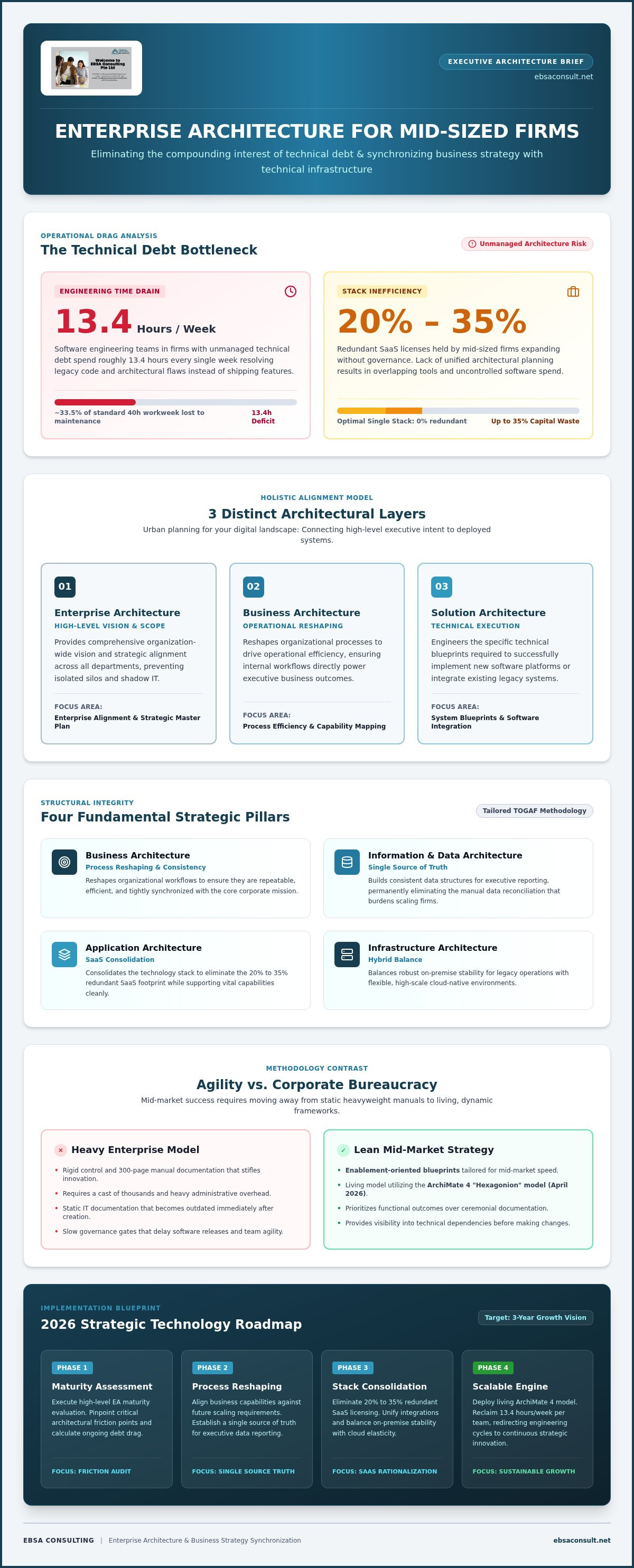
Software engineering teams in organizations with unmanaged technical debt spend approximately 13.4 hours every week resolving legacy code and architectural flaws. It's a frustrating reality for many leaders who feel their technology is becoming a bottleneck rather than a catalyst for growth. When you prioritize enterprise architecture for mid-sized firms, you address the root cause of this friction before it stalls your momentum. You've likely noticed that as your company expands, the systems that once served you well are starting to feel fragile and disconnected from your executive vision.
Strategic architectural synchronization isn't about adding layers of corporate bureaucracy. Instead, it's about creating a stable foundation for sustainable scaling. You can transform your IT environment from a collection of temporary fixes into a high-performance engine. This article explores how to leverage enterprise architecture to eliminate technical debt and synchronize your business strategy with your technical infrastructure. We'll provide a clear roadmap for digital transformation, showing you how to build a scalable blueprint that reduces operational drag and supports your long-term vision.
Key Takeaways
- Synchronize your business strategy with technical infrastructure to transform IT from a growth bottleneck into a scalable operational engine.
- Discover how enterprise architecture for mid-sized firms eliminates the compounding interest of technical debt by replacing architectural shortcuts with structured blueprints.
- Utilize a lean implementation framework that starts with a high-level maturity assessment and focuses on your specific three-year growth vision.
- Build a single source of truth for executive reporting by reshaping organizational processes and data structures for maximum clarity.
- Create a resilient strategic technology roadmap that balances immediate operational needs with long-term digital transformation goals for 2026 and beyond.
Defining Enterprise Architecture for the Mid-Market
Enterprise Architecture (EA) isn't a purely technical exercise; it's the strategic synchronization of your business goals, data, and technology. For many leaders, it acts as the "urban planning" for a rapidly growing digital landscape. Just as a city needs a master plan to ensure utilities, transport, and housing work together, your firm needs a blueprint to prevent fragmented data silos and "shadow IT" from stalling your progress. Effective enterprise architecture for mid-sized firms ensures that every technology investment directly fuels a specific business objective.
We view architecture through three distinct but interconnected layers. Enterprise architecture provides the high-level vision and alignment across the entire organization. Business architecture focuses on reshaping processes to drive operational efficiency. Solution architecture creates the specific technical blueprints required to implement new systems or integrate existing ones. Ultimately, mid-market enterprise architecture is a dynamic instrument for organizational agility that prioritizes functional outcomes over static IT documentation.
The Agility vs. Bureaucracy Debate
Many mid-sized organizations hesitate to adopt formal frameworks because they fear the bureaucracy associated with global corporations. Traditional enterprise architecture principles often focus on rigid control, which can stifle a lean team. You don't need a 300-page manual to be successful. Instead, the goal is to shift toward "enablement-oriented" blueprints. By utilizing simplified frameworks like the ArchiMate 4 "Hexagonion" model, released in April 2026, you can maintain a living model of your organization. This approach ensures your architecture evolves alongside your growth, providing a steady hand without slowing down your innovation cycles.
Core Benefits of Strategic Alignment
Strategic alignment offers tangible advantages for firms that have moved past the startup phase but haven't yet reached enterprise scale. When you implement enterprise architecture for mid-sized firms, you gain immediate visibility into technical dependencies. This clarity accelerates decision-making because executives can see the ripple effects of a change before it's made. It also improves operational resilience. By identifying redundant technology spend, which often accounts for 20% to 35% of SaaS licenses in rapidly growing firms, you can consolidate your stack. This consolidation reduces friction and frees up significant capital for your next phase of digital transformation.
Core Pillars of a Mid-Sized Architectural Strategy
A sustainable architectural strategy for mid-market organizations rests on four fundamental pillars. While global enterprises might employ massive teams for each, enterprise architecture for mid-sized firms requires a more integrated, lean approach that prioritizes high-value outcomes. You don't need a cast of thousands; you need a clear structure that connects your technical assets to your business intent.
- Business Architecture: This involves reshaping organizational processes to ensure they're efficient, repeatable, and aligned with your core mission.
- Information and Data Architecture: This pillar focuses on ensuring a "single source of truth" for executive reporting, eliminating the manual data reconciliation that often plagues growing firms.
- Application Architecture: By consolidating your tech stack, you can support core capabilities without the burden of redundant software. Research indicates that mid-sized firms expanding without governance often hold 20% to 35% redundant SaaS licenses.
- Infrastructure Architecture: This requires balancing on-premise stability for legacy systems with the flexibility of cloud-native environments to support rapid scaling.
Adopting an industry standard like the TOGAF enterprise architecture framework provides a proven foundation for these pillars. However, the secret for mid-market leaders lies in tailoring these methodologies to avoid unnecessary weight while maintaining structural integrity.
Business Architecture for Operational Excellence
High-growth firms often outpace their internal processes, leading to "chaos by design." By utilizing specialized business architecture services, you can map your current capabilities against your future needs. This process identifies critical "capability gaps" that hinder scaling, such as manual bottlenecks in a digital-first workflow. When you link process optimization directly to bottom-line revenue, you turn architecture from a cost center into a growth engine.
Translating Strategy into Solution Architecture
Strategy remains a wishlist until it's translated into a technical reality. This is where solution architecture design plays its vital role. These blueprints prevent the "ad-hoc" software purchases that lead to disconnected silos and security vulnerabilities. By ensuring that every technical implementation meets specific, documented business objectives, you protect your firm from the "Vibe Coding" pitfalls of the AI era. If you're looking to bridge the gap between your vision and your infrastructure, partnering with a strategic guide can provide the clarity needed to scale without the usual friction.
The Technical Debt Trap: Why Scaling Firms Stagnate
Technical debt is often described as the "interest" paid on sub-optimal technical decisions made during periods of intense pressure. For many mid-sized organizations, this debt accumulates rapidly during "Series A" or similar high-growth phases where speed-to-market is prioritized over structural integrity. While these shortcuts might offer short-term gains, they create a compounding drag on future innovation speed. Research from Deloitte in 2026 suggests that technical debt consumes between 21% and 40% of an organization's IT spend, representing unallocated capital lost to system maintenance rather than growth. This debt creates a significant barrier to entry for new technologies, often resulting in a 40% to 60% velocity loss in product delivery as teams struggle with legacy code instead of building new features.
Strategic enterprise architecture for mid-sized firms provides the visibility needed to identify, categorize, and prioritize the retirement of this legacy debt. By aligning with MIT CISR's definition of enterprise architecture, leaders can view their systems as a strategic organizing logic rather than just a collection of tools. This perspective allows you to see exactly where band-aid fixes are draining resources and preventing your team from delivering high-value features. Ultimately, EA serves as the diagnostic tool that identifies which systems are assets and which have become liabilities.
Identifying the Symptoms of Architectural Decay
Before you can address technical debt, you must recognize how it manifests in your daily operations. Architectural decay isn't always obvious; it often hides behind manual workarounds that your staff has simply accepted as "part of the job." Common symptoms include:
- Frequent system outages or performance degradation during peak load periods as fragile, non-scalable connections fail.
- High costs and extended timelines for even minor feature updates or simple system integrations.
- Persistent data silos that prevent accurate cross-departmental reporting and force leadership to make decisions based on incomplete information.
Modernizing Legacy Systems Strategically
Effective modernization isn't about replacing every old system at once. Instead, it requires a nuanced understanding of the role of the enterprise architect in legacy modernization. Rather than a "Big Bang" replacement that carries high risk and cost, we advocate for an incremental approach that balances stability with evolution. This strategy prioritizes modernization based on business impact rather than the technical age of the system. By focusing on components that cause the most significant operational friction, you can accelerate your digital transformation while maintaining steady operations. This structured approach ensures that enterprise architecture for mid-sized firms remains focused on generating measurable value, not just updating code for its own sake.
A Lean Framework for EA Implementation
Implementing a successful framework doesn't require a multi-year, multi-million dollar commitment. For mid-market leaders, the goal is "Just-Enough" architecture that delivers immediate value. This lean approach to enterprise architecture for mid-sized firms focuses on five methodical steps designed to create alignment without adding unnecessary weight. By following a structured path, you can ensure that your technology investments are always in lockstep with your strategic intent.
- Step 1: Conduct a high-level maturity assessment of current capabilities to establish an honest baseline of your technical health.
- Step 2: Define a "Target State" that supports your three-year business vision. This shouldn't be a rigid waterfall plan but a flexible destination that accounts for market shifts.
- Step 3: Identify the most critical "Architecture Hotspots." These are specific areas where data silos, system fragility, or technical debt cause the most operational friction.
- Step 4: Establish lean IT governance to guide future technology investments, ensuring they align with the agreed-upon blueprint.
- Step 5: Iterate and refine the model. Architecture is a living asset that must evolve as your business grows and market conditions change.
Focusing on Business Capability Mapping
Mid-sized firms often make the mistake of cataloging "what we own" instead of "what we do." By shifting your focus to business capability mapping, you create a shared visual map of the enterprise that every stakeholder can understand. This process helps you identify redundant software and manual process bottlenecks that are often invisible at the department level. Since rapid growth typically leads to 20% to 35% redundant SaaS licenses, mapping your capabilities allows you to rationalize your tech stack and redirect that capital toward high-impact innovation.
Governing Without Slowing Down
The most effective governance models act as guardrails rather than gatekeepers. Instead of creating rigid audits that stifle development, you can empower your teams with architectural blueprints that define clear standards. This enablement-oriented approach allows for faster execution while maintaining structural integrity. By monitoring compliance through periodic health checks rather than bureaucratic hurdles, you ensure that your enterprise architecture for mid-sized firms accelerates growth instead of hindering it. If you're ready to build a leaner, more resilient organization, explore our enterprise architecture consulting services to start your transformation today.
Designing Your 2026 Strategic Technology Roadmap
A strategic roadmap serves as more than a simple timeline; it's the essential bridge between your current operational state and your future vision. For organizations navigating the complexities of 2026, creating a digital transformation roadmap requires a disciplined architectural approach. This plan must carefully balance immediate "Quick Wins"—such as rationalizing SaaS sprawl to capture immediate savings—with the foundational investments in API orchestration and data integrity that support long-term scaling. When implementing enterprise architecture for mid-sized firms, the roadmap acts as a living document that evolves with market conditions, ensuring your firm remains responsive to emerging trends while staying anchored to its core objectives.
Architecting for Digital Agility
True agility originates from a structure that supports rapid pivots rather than resisting them. By leveraging enterprise architecture for innovation, you can design "modular" environments where individual components are easily replaced or upgraded without disrupting the entire system. This modularity prevents the monolithic bottlenecks that often plague scaling firms during growth spurts. As global IT spending is projected to reach $6.15 trillion in 2026, keeping your tech stack future-ready is a strategic necessity. It's the difference between maintaining a competitive edge and being slowed by unmanageable technical complexity.
The Value of Strategic Architecture Consulting
Many mid-sized firms find themselves in a "capability gap" where they need high-level guidance but don't yet require a full-time Chief Architect. Fractional or project-based expertise offers a pragmatic solution to this dilemma. Professional enterprise architecture for mid-sized firms provides the specialized insight needed to bridge the distance between executive vision and technical execution. EBSA Consulting acts as a strategic guide, synchronizing your organizational structures to ensure sustained, friction-free growth. We translate complex business requirements into actionable technical blueprints, providing the confidence and stability required to navigate your digital transformation journey. This collaborative approach ensures that your technical infrastructure is always an asset, never a liability.
Building a Resilient Architectural Future
Scaling a business requires more than just adding resources; it demands a structural integrity that supports rapid evolution. We've explored how enterprise architecture for mid-sized firms acts as the vital bridge between high-level executive vision and technical execution. By prioritizing business capability mapping and addressing the compounding interest of technical debt, you can transform your IT landscape into a high-performance engine. A well-designed 2026 roadmap ensures that every technical decision you make today strengthens your foundation for tomorrow's market shifts.
Managing these complexities doesn't have to be an isolated journey. EBSA Consulting provides specialized expertise in bridging business strategy and technical blueprints. We focus on national-level strategic consulting to enhance your organizational agility and ensure long-term reliability. If you're ready to reduce operational friction and accelerate your digital transformation, it's time to take the next step. Optimize your organization with EBSA Consulting’s strategic architecture services and build the steady foundation your growth deserves. The path toward operational excellence is clear; we're here to help you navigate it with confidence.
Frequently Asked Questions
What is the difference between IT architecture and enterprise architecture for mid-sized firms?
IT architecture focuses on the technical components of a system, such as servers, databases, and network configurations. In contrast, enterprise architecture for mid-sized firms synchronizes those technical elements with your broader business goals and data strategy. It's the difference between building an individual room and planning an entire city. EA ensures that every technology investment serves a specific functional business capability, preventing the silos that often occur when IT decisions are made in isolation.
Does a mid-sized company really need a full-time enterprise architect?
Most mid-sized organizations don't require a permanent, full-time enterprise architect and instead benefit from fractional or project-based consulting. This approach provides access to high-level strategic expertise without the overhead of a full-time executive salary. In the same way growing firms leverage carterstrategies.ca for business strategy consulting and fractional executive leadership, you can engage specialized partners to design your blueprints and govern your technology roadmap during critical growth phases. This ensures your infrastructure remains scalable while your internal teams focus on daily execution and product delivery.
How long does it take to see ROI from an enterprise architecture initiative?
You can often observe initial ROI within three to six months through "Quick Wins" like application rationalization and the elimination of redundant SaaS licenses. Research shows mid-sized firms often hold 20% to 35% redundant software licenses. Long-term value, such as reduced technical debt and improved engineering velocity, typically manifests between 12 and 18 months as your teams spend less time fixing legacy flaws and more time delivering new revenue-generating features.
What are the most common EA frameworks used by mid-sized businesses in 2026?
In 2026, mid-sized businesses favor lean frameworks that prioritize agility over heavy documentation. Common choices include:
- The TOGAF Standard, 10th Edition, tailored for agile environments.
- ArchiMate 4, specifically the simplified "Hexagonion" framework for cross-functional modeling.
- The MIT CISR operating model framework for defining business-IT alignment.
These tools provide "Just-Enough" documentation to maintain structural integrity across your digital landscape without slowing down your innovation cycles.
How does enterprise architecture help in reducing technical debt?
Enterprise architecture identifies technical debt by mapping system dependencies and highlighting where band-aid fixes are draining resources. It provides a diagnostic view that categorizes debt into liabilities that stall innovation. By visualizing these bottlenecks, EA helps leadership prioritize the retirement of legacy systems based on business impact. This structured approach reduces the 21% to 40% of IT spend typically lost to unmanaged debt, freeing capital for growth.
Can enterprise architecture support mergers and acquisitions for mid-market firms?
EA is a critical tool for mergers and acquisitions as it facilitates the rapid integration of disparate technical environments. By having a clear blueprint of your own capabilities, you can quickly assess the compatibility of an acquisition's tech stack. This visibility prevents the accumulation of "accidental" technical debt during the merger. It ensures that the combined entity's data and processes are synchronized for operational efficiency from the first day of integration. For technology leaders exploring strategic transaction opportunities or scaling through acquisitions, check out AGC Partners for specialized M&A advisory expertise.
What is the first step in implementing EA if we have no existing framework?
The first step is conducting a high-level maturity assessment to establish an honest baseline of your current architectural health. You can't plan a destination without knowing your starting point. This assessment involves cataloging your core business capabilities and identifying the "Architecture Hotspots" causing the most friction. Once you understand where your systems are fragile or disconnected, you can define a "Target State" that supports your three-year strategic vision.
How does EA improve business and IT alignment?
EA improves alignment by translating high-level executive vision into actionable technical blueprints. It creates a shared visual language that both business leaders and technical teams can understand. Instead of IT operating as a separate cost center, it becomes an integrated engine for growth. This synchronization ensures that every software purchase or infrastructure change directly supports a documented business objective, reducing the friction that occurs when technology and strategy drift apart.


