

A bold strategy is only as effective as the infrastructure that carries it. In Singapore's competitive 2026 market, many organizations find themselves trapped between ambitious growth targets and a technical reality that simply can't keep pace. You've likely experienced the frustration of product releases slowed by years of accumulated technical debt or operational processes that break the moment you try to scale. It's a common challenge where the executive vision and IT capabilities exist in two different worlds, creating friction that drains resources and stalls innovation.
Professional enterprise architecture consulting solves this by transforming technical complexity into a streamlined engine for operational excellence. By aligning your digital foundations with your business goals, you can finally eliminate the hurdles that hold your team back. This article provides a clear roadmap for technology modernization, showing you how to synchronize your capabilities and reduce costs through strategic system consolidation. We'll examine the methodologies that turn fragmented systems into a unified, future-proof framework, ensuring your infrastructure is an asset rather than a bottleneck.
Key Takeaways
- Learn how aligning technical infrastructure with executive vision shifts IT from a cost center to a strategic engine for growth.
- Understand the essential synergy between Enterprise, Business, and Solution architecture to build a foundation that supports rapid scaling.
- Discover how professional enterprise architecture consulting identifies hidden costs and provides a framework for reducing long-term technical debt.
- Explore the collaborative lifecycle of an architectural engagement that translates complex business requirements into executable technical blueprints.
- Gain insights into building organizational resilience by bridging the gap between high-level strategy and operational reality.
What is Enterprise Architecture Consulting and Why Does it Drive Growth?
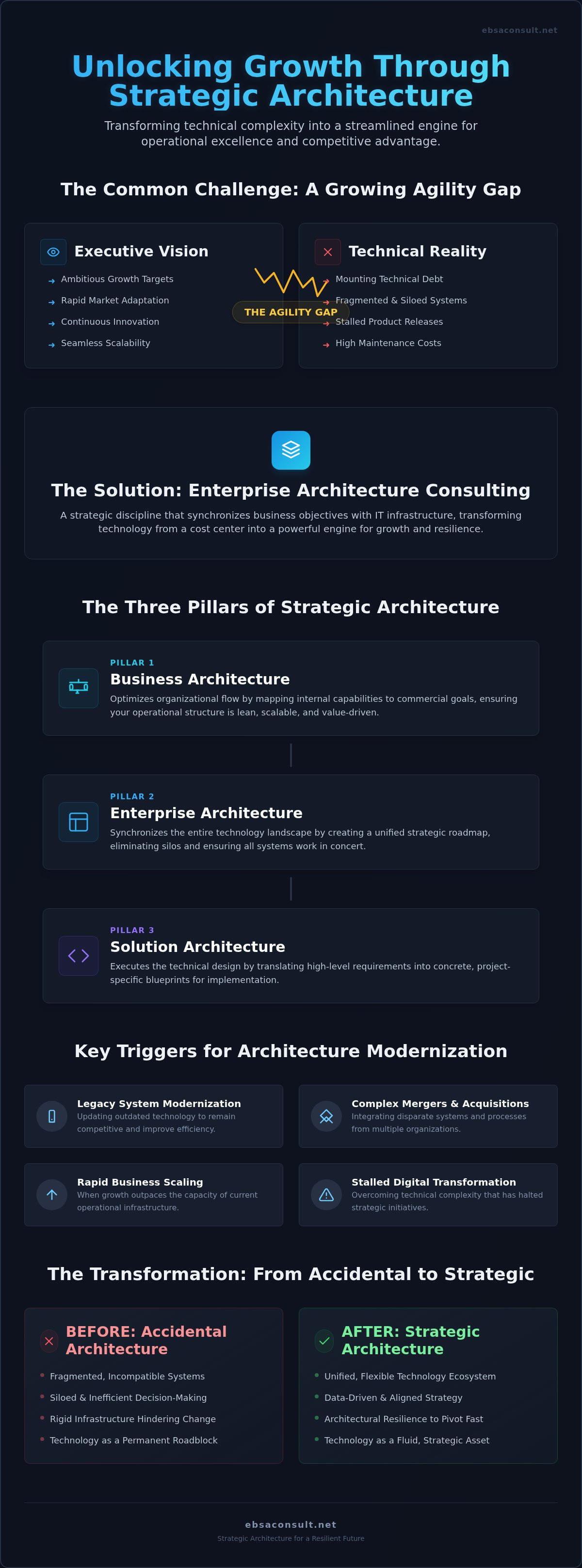
At its core, enterprise architecture represents the strategic synchronization of an organization's business objectives with its underlying IT infrastructure. It's the blueprint that ensures every digital investment directly supports a commercial outcome. Historically, leaders viewed IT as a necessary cost center, a department meant to keep the lights on. In 2026, this perspective has shifted. High-performing organizations now treat architecture as a growth engine. They recognize that a well-structured technical foundation doesn't just support the business; it accelerates it.
Several critical triggers often lead firms to seek professional enterprise architecture consulting. These include:
- Complex mergers and acquisitions (M&A) requiring system integration.
- Rapid scaling that outpaces current operational capacity.
- Digital transformation initiatives that have stalled due to technical complexity.
- The need to modernize legacy systems to remain competitive in the Singapore market.
Enterprise architecture consulting is the methodical process of mapping high-level organizational intent to a scalable, high-performance technical reality.
The True Cost of Architectural Misalignment
When systems grow without a master plan, the result is "accidental architecture." This leads to insurmountable technical debt. Every new feature becomes harder to build because the foundation is fragmented. This creates an Agility Gap. Your business needs move at the speed of the market, but your tech stack is stuck in the past. Siloed decision-making compounds this risk. When departments choose software in isolation, they create a web of incompatible systems that are expensive to maintain and impossible to integrate. Strategic enterprise architecture consulting identifies these friction points before they become permanent roadblocks.
Enterprise Architecture for Growth: Beyond Governance
Modern architecture moves beyond simple policing or IT governance. It focuses on enabling business capabilities that didn't exist before. A robust framework allows for faster market entry, as new products can be plugged into an existing, flexible ecosystem. This creates architectural resilience. In the volatile market of 2026, being able to pivot your operations without rebuilding your entire infrastructure is a massive competitive advantage. It turns your technology from a rigid constraint into a fluid asset that responds to your vision, ensuring long-term operational excellence.
The Three Pillars of Strategic Architecture: Reshaping the Core
Effective enterprise architecture consulting isn't a singular activity. It is a tiered ecosystem where strategy, process, and execution must work in perfect harmony. Many organizations struggle because they focus on "localized optimization," fixing a single software issue or updating a specific department's workflow without considering the impact on the whole. This fragmented approach often leads to systems that don't talk to each other, creating more friction than they solve. EBSA Consulting addresses this by focusing on three distinct yet interconnected pillars:
- Business Architecture optimizes organizational flow by aligning internal capabilities with commercial goals.
- Enterprise Architecture synchronizes the technology landscape by creating a unified strategic roadmap.
- Solution Architecture executes technical design by translating high-level requirements into project-specific blueprints.
By treating these as a unified discipline, you ensure that every technical decision serves a clear business purpose, preventing the structural fragmentation that stalls growth.
Business Architecture: Optimizing Organizational Flow
Business architecture serves as the blueprint for organizational agility. It's about understanding how your company actually creates value. We use capability mapping to identify exactly what your organization can do and where the gaps lie. Instead of just looking at software, we reshape processes to align with your overarching vision. This ensures that your operational flow is lean, scalable, and ready for the demands of the 2026 market. If you are looking to refine your internal structures, exploring business architecture services can provide the clarity needed for long-term efficiency.
Enterprise Architecture: The Strategic North Star
The Enterprise Architect acts as the essential bridge between the C-suite and the engineering teams. While executives focus on market share and ROI, engineers focus on code and uptime. EA synchronizes these worlds. This pillar involves technology stack consolidation and long-term infrastructure planning. We often implement proven frameworks like TOGAF or Zachman to create a standardized language across the firm. For example, the Federal Enterprise Architecture Framework illustrates how even the largest organizations maintain coherence through rigorous structural standards. This strategic oversight prevents the "accidental architecture" that often results in expensive technical debt.
Solution Architecture: Translating Requirements into Blueprints
Solution Architecture: Translating Requirements into Blueprints
Solution architecture is where the high-level vision meets specific technical execution. It bridges the gap between the enterprise-wide roadmap and the needs of an individual project. A solution architect creates robust technical blueprints that meet specific business objectives while ensuring the project contributes to the overall health of the enterprise. This ensures that a single software implementation doesn't inadvertently introduce security vulnerabilities or integration hurdles that could compromise the entire organization later. For organizations looking to implement specific platforms, global consultancies like Kagool provide the specialized knowledge necessary to execute complex SAP, Microsoft, and Databricks projects within a broader architectural strategy.
Measuring the return on investment for strategic initiatives requires looking beyond immediate cost savings. For enterprise architecture consulting, the value is found in the intersection of operational efficiency and long-term cost avoidance. When you reduce technical debt, you aren't just cleaning up code; you're reclaiming millions of dollars otherwise spent on maintaining redundant systems and overlapping software licenses. Streamlined architectural pathways also significantly improve time-to-market. By removing the friction caused by fragmented data and siloed applications, engineering teams can move from concept to deployment with much higher velocity. Industry benchmarks suggest that a comprehensive architectural audit can lead to a 25% reduction in IT infrastructure complexity by identifying and decommissioning underutilized or duplicate systems.
In-house vs. External Consulting vs. Fractional Architects
Many Singaporean firms struggle to decide between building an internal team or hiring external experts. While in-house teams understand the daily culture, they often suffer from "tunnel vision" and internal politics that can stall transformation. External consultants provide the objectivity needed to make difficult structural decisions. Because EBSA Consulting doesn't sell software, our advice remains vendor-neutral and focused solely on your business goals. For mid-sized organizations, a "Fractional Enterprise Architect" offers a strategic middle ground. It provides access to senior-level expertise at a fraction of the S$250,000 or more required for a full-time principal architect's annual salary, ensuring professional oversight without the heavy overhead.
Tangible Outcomes of a Strategic Health Check
An engagement typically begins with an "EA Health Check," a diagnostic tool designed to uncover immediate efficiency gains. This process moves beyond theory to produce concrete deliverables that guide your future investments. You'll receive detailed capability maps, multi-year technology roadmaps, and comprehensive risk assessments. These documents do more than just organize your tech; they improve your regulatory readiness. In Singapore's strict compliance environment, having a documented The Open Group Architecture Framework (TOGAF) compliant architecture simplifies audits for MAS or PDPA requirements. It transforms your infrastructure into a transparent, audit-ready asset that supports both commercial growth and legal resilience.
From Blueprint to Execution: Navigating the Architectural Journey
Moving from a high-level vision to a tangible, operational reality requires more than just a set of technical documents. It demands a partnership that balances deep technical expertise with a thorough understanding of your business culture. Professional enterprise architecture consulting shouldn't feel like a distant audit or a series of rigid mandates. Instead, it's a collaborative journey that brings stakeholders together to solve complex problems through structured thinking. This steady approach ensures that everyone, from the engineering floor to the boardroom, is synchronized around a single source of truth. By following a methodical lifecycle, we transform abstract goals into a resilient technical foundation.
Phase 1: Discovery and Capability Assessment
Discovery begins by identifying hidden technical debt and process bottlenecks that quietly drain resources. We conduct interviews with business and technical leaders to uncover where vision and reality have diverged. Documenting your current technology stack and business capabilities creates a necessary baseline for change. This assessment is essential for understanding what needs reshaping to meet your 2026 growth objectives. It ensures that the subsequent roadmap is built on facts rather than assumptions, reducing risk during the later implementation stages.
Phase 2: Strategic Roadmap and Blueprint Design
Once the current state is defined, we shift focus to future-state visioning. This involves creating a technology roadmap that supports your strategic goals for the coming year. We design blueprints that translate business requirements into precise technical specifications. Every initiative is prioritized based on ROI and organizational impact. This ensures transformation efforts focus on areas that yield the most significant results for operational excellence. These blueprints serve as the definitive guide for all future engineering decisions, keeping the enterprise aligned as it scales.
Phase 3: Implementation Governance and Support
The final stage ensures technical implementations adhere to the agreed-upon architecture. We provide implementation governance and ongoing support to internal teams during the transition. This isn't just about oversight; it's about providing the guidance needed to manage change effectively without slowing down development. By measuring progress against your digital transformation roadmap, we ensure the project remains on track and continues to deliver the promised value. To begin your journey toward a synchronized infrastructure, you can partner with a strategic guide today and secure your organization's future.
Partnering for Resilience: The EBSA Consulting Approach
Resilience in the 2026 Singapore business landscape requires more than just reactive IT fixes. It demands a proactive, structural alignment that ensures your organization can pivot without breaking its technical foundation. EBSA Consulting operates as a dedicated partner, providing the structured thinking necessary to manage complex organizational hurdles. We serve as the essential bridge between high-level executive vision and the intricate technical requirements of modern engineering. By positioning ourselves as a strategic guide, we help you transition from fragmented systems to a unified, high-performance ecosystem. Our commitment to operational excellence ensures that your infrastructure doesn't just support your current needs but actively accelerates your future growth.
Our approach is deeply collaborative. We don't believe in delivering a static document and walking away. Instead, we invest in your journey, working closely with your leadership and technical teams to ensure every blueprint is executable and every roadmap is realistic. This partnership-driven mindset builds long-term reliability into your systems, giving you the confidence to scale in an increasingly volatile global market. In 2026, the ability to synchronize strategy and technology is the primary differentiator for successful enterprises in Singapore.
Why Specialized Architecture Focus Matters
There is a significant advantage in partnering with a firm that focuses exclusively on architectural frameworks rather than general IT services. Because we don't sell software or provide managed IT support, our advice remains strictly vendor-neutral. We help you select a technology stack based on its ability to meet your specific business objectives, not its commission potential. This independence is vital for creating an unbiased, future-proof infrastructure. Our specialized focus on enterprise architecture consulting, business architecture, and solution design allows us to handle complex hurdles with a level of precision that generalist firms often lack. We provide the clarity needed to reshape your core systems into a resilient, scalable asset.
Next Steps for Your Digital Transformation
The path toward a streamlined organization begins with a clear understanding of your current capabilities. Initiating an Enterprise Architecture Health Check allows you to identify immediate efficiency gains and uncover the hidden technical debt slowing your progress. Aligning your IT infrastructure with your business goals before your next major scale-up is the most effective way to prevent future operational friction. It's about moving from "accidental architecture" to an intentional, growth-oriented framework. Schedule a consultation with EBSA Consulting to synchronize your strategy and tech.
Building Your Future-Ready Infrastructure
A resilient organization in 2026 requires more than just modern software; it demands a synchronized foundation where every technical decision serves a strategic business intent. We have explored how the three pillars of architecture reshape the core of an enterprise, turning technical debt into operational excellence. By moving from accidental structures to intentional blueprints, you eliminate the agility gap and ensure your infrastructure scales alongside your ambitions.
EBSA Consulting provides the specialized strategic architectural frameworks and Singapore national expertise needed to bridge the gap between executive vision and engineering reality. Our vendor-neutral advisory ensures that your technology stack is selected solely for its ability to drive growth, free from the bias of software sales. Professional enterprise architecture consulting is the steady hand that guides this transformation, providing the clarity required to manage complexity with confidence. It is time to move beyond fragmented systems and embrace a unified approach to digital evolution.
Scale your organization with expert Enterprise Architecture Consulting and transform your technical landscape into a powerful engine for long-term success.
Frequently Asked Questions
What is the difference between enterprise architecture and solution architecture?
Enterprise architecture focuses on high-level strategic alignment across the entire organization; solution architecture concentrates on the technical design of specific projects. EA provides the overarching roadmap and standards that all departments must follow. In contrast, solution architecture translates those broad requirements into a functional technical blueprint for a single implementation. Both work together to ensure that individual projects contribute to the collective health and scalability of the enterprise, preventing siloed decision-making.
How long does a typical enterprise architecture consulting engagement take?
A typical engagement varies based on organizational complexity, but a foundational assessment usually spans eight to twelve weeks. This timeframe allows for deep discovery, stakeholder interviews, and the development of an initial strategic roadmap. More complex transformations involving large-scale system consolidation or mergers may extend into multi-month partnerships. We focus on delivering incremental value throughout the process, ensuring that each phase provides actionable insights that your internal teams can implement immediately.
Can enterprise architecture consulting help reduce technical debt?
Yes, enterprise architecture consulting is one of the most effective ways to identify and mitigate technical debt. By conducting a thorough audit of your current technology stack, we pinpoint redundant systems and inefficient legacy processes that drain resources. We then create a structured decommissioning plan and modernization roadmap. This proactive approach prevents the accumulation of future debt by ensuring all new technical investments align with a standardized, scalable framework.
Do you provide managed IT support alongside architecture consulting?
We don't provide managed IT support, software products, or recruitment services. Our focus remains exclusively on strategic architecture, including enterprise, business, and solution design. This specialization ensures our advisory remains vendor-neutral and objective. By staying independent from IT maintenance and software vendor incentives, we provide unbiased blueprints that prioritize your long-term commercial goals rather than the sale of a specific product or a recurring support contract.
Is enterprise architecture only for large multinational corporations?
Architecture is essential for any organization facing complexity or rapid scaling, not just large multinationals. Mid-sized firms often benefit the most from these services as they transition from startup-style "accidental architecture" to a more structured infrastructure. Implementing architectural standards early prevents the high costs of fixing fragmented systems later. Whether you're a growing Singaporean enterprise or a global firm, strategic alignment ensures your technology stack supports your specific growth trajectory.
How does business capability mapping integrate with IT strategy?
Business capability mapping identifies what your organization needs to do to succeed, which then dictates your IT strategy. It acts as the translation layer between commercial goals and technical requirements. By visualizing every capability, from supply chain management—where expert partners like Buying Office Asia provide critical on-the-ground procurement support—to customer service, we pinpoint which technical systems are critical and which are underperforming. This ensures your IT investments are directly synchronized with the activities that drive revenue and operational excellence.
We utilize industry-standard methodologies such as The Open Group Architecture Framework (TOGAF) and the Zachman Framework to ensure a structured approach. These frameworks provide a common language and a proven set of tools for managing complex infrastructures. However, we don't believe in a rigid model. We adapt these rigorous standards to fit the specific regulatory environment and market conditions of Singapore, ensuring the resulting blueprints are both robust and practical.
What are the immediate benefits of an EA health check?
An EA health check provides immediate clarity on your current technical bottlenecks and hidden operational risks. Within the first few weeks, you receive a clear visualization of your technology stack and its alignment with business goals. This diagnostic identifies low-hanging fruit for cost savings, such as redundant software licenses or underutilized systems. It also highlights critical security or compliance gaps, providing a prioritized list of actions to stabilize your infrastructure before you scale further.


