
Why do so many high-stakes digital transformations in Singapore fail to deliver on their initial promise? It's a question that keeps many leaders awake as they watch maintenance costs for monolithic systems climb while innovation stalls. You've likely seen how crippling technical debt and the rising costs of cloud infrastructure, which some experts suggest could increase by up to 35% by the end of 2026, can suffocate even the most ambitious growth plans. It's frustrating to feel anchored by aging systems when the market demands immediate compatibility with AI and real-time data standards.
This guide illustrates how the role of enterprise architect in legacy modernization serves as the vital bridge between complex technical requirements and high-level business vision. You'll learn how to synchronize your technical evolution with strategic objectives to ensure every dollar spent on IT directly fuels organizational agility. We'll provide a clear roadmap for reshaping your infrastructure, focusing on how to reduce operational risk during transitions and align your architecture with the rigorous demands of the 2026 digital economy. By the end of this guide, you'll understand how to transform your legacy systems into a stable foundation for long-term excellence.
Key Takeaways
- Understand that legacy modernization is a strategic evolution focused on business agility rather than the chronological age of your systems.
- Explore how the role of enterprise architect in legacy modernization serves as the critical link between executive strategy and technical execution to eliminate the "Technical Debt Tax."
- Analyze the strategic trade-offs of the "7 Rs", including Rehosting and Rearchitecting, to balance immediate delivery needs with long-term architectural health.
- Learn to build a compelling business case for transformation by aligning technical upgrades with a five year Total Cost of Ownership and measurable business outcomes.
- Implement strong IT governance to transition from one-time projects to a model of continuous evolution, preventing the recurrence of technical debt.
Understanding Legacy Modernization in a Strategic Context
Legacy modernization isn't just a technical patch; it's the strategic evolution of systems to ensure business agility in a volatile market. Many Singaporean firms mistake "legacy" for old software, but it's more accurate to view it as any system that actively hinders growth. Whether a platform was built three years ago or thirty, it becomes legacy when it can't scale, lacks interoperability, or fails to meet the performance demands of modern consumers. For a comprehensive look at foundational concepts, Understanding Legacy Systems provides a neutral perspective on how these technical dependencies form and persist.
The role of enterprise architect in legacy modernization involves moving beyond tactical maintenance to orchestrate a true strategic transformation. This is where enterprise architecture consulting becomes essential. It provides the structured scoping required to ensure modernization isn't just about replacing code, but about aligning every technical decision with the long-term vision of the organization. While tactical maintenance focuses on keeping the lights on, strategic transformation prepares the enterprise for 2026 standards by reshaping the core infrastructure for maximum resilience.
The Evolution of the Enterprise Technology Stack
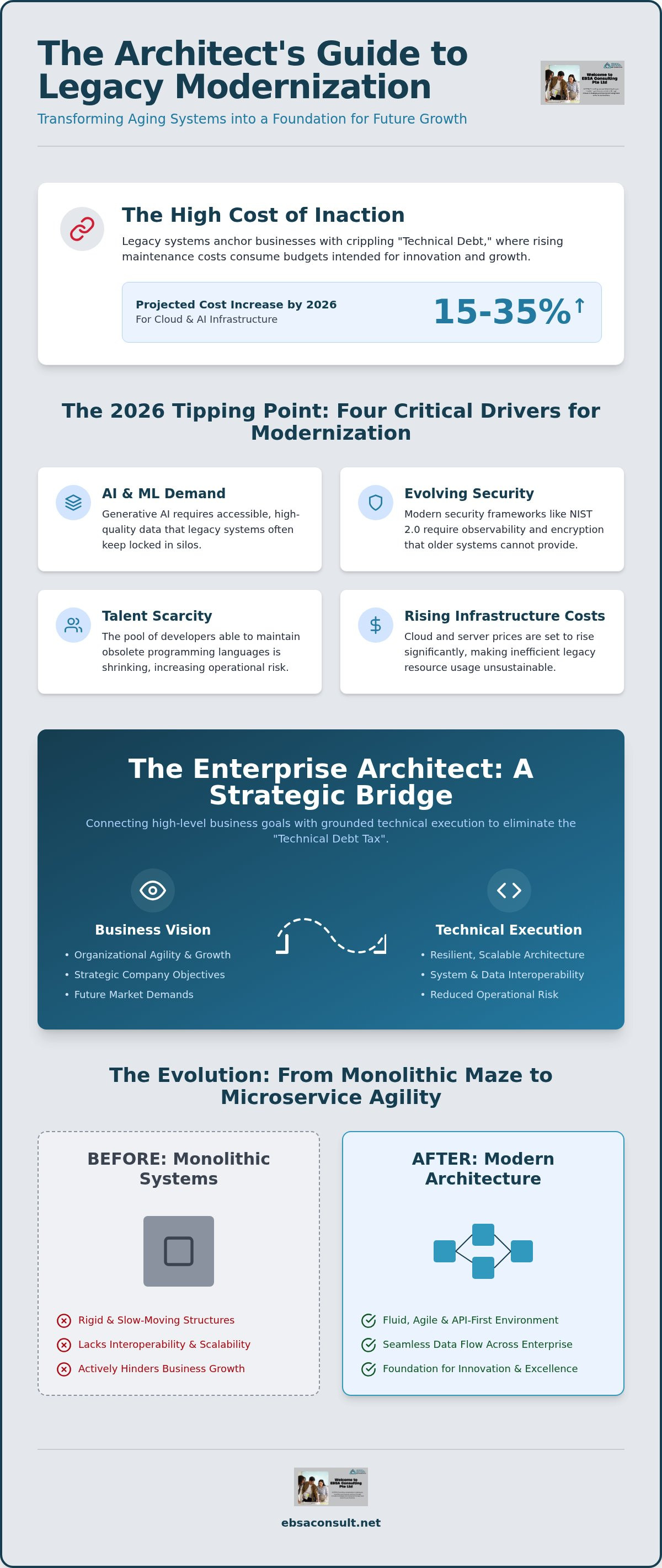
Enterprise stacks have shifted from monolithic silos toward microservices and API-first architectures. Historical systems often struggle with today's real-time data requirements because they weren't designed for the high-velocity exchange of information. Legacy modernization is the synchronisation of historical data with future-ready platforms. This transition allows organizations to move from rigid, slow-moving structures to a fluid environment where data flows seamlessly across the enterprise, enabling faster decision-making and improved customer experiences.
Why 2026 is the Critical Year for Modernization
The year 2026 represents a tipping point for several reasons. The surge in Generative AI and machine learning has created a massive demand for accessible, high-quality data that legacy code often keeps locked away. Security standards are also evolving rapidly; frameworks like NIST 2.0 require a level of observability and encryption that older systems simply can't provide. Furthermore, the scarcity of talent for maintaining obsolete programming languages is reaching a crisis point. As cloud and server prices are expected to rise by 15% to 35% by the end of 2026 due to AI infrastructure demands, the cost of inaction is no longer just a line item on a balance sheet. It's a threat to operational survival.
The Enterprise Architect: The Catalyst for Successful Transformation
The enterprise architect (EA) functions as the essential bridge between high-level executive vision and the granular realities of technical execution. Success in complex transformations requires more than just technical savvy; it demands a strategic mindset that can translate business goals into resilient architectural frameworks. By understanding the role of an enterprise architect, leaders can better appreciate how these professionals sequence modernization to avoid common pitfalls. The EA identifies the "Technical Debt Tax," which is the silent drain on IT budgets where resources are consumed by maintaining brittle systems instead of funding innovation.
To address this, EAs utilize business architecture services to map technical deficiencies directly to organizational pain points. This alignment ensures that modernization isn't treated as a purely technical exercise. Instead, it becomes a strategic initiative focused on removing barriers to growth. During the transition phase, the EA maintains strict architectural standards, ensuring that short-term fixes don't compromise the integrity of the future state. For those looking to de-risk their transformation journey, engaging with professional architecture consultants can provide the necessary oversight to keep projects on track.
Mapping Technical Debt to Business Capabilities
EAs use capability mapping to visualize which specific business units suffer most from aging technology. By overlaying technical health data onto a business capability map, the architect identifies where systems hinder critical functions like real-time customer service or automated supply chain management. This process allows the organization to prioritize modernization based on actual business impact rather than the chronological age of the software. Identifying "low-hanging fruit"-systems that are relatively simple to modernize but offer high business value-creates quick wins that build momentum and secure continued stakeholder support.
Defining the North Star Architecture
The North Star architecture is a visionary blueprint that guides every step of the modernization journey. It ensures that every new solution design remains compatible with the broader enterprise roadmap, preventing the creation of new silos. This long-term perspective is vital for maintaining coherence as the organization evolves. Strategic modernization acts as a catalyst for organizational agility by removing the friction inherent in legacy processes. By defining this future state early, the EA provides a steady sense of direction, helping the organization navigate the complexities of transformation with confidence and clarity.
Modernization Strategies: Rehost, Refactor, or Rearchitect?
Choosing the right path among the various Legacy Modernization Strategies is a high-stakes decision that defines an organization's trajectory for years. The role of enterprise architect in legacy modernization is to steer this selection by balancing the pressure for rapid delivery against the necessity of long-term architectural health. While technical teams might favor the most advanced rebuilds, and business units often push for the fastest migrations, the architect provides a neutral, data-driven perspective. They ensure that the chosen strategy doesn't just move problems to a new environment but actively resolves them.
Central to this decision-making is the solution architecture design process. This framework allows stakeholders to evaluate the "7 Rs"-Retain, Rehost, Replatform, Refactor, Rearchitect, Rebuild, and Replace-within a structured context. By quantifying risk versus reward, the architect helps the board understand that the cheapest option today often carries the highest "interest rate" in future technical debt. This strategic oversight prevents the common mistake of choosing a path based solely on initial cost.
When to Choose Rehosting (Lift and Shift)
Rehosting is often the most enticing route for firms facing immediate data centre contract expirations or urgent cost-cutting mandates. It offers the fastest path to the cloud with minimal code changes. However, it's a double-edged sword. Rehosting rarely addresses the underlying technical debt that slows innovation. Moving a monolithic legacy application to the cloud without modification can actually increase operational complexity. It's often difficult to realize the full benefits of cloud-native scaling or consumption-based pricing when the core software remains rigid and unoptimized.
The Power of Rearchitecting for Cloud-Native Value
Rearchitecting represents the most transformative approach, involving a fundamental shift toward cloud-native values. This path breaks down rigid monoliths into scalable microservices that can be deployed independently. By leveraging serverless computing and containerization, organizations gain the ability to respond to market changes in hours rather than months. While this requires a higher initial investment and longer timelines, the architect structures the transition to minimize business interruption. They use proven patterns to gradually replace legacy functionality, ensuring the enterprise remains operational while the core is rebuilt for a competitive 2026 landscape.
Building the Business Case for Modernization
Gaining executive buy-in for large-scale technical changes requires a fundamental shift in perspective. Instead of presenting a list of technical features or server specifications, the focus must move toward tangible business outcomes. The role of enterprise architect in legacy modernization is to act as a translator, turning complex architectural requirements into a compelling narrative of risk mitigation and growth. This isn't just about moving to the cloud; it's about a total architectural realignment that positions the organization to thrive in a data-driven 2026 market.
A robust business case must incorporate a 5-year Total Cost of Ownership (TCO) analysis. This long-term view accounts for the hidden expenses of aging systems, such as specialized talent costs and the increasing energy consumption of on-premise hardware. Beyond cost savings, modernization significantly improves "Time to Market." By transitioning to modular architectures, business units can launch new digital products in weeks rather than months. This agility is further enhanced by unlocking "dark data"-the vast amounts of siloed information that, once modernized, provide the foundation for real-time analytics and AI-driven insights.
Quantifying the Cost of Inaction
One of the most persuasive arguments for change is the rising ratio of "Run" versus "Build" in IT budgets. In many legacy-heavy organizations in Singapore, up to 80% of the technology spend is dedicated solely to maintaining existing operations, leaving little room for innovation. This imbalance creates a significant opportunity cost. There's also the looming financial impact of security vulnerabilities. Systems that cannot support modern standards, such as the NIST 2.0 framework, represent a liability that far outweighs the cost of an upgrade. To ensure your transformation strategy is backed by a robust financial framework, consider engaging Enterprise Architecture Consulting to validate your roadmap.
Measuring Transformation Success
Establishing clear Key Performance Indicators (KPIs) early in the process ensures that progress is visible and measurable. Success shouldn't just be measured by the completion of a migration but by improvements in performance, agility, and cost-efficiency. Using an initial architecture health check as a baseline allows the organization to track how modernization reduces system latency and increases deployment frequency. It's vital to communicate these technical milestones in the language of business value. For example, instead of reporting on database optimization, highlight how the change has reduced customer onboarding time by 30%. This approach maintains stakeholder confidence and reinforces the strategic importance of the architect's work.
Navigating the Journey with Strategic Oversight
Modernization is a continuous evolution rather than a finite project with a fixed end date. It's a shift toward a state of operational excellence where technology and business strategy remain in constant harmony. The role of enterprise architect in legacy modernization involves establishing the governance frameworks necessary to prevent the immediate accumulation of new technical debt. Without this steady oversight, the agility gained during transformation can quickly erode as teams revert to siloed decision-making. Strong IT governance ensures that every subsequent update or integration adheres to the established North Star architecture, maintaining the integrity of the enterprise stack.
Many Singaporean enterprises find that fractional architecture consulting provides the high-level expertise required for these complex shifts without the overhead of a full-time executive hire. This model allows organizations to access seasoned strategic guides who have navigated similar hurdles across various industries. It de-risks the transformation by providing objective validation of technical roadmaps. This ongoing strategic alignment is the essential foundation for future initiatives, such as deploying Generative AI at scale or implementing edge computing. These advanced technologies require a clean, modular data environment that only a modernized architecture can provide.
The Role of Strategic Consulting in Modernization
Engaging in Enterprise Architecture Consulting provides an objective, third-party perspective on architectural health and potential risks. Internal teams are often deeply embedded in the daily maintenance of existing systems, which can make it difficult to identify systemic flaws. Strategic consultants bridge the talent gap for specialized architectural framework implementation, ensuring that global best practices are tailored to local market dynamics. This external viewpoint helps keep the modernization roadmap on track, even as national regulations or economic conditions shift.
Next Steps: From Blueprint to Execution
Moving from a strategic blueprint to successful execution requires a methodical approach. It starts with a comprehensive enterprise architecture maturity assessment to identify exactly where the organization stands. From there, leaders can take several concrete steps:
- Prioritize the backlog: Use a risk-value matrix to determine which systems offer the highest business impact with manageable technical risk.
- Establish a steering committee: Form a cross-functional group to oversee architectural standards and manage the organizational change process.
- Define clear milestones: Break the modernization journey into phases that deliver incremental value, ensuring the role of enterprise architect in legacy modernization remains visible and impactful.
- Monitor and adapt: Regularly review the progress against the North Star architecture and adjust the roadmap as new business requirements emerge.
By following this structured path, organizations don't just replace old software. They build a resilient, future-ready enterprise capable of leading in the digital economy.
Securing Your Competitive Advantage Through Architectural Excellence
Transforming aging infrastructure into a future-ready platform requires more than a simple cloud migration. It demands a holistic realignment of your technical stack with your core business objectives. The role of enterprise architect in legacy modernization is pivotal in identifying the hidden costs of technical debt and designing a North Star architecture that supports long-term growth. By prioritizing strategic rearchitecting, you ensure your organization is prepared for the AI-driven demands of 2026.
Operational excellence in Singapore's competitive market isn't achieved through luck. It's the result of steady, structured thinking and professional oversight. EBSA Consulting provides the expertise needed to navigate these high-stakes transitions with confidence. Our team specializes in expert Enterprise and Business Architecture alignment and customized Solution Architecture blueprints that de-risk complex projects.
Partner with EBSA Consulting to build your strategic modernization roadmap.
Let's work together to turn your historical systems into a powerful foundation for future innovation.
Frequently Asked Questions
What is the primary role of an Enterprise Architect in a modernization project?
The primary role is to serve as a strategic bridge between business vision and technical execution. They ensure that technology investments align with long-term goals. By developing comprehensive blueprints, they help organizations avoid the common trap of isolated technical upgrades. The role of enterprise architect in legacy modernization involves identifying dependencies, managing technical debt, and ensuring that the new architecture supports future scalability and operational excellence.
How do I identify which legacy systems should be modernized first?
Prioritize systems based on a risk-value matrix rather than chronological age. You should identify platforms that actively hinder business agility or incur high maintenance costs. Look for "low-hanging fruit" where modernization provides immediate value with manageable risk. A thorough assessment of business capabilities often reveals which systems are the most significant bottlenecks for growth. This strategic evaluation ensures that your limited resources are directed toward the most impactful transformations.
What is the difference between application modernization and legacy system modernization?
Application modernization focuses specifically on updating individual software programs to newer languages or frameworks. In contrast, legacy system modernization addresses the entire enterprise environment, including infrastructure, data silos, and business processes. While application updates are often tactical, system-wide modernization is a strategic initiative. It aims to reshape the entire architectural foundation to improve interoperability and ensure the organization can meet 2026 standards for real-time data processing and security.
Can legacy modernization be achieved without moving to the cloud?
Yes, legacy modernization can be achieved through on-premise rearchitecting or hybrid models. While cloud-native deployments offer superior scalability, some organizations choose to modernize within their own data centers due to specific regulatory or data residency requirements in Singapore. The goal is to improve system agility and reduce technical debt, regardless of the hosting environment. However, modern architectural patterns like microservices and containerization are often most effectively realized using cloud or hybrid infrastructure.
What are the most common risks associated with legacy system modernization?
Common risks include business interruption during the transition, data migration failures, and a lack of alignment between technical changes and business needs. Scope creep is also a frequent challenge when the initial blueprint isn't sufficiently detailed. To mitigate these risks, organizations should establish strong IT governance and a clear steering committee. Professional oversight helps ensure that the project remains focused on delivering measurable business value while maintaining architectural standards throughout the lifecycle.
How does technical debt impact an organization’s ability to adopt AI?
Technical debt creates rigid data silos and brittle infrastructure that cannot handle the high-velocity data requirements of Generative AI. If your core systems are inflexible, you'll struggle to integrate AI models effectively or access the "dark data" needed for training. The role of enterprise architect in legacy modernization is to eliminate these bottlenecks. By creating a modular and scalable foundation, they enable the seamless adoption of advanced technologies like machine learning and real-time analytics.
What is the average ROI timeline for an enterprise modernization initiative?
While timelines vary, most organizations begin to see a positive return on investment within 18 to 36 months. This ROI is measured through reduced maintenance costs, improved time-to-market for new products, and lower operational risk. A comprehensive five year Total Cost of Ownership (TCO) analysis often reveals that the cost of inaction far exceeds the investment in modernization. Strategic transformation pays dividends by enabling the organization to capture new market opportunities that legacy systems simply cannot support.
Should we hire a full-time Enterprise Architect or use a consultant for modernization?
Many Singaporean firms find that fractional Enterprise Architecture Consulting offers the best balance of expertise and cost-efficiency. A consultant provides an objective, third-party perspective that is often missing from internal teams. This model allows you to access high-level strategic guidance for specific modernization phases without the overhead of a full-time executive. Consultants bring specialized knowledge of architectural frameworks, helping you de-risk the transformation and ensure your roadmap remains aligned with shifting national market dynamics.


