

A monolith may be the better starting point for a growing system. Microservices structure an application as two or more loosely coupled, independently deployable services, usually aligned with distinct business capabilities. Effective microservices architecture consulting helps teams decide where that separation creates value and how to shape it without adding unnecessary complexity.
If you’re considering microservices, you’re likely looking for more than a new technical pattern. You want teams to release changes more independently, scale workloads selectively, and keep data consistent across services. Those benefits depend on clear service boundaries and a sound approach to communication, operations, and governance.
This article explains how microservices work, when they fit better than a monolith, and which design choices support scalability. It also covers common patterns, distributed-system challenges, and how architecture guidance can align technical decisions with business priorities.
Key Takeaways
- Choose microservices when separate business domains need different release rhythms or scaling approaches, rather than adopting them simply because they’re popular.
- Define service boundaries around business capabilities and give each service clear responsibility for its data to reduce coupling between teams.
- Use patterns such as bounded contexts, an API Gateway, and asynchronous domain events to structure communication and clarify responsibilities.
- Plan for distributed-system complexity with early logging, monitoring, and tracing, alongside deliberate approaches to resilience and data consistency.
- For a monolith that has outgrown its limits, consider a gradual migration that extracts one domain at a time instead of replacing the system all at once.
Why choose a microservices consulting partner for architecture creation?
A consulting partner can help determine whether service separation addresses a real business challenge. Microservices architecture consulting can also align migration decisions with team ownership, infrastructure, and release needs.
Microservices and Monolithic Architecture Trade-offs
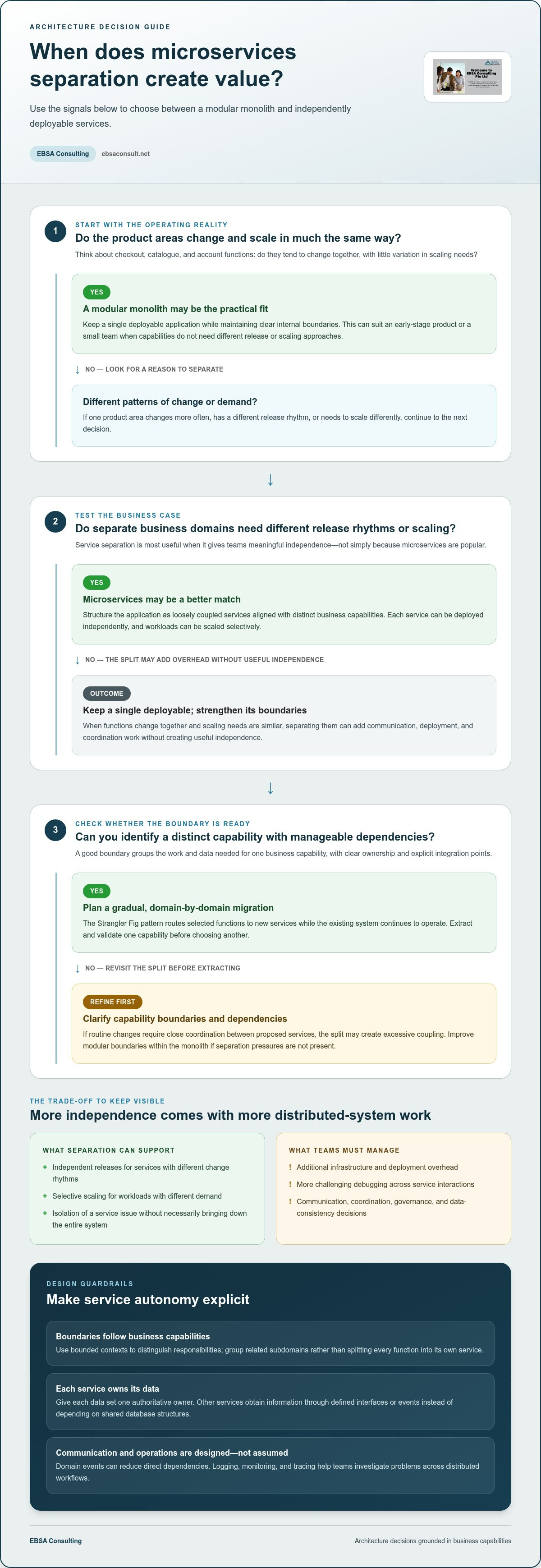
A monolithic architecture packages application components for deployment together, while microservices separate capabilities into independently deployable services. This distinction matters when one product area changes more often than another: teams can release that service separately, but must also manage additional deployment overhead and coordination.
Microservices can isolate a service issue without bringing down the entire system. They also add operational complexity, including more infrastructure and more challenging debugging across service interactions. A modular monolith preserves clear internal boundaries with a single deployable, making it a practical choice for an early-stage product or a small team with limited variation in scaling needs.
Consider a small team whose checkout, catalogue, and account functions change together. Separating them may add communication and deployment work without creating useful independence. By contrast, if catalogue demand scales differently or release schedules diverge, separate services may better match those needs.
Monolith-to-Microservices Migration
Migration moves selected business capabilities from a monolith into independently deployable services. The Strangler Fig pattern supports this transition by directing chosen functions to new services while the existing system continues to operate.
How long does a microservices migration typically take? It depends on the domains being separated, their coupling, data dependencies, and testing needs. Because migration proceeds domain by domain, its duration depends on the scope and complexity of those transitions.
Start by identifying a capability with a distinct business purpose and manageable dependencies. Define its boundary, establish how it communicates with the remaining monolith, then extract and validate it before choosing another domain. This staged approach avoids a risky big-bang rewrite and gives teams room to refine the architecture as they learn.
Migration makes sense when tight coupling delays releases, change frequency differs across domains, or workloads need different scaling. If those pressures aren’t present, improving modular boundaries within the monolith may be more efficient.
Problems Addressed by Microservices Consulting
Microservices consulting can address unclear service boundaries, excessive inter-service communication, governance gaps, and inconsistent data ownership. Each issue matters because it can weaken the release independence that motivated service separation.
A consultant can help map business capabilities to service boundaries, clarify team responsibilities, and compare communication and deployment strategies. For example, domain events can reduce direct dependencies between services, while logging, monitoring, and tracing help teams investigate problems across distributed workflows.
What cloud platforms and technologies do Singapore microservices consultants support? Architecture discussions can cover cloud or hybrid infrastructure, Docker containerisation, Kubernetes orchestration, CI/CD automation, service discovery, and communication protocols. The right combination depends on existing infrastructure, integration needs, and the organisation’s operating model.
How do you design a scalable microservices architecture?
Design begins by matching service boundaries to business capabilities, then assigning clear data ownership. Communication, integration, and runtime governance help each component scale without unnecessary coupling.
Service Boundaries and Business Capabilities
A service boundary groups the work and data needed to deliver one business capability. Domain-driven design uses bounded contexts to distinguish capabilities, such as order fulfilment and customer accounts. Boundaries matter because they shape team ownership, interfaces, and which components can change independently.
Start by mapping business activities and identifying where rules, language, and data belong together. Then group related subdomains into services instead of splitting every function into a separate unit. For example, a checkout capability might own order placement and payment coordination, while inventory remains a separate capability with its own responsibilities.
Review each proposed boundary against actual business change. If two services must coordinate for routine changes, the split may create excessive coupling. A coherent boundary lets a team deliver its capability with fewer dependencies while defining explicit integration points for neighbouring services.
Data Ownership and Service Autonomy
Data ownership means each service controls the records and rules for its business capability. This matters because independent services cannot remain autonomous if they depend on other teams editing the same database tables.
Assign one authoritative owner to each data set, then let other services obtain information through defined interfaces or events. For example, an order service can own order status while a fulfilment service consumes status updates. This avoids hidden dependencies on shared database structures and clarifies which service handles each change.
Dependency management also requires identifying synchronous calls and shared assumptions. A service that relies on several others to complete each request may become fragile and difficult to scale. Map dependencies before implementation, then reduce unnecessary calls through stable APIs or asynchronous domain events when immediate responses aren’t required.
Implementation and Inter-Service Communication
Implementation turns service boundaries into deployable components, communication contracts, and operational controls. An architecture diagram alone cannot govern integration or service behaviour at runtime.
Choose synchronous communication, such as REST APIs, when a caller needs an immediate response. Use asynchronous domain events when services can respond later, such as notifying fulfilment after an order is placed. An API is an interface, not an independently deployable business capability.
Treat model inference as a service for an AI capability only when its business role and operational needs justify separation. Define its input and output contracts, data access, and failure behaviour. As the service portfolio grows, runtime governance should cover lifecycle controls, traceability, and SLO-driven observability.
Implement logging, monitoring, and tracing early, then align CI/CD and container orchestration with team responsibilities. A cohesive architecture design approach can help connect these technical choices to business capabilities and integration needs.
Architecture design patterns and frameworks
Patterns give engineering teams reusable ways to structure services, communication, and data flows. Domain-driven design, the API Gateway, and event-driven communication each address different architectural needs.
Domain-Driven Design and Bounded Contexts
Domain-driven design uses bounded contexts to separate areas of a business model with distinct rules and language. This matters because a context can guide which responsibilities belong together and where service interfaces should sit.
For example, a retail platform might distinguish ordering from fulfilment. Each domain uses its own terms and rules, even when both processes concern the same purchase. Mapping these boundaries helps teams avoid mixing responsibilities in one service or scattering a single capability across unrelated services.
Use domain workshops to identify business activities, shared terms, and points where rules differ. Then map subdomains into services, checking that each proposed boundary supports a coherent capability. This gives engineering teams a model for decisions instead of treating every database table or software component as a separate service.
Microservice Architecture Design
A microservices architecture structures an application as two or more loosely coupled, independently deployable services. The design must coordinate service ownership, integration, deployment, and operational controls across the whole system.
Start with domain-aligned services and define their interfaces before selecting platform components. An enterprise design also needs API governance, container orchestration, CI/CD automation, observability, hybrid integration alignment, and an operating model. These elements connect engineering choices to how teams build, release, and support services.
For example, an order service could expose a governed API while emitting domain events for downstream processes. A platform design can standardise deployment and observability without requiring every service to share the same internal implementation. An architecture partner should make those standards explicit while preserving meaningful autonomy at service boundaries.
Framework selection should follow the system’s integration and operating requirements. Container orchestration supports deployment coordination, while CI/CD automation makes release practices repeatable. Governance then defines how services enter the portfolio, evolve, and remain observable as the architecture expands.
Microservices Design Patterns
Microservices design patterns address recurring needs in service access, data handling, and communication. Choosing a pattern for a specific constraint matters more than applying every pattern across the system.
The API Gateway pattern provides a unified entry point for clients accessing multiple services. Event-driven communication uses domain events to reduce direct dependencies between services. These patterns can simplify integration, but teams still need clear contracts and ownership for each service.
Event sourcing records changes as a sequence of events, while CQRS separates command handling from query models. They can support particular data and read/write requirements, but also introduce design and operational considerations. Use them when those requirements justify the added structure.
Pair each pattern with a stated problem and an operating rule. An API Gateway can centralise client access, while domain events can coordinate asynchronous work. Event sourcing or CQRS can shape data flows when their specific approach fits. This keeps patterns grounded in business needs instead of making them the default.
Distributed-system complexity and data consistency
Independent deployment distributes communication, data, and operational responsibilities across services. Teams need to manage these connections alongside infrastructure overhead.
Distributed-System Complexity and Deployment Overhead
Distributed-system complexity comes from coordinating independently running services across networks and deployment pipelines. It matters because a failure or delay in one dependency can affect workflows elsewhere.
For example, an order service may call inventory and payment services before confirming checkout. Each call introduces another point to monitor, trace, and troubleshoot. A single deployment may also require coordinated changes across several services when their interfaces or assumptions change together.
Microservices can increase infrastructure and operational overhead through separate deployment, monitoring, and service management needs. Debugging also becomes more complex than in a monolith because a request can cross multiple services. Teams should weigh these responsibilities when assessing whether independent releases justify the additional operational work.
Container orchestration and automated CI/CD can standardise deployment practices, but they don’t remove system complexity. Teams still need service ownership, lifecycle controls, resilience patterns, and traceability. Establishing these controls early helps operators identify where a failure began and which dependent service needs attention.
Data Consistency Across Services
Data consistency describes how services keep related information accurate across separate data stores. It matters because distributed services can’t rely on one shared transaction to update every record.
Consider an order that reserves inventory and then awaits payment. If payment fails, the system needs a defined response for the reservation. Domain events can communicate state changes asynchronously, while aggregates can support transactional consistency within a service’s boundary.
Define the authoritative owner for each record, then document which events update other services. When order status changes, the order service can publish an event; fulfilment can consume it and update its own view. Teams should also define how they handle duplicate events, delayed messages, and failed processing.
Consistency choices affect what users see and when. A customer may see an order accepted before a fulfilment screen reflects the update. Clear status definitions and recovery behaviour help teams distinguish expected delays from genuine processing faults.
Regulatory compliance automation also depends on traceable data and controls. One regulatory compliance automation initiative achieved 100% compliance success rates across all regulatory frameworks. For Singapore organisations, the practical design task is mapping applicable obligations to system controls, retaining evidence, and making ownership clear.
As services expand, review deployment overhead and data flows together. A change to one service’s records may affect downstream reports, audit trails, or customer-facing status. Documenting these dependencies gives engineering and operational teams a shared basis for testing changes and investigating inconsistencies.
Microservices architecture consulting
Microservices architecture consulting aligns service design, platform choices, and operating practices with business goals. It helps teams define where independent services add value and which migration or governance actions should follow.
Microservices Consulting Scope
The scope can cover architecture, platform, and operating-model change through domain modelling, platform selection, and governance frameworks. Service boundaries alone don’t address how teams deploy, integrate, and manage a growing portfolio.
For an online marketplace, an assessment might map ordering, payment, and fulfilment capabilities, then identify coupling and scaling needs. Consultants can also advise on service discovery, communication protocols, data management, and deployment strategies. The result is a clearer basis for selecting architecture patterns and sequencing implementation.
Good guidance defines the business outcome before recommending a technical action. If a payment capability needs independent releases, teams can assess its boundary, data ownership, and dependencies. If the actual constraint is a slow database query, targeted optimisation may address it without creating another service.
Consulting Services and Deliverables
Consulting turns an architecture assessment into decisions teams can act on. A roadmap connects design recommendations with ownership, sequencing, and operating requirements.
A typical engagement uses a four-week sequence: discovery and stakeholder interviews in the first week, an architecture audit in the second, and a roadmap with recommendations in the third. The fourth week focuses on team workshops and knowledge transfer. This structure links business priorities to technical decisions and shared understanding.
Useful deliverables can include a domain map, target architecture, platform considerations, governance principles, and a migration roadmap. For example, a roadmap may prioritise a domain with distinct release needs, define its interface, and identify data and deployment dependencies before extraction begins.
Assess recommendations against operational readiness as well as business value. Teams need ownership for service lifecycle, observability, resilience, and traceability as the portfolio expands. A proposed scaling action should also account for integration demands and the operational work needed to maintain each service.
To connect architecture choices with business priorities, shape your architecture roadmap around clear domains, ownership, and migration actions.
EBSA Consulting: Enterprise Architecture Consulting
EBSA Consulting helps organisations align architecture decisions with business priorities through Enterprise Architecture. Turn to this service when service boundaries, platform choices, and operating needs must work together across the wider technology environment.
When the challenge involves clarifying capabilities and improving alignment across teams and processes, Business Architecture can connect organisational needs with the architecture. For specific technical designs, Solution Architecture shapes implementations around defined business requirements.
These services provide a structured next step when your microservices decisions need to fit broader business and technology plans. Contact EBSA Consulting to discuss your architecture needs, or visit ebsaconsult.net.
Shape the Next Stage of Your Architecture
Your next architecture decision can set the direction for how teams evolve systems, responsibilities, and delivery practices. Treat it as a business decision as well as a technical one: define the outcome you need, identify who will own the change, and establish how progress will be assessed. That clarity gives future work a stable foundation.
Microservices architecture consulting is most useful when it connects technical decisions to your organisation’s broader priorities. EBSA Consulting supports that alignment through Enterprise Architecture, Business Architecture, and Solution Architecture, connecting technology choices with business structure and objectives.
Bring your current architecture questions and priorities into the next discussion. Contact EBSA Consulting to discuss your architecture and take a considered next step toward systems that can evolve with your needs.
Frequently Asked Questions
What are microservices?
Microservices are independently deployable software components that each support a defined business capability. For example, an online booking system might separate availability, reservations, and notifications into services. Each can evolve independently, provided its interfaces and responsibilities are clear. This approach changes how teams coordinate development and operations, so service boundaries should reflect business needs rather than simply splitting an application into smaller pieces.
What are the benefits of adopting microservices architecture?
Microservices can let teams release capabilities independently and scale specific workloads without scaling the entire application. For example, a reporting service handling heavy batch processing can be scaled separately from a customer-facing account service. This can improve flexibility when workloads or release schedules differ. The benefits depend on clear ownership and operational practices for managing distributed services, not simply adopting the architecture style.
What are common challenges in microservices implementation?
Common challenges include coordinating service changes, handling network failures, tracking requests across components, and keeping distributed data aligned. For example, a delayed or duplicated event can leave a downstream service with an outdated view. API changes can also disrupt dependent services without versioning practices. Address these risks with explicit contracts, retry and error-handling behaviour, traceable workflows, and clear ownership for investigating incidents.
When should a company move from monolith to microservices?
Consider a move when separate business domains need different release schedules, tight coupling regularly delays changes, or workloads require distinct scaling strategies. For example, a high-volume search capability may need different scaling from an infrequently used administration function. First assess whether modularising the existing application could address the constraint. Migration is more compelling when independent deployment solves a defined business problem and the organisation can support the added operational work.
How much does microservices architecture consulting cost in Singapore?
The cost depends on the scope and complexity of the engagement, including the business domains involved, existing integrations, and whether the work includes architecture recommendations or migration planning. A focused review of service boundaries differs from work involving platform choices, operating-model changes, and a detailed roadmap. Define the decisions and deliverables you need to establish a suitable scope.
How to choose a microservices architecture consulting firm in Singapore?
Choose a firm that connects architecture decisions to business outcomes and can explain how it will assess domain boundaries, dependencies, data ownership, and operational readiness. Ask for a clear method and practical deliverables, such as an architecture assessment or prioritised roadmap. Review relevant client testimonials, project results, and technology-provider partnerships or certifications. A strong fit should challenge unnecessary service separation and explain the trade-offs in terms your business and engineering teams can act on.
What are the steps in a microservices architecture assessment and migration?
Begin by mapping business capabilities, system dependencies, and current delivery constraints. Next, assess service boundaries, data ownership, integration, and operational readiness. Prioritise a domain whose separation addresses a clear need, define its interface and migration approach, then validate the change before expanding. During the transition, monitor service interactions and data flows, resolve issues, and update the roadmap based on lessons from each extracted capability.


