

In 2026, the primary obstacle to rapid growth isn't a lack of vision; it's a structural paradox where legacy systems act as anchors rather than foundations. While global IT spending is projected to reach $6.37 trillion this year, many organizations still find their most ambitious digital initiatives stalled by rigid compliance frameworks. You've likely seen high-level business goals lose momentum when they hit the technical execution phase, creating a gap that slows down scaling and frustrates leadership. It's a common challenge, but it doesn't have to be your reality.
This guide shows you how to redefine enterprise architecture for innovation, transforming it from a gatekeeper of rules into a strategic engine for scalable growth. We'll provide a clear framework for architecting digital agility and aligning your business architecture with modern technical blueprints. By moving away from static documentation toward a data-driven decision engine, you'll learn how to reduce time-to-market and ensure your organization is ready to lead. We'll walk through the specific methodologies that bridge the divide between complex technical requirements and your highest strategic aspirations, ensuring your digital journey remains steady, focused, and exceptionally fast.
Key Takeaways
- Shift from rigid compliance to a proactive strategic framework that ensures organizational structure dictates speed rather than hindering it.
- Leverage modularity and microservices to synchronize business architecture with technical execution, enabling faster experimentation and scaling.
- Replace traditional "Big Up-Front Design" with agile, "Just-in-Time" methodologies to remove bottlenecks and accelerate digital product delivery.
- Follow a structured 2026 roadmap to assess your current maturity and map strategic innovation goals directly to scalable technical blueprints.
- See how enterprise architecture for innovation serves as the essential bridge between your highest business aspirations and the technical systems required to realize them.
The 2026 Innovation Imperative: Why Structure Dictates Speed
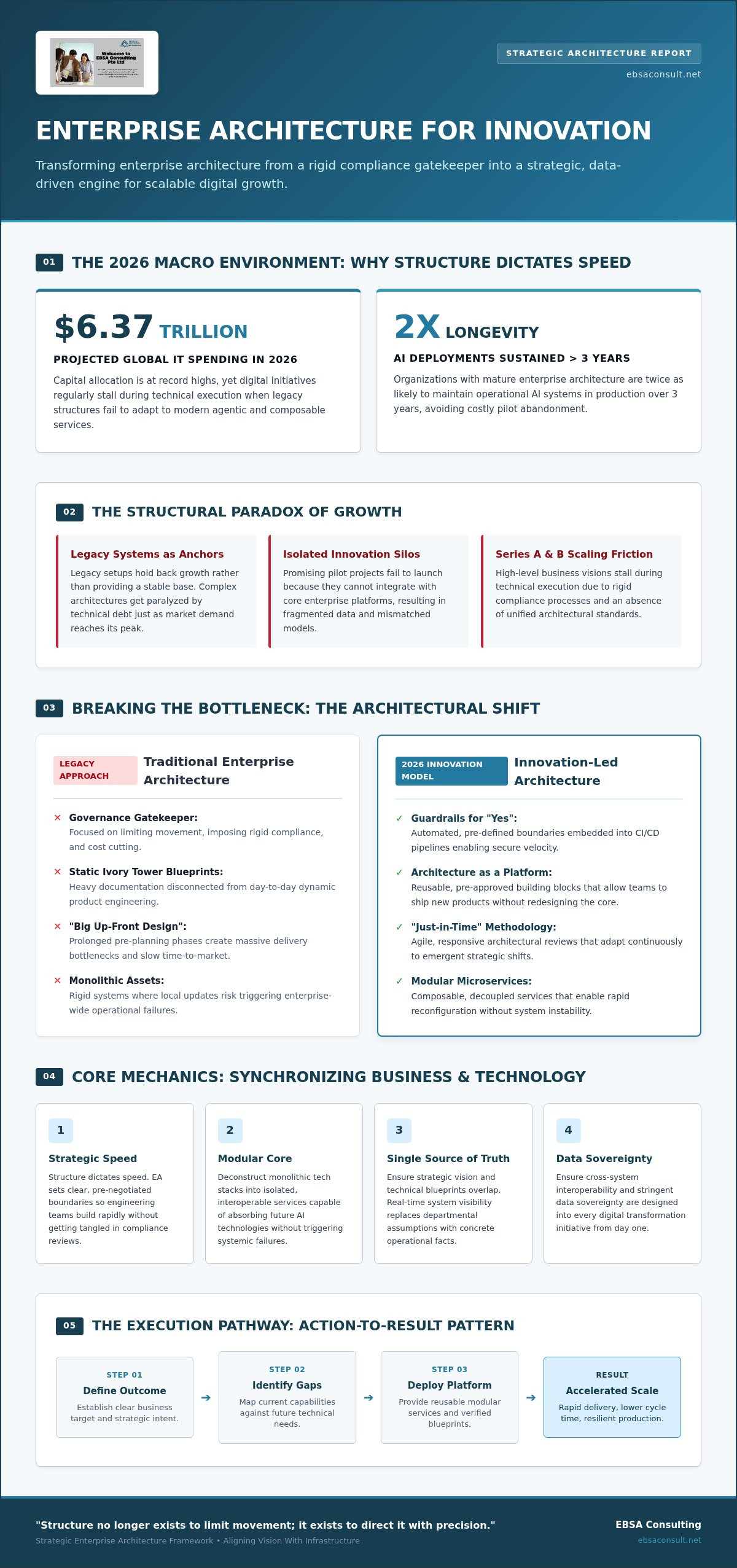
In 2026, organizational agility is a survival requirement. As global IT spending climbs toward $6.37 trillion, the difference between market leaders and those struggling to scale lies in their underlying structure. Traditional, rigid models that prioritize static documentation over dynamic decision-making are failing. These legacy approaches can't handle the complexity of an AI-native enterprise where agentic systems and composable services require fluid, real-time adjustments. Structure no longer exists to limit movement; it exists to direct it with precision.
Effective enterprise architecture for innovation serves as a proactive strategic framework. It moves away from the ivory tower blueprints of the past toward "Architecture as a Platform." This approach treats the enterprise structure as a set of reusable, pre-approved services that innovation drivers can leverage to launch new products without starting from scratch. By adhering to foundational enterprise architecture principles, leaders create an environment where technical systems support, rather than hinder, strategic business execution.
From Governance Gatekeeper to Innovation Enabler
Historically, architecture teams were viewed as gatekeepers who focused on compliance and cost reduction. In 2026, the mandate has shifted toward providing the guardrails for "yes." This change allows teams to move fast because the boundaries are clearly defined and often automated within the development pipeline. Structured thinking reduces the inherent anxiety of complex organizational transformation by providing a reliable map for change. Ultimately, enterprise architecture for innovation is the synchronizing force that bridges the gap between a visionary business idea and its technical reality.
The Cost of Architectural Neglect in 2026
Neglecting structure leads to innovation silos where brilliant pilot projects fail because they cannot integrate with the core enterprise. This is particularly visible in Series A and B scaling efforts, where technical debt often paralyzes growth just as market demand peaks. Organizations with mature architecture are twice as likely to sustain AI deployments in production for over three years compared to their less mature counterparts. Without a cohesive plan, you face fragmented data and incompatible models that drive up costs. Engaging in strategic enterprise architecture consulting helps leaders avoid these pitfalls by ensuring every new initiative aligns with a resilient, scalable infrastructure.
Reshaping the Core: How EA Enables Scalable Digital Transformation
Scaling digital initiatives requires more than just adding new software. It demands a fundamental reshaping of how technical assets support business goals. Modern enterprise architecture for innovation focuses on creating a "single source of truth" where strategic vision and technical blueprints overlap. This clarity allows leaders to make decisions based on real-time data rather than departmental assumptions. By establishing a unified architectural view, organizations ensure that data sovereignty and interoperability are baked into every project from day one.
The goal is to move away from monolithic structures that resist change. In 2026, the most successful enterprises treat their core systems as a collection of modular assets. This approach allows for rapid reconfiguration without the risk of system-wide failure. When you architect for scalability, you aren't just planning for today's needs; you're building the capacity to absorb future technologies as they emerge. It's about creating a stable foundation that remains flexible enough to pivot when market conditions shift.
Synchronizing Business and IT Alignment
Achieving true harmony between departments starts with precise mapping. Organizations often leverage professional business architecture services to identify specific gaps between current capabilities and future needs. This mapping process follows a logical "action-to-result" pattern. First, you define the desired business outcome. Then, you identify the necessary organizational processes and the technical infrastructure required to support them. This method ensures every technical investment has a direct, measurable impact on the high-level vision, preventing the waste of resources on misaligned projects.
Architecting for Autonomous Innovation
The shift toward modularity is central to MIT Sloan research on enterprise architecture, which highlights the transition from rigid silos to reusable digital components. By building a "plug-and-play" environment, companies can integrate emerging technologies like generative AI without destabilizing their core operations. APIs act as the essential connective tissue here, reducing the friction between complex legacy systems and agile new ventures. Reshaped infrastructure accelerates the deployment of innovative solutions by providing a stable platform for experimentation. When your core systems are decoupled and interoperable, innovation becomes a repeatable process rather than a series of one-off projects. If your organization is ready to move beyond fragmented systems, engaging with a strategic architectural partner can help you synchronize these disparate elements into a cohesive growth engine.
Breaking the Bottleneck: Traditional EA vs. Innovation-Led Frameworks
The most common objection innovation teams raise is that enterprise architecture is simply too slow. In many organizations, the architectural review process is seen as a bureaucratic hurdle that adds weeks to a project's timeline without adding visible value. This friction usually stems from a reliance on "Big Up-Front Design," an outdated model that attempts to predict every technical variable years in advance. In the fast-moving landscape of 2026, this rigidity doesn't just slow down progress; it kills it. Modern enterprise architecture for innovation replaces these static blueprints with "Just-in-Time Architecture," providing enough structure to ensure stability without delaying the next release.
Innovation-led frameworks manage risk differently. Instead of trying to prevent every possible error through strict control, they focus on building resilience and observability. This shift allows teams to experiment with new digital products while the architecture team provides the automated guardrails that keep the enterprise secure. By focusing on outcomes rather than just documentation artifacts, architects become active participants in the creative process rather than distant judges of technical compliance. To help teams unlock this creative problem-solving and accelerate breakthrough thinking, organizations often collaborate with innovation partners like CtrlX to facilitate hands-on workshops that align technical and business stakeholders.
Outcome-Driven vs. Compliance-Driven Architecture
Traditional EA often prioritizes steady-state maintenance and cost containment. While these are important, a modern approach is growth-oriented, treating the architectural roadmap as a living digital document that evolves alongside market demands. It's the difference between a rigid map and a dynamic GPS system. EBSA Consulting helps firms move toward this collaborative mindset by establishing feedback loops between technical leaders and business visionaries. We ensure that the architecture isn't just a set of rules, but a synchronizing force that helps your teams move from a concept to a scalable reality with minimal friction.
Managing Technical Debt While Accelerating Growth
One of the hardest balances to strike is expanding quickly while keeping the system clean. This is where the specific expertise of the enterprise architect in legacy modernization becomes vital. They create "architectural runways," which are pre-built technical foundations that support rapid feature releases without accumulating crippling debt. By strategically consolidating the technology stack, architects ensure that the organization doesn't lose functional agility as it grows. It's a methodical process of pruning what doesn't work and reinforcing what does, ensuring your enterprise architecture for innovation remains a lean, high-performance engine that supports continuous delivery.
Creating Your Digital Transformation Roadmap: A 2026 Strategic Guide
Implementing a resilient enterprise architecture for innovation requires a phased approach that balances immediate speed with long-term stability. The process begins with a comprehensive maturity assessment of your current architectural capabilities to identify where legacy friction exists. Once you've established this baseline, you can map your innovation goals to specific business and technical capabilities. This ensures that every new digital initiative is anchored in organizational reality rather than just aspirational vision.
For pilot projects, it's essential to design a strategic solution architecture that allows for rapid experimentation without compromising the core systems. These pilots should feed into continuous feedback loops between innovation labs and the broader architecture team, allowing for real-time adjustments. Finally, you scale this framework across the national enterprise landscape, ensuring your systems align with Singapore-wide national digital excellence standards. This methodical progression transforms enterprise architecture for innovation from a theoretical concept into a repeatable growth engine.
Mapping Capabilities to Strategic Vision
Identifying "innovation-ready" areas of the business involves looking for high-impact processes where technical debt is manageable. Translating these business requirements into robust technical blueprints ensures that your development teams have a clear, pre-approved path forward. A methodical and logical flow in roadmap design is essential for maintaining harmony between high-level strategic vision and the granular technical execution required to achieve it. Moreover, as companies build modern digital capabilities, upskilling commercial teams through executive programs like ClickAcademy Asia ensures that sales and digital marketing strategies evolve in tandem with underlying systems. This alignment prevents the common pitfall of launching digital products that cannot integrate with the wider enterprise ecosystem.
Iterative Implementation and Risk Mitigation
Small-scale solution designs serve as a vital proof of concept, allowing you to validate architectural assumptions before committing significant resources. During this phase, regular "health checks" are necessary to maintain stability and catch emerging technical debt before it becomes a bottleneck. Structured thinking reduces the friction of organizational change by providing a predictable and reassuring framework for transformation. By moving in calculated, iterative steps, you can accelerate growth while keeping the enterprise secure and resilient. If you're ready to formalize your path to digital agility, our team provides the strategic architecture consulting needed to synchronize your vision with a scalable infrastructure.
Navigating Complexity with Strategic Architecture Consulting
Managing technical complexity in 2026 requires more than just technical proficiency. It demands a partnership that understands how to translate high-level business vision into actionable technical blueprints. EBSA Consulting serves as a seasoned partner and strategic guide, offering an external, unbiased perspective that is often missing from internal reviews. Because we don't sell software products, our advice remains focused entirely on your organizational health and strategic outcomes. This independence allows us to design an enterprise architecture for innovation that prioritizes your unique growth targets over vendor-driven agendas.
The value of a strategic partner lies in the ability to see across silos. We act as the essential bridge between complex technical requirements and your high-level business vision, ensuring that infrastructure supports rather than restricts your goals. By providing a steady, professional presence, we help leaders manage the stress of modernization while maintaining operational excellence. Our focus is on building long-term reliability and ensuring that your systems are ready for the next wave of digital shifts.
The EBSA Approach: Collaborative and Growth-Oriented
Our consulting model is built on a foundation of deep collaboration. We don't deliver static reports and walk away; we act as a close collaborator invested in your long-term success. We focus on establishing operational excellence, ensuring that your systems can handle the demands of a modern digital economy. By synchronizing disparate parts of your organization, we create a sense of harmony that reduces the friction of transformation. We invite you to work with us to develop custom architectural frameworks that provide the structural permission for your teams to innovate autonomously. This growth-oriented mindset ensures that your enterprise architecture for innovation remains a dynamic asset rather than a rigid set of rules.
Why National Expertise Matters for Singapore Enterprises
For enterprises operating within the Singapore ecosystem, working with a partner who understands national digital excellence standards is essential. EBSA provides the strategic expertise needed to navigate this specific landscape while maintaining global competitiveness. We ensure your architecture aligns with national strategic goals and regulatory requirements, providing a stable foundation for expansion. Our methodical approach ensures that your architecture is not just a technical necessity, but a strategic engine that accelerates your journey toward digital leadership. Partner with EBSA Consulting to architect your innovation journey and turn your organizational hurdles into pathways for sustainable efficiency.
Securing Your Competitive Edge Through Structural Agility
Ultimately, the organizations that thrive in the coming years won't be those with the most tools, but those with the most coherent structures. We've explored how transitioning from rigid compliance to a proactive enterprise architecture for innovation allows you to scale digital initiatives without the weight of technical debt. By synchronizing business capabilities with technical blueprints and adopting iterative roadmaps, you create a system where innovation is no longer a localized experiment but a core organizational competency. This shift ensures that your infrastructure remains a stable foundation for rapid, repeatable growth.
Navigating this transformation requires a partner who understands the specific digital excellence standards in Singapore. EBSA Consulting provides alignment-focused strategic expertise with zero software bias, ensuring our architectural advice remains completely objective and focused on your long-term reliability. We're ready to help you bridge the gap between complex requirements and your highest strategic vision. Architect Your Innovation Strategy with EBSA Consulting and build a foundation that turns organizational complexity into a clear pathway for sustainable growth. Your journey toward a more agile and resilient future starts with a single, well-architected step.
Frequently Asked Questions
How does enterprise architecture directly foster innovation?
Enterprise architecture fosters innovation by providing the structural guardrails that allow teams to experiment safely. By defining a modular environment, it ensures new digital products can integrate with the core without destabilizing operations. This "Architecture as a Platform" model reduces the time spent on foundational setup. It lets innovation teams focus on unique value rather than reinventing the technical wheel for every new project.
Can enterprise architecture be agile enough for a fast-moving startup?
Modern architecture is highly agile when it adopts "Just-in-Time" methodologies instead of big up-front designs. Startups use these frameworks to avoid the scaling wall after Series A by ensuring their tech stack is built on extensible interfaces. It's not about creating bureaucracy; it's about making sure your rapid growth doesn't collapse under its own complexity as you add more users and features.
What is the difference between solution architecture and enterprise architecture for innovation?
Solution architecture focuses on the specific technical design of a single project or product. In contrast, enterprise architecture for innovation looks at the entire organizational ecosystem. It ensures that individual solutions don't become isolated silos. Instead, it builds a cohesive, agile infrastructure that supports multiple innovation streams simultaneously, aligning every technical implementation with the broader strategic vision of the company.
How much does technical debt hinder an organization’s ability to innovate?
Technical debt acts as a significant drag on speed, often forcing teams to spend nearly half their time on maintenance rather than new features. Organizations with mature architecture are twice as likely to sustain AI deployments long-term because their systems are built for change. High debt levels create rigid structures that can't absorb new technologies without extensive and costly refactoring that drains your budget.
How do you measure the ROI of enterprise architecture in innovation projects?
ROI is measured through metrics like reduced time-to-market for digital products and significantly lower integration costs. You also track the decrease in project failure rates caused by technical misalignment. By providing a single source of truth, architecture reduces redundant spending. It ensures that every technical investment has a direct, measurable impact on the high-level business vision and long-term revenue growth.
What role does business architecture play in digital agility?
Business architecture serves as the essential bridge between strategy and execution. It uses capability mapping to identify exactly where the organization needs to pivot to meet market demands. By synchronizing organizational processes with technical blueprints, it ensures that digital transformation is driven by business value. This alignment prevents the common mistake of chasing technical trends that don't actually support your strategic goals.
How can Singapore-based enterprises align their architecture with national standards?
Alignment requires a deep understanding of Singapore-wide national digital excellence standards and specific regulatory frameworks. Enterprise architecture for innovation involves designing systems that are interoperable with national digital infrastructure while ensuring data sovereignty. Working with Singapore-based experts ensures your architectural strategy remains compliant with local requirements. This approach provides a stable foundation that supports both domestic excellence and seamless global expansion.


