

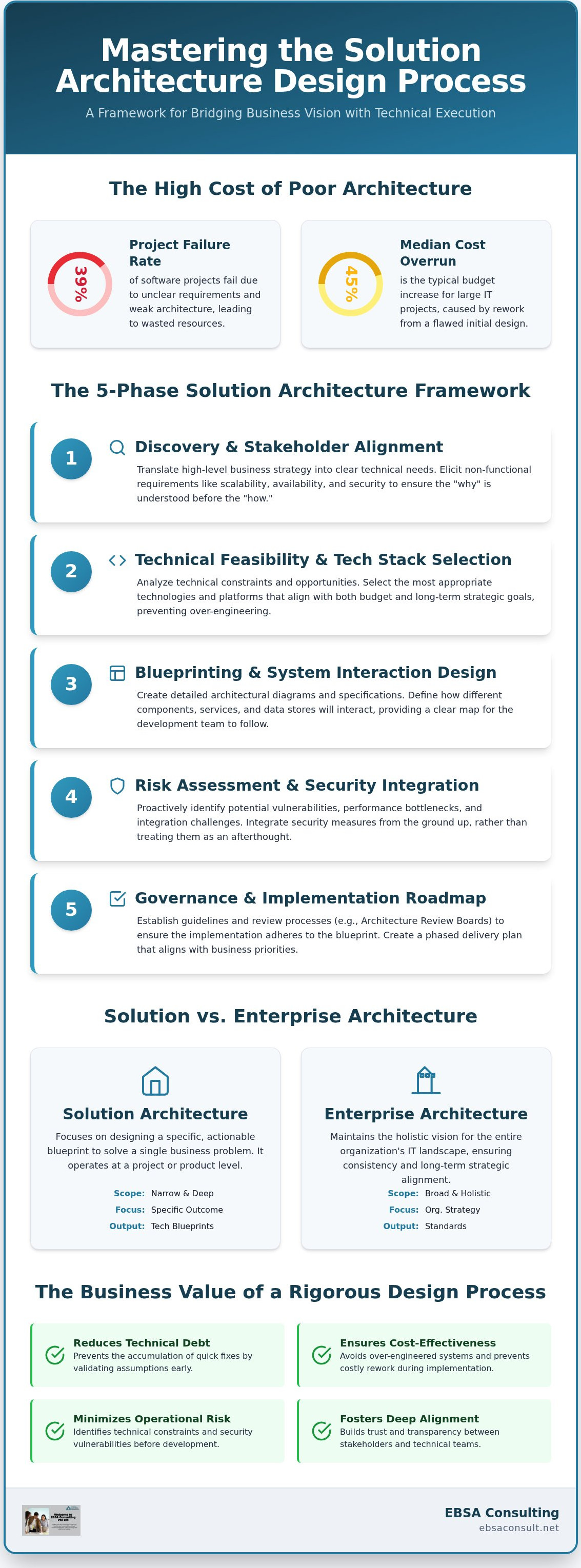
Industry research indicates that approximately 39% of software projects fail due to unclear requirements and weak architecture. When technical blueprints aren't synchronized with business vision, the result is often a mounting pile of technical debt and a median cost overrun of 45% for large IT projects. You've likely experienced the frustration of seeing a promising initiative stall because the solution architecture design process didn't account for real-world operational complexities. It's a common hurdle, but it's one that structured, strategic thinking can solve.
This article provides a comprehensive framework to help you master every phase of architectural planning, ensuring your technical decisions drive high-level business objectives. You'll learn how to create a scalable, robust blueprint that reduces implementation risk and fosters deep alignment between your stakeholders and technical teams. We'll walk through the methodical steps required to bridge the gap between vision and execution, using the most current standards for 2026 to turn technical challenges into reliable paths for organizational growth.
Key Takeaways
- Learn why a structured solution architecture design process serves as the primary defense against technical debt and misaligned IT capabilities.
- Explore a rigorous 5-phase framework that moves from stakeholder alignment to technology stack selection with precision and clarity.
- Analyze the strategic benefits of engaging external architectural expertise to gain an objective, cross-industry perspective on complex organizational challenges.
- Understand the role of implementation governance and Architecture Review Boards in maintaining the integrity of your technical blueprint during deployment.
- Discover how a collaborative, partnership-driven consulting approach synchronizes your technical infrastructure with long-term business strategy.
Understanding the Strategic Role of a Solution Architecture Design Process
Solution architecture is the rigorous practice of designing and managing technical solutions to address specific business problems. As we look toward 2026, the solution architecture design process has evolved from delivering static, rigid blueprints to fostering dynamic, agile frameworks that adapt to rapid market shifts. This process acts as a vital bridge, synchronizing high-level business architecture services with the intricate realities of engineering execution. It transforms abstract goals into concrete technical requirements, ensuring that every investment in technology yields a direct business dividend.
A structured approach serves as your primary defense against technical debt. By validating assumptions early, you prevent the accumulation of quick fixes that eventually paralyze innovation. In 2026, this isn't just about documentation; it's about creating a living strategy that evolves alongside the project. Without this structured thinking, organizations often find themselves reacting to technical limitations rather than proactively shaping their digital future.
The Business Value of a Rigorous Design Phase
Investing time in a rigorous design phase yields measurable returns. It allows for the early identification of technical constraints, which significantly reduces operational risk before a single line of code is written. This foresight ensures cost-effectiveness by preventing the common pitfalls of over-engineered systems that waste resources or under-scaled systems that fail under pressure. The solution architecture design process is a strategic synchronization of business goals and technical feasibility.
Operational excellence depends on this initial clarity. When stakeholders understand the technical boundaries from the outset, expectations remain realistic and project timelines become predictable. This transparency builds trust between leadership and technical teams, creating a culture of accountability and shared success.
Solution vs. Enterprise Architecture: Defining the Boundary
While they share common goals, these disciplines operate at different altitudes. Solution architecture fits precisely within a broader enterprise architecture consulting framework. Enterprise architecture maintains the holistic vision for the entire organization, whereas solution design focuses on the transition from that vision to specific, actionable blueprints. This shift requires a narrower, deeper focus than general business architecture, ensuring that every technical component directly supports a defined business outcome. For a foundational perspective, a Solution Architecture Overview helps clarify how these roles interact to maintain organizational harmony. By defining these boundaries, leaders can ensure that high-level strategy isn't lost in the technical minutiae of implementation.
The 5-Phase Solution Architecture Design Framework
The solution architecture design process is not a linear checklist; it's a strategic cycle that ensures technical execution remains tethered to business value. By breaking this down into five distinct phases, organizations can move from abstract concepts to a concrete implementation roadmap with confidence. These phases include:
- Phase 1: Requirements Discovery & Stakeholder Alignment.
- Phase 2: Technical Feasibility & Technology Stack Selection.
- Phase 3: Blueprinting & System Interaction Design.
- Phase 4: Risk Assessment & Security Integration.
- Phase 5: Governance & Implementation Roadmap.
Each phase serves a specific purpose in de-risking the final deployment and ensuring the resulting system is both scalable and maintainable. This structured approach prevents the fragmented decision-making that often leads to project failure or excessive cost overruns.
Discovery: Translating Business Strategy into Technical Needs
Successful architecture begins with understanding the "why" before the "how." During this phase, we focus on eliciting non-functional requirements such as scalability, high availability, and security. It's here that business architecture services become indispensable. By mapping business capabilities directly to technical components, we ensure that the proposed solution actually solves the intended problem. This alignment prevents the common trap of building technically impressive systems that offer little organizational value. We work closely with stakeholders to prioritize these needs, ensuring that the most critical business drivers are addressed first.
Blueprinting: Creating the Technical Roadmap
Once requirements are clear, the process shifts to creating the high-level system architecture. This involves designing data flows and documenting API strategies that allow disparate systems to communicate seamlessly. For many national enterprises, this phase must also incorporate a robust legacy system modernization strategy. The goal is to create a blueprint that respects existing infrastructure while providing a clear path toward a more agile, modern state. We focus on integration patterns that promote decoupling, which reduces the long-term cost of change and prevents vendor lock-in.
Validation: Testing the Design Against Constraints
A design is only as strong as its ability to withstand real-world constraints. We use the Architecture Trade-off Analysis Method (ATAM) to evaluate how different architectural decisions impact quality attributes like performance and maintainability. This phase also ensures the design adheres to the strict regulatory and compliance standards expected of enterprise-level systems. For high-risk components, creating a Proof of Concept (PoC) provides the empirical evidence needed to move forward. This evidence-based approach removes the guesswork from complex deployments. If you're looking for a steady hand to guide these critical decisions, consulting with experienced architects can provide the clarity and confidence your team needs to succeed.
Strategic Evaluation: Comparing Internal vs. Consultative Design
Choosing the leadership for your solution architecture design process is a pivotal decision that impacts your organization's long-term agility. While in-house developers bring valuable institutional context, they often operate under the weight of daily operational pressures. This proximity can lead to "tunnel vision," where the design is shaped by existing constraints rather than future possibilities. Engaging professional architecture consulting services introduces an objective, cross-industry perspective that internal teams may lack. This consultative approach ensures that your blueprints aren't merely functional; they're strategically optimized against global standards and emerging methodologies.
A significant benefit of external expertise is the avoidance of "vendor lock-in." Professional architects prioritize modularity and interoperability, ensuring your system remains flexible as new technologies emerge. They act as a neutral partner, focusing on the "why" before the "how" to ensure that technical decisions serve your broader business vision. This independence is a cornerstone of operational excellence, providing the stability needed to manage complex organizational shifts with confidence.
The Risk of "Developer-Led" Architecture
When developers are responsible for both design and execution, the pressure to deliver quickly often results in short-term technical shortcuts. These compromises might solve an immediate problem, but they inevitably lead to mounting technical debt. Internal teams also tend to favor familiar technologies, even if they aren't the most effective tools for a specific challenge. A dedicated architect is essential to maintain the "big-picture" vision. They ensure the solution architecture design process remains focused on scalability and maintainability rather than just immediate delivery. Without this oversight, projects often become rigid and difficult to evolve.
When to Engage External Architecture Experts
Certain high-stakes scenarios demand a level of specialized expertise that internal teams may not yet possess. During mergers and acquisitions or periods of rapid national scaling, the complexity of synchronizing disparate systems requires a steady, authoritative guide. This is also a critical moment to engage experts for a cloud architecture strategy design. If your organization is transitioning to modern patterns like microservices or event-driven architecture, external consultants provide the necessary knowledge transfer. They bridge the gap between current IT capabilities and the visionary requirements of a successful digital transformation.
De-risking Implementation: Governance and Quality Assurance
A technical blueprint only provides value if the implementation remains faithful to its core principles. Without rigorous governance, the most sophisticated solution architecture design process can fall victim to "Architectural Drift," where development decisions slowly diverge from the original strategic vision. This divergence often happens silently, driven by immediate project pressures or misunderstood requirements. Maintaining "Traceability" is the essential antidote, creating a clear, documented link from every line of code back to the architectural decisions that justified it. This ensures that the final product isn't just functional, but also strategically sound.
The Architecture Review Board (ARB) plays a central role in this safeguarding effort. Far from being a bureaucratic hurdle, the ARB acts as a strategic partner that validates technical choices against long-term business objectives. It provides a platform for cross-functional collaboration, ensuring that individual solutions don't create silos or introduce incompatible technologies into the enterprise ecosystem. This level of oversight is what transforms a simple design into a resilient organizational asset that can withstand future shifts in the market.
Establishing an Effective Governance Framework
To succeed, governance must be proactive rather than reactive. This involves setting clear architectural principles and guardrails that empower development teams to make localized decisions without compromising the broader system integrity. Regular design audits and technical reviews serve as checkpoints to catch misalignments before they become costly errors. These efforts must be integrated into a wider it governance framework to ensure regulatory compliance and operational stability. By embedding these reviews into the development lifecycle, organizations can maintain a steady pace of innovation without sacrificing quality.
Measuring Success in Solution Design
Quantifying the impact of architecture is vital for sustained executive support. Key Performance Indicators (KPIs) should focus on architectural health, such as the rate of technical debt accumulation and the speed of feature deployment. Industry benchmarks suggest that a successful solution architecture design process results in a 25% to 40% reduction in long-term maintenance costs by eliminating systemic inefficiencies early. Tracking these metrics allows leadership to see architecture not as a cost center, but as a driver of operational excellence. If you're ready to strengthen your implementation oversight, partner with our strategic architects to establish a governance model that ensures long-term reliability.
Elevating Your Infrastructure with EBSA Consulting
Organizations facing complex digital transformations need more than a vendor; they need a strategic partner who understands the high stakes of enterprise-level change. EBSA Consulting serves as that steady, authoritative guide, helping national enterprises navigate the transition from fragmented, siloed infrastructure to synchronized operational excellence. Our focus remains exclusively on high-level strategic frameworks and technical blueprints, ensuring that every architectural decision is grounded in proven methodologies. By intentionally excluding managed IT services and software sales from our portfolio, we maintain the absolute objectivity required to prioritize your organization's unique goals over specific product agendas or licensing quotas.
Our Approach to Solution Architecture Design
We move methodically from broad strategic concepts to specific, actionable technical blueprints that your engineering teams can execute with precision. Every engagement is rooted in a collaborative mindset, where our consultants work as an extension of your leadership team rather than a distant third party. This partnership-driven approach ensures the resulting solution architecture design process is tailored to your specific organizational DNA and market constraints. Our refined solution architecture design process focuses on long-term reliability and agility, providing tool-agnostic advice that prevents the common pitfalls of vendor lock-in. We don't just solve immediate problems; we create a technical foundation that actively accelerates your journey toward future innovation.
Ready to Reshape Your Technical Future?
Shifting from a culture of "reactive fixing" to one of "proactive design" is the most significant step an organization can take toward sustainable growth. A professional architecture health check identifies the hidden technical debt and misalignments that might be quietly eroding your project margins. By reshaping your technical future today, you ensure that your IT capabilities are perfectly synchronized with your overarching business vision. Our strategic guides are ready to help you build a robust, scalable infrastructure that serves as a genuine competitive advantage. If you're prepared to move beyond temporary patches and toward a sustainable, high-performance technical roadmap, we invite you to consult with our strategic guides to begin your transformation journey.
Building a Resilient Technical Foundation for 2026
Mastering the solution architecture design process is the most effective way to ensure your technology investments remain synchronized with your high-level business vision. By following a structured 5-phase framework, you transform fragmented systems into a scalable, robust blueprint that actively reduces implementation risk. This rigorous approach to governance eliminates technical debt and turns architectural planning into a genuine engine for operational excellence.
Choosing a consultative partner ensures your roadmap is built on objectivity rather than software sales bias. EBSA Consulting specializes in high-level strategic technology roadmap design, utilizing a deeply collaborative methodology to reshape your infrastructure for long-term reliability. It's time to move beyond reactive fixes and embrace a proactive design strategy that accelerates your organizational growth.
Contact EBSA Consulting to synchronize your business vision with a professional Solution Architecture Design and begin building the stable, visionary infrastructure your enterprise deserves.
Frequently Asked Questions
What is the primary goal of the solution architecture design process?
The primary goal is to ensure that a specific technical solution directly addresses a business problem while remaining scalable and cost-effective. This process translates abstract strategic needs into a concrete technical blueprint. By focusing on a structured solution architecture design process, organizations can validate technical feasibility early, which prevents the waste of resources on systems that can't support long-term growth or operational excellence.
How does solution architecture differ from enterprise architecture?
Solution architecture focuses on designing a specific system to solve a particular problem, whereas enterprise architecture oversees the entire organization's technical landscape. You can think of enterprise architecture as the city's master plan and solution architecture as the detailed blueprint for a single building. While they are distinct, they must remain synchronized to ensure that individual projects contribute to the broader organizational vision without creating technical silos.
When should a company hire an external solution architecture consultant?
Engaging an external consultant is ideal during periods of rapid national scaling, complex cloud migrations, or mergers and acquisitions. External experts provide an objective, tool-agnostic perspective that internal teams often lack due to project bias or operational pressures. They bridge the gap between high-level vision and technical reality, offering cross-industry insights that help de-risk high-stakes digital transformations and prevent expensive long-term vendor lock-in.
Can solution architecture design help reduce existing technical debt?
Yes, a structured architectural approach is the most effective way to identify and remediate existing inefficiencies. By analyzing current system interactions, the solution architecture design process pinpoints where legacy constraints are hindering performance. This allows for the creation of a targeted modernization roadmap that replaces short-term patches with sustainable, agile frameworks, ultimately reducing maintenance costs by up to 40% over time.
What are the most common risks of skipping the architectural design phase?
Skipping this phase often leads to project failure, with industry data suggesting that 39% of failed software projects stem from weak initial architecture. Without a clear design, companies face median cost overruns of 45% and the rapid accumulation of technical debt. These risks manifest as poor system performance, security vulnerabilities, and a lack of scalability, which eventually forces expensive and disruptive reactive fixing instead of proactive innovation.
How long does a typical solution architecture design process take for an enterprise project?
The timeline for a typical enterprise-level engagement usually spans four to twelve weeks, depending on the project's complexity and scope. This duration allows for thorough requirements discovery, stakeholder alignment, and technical feasibility testing. While it requires an upfront investment of time, this phase significantly accelerates the actual development cycle by providing a clear, validated roadmap that prevents the need for major mid-project pivots or architectural redesigns.
What deliverables should I expect from a solution architecture design engagement?
You should expect a comprehensive suite of documents, including high-level system blueprints, detailed data flow diagrams, and API integration strategies. Other critical deliverables include a formal risk assessment, a technology stack selection report, and a phased implementation roadmap. These assets serve as the authoritative guide for your engineering teams, ensuring that every technical component remains aligned with the original business objectives throughout the deployment.
How does the design process ensure security and regulatory compliance?
Security and regulatory compliance are integrated as core non-functional requirements from the very first phase of discovery. The process involves identifying specific industry standards and legal mandates to ensure the design includes necessary guardrails, such as data encryption and access controls. By conducting regular audits and using frameworks like TOGAF, architects ensure that the final technical blueprint provides a secure environment that meets all national regulatory expectations.


