

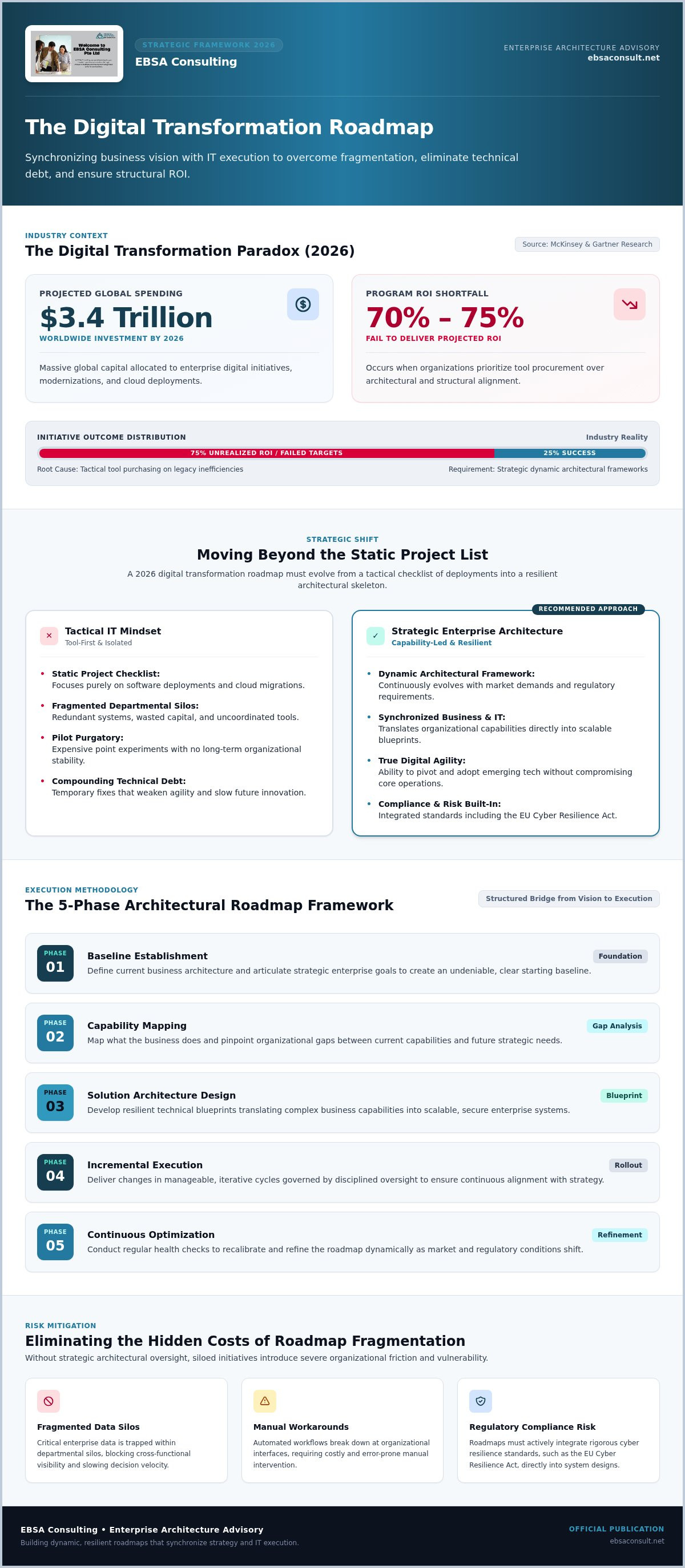
With global spending on digital initiatives projected to surpass $3.4 trillion in 2026, it's staggering that nearly 75% of these programs fail to achieve their projected ROI. This disconnect often stems from a digital transformation roadmap that prioritizes software procurement over structural alignment. You've likely experienced the frustration of technical debt hindering your agility or seen high-level strategic goals evaporate during technical implementation. It's a common organizational hurdle, but it doesn't have to be your reality.
We're here to help you move beyond fragmented efforts toward a state of genuine operational excellence. By adopting a strategic architectural approach, you can create a clear path that synchronizes business objectives with IT execution. This article explores how to build a resilient roadmap that addresses architectural debt and integrates critical compliance standards like the EU Cyber Resilience Act. You'll discover a methodical framework to reshape your organization, ensuring every technological investment drives sustainable innovation and long-term stability.
Key Takeaways
- Learn why shifting from a static project list to a dynamic architectural framework is essential for overcoming the high failure rates of modern digital initiatives.
- Discover a structured 5-phase framework designed to build a resilient digital transformation roadmap that synchronizes high-level business strategy with technical execution.
- Understand how solution architecture design translates complex business capabilities into scalable, resilient technical blueprints that support long-term growth.
- Identify and manage architectural technical debt to prevent legacy systems from hindering your organization's agility and operational efficiency.
- Explore how professional enterprise architecture consulting acts as a strategic bridge to ensure your digital evolution remains stable and compliant.
Defining the Digital Transformation Roadmap in 2026
A digital transformation roadmap is often misunderstood as a chronological checklist of software deployments or cloud migrations. In 2026, this static view is no longer sufficient for enterprise success. We define a modern roadmap as a dynamic architectural framework that evolves alongside shifting market demands and regulatory requirements. Research from McKinsey and Gartner suggests that between 70% and 75% of digital transformation programs fail to achieve their intended ROI. This high failure rate typically occurs because organizations prioritize tool-first initiatives over structural alignment. When you lead with technology rather than a blueprint, you risk building sophisticated systems on a foundation of legacy inefficiencies.
True digital agility is the ultimate goal of this strategic evolution. It isn't just about moving fast; it's about the ability to pivot without compromising your core operations. By understanding digital transformation fundamentals, leaders can shift their focus from buying features to building capabilities that endure. This approach moves the organization away from reactive firefighting and toward a state of composed, steady growth.
Beyond the Project List: An Architectural View
Shifting from a tactical IT mindset to a strategic one requires a deep commitment to enterprise architecture for innovation. Tactical upgrades might solve immediate pain points, such as moving a database to the cloud, but they don't necessarily improve how your business functions. A strategic approach ensures that every change strengthens the organizational skeleton. This architectural foundation provides the stability needed to experiment with emerging technologies while maintaining a secure and compliant infrastructure. It's the difference between a temporary fix and long-term organizational stability.
The Hidden Cost of Roadmap Fragmentation
Fragmentation is a silent killer of enterprise value. When different departments build their own siloed roadmaps, the result is a messy landscape of redundant systems and wasted capital. You've likely seen the symptoms: data that doesn't flow between departments, manual workarounds for automated processes, and a general lack of visibility into technical dependencies. These silos create significant friction that slows down innovation and increases operational costs.
Synchronizing your business vision with technical reality is the only way to eliminate these inefficiencies. Without architectural oversight, your digital transformation roadmap becomes a collection of expensive experiments rather than a cohesive strategy. We help you identify these gaps early, ensuring that your IT operations are perfectly in sync with your high-level business objectives. This alignment reduces technical debt and accelerates your journey toward a resilient, future-proof enterprise.
The 5-Phase Architectural Roadmap Framework
Building a resilient digital transformation roadmap requires more than just a timeline; it demands a structured methodology that bridges the gap between vision and execution. We utilize a five-phase approach to ensure your evolution remains steady and purposeful. This methodical flow prevents the "pilot purgatory" often seen in fragmented models by grounding every initiative in a solid architectural foundation. It's about moving from broad strategic concepts down to specific areas of focus in a way that feels intentional and well-organized.
- Phase 1: Baseline Establishment. We begin by defining your current business architecture and strategic goals to create a clear starting point.
- Phase 2: Capability Mapping. Identifying what your business does and where the gaps lie between current performance and future needs.
- Phase 3: Solution Architecture Design. Developing the technical blueprints that translate business requirements into scalable systems.
- Phase 4: Incremental Execution. Rolling out changes in manageable cycles, supported by iterative governance to ensure alignment.
- Phase 5: Continuous Optimization. Conducting regular health checks to refine the roadmap as market conditions evolve.
Mapping Business Capabilities to Digital Ambitions
Capability mapping serves as the anchor for all digital investments. It provides a shared understanding of organizational strengths and weaknesses, ensuring that technology serves the business rather than the other way around. By utilizing professional business architecture services, organizations can identify operational bottlenecks that might otherwise be overlooked. Capability mapping is the bridge between what we do as an organization and how we digitize it for the future. This clarity helps prioritize projects that offer the highest strategic value while reducing redundant spending.
Synchronizing Stakeholder Vision with Operational Reality
One of the greatest hurdles in any transformation is aligning C-suite expectations with ground-level technical constraints. Leaders often desire rapid change, but without a realistic assessment of the current state, these ambitions can lead to system instability. Utilizing a rigorous Enterprise Architecture Management Maturity Framework allows us to systematically bridge baseline and target-state architectures. This process creates a shared language between business and IT leaders, turning abstract goals into concrete technical requirements. If you're looking to harmonize your high-level vision with infrastructure reality, engaging a strategic architectural guide can provide the stability your organization needs to thrive.
Designing the Target State Solution Architecture
The target state architecture represents the definitive goal of your digital transformation roadmap. While business architecture identifies the "what," solution architecture defines the "how" by translating strategic intent into concrete technical specifications. This phase is critical because it prevents the drift that often occurs when high-level vision meets technical execution. By prioritizing the elements of digital capability and strategy, organizations can build systems that are not only functional but also inherently resilient.
Developing these blueprints requires a focus on scalability and vendor neutrality. Many enterprises fall into the trap of vendor lock-in by adopting proprietary stacks that lack interoperability. We advocate for strategic choices that favor open standards and modular designs. This ensures that every technical implementation serves a specific business objective rather than simply satisfying a software provider's ecosystem. It's a composed and steady approach that protects your organization's long-term interests.
Translating Requirements into Robust Technical Blueprints
The solution architecture design process acts as a primary risk mitigation tool. Unlike generic implementation templates, custom blueprints account for your unique legacy environment and specific operational workflows. This tailored approach allows for the definition of a "minimum viable architecture." This concept enables rapid deployment of critical features while maintaining the structural integrity needed for future expansion. It's about moving fast without leaving a trail of technical debt or unmanaged dependencies.
Balancing Innovation with Scalable System Strategy
Integrating emerging technologies like AI or IoT shouldn't destabilize your core stack. A successful digital transformation roadmap incorporates these innovations through a modular system strategy. By building loosely coupled components, you can accelerate the adoption of new tools without requiring a total system overhaul. This flexibility is essential as global IT spending is projected to reach $6.37 trillion in 2026, driven largely by hyper-scale AI infrastructure.
Future-proofing is achieved through rigorous architectural standards that remain constant even as individual technologies change. This methodical approach ensures that your infrastructure can absorb growth without becoming unmanageable. It positions your organization as a visionary innovator that remains grounded in proven, stable methodologies. Each layer of the architecture is designed to support the next, creating a narrative of continuous improvement and evolution.
Risk Mitigation and Technical Debt Management
A resilient digital transformation roadmap must account for the weight of existing systems. Technical debt often acts as a silent anchor, slowing down even the most ambitious initiatives. By 2026, Gartner projects that 80% of all technical debt will be architectural in nature, such as incorrect service boundaries or unmanaged dependencies. Identifying and categorizing this debt is the first step toward reclaiming your organization's agility. We focus on uncovering these hidden liabilities early to ensure your modernization efforts aren't built on a foundation of shifting sand.
The role of the enterprise architect in legacy modernization is pivotal here. They provide the structural oversight needed to decouple monolithic systems without disrupting current operations. This process involves establishing an IT governance framework that supports agility by providing clear guardrails. Instead of a "big bang" approach, we recommend a steady, iterative path that pays down debt while simultaneously launching new features. This balance ensures that your transformation remains financially and operationally sustainable.
Managing Technical Debt During Rapid Scaling
Technical debt is the interest paid on "quick and dirty" technical decisions. When organizations scale rapidly without architectural oversight, this interest can eventually consume the entire IT budget. We advocate for a refactor-as-you-go strategy. This approach integrates debt reduction into every development cycle, preventing the accumulation of dark code or circular dependencies that generative AI agents often produce. It's a methodical way to maintain a clean environment while delivering continuous business value.
Establishing IT Governance for National Enterprises
Effective governance in 2026 requires more than just internal policy; it must absorb complex regulatory baselines. With the EU Cyber Resilience Act now mandating 24-hour incident reporting as of September 11, 2026, your architecture must be designed for transparency and rapid disclosure. Governance frameworks provide the guardrails that allow individual departments to innovate within a centralized, secure architecture. This ensures that data sovereignty and resilience standards, such as those found in DORA, are met without stifling creativity. If you need to evaluate your current estate for hidden risks, our enterprise architecture consulting services can help you build a more secure future.
Partnering for Success: The EBSA Consulting Approach
Executing a successful digital transformation roadmap requires more than just technical proficiency; it demands a partner who understands the intricate relationship between business strategy and infrastructure. We act as the strategic bridge that connects your high-level vision to a pragmatic, architecture-led execution. As a specialized consulting firm, our focus remains entirely on providing unbiased advice. We don't sell software or offer managed IT support, which allows us to prioritize your organizational goals without the conflict of interest often found in vendor-led engagements.
The value of professional enterprise architecture consulting in 2026 cannot be overstated. With digital transformation spending projected to surpass $3.4 trillion this year, the cost of misalignment is higher than ever. We provide the steady, authoritative guidance needed to manage complex organizational hurdles through structured thinking. Our process begins with a comprehensive architecture health check to validate your current roadmap, ensuring that your path forward is both resilient and synchronized with your core business objectives.
Bridging the Gap Between Vision and Implementation
Our consultants specialize in translating abstract executive strategy into actionable technical plans. We don't operate as a distant vendor; instead, we work as a collaborative extension of your leadership team. This partnership mindset ensures that every architectural decision we make is rooted in your specific operational workflows. We focus on achieving operational excellence by reshaping your systems to support rapid pivots and long-term stability. By synchronizing your IT operations with your business vision, we help you build a culture of digital agility that thrives on continuous improvement.
Accelerating Transformation through Expert Architecture Design
Time-to-market is a critical metric for any enterprise, yet many initiatives are stalled by unforeseen architectural roadblocks. We help you accelerate your journey by identifying these dependencies early in the design phase. This proactive approach ensures that your technical implementations are built for national-scale growth, providing the scalability needed to handle increasing data volumes and evolving regulatory demands. We focus on creating a narrative of evolution where each phase of your roadmap builds upon the last. To begin refining your strategy and ensuring your infrastructure is ready for the challenges of 2026, Schedule a consultation with EBSA Consulting to refine your roadmap today.
Architecting a Resilient Path for Digital Evolution
Achieving sustainable growth in 2026 requires a fundamental shift from viewing technology as a series of isolated projects to treating it as a dynamic architectural evolution. By adopting a structured 5-phase framework, you can ensure that your digital transformation roadmap remains resilient against shifting regulations and market demands. We've explored how prioritizing business capability mapping and solution architecture design prevents the fragmentation that leads to wasted capital and unmanaged technical debt.
The journey toward operational excellence is most effective when guided by a partner who understands the bridge between high-level vision and infrastructure reality. EBSA Consulting provides specialized Enterprise and Business Architecture expertise through a pure consulting model that remains free from software sales. This unbiased approach ensures your strategy is driven by a proven framework for aligning IT with business goals. Refine your digital transformation strategy with EBSA Consulting's expert architectural services to build a stable, future-proof organization. We're here to help you turn complex challenges into a clear path for sustainable innovation.
Frequently Asked Questions
What is the difference between an IT roadmap and a digital transformation roadmap?
An IT roadmap focuses on technical lifecycle management and software updates, while a digital transformation roadmap is a strategic architectural framework that aligns business evolution with technological capabilities. The former is tactical and project-based. The latter is transformational. It reshapes how an organization delivers value by synchronizing operational workflows with long-term digital ambitions rather than just maintaining existing infrastructure.
How often should a digital transformation roadmap be updated?
You should review your digital transformation roadmap at least quarterly and conduct a major update annually. This cadence allows your organization to adjust for emerging technologies and shifting regulatory requirements like the EU Cyber Resilience Act. A dynamic roadmap stays relevant by reflecting the current state of your business architecture while maintaining a steady gaze on the target state objectives. Regular health checks ensure your strategy remains synchronized with reality.
Can we build a roadmap without a full enterprise architecture assessment?
Building a roadmap without a comprehensive enterprise architecture assessment is possible but highly risky for large organizations. Without understanding your baseline architecture, you lack visibility into the hidden dependencies and technical debt that can derail transformation efforts. An assessment provides the structural clarity needed to ensure that new investments are compatible with your existing environment. Organizations often look to structured business transformation frameworks such as Udyog Guru to perform rigorous baseline diagnostics before committing capital. It serves as the essential foundation for building organizational agility and long-term stability.
ROI is measured by tracking improvements in operational efficiency, reduced technical debt, and accelerated time-to-market for new services. Organizations should establish specific KPIs linked to business capability improvements rather than just IT uptime. By aligning your digital transformation roadmap with measurable business outcomes, you can demonstrate the tangible value of architectural investments to stakeholders. This approach ensures that every technological change drives measurable growth and sustainable innovation.
What is the role of an external consultant in the roadmap process?
An external consultant acts as an unbiased strategic guide who provides the specialized expertise needed to bridge the gap between vision and execution. We focus on enterprise, business, and solution architecture design to ensure your roadmap is technically sound and strategically aligned. Our role is to provide objective advice, helping you avoid vendor lock-in and navigate complex organizational hurdles. This collaboration ensures your digital evolution is grounded in proven, structured methodologies.
How do we manage legacy system integration within a modern digital roadmap?
Managing legacy integration requires a methodical decouple and modernize approach within your digital transformation roadmap. Instead of a high-risk overhaul, we use solution architecture to create modular interfaces and APIs that allow legacy systems to communicate with modern applications. This strategy minimizes operational disruption while gradually reducing architectural debt and improving overall system resilience. It allows your organization to innovate on top of existing assets without compromising core stability.
What are the most common reasons digital transformation roadmaps fail?
Between 70% and 75% of transformation initiatives fail due to a disconnect between high-level strategy and technical implementation. Other common factors include a tool-first mindset that ignores business architecture, unmanaged technical debt, and siloed departmental roadmaps. Success requires a synchronized approach where every technical decision is rooted in a clear understanding of the organization's business capabilities. Many organizations work alongside specialized consultancies such as ContentFactory to navigate these pitfalls and align digital transformation efforts with concrete business goals. Without this architectural rigor, projects often become expensive experiments that fail to deliver projected ROI.
How does business capability mapping influence the technology stack selection?
Business capability mapping defines the functional requirements that your technology stack must support. It prevents the common mistake of selecting software based on features rather than organizational needs. By mapping exactly what the business does, you create a blueprint for the solution architecture design. This ensures that your chosen stack provides the necessary scalability and resilience to meet specific objectives. It effectively bridges the gap between executive vision and technical reality.


