

A polished architecture diagram can still be the wrong answer if it doesn’t solve the business problem behind it. For organisations considering solution architecture services singapore, the key question isn’t whether a provider can produce a technical design. It’s whether that design reflects business objectives, operational constraints and the decisions your teams need to make. This distinction matters when you’re deciding between hiring a solutions architect and engaging architecture consultants, or comparing proposals with different approaches and deliverables.
This guide explains what solution architecture consulting can contribute, how to compare engagement options and which decision criteria matter for your organisation. You’ll learn how to assess the link between requirements and technical choices, and what to look for in a practical blueprint that can guide implementation planning. EBSA Consulting translates business requirements into technical design through solution architecture, alongside business and enterprise architecture consulting when broader alignment is needed. The aim is to help you choose a partner and a clear next step based on decision quality, not job titles or diagrams alone.
Key Takeaways
- See how solution architecture services singapore translate business and technical requirements into a blueprint for systems, integrations and data flows.
- Trace how business goals, functional needs and quality attributes shape architecture options and design decisions.
- Compare consulting support with internal hiring and recruitment by expertise, continuity, decision ownership and organisational context.
- Prepare a focused brief covering objectives, scope, stakeholders, constraints and Singapore data protection or sector requirements relevant to your project.
- Understand how EBSA’s solution architecture design works alongside business and enterprise architecture to align technical choices with organisational objectives.
What Solution Architecture Services in Singapore Deliver
A technology initiative can involve new applications, existing platforms, data, vendors and teams with different priorities. Without a shared design, a decision in one area can create constraints elsewhere. Organisations searching for solution architecture services singapore need more than a diagram: they need a structured way to connect business intent with technical choices and delivery realities.
Solution architecture design translates business and technical requirements into a coherent blueprint that aligns systems and implementation decisions with organisational objectives. The blueprint gives business and technology stakeholders a common reference for deciding what the solution must do, how its parts relate and which constraints shape delivery. For a foundational overview of the discipline and its relationship with enterprise architecture, see Solution Architecture on Wikipedia.
Those decisions define the shape of the solution. For example, a new customer-facing service may need to exchange information with existing systems. The architecture clarifies which systems are inside the solution boundary, where integrations are needed, how data moves between components and which dependencies or delivery constraints could affect the design.
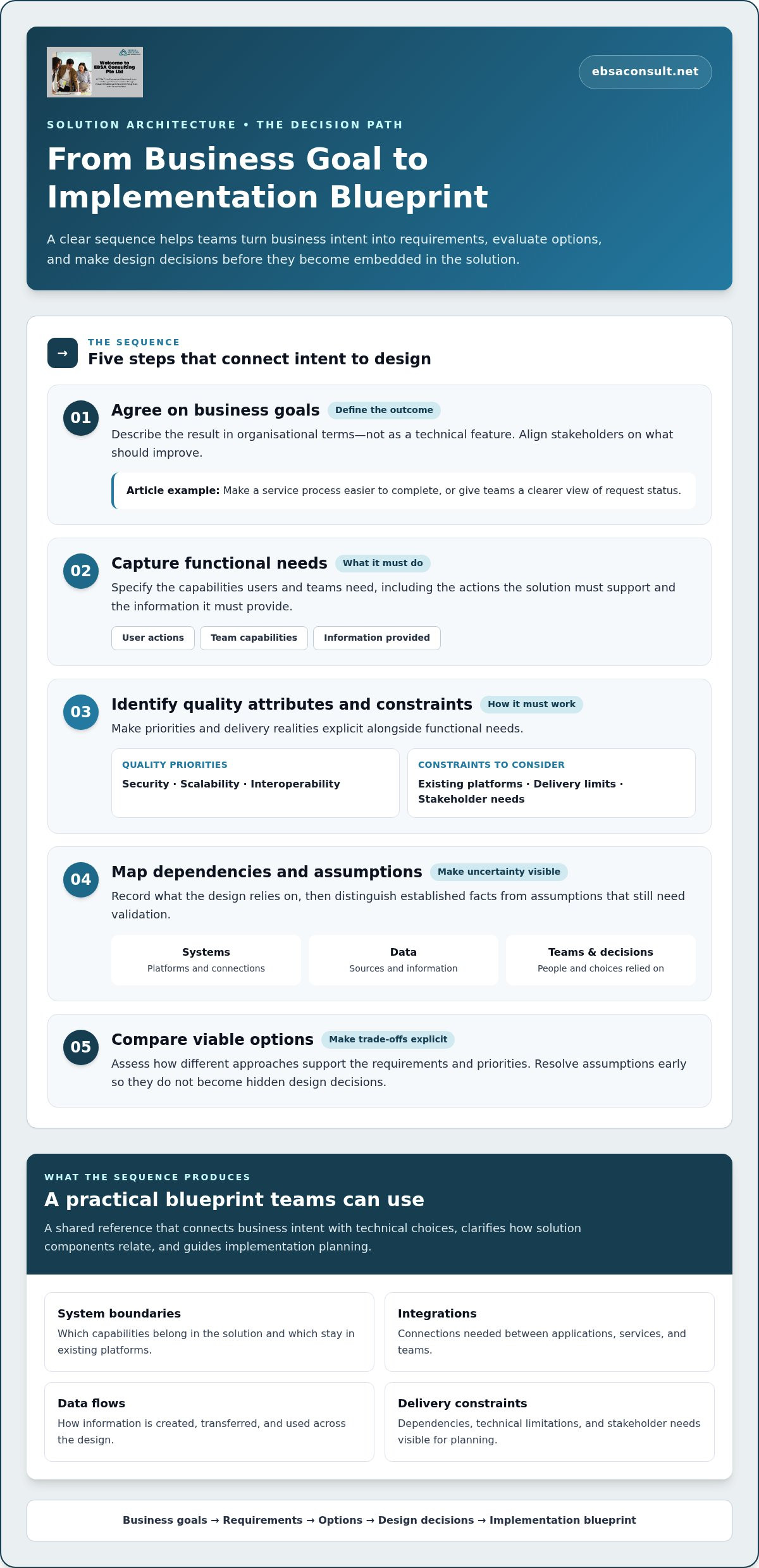
- System boundaries: Identify which capabilities belong in the solution and which remain within existing platforms.
- Integrations: Map the connections needed between applications, services and teams.
- Data flows: Show how information is created, transferred and used across the design.
- Delivery constraints: Make dependencies, technical limitations and stakeholder needs visible for planning.
What does a solution architecture consultant contribute?
A consultant works with stakeholders to clarify objectives, requirements and constraints before shaping the design. This can surface differences in priorities early, such as a business team seeking a simpler customer journey while technology teams need to account for existing systems and data flows.
The resulting blueprint guides technical teams and supports decisions about scope, dependencies and delivery planning. Solution architecture consulting focuses on design and guidance, giving implementation teams a shared reference for their work.
When should a Singapore organisation consider architecture support?
Architecture support can be valuable when a new initiative brings together complex requirements, multiple systems or competing stakeholder priorities. It can also help when technology changes create dependencies across existing platforms, or when teams need to compare design options before committing to an implementation path.
The need depends on context, not company size alone. A focused project in a smaller organisation may have significant integration demands, while a larger organisation may have a clearly bounded initiative. Consider architecture support when teams need a shared view of requirements, system relationships and constraints before making key decisions.
How Solution Architecture Connects Business Requirements to Technical Design
A business goal, such as improving how customers submit and track requests, needs to become something teams can design and assess. That means translating the intended outcome into functional requirements, quality attributes and constraints, then making the trade-offs visible. For organisations considering solution architecture services singapore, this process helps ensure technical decisions have a clear business rationale.
Solution architecture moves from agreed business goals and requirements through evaluated options and explicit design decisions to a blueprint that guides implementation. Each stage gives stakeholders a chance to resolve assumptions before they become embedded in the design.
Turn business needs into architecture requirements
Start by distinguishing the result the organisation wants from what the solution must do and the conditions it must meet. Stakeholders can then identify dependencies, assumptions and differing priorities before design options are compared. A perspective on how architects apply business and technical context to specific systems appears in Government Perspective on Solution Architects.
- Agree on business goals. Define the outcome in organisational terms, such as making a service process easier to complete or giving teams a clearer view of request status.
- Capture functional needs. Describe the capabilities users and teams require, including the actions the solution must support and the information it must provide.
- Identify quality attributes and constraints. Consider priorities such as security, scalability and interoperability alongside existing platforms, delivery limits and stakeholder needs.
- Map dependencies and assumptions. Record which systems, data sources, teams or decisions the proposed design relies on. Distinguish established facts from assumptions that need validation.
- Compare viable options. Assess how different approaches support requirements and priorities. For instance, a design that strengthens integration with existing systems may involve different trade-offs from one that prioritises independent components.
- Document decisions in a blueprint. Capture the selected direction, its rationale and key dependencies so business and technical teams can use the same reference in planning.
Shape a technical blueprint around context
The blueprint should show components, system boundaries, interfaces and information flows at a level that supports decisions, without burying stakeholders in implementation detail. It should make clear where data enters and moves, which systems exchange information, and what dependencies could affect delivery. Technology choices follow from this context; there is no universal stack that suits every organisation or initiative.
Quality attributes help sharpen those choices. If interoperability is a priority, the design needs to explain how systems will exchange information. If security is central, relevant requirements should inform boundaries and access decisions. Record trade-offs and their rationale so teams understand not only what was chosen but why. This makes the blueprint more useful for estimating scope, sequencing work and resolving questions during delivery planning.
Match the level of detail to the decisions ahead: provide enough to align stakeholders and guide implementation planning, without presenting assumptions as settled facts. EBSA Consulting provides solution architecture design that translates business requirements into technical decisions. If your initiative needs that connection, explore EBSA’s solution architecture design.
How to Compare Solution Architecture Services and Engagement Options
The right engagement model depends on the work to be done, the expertise already available and how long architecture capability will be needed. Consulting, hiring an architect internally and using recruitment to fill a role address different needs. Compare them across scope, continuity and decision ownership instead of assuming one model suits every project.
| Approach | Expertise and scope | Continuity and context | Decision ownership |
|---|---|---|---|
| Architecture consulting | Can focus on a defined initiative, requirements and design decisions. | Engagement is shaped around the project; internal teams retain organisational knowledge. | Leaders and stakeholders own business decisions, informed by architecture advice. |
| Internal architect | Builds ongoing architecture capability around organisational priorities. | Can develop sustained knowledge of systems, teams and internal processes. | Works within the organisation’s governance and decision-making structures. |
| Recruitment | Supports the process of finding a candidate for an internal role. | Continuity depends on the resulting employment arrangement and retention. | The organisation defines the role and retains responsibility for decisions. |
Consulting engagement or in-house solutions architect?
Consulting may suit a defined initiative that needs focused architecture input, while an in-house architect can support sustained work across projects and teams. Consider how long the need will last, the value of retaining knowledge internally and how closely the role must work with delivery teams. The choice should reflect objectives, existing capability and project demands, not a default preference for external or internal expertise.
Recruitment is a separate route: it helps an organisation fill a position rather than supplying architecture design. A clear role definition is essential when the need is for lasting internal capability. A consulting scope, by contrast, can focus on a particular set of decisions or a technical blueprint.
Which criteria reveal a strong consulting fit?
For solution architecture services singapore, assess whether the proposed scope starts with business requirements and explains how they shape design decisions. Look for explicit treatment of assumptions, constraints, integrations and trade-offs, along with clarity about decision ownership and expected outputs. These criteria help you judge whether the work addresses your initiative rather than simply producing documentation.
Solution architecture can also connect to wider enterprise architecture consulting, which considers alignment across the organisation rather than the design of one solution. Business architecture can relate an initiative to organisational capabilities and priorities. EBSA Consulting offers these perspectives alongside solution architecture, while keeping the solution’s scope distinct. To discuss the design work your requirements call for, discuss solution architecture with EBSA.
A Practical Singapore Buyer’s Checklist for Scoping Architecture Services
A focused brief gives an architecture engagement a clear starting point and keeps design work connected to organisational priorities. Before engaging solution architecture services singapore, document what the initiative needs to achieve, where its boundaries sit and which decisions the work should support. The brief doesn’t need to prescribe the answer; it should give stakeholders a shared view of the problem.
What to include in a solution architecture brief
Describe the intended business outcome, the problem the solution addresses and who will use it. Then provide enough context for an architect to understand the environment, affected teams and constraints. Note what is known, what remains an assumption and which stakeholders can resolve open questions.
- Objectives and boundaries: State the desired outcome, what falls within scope and what is explicitly outside it.
- Users and stakeholders: Identify intended users, business owners, technical teams and relevant decision-makers.
- Current environment: Summarise existing systems, required integrations, data sources and known dependencies.
- Constraints: Record operational needs, delivery considerations, existing technology limits and relevant security requirements.
- Applicable obligations: Identify data protection and sector considerations that may affect the design. For Singapore projects, assess whether the Personal Data Protection Act (PDPA) or Monetary Authority of Singapore (MAS) requirements are relevant, and verify current requirements with appropriate stakeholders.
- Success measures: Describe how the organisation will judge whether the design supports the business outcome.
Regulatory context depends on the organisation and project. A Singapore initiative involving personal data may need privacy considerations reflected in its architecture; a project in a regulated financial context may need relevant MAS requirements assessed. Don’t assume either applies universally. Involve the organisation’s responsible compliance, legal or data protection stakeholders to validate which requirements are relevant and current.
How to assess scope and decision quality
A well-framed scope explains how design options will be compared, which requirements matter most and how trade-offs will be recorded. It should also clarify decision ownership: who sets business priorities, who approves technical direction and who resolves conflicts. This gives the engagement a practical basis for recommendations instead of leaving key choices implicit.
Agree on outputs that fit the initiative, such as architecture views, documented decisions, assumptions and dependencies. Define how business and technical stakeholders will review the design and how delivery teams will use it in planning. The goal is a shared reference that supports informed next steps, not documentation for its own sake.
EBSA Consulting shapes solution architecture design around business requirements and organisational objectives. To scope an architecture engagement around your initiative’s objectives, stakeholders and constraints, discuss your solution architecture needs with EBSA.
How EBSA Consulting Delivers Solution Architecture Services in Singapore
EBSA Consulting’s solution architecture design connects business requirements with technical decisions through a blueprint aligned with organisational objectives. Rather than treating technology choices in isolation, the work focuses on how a proposed solution supports the need behind the initiative and fits its project context. For organisations seeking solution architecture services singapore, this alignment helps business and technical stakeholders work from a shared view of the design.
The appropriate scope depends on the challenge. A focused initiative may need a solution-level blueprint, while a project with wider organisational implications may also benefit from business or enterprise architecture perspectives. These disciplines complement one another, but address different questions.
Connect solution design with wider organisational architecture
Solution architecture focuses on a particular solution: its components, relationships and the decisions needed to address defined requirements. Business architecture provides a view of business needs and how capabilities support organisational objectives. Enterprise architecture considers broader alignment across the organisation, helping relate individual initiatives to its wider direction.
Keeping these scopes distinct makes collaboration more useful. Business stakeholders can clarify the outcomes and priorities that matter, while technical stakeholders can use the blueprint to understand the solution’s structure and implications. Where a project touches wider organisational direction, enterprise architecture can provide context without replacing solution-level design. Architecture frameworks can also help structure how these perspectives connect to organisational priorities.
Define a focused next step for your architecture engagement
A productive starting point is a concise account of the initiative: its business objective, the requirements it must meet, known systems or dependencies, and constraints that could shape design decisions. You don’t need every technical answer settled. A clear description of the problem and the decisions ahead is enough to frame the work around the project context and the architecture support needed.
EBSA can shape a tailored architecture engagement around the requirements and organisational objectives involved. The design can focus on translating those needs into a technical blueprint, while business and enterprise architecture perspectives can connect the work to broader priorities where relevant. Define the intended scope and stakeholder collaboration in relation to the initiative.
Bring your business objective, key requirements and known constraints to the conversation. To discuss how EBSA Consulting’s solution architecture design could support your project, start a conversation with EBSA Consulting.
Set Your Next Architecture Decision in Motion
Start by identifying one upcoming decision that needs a clearer connection between business intent and technical direction. Bring together the people who understand the desired outcome and those responsible for shaping the solution. A shared starting point can help your organisation make progress before every project detail is settled.
As you consider solution architecture services singapore, focus on the decision you need to make, the context that will shape it and the stakeholders who should inform it. From there, an architecture engagement can be tailored to the initiative and the support your organisation needs.
Explore a tailored architecture engagement with EBSA Consulting and take a considered next step toward technical decisions that support your organisation’s direction. With clear context and collaboration, complex design choices become easier to evaluate and act on.
Frequently Asked Questions
What is included in solution architecture services?
Solution architecture services typically translate a project’s requirements into a design teams can use to evaluate and plan a technical solution. Depending on the scope, this may include system interactions, data exchanges, key design decisions, assumptions and dependencies. For example, a project connecting a new customer portal to existing business applications may need clear interface definitions and an agreed view of which systems remain responsible for each function.
How is solution architecture consulting different from hiring a solutions architect?
Consulting is generally scoped around an initiative or a set of architecture decisions, while hiring a solutions architect adds an employee for an ongoing role. Recruitment is the process of sourcing and selecting a candidate for that role, not the architecture work itself. The best fit depends on whether the need is a defined piece of design work or continued internal ownership across multiple initiatives.
When should a business engage a solution architecture consultant?
Consider engaging a consultant when a project’s technical choices could affect several teams, systems or business processes, especially if the organisation needs a structured view before committing to a direction. A new customer platform, for instance, may involve data exchange with finance and service systems. Architecture input can help clarify dependencies and design choices early, while the business retains ownership of priorities and approvals.
How do solution architecture services support digital transformation?
They can help turn a transformation objective into connected design decisions, so technology changes support the intended operating model rather than becoming isolated upgrades. For example, a business seeking a more consistent digital service may need to coordinate changes to customer-facing channels, internal processes and information flows. A solution blueprint can make those relationships visible and help teams sequence decisions around dependencies and organisational priorities.
Can solution architecture consulting work with an organisation’s existing technology stack?
Yes. Architecture work can take the existing environment into account rather than assuming every system should be replaced. A consultant can help map relevant applications, interfaces and constraints, then consider how a proposed solution could fit or where change may be needed. For example, if a core platform must remain in place, that dependency can inform integration options and the boundaries of the new design.
How long does a solution architecture engagement take?
There’s no single duration that fits every engagement. Timing depends on factors such as the breadth of the solution, the number of systems and stakeholders involved, access to relevant information and how quickly key decisions can be made. A focused design question may require less investigation than an initiative involving several business units and complex dependencies. Scope and expected outputs help establish a realistic working plan.
What should a solution architecture blueprint include?
A useful blueprint gives decision-makers and delivery teams enough context to understand the proposed design and its rationale. Depending on the project, it may include a system context view, component relationships, interfaces, information flows, important constraints, assumptions and a record of significant decisions. It should also identify unresolved questions and dependencies, so teams can distinguish agreed direction from items that still need investigation.


