

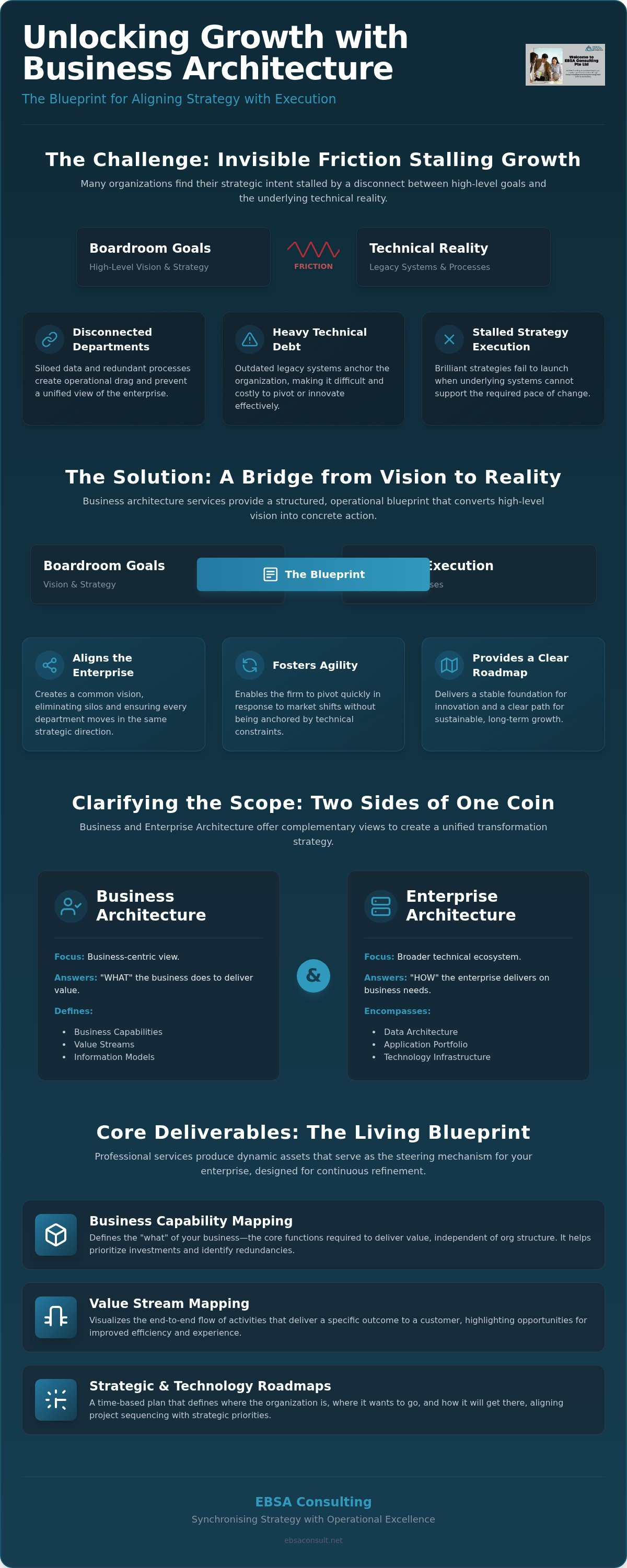
What if the primary obstacle to your company's growth isn't a lack of vision, but the invisible friction between your boardroom goals and your technical reality? It's a common challenge for maturing organizations to find their strategic intent stalled by disconnected departments and the heavy drag of technical debt. You've likely felt the frustration of watching a brilliant strategy lose momentum because the underlying systems simply can't support the pace of change.
Professional business architecture services act as the essential bridge in these moments, converting high level vision into a concrete, operational blueprint. We understand that achieving true enterprise alignment requires more than just new tools; it demands a methodical reshaping of how your business and IT units interact. By establishing a clear line of sight from strategy to execution, you can finally eliminate silos and accelerate your path toward operational excellence.
In this guide, we'll explore how a structured architectural approach provides a roadmap for sustainable transformation. You'll discover how synchronizing your internal structures leads to improved efficiency and a more resilient, growth oriented organization that's ready to scale with confidence.
Key Takeaways
- Understand how business architecture services function as the essential blueprint for synchronizing your organization's high level strategy with its technical infrastructure.
- Identify the core deliverables of a professional engagement and learn why these outputs must remain living documents to support ongoing evolution.
- Evaluate established frameworks like TOGAF and BIZBOK to determine which methodology best fits your organization's specific maturity level and goals.
- Gain a practical checklist for selecting a strategic partner who can bridge the gap between visionary leadership and complex technical constraints.
- Discover the benefits of a collaborative consulting model that focuses on sustainable growth and long term operational excellence.
What are Business Architecture Services?
Business architecture acts as the definitive blueprint of the enterprise, providing a unified understanding of how an organisation functions at its core. It's far more than a collection of process maps or organisational charts; it's a strategic framework that ensures every stakeholder, from executive leadership to technical teams, shares a common vision. Business architecture is the discipline that models the "what" and "how" of an enterprise to achieve its "why". By utilising professional business architecture services, companies can transition from a state of reactive IT support to one of proactive strategic planning. Instead of simply maintaining legacy systems, leaders can design an environment where IT infrastructure is perfectly synchronised with the broader business strategy.
This shift in perspective is vital for modern enterprises. When technology and business goals are treated as separate entities, the result is often a fragmented landscape of siloed data and redundant processes. Professional consultants act as strategic guides, helping you move beyond the "firefighting" mentality of traditional IT management. They focus on creating a stable foundation that supports innovation, ensuring that every technical investment is a direct contributor to your organisational objectives.
The Strategic Value of Architectural Alignment
Achieving alignment isn't just a theoretical exercise. It has tangible impacts on your bottom line. When business strategy and technical execution are out of sync, the result is operational waste and stalled innovation. A structured architectural approach accelerates time to market by removing the ambiguity that often plagues complex projects. This clarity fosters organisational agility, allowing your firm to pivot quickly in response to market shifts without being anchored by technical debt. By systematically addressing the friction caused by outdated legacy systems, business architecture services clear the path for sustainable, long term growth. It's about building a resilient structure that thrives on change rather than being disrupted by it.
Business vs. Enterprise Architecture: Clarifying the Scope
While these terms are often used interchangeably, they represent different but complementary lenses. Business architecture maintains a specific, business centric focus, mapping out capabilities, value streams, and the information required to deliver value to customers. It defines the "what" of the business. In contrast, enterprise architecture takes a broader view, encompassing data, applications, and technology across the entire organisation. It ensures the underlying technical ecosystem can actually deliver what the business architecture requires.
These disciplines work in tandem to create a unified transformation roadmap. This roadmap ensures that technical implementation never loses sight of business value, and business goals remain grounded in technical reality. This integrated approach is why strategic enterprise architecture consulting remains a critical pillar for organisations aiming for global scale and operational excellence. By bridging these gaps, you create a harmonious environment where every part of the enterprise moves in the same direction.
Core Deliverables of Professional Business Architecture Consulting
Professional business architecture services provide more than just advisory reports. They produce a suite of tangible, dynamic assets that serve as the steering mechanism for your enterprise. These deliverables aren't static documents destined for a shelf; they're living blueprints designed for continuous refinement as your market evolves. By working collaboratively with your internal teams, consultants ensure these maps reflect the ground reality of your operations while aligning with high level strategic goals. This collaborative approach empowers stakeholders to make data driven decisions with confidence, as they can finally see the direct impact of operational changes on the broader business vision.
Business Capability Mapping
Capability mapping defines the "what" of your business. It identifies the core functions required to deliver value, regardless of how those functions are currently performed or which department owns them. For a growth oriented enterprise, this might include mapping capabilities like "Omnichannel Customer Engagement" or "Predictive Supply Chain Management." By clarifying these foundational blocks, you can prioritize investments where they'll have the greatest strategic impact. It's about ensuring your capital and talent are directed toward the specific capabilities that drive your competitive advantage.
Value Stream Mapping and Information Architecture
While capabilities define what you do, value streams describe the end to end journey of how you deliver value to your customers. These maps highlight the flow of activities and the specific information required at each stage of the process. When paired with robust information architecture, you gain a clear view of how data moves through your organization. This visibility is essential for identifying operational bottlenecks and data silos that frequently slow down execution. Optimizing these flows is a core focus of business architecture services, as it turns abstract strategy into efficient, repeatable, and measurable processes.
Transitioning to Solution Architecture Design
The final critical deliverable is the methodical hand off from business blueprints to technical implementation. This is where business architecture meets Solution Architecture Design. By translating strategic requirements into actionable technical blueprints, you effectively de-risk the digital transformation process. This phase ensures that every new software deployment or infrastructure change directly supports a documented business objective. It prevents the common pitfall of implementing technology for technology's sake, keeping your transformation efforts grounded in measurable business value and long term operational excellence.
Evaluating Strategic Architectural Frameworks
Choosing an architectural framework is a foundational decision that dictates how your organization perceives and manages its own complexity. These frameworks aren't simple checklists; they are the scaffolding upon which your transformation is built. While popular models like TOGAF, Zachman, and BIZBOK offer rigorous structures, the most effective choice is always the one tailored to your organization's specific maturity level. A vendor neutral approach to framework selection is essential here. It ensures your strategic direction isn't dictated by the limitations or biases of a particular software suite. Strategic frameworks provide the necessary language for alignment, but professional consulting provides the essential translation required for business success.
The primary goal of utilizing business architecture services is to find a methodology that resonates with your corporate culture. A framework that's too rigid can stifle innovation in a fast moving startup, while one that's too loose might fail to provide the governance needed in a global enterprise. By evaluating these models through the lens of your unique operational hurdles, you can select a path that balances structured thinking with the need for speed and flexibility.
TOGAF and the Open Group Standards
TOGAF remains the most widely adopted industry standard for enterprise architecture. Developed by The Open Group, it provides a highly structured Architecture Development Method (ADM) that's ideal for large scale enterprise transformation. Its strength lies in its comprehensiveness and its ability to provide a common vocabulary across global teams. However, its rigorous nature can sometimes lead to "analysis paralysis" if not managed by experienced guides. Organizations often turn to TOGAF when they require a high degree of governance and a proven, repeatable process for managing complex technical ecosystems across multiple business units.
Bespoke Frameworks for Rapid Growth
Mid sized firms and rapidly scaling organizations often find that standard frameworks require too much overhead. In these scenarios, an agile, bespoke approach is more effective. We focus on adapting global standards to create "Realistic, Enabling, Actionable, and Logical" applications that fit your specific needs. This isn't about cutting corners; it's about focusing on the components of business architecture services that drive the most immediate value. By stripping away unnecessary bureaucracy and focusing on core capabilities, we help you build a resilient structure that accelerates growth without the friction of overly complex methodologies. This tailored approach ensures that your architectural journey remains grounded in operational reality while still being guided by proven, visionary principles.
Selecting the Right Business Architecture Partner
Choosing a partner for business architecture services is a high stakes decision that impacts your organization's long term structural health. Many firms in this space are actually software vendors in disguise, pushing specific SaaS tools as a cure-all for operational friction. A true strategic partner remains software neutral, focusing instead on the unique alignment between your business goals and technical reality. They should act as a bridge, understanding both the high level nuances of strategy and the granular constraints of technical implementation. This ensures your architectural roadmap is built on what your business actually needs, not what a specific software package is designed to do.
Key Criteria for Evaluating Architecture Consultants
Executives should prioritize partners with a proven track record in both business capability mapping and solution design. It's not enough to create abstract diagrams; the consultant must demonstrate an "Action-to-Result" pattern where every architectural decision leads to a measurable operational outcome. Communication is equally vital. Your partner must be able to translate complex technical blueprints into the language of value and risk for C-suite stakeholders. Look for a methodology that emphasizes clarity over jargon and results over activity. A successful engagement should feel like a steady, logical progression toward a more synchronized enterprise.
The Importance of a Collaborative Partnership Model
Architectural projects often fail when treated as a "distant vendor" transaction. You don't need someone to hand over a static report and walk away; you need a strategic guide who navigates the complexities of organizational change alongside you. This collaborative model ensures that your internal teams are upskilled during the process, leaving your organization more capable than it was before. It's about building a partnership that fosters confidence and stability throughout the transformation journey. By working as close collaborators, your consultants can better identify the cultural hurdles that often stall technical implementation.
Depending on your current organizational maturity, you might not require a permanent, full time resident architect. Many scaling firms find success with a fractional model, bringing in expert business architecture services to guide specific phases of growth or to provide steady, high level oversight without the overhead of a permanent executive hire. This flexibility allows you to access deep expertise exactly when your strategy requires it most. If you're ready to bridge the gap between your vision and execution, consider how partnering with a strategic architecture firm can accelerate your results and drive sustainable excellence.
EBSA Consulting: Synchronising Strategy with Operational Excellence
EBSA Consulting operates as the essential bridge between high level vision and operational reality. We focus on providing specialised business architecture services that empower organisations to move past the friction of siloed data and technical debt. Headquartered in Singapore with a national reach, our firm is dedicated to the discipline of pure consulting. We don't sell off the shelf software, nor do we provide managed IT support. This independence allows us to remain entirely objective, ensuring our recommendations are driven solely by your strategic needs and long term growth objectives. By maintaining this focus, we provide the stability and confidence required to manage even the most complex organisational transitions.
Our Approach to Business Architecture Services
Our methodology is built on a methodical, logical, and highly structured communication flow. We move intentionally from broad strategic concepts to specific operational focus areas, ensuring every phase of the process is absorbed and understood by your leadership team. This isn't about technical minutiae for its own sake; it's about reshaping and synchronising your enterprise to accelerate growth. We prioritise growth oriented outcomes through a series of intentional steps:
- Establishing a common organisational language through proven, strategic frameworks.
- Synchronising business capabilities with the underlying technical infrastructure.
- Accelerating time to market by removing structural bottlenecks and data silos.
- Reshaping legacy processes to support modern, agile operations and innovation.
Each section of our process builds upon the previous one, creating a narrative of continuous improvement. We believe that true operational excellence is achieved when every part of the organisation moves in harmony toward a shared goal.
Reshaping the Enterprise for the Future
We bring the personality of a visionary innovator grounded in proven methodologies. Complex organisational hurdles can be overwhelming, but we provide a calm, steady presence that reassures leadership that these challenges are manageable through structured thinking. Our collaborative partnership model means we're deeply invested in your journey, acting as a strategic guide rather than a distant vendor. We're here to help you navigate the path toward operational excellence, ensuring your organisation is resilient and ready for the future. By focusing on the "what" and "how" of your enterprise, we ensure you achieve your "why" with greater precision and less waste.
If you're ready to synchronise your strategy with execution, it's time to take the next step. Professional business architecture services provide the roadmap you need to turn strategic intent into sustainable results. Contact EBSA Consulting today to schedule a strategic consultation and discover how we can help you build a more aligned, efficient, and growth oriented enterprise.
Building a Resilient Foundation for Sustainable Growth
Achieving true enterprise alignment isn't a one-time project; it's an ongoing commitment to operational excellence and strategic clarity. By utilizing professional business architecture services, you can transform fragmented processes and siloed data into a synchronized engine for innovation. This structured approach ensures that your technical implementations always serve your high level strategic vision, effectively reducing technical debt while accelerating your time to market. It's about creating a common language across your organization that translates complex goals into actionable, technical blueprints.
EBSA Consulting provides the specialized expertise in Enterprise, Business, and Solution Architecture needed to navigate these complex organizational hurdles with confidence. Our deeply collaborative and partnership-driven mindset ensures that your internal teams are empowered and upskilled throughout the transformation journey. We focus entirely on strategic alignment and operational efficiency, remaining a neutral, expert guide in an often crowded marketplace. Contact EBSA Consulting for a Strategic Architecture Consultation and start reshaping your enterprise for a more stable and efficient future. Your path to operational harmony begins with a single, intentional step toward clarity.
Frequently Asked Questions
What is the difference between business architecture and business process management (BPM)?
Business architecture provides the high level blueprint of what the business does and how it aligns with strategy, while BPM focuses on the granular optimization of specific process flows. Think of architecture as the city map and BPM as the traffic management system for a specific intersection. Architecture ensures the right processes are built to support core business capabilities, while BPM ensures those processes run as efficiently as possible on a daily basis.
How much do business architecture services typically cost for a mid-sized enterprise?
Fees for professional consulting are typically based on the scope and complexity of the engagement rather than a fixed industry rate. Factors influencing the investment include the number of business units involved, the maturity of existing documentation, and the depth of solution design required. We recommend a discovery session to define a bespoke engagement model that aligns with your specific transformation goals, ensuring the project remains focused on delivering measurable strategic value.
How long does a typical business architecture engagement take to show ROI?
While long term structural benefits accumulate over years, initial ROI often becomes visible within three to six months through the identification of redundant systems and streamlined decision making. Early wins usually involve retiring underutilized software or resolving cross departmental friction. By establishing a clear roadmap early in the process, organizations avoid the wasted capital associated with misaligned technical projects, providing immediate value through improved resource allocation and strategic clarity.
Do I need specific software before hiring a business architecture consultant?
No, you don't need to purchase specific architectural software before engaging a consultant. In fact, selecting tools before defining your architectural requirements often leads to unnecessary technical debt. A strategic guide helps you identify the right frameworks first. Once your capabilities and value streams are mapped, you'll be in a much stronger position to evaluate which software tools, if any, actually support your long term operational needs and growth targets.
Can business architecture services help with mergers and acquisitions?
Yes, business architecture services are instrumental during M&A by providing a clear view of overlapping capabilities and redundant infrastructure between two entities. This structural clarity allows leadership to make informed decisions about which systems to integrate, migrate, or decommission. It reduces the risk of post merger friction and ensures that the combined organization achieves its intended synergies without losing operational momentum or creating new siloes during the integration phase.
What are the most common signs that my organisation needs business architecture services?
Frequent signs include persistent silos between business and IT units, difficulty executing strategic initiatives, and a growing list of legacy systems that slow down innovation. If your leadership struggles to see how technical projects contribute to the bottom line, or if departments are duplicating efforts, it's likely that your structural foundation needs realigning. A lack of clear line of sight from vision to execution remains the most telling indicator of structural misalignment.
How does business architecture help in reducing technical debt?
Professional business architecture services reduce technical debt by ensuring every new implementation is mapped to a specific business capability. This prevents the sprawl of disconnected applications that often occurs when departments buy software in isolation. By establishing a unified blueprint, you can systematically identify and retire legacy systems that no longer serve a strategic purpose. This creates a leaner and more agile technical ecosystem that supports innovation rather than hindering it.
Is business architecture only for large corporations?
While large enterprises face significant scale related complexity, mid sized firms and rapidly growing startups benefit immensely from structured thinking. Establishing an architectural foundation early prevents the chaotic growth that leads to expensive technical debt later. For smaller organizations, the focus is often on agility and ensuring that limited resources are funneled into the specific capabilities that drive the most competitive advantage. It is about building right from the start to scale effectively.


