
What if the very tools you purchased to accelerate your business are actually the primary anchors holding your growth back? Most enterprise leaders recognize the friction caused by redundant software costs and data silos, yet implementing a successful technology stack consolidation strategy often feels blocked by departmental resistance and legacy complexity. You've likely felt the weight of maintaining disconnected platforms that don't talk to each other, creating a drain on both your budget and your team's productivity. It's a frustrating reality where technical debt quietly erodes the agility you need to compete.
This article outlines a robust framework built for the unique demands of the 2026 business environment. By shifting from reactive cost-cutting to a proactive architectural realignment, you'll learn how to synchronize your infrastructure with your overarching business objectives. We'll explore a methodical approach to lower your total cost of ownership, resolve technical debt, and build a scalable blueprint that ensures long-term data integrity. We'll walk through the process of transforming a fragmented landscape into a unified, high-performance engine for growth, ensuring your technical foundations are prepared for the next wave of innovation.
Key Takeaways
- Shift your perspective from simple cost-cutting to a holistic architectural alignment that synchronizes your technical infrastructure with core business capabilities.
- Discover how to build a resilient technology stack consolidation strategy by conducting a comprehensive inventory and mapping functional redundancies across the enterprise.
- Evaluate the critical trade-offs between integrated platforms and specialized tools to design a target-state architecture that supports long-term scalability and growth.
- Learn execution techniques that prioritize phased migrations and data integrity, ensuring your transformation occurs without significant operational disruption.
- Understand the importance of vendor-neutral architectural consulting in overcoming departmental silos and maintaining an objective focus throughout the consolidation journey.
The Strategic Imperative for Technology Stack Consolidation
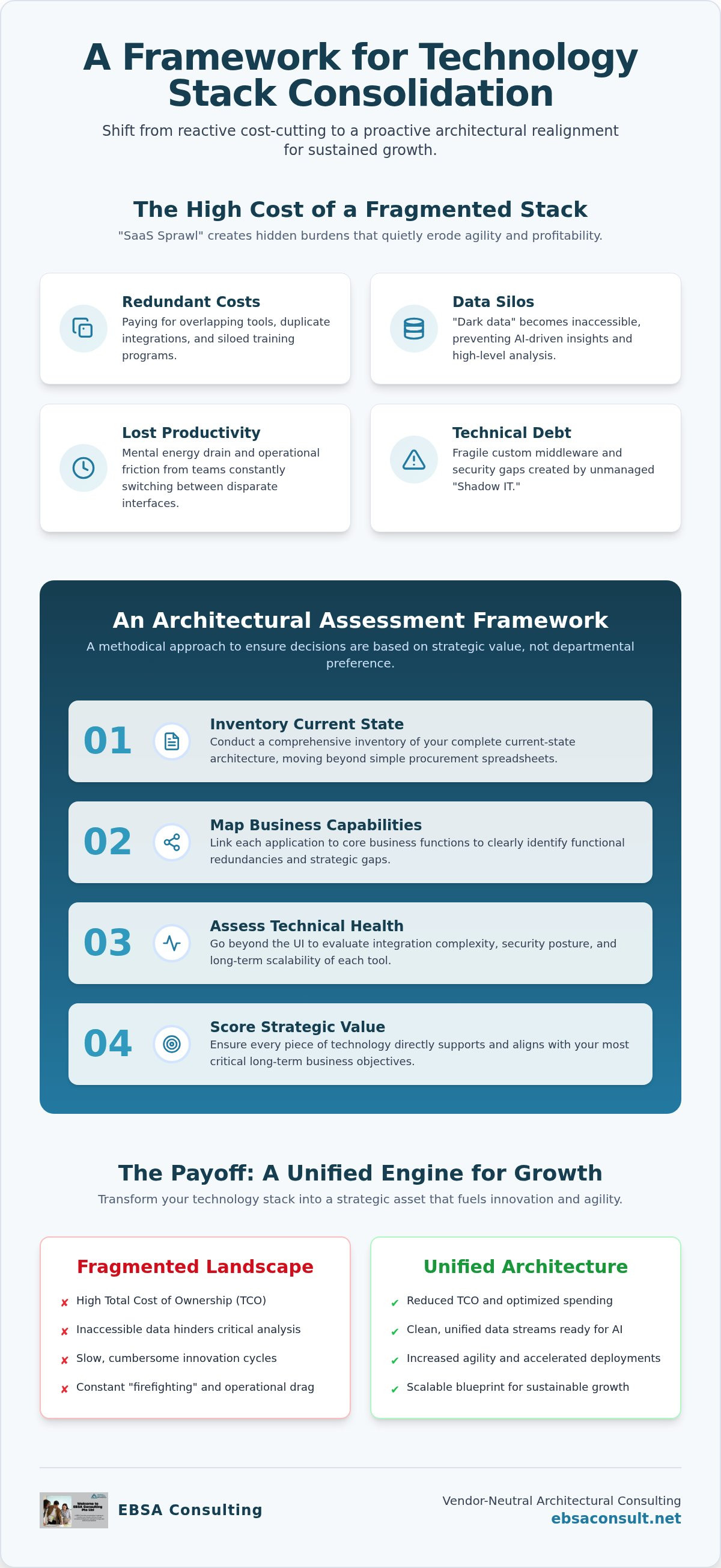
The 2026 enterprise landscape is defined by an explosion of specialized tools. While these were meant to empower teams, they've often led to "SaaS sprawl," a condition that quietly suffocates organizational agility. A robust technology stack consolidation strategy is no longer just a financial preference; it's a structural necessity. When your infrastructure is fragmented, every new initiative requires navigating a labyrinth of disconnected systems. This complexity slows down deployment cycles and creates a barrier to innovation that competitors with leaner, more integrated stacks simply don't face.
Beyond the obvious monthly subscription fees, technical debt carries heavy hidden burdens. You're likely paying for redundant integrations, specialized training for overlapping tools, and the mental energy spent by employees switching between disparate interfaces. This fragmentation also creates "dark data" that remains inaccessible for high-level analysis. If your data is trapped in silos, your organization isn't ready for the AI-driven requirements of 2026. Artificial intelligence requires clean, unified data streams to provide value; a fractured stack prevents this synchronization.
The Anatomy of Technical Debt in Fragmented Stacks
Fragmented stacks are often the byproduct of "Shadow IT," where departments procure tools without centralized oversight. This creates significant security vulnerabilities and governance gaps. Maintaining custom middleware to force these systems to communicate is expensive and fragile. By focusing on reducing technical debt with enterprise architecture, you can replace these patchwork solutions with a cohesive framework. This transition reduces the operational overhead required to simply keep the lights on, allowing your team to focus on value-added projects.
Business and IT Alignment: The Core Objective
Successful consolidation must be rooted in business outcomes rather than just IT budget reductions. It's about ensuring every piece of software serves a specific business capability. Utilizing business architecture services helps identify which functions are critical and which are redundant. In this journey, the architect acts as a strategic guide, serving as the essential bridge that translates high-level business vision into a stable, executable technical roadmap. This alignment ensures that your technology stack consolidation strategy actually supports the way your company operates and grows.
An Architectural Framework for Technology Stack Assessment
Successful consolidation begins by moving beyond procurement spreadsheets. Many organizations treat this process as a simple exercise in spend management, but a truly resilient technology stack consolidation strategy requires a deep architectural audit. You must view the enterprise as a series of interconnected capabilities rather than a collection of software licenses. This framework involves four critical steps: documenting your current-state architecture, mapping business capabilities, assessing technical health, and scoring strategic value. This methodical approach ensures you don't accidentally remove a low-cost tool that serves a mission-critical function.
Utilizing Business Capability Mapping
Business capabilities represent what your organization does to generate value. They remain stable even as specific tools and processes evolve. By mapping your existing software to these capabilities, you can clearly see functional redundancies. For example, you might discover three different departments using three separate project management tools for the same core capability. Conversely, this mapping reveals "orphaned" capabilities, which are strategic areas where your current stack provides no support at all. This clarity allows you to make decisions based on organizational needs rather than departmental preferences. If you're struggling to visualize these connections, engaging with a strategic guide can help illuminate the path forward.
The Technical Audit: Beyond the User Interface
A tool might look great to the end-user but create a nightmare for your integration team. Your audit must evaluate API maturity and the flexibility of the vendor's integration ecosystem. If a platform uses a proprietary data model that's incompatible with your primary systems, it's a candidate for replacement regardless of its feature set. This evaluation ensures your infrastructure remains agile and ready for future expansion. Utilizing a structured enterprise architecture framework for scalability informs this audit by providing a benchmark for performance and security standards. By looking under the hood, you ensure that the tools you keep are technically sound and capable of supporting a unified data strategy across the entire enterprise.
Developing the Consolidation Roadmap: Tools vs. Capabilities
Building a roadmap is the phase where your assessment data transforms into a tangible plan of action. A successful technology stack consolidation strategy requires balancing the immediate need for cost reduction with the long-term requirement for operational flexibility. In 2026, the traditional debate between "Best-of-Breed" and "All-in-One" platforms has evolved into a focus on ecosystem compatibility. It's no longer about finding one tool that does everything; it's about selecting core platforms that act as stable anchors for your specialized services while ensuring seamless data flow across the enterprise.
Prioritizing the decommissioning sequence is a delicate balancing act that requires a deep understanding of system dependencies. You don't want to retire a legacy application that still supports a mission-critical revenue stream before its replacement is fully vetted and integrated. This is exactly why the role of enterprise architect in legacy modernization is so vital. They provide the high-level oversight needed to sequence these transitions, ensuring they minimize operational risk while maximizing the overall speed of your digital transformation.
Criteria for the "Keep, Retire, or Replace" Decision
Deciding the fate of each tool in your inventory requires a multi-dimensional lens that goes beyond simple usage metrics. You must evaluate each asset based on three primary pillars. First, consider the Strategic Fit: does the tool align with your future-state blueprint or is it a relic of an outdated workflow? Second, assess Economic Viability by calculating the total ROI of migrating data versus the ongoing maintenance of the existing system. Finally, verify Technical Integrity to determine if the tool is a "dead end" with limited vendor support or a solid foundation for future innovation. This structured thinking prevents emotional attachments to legacy tools from clouding your strategic judgment.
Designing the Target-State Blueprint
Your target-state blueprint serves as the definitive north star for all future technical acquisitions and integrations. By utilizing a structured solution architecture design process, you can effectively bridge the gap between your current reality and a streamlined future. This design process ensures that every remaining tool contributes to organizational agility rather than creating new silos. Developing a vendor-neutral blueprint is essential because it protects your organization from becoming locked into a single provider's ecosystem, ensuring your stack remains adaptable as market conditions and business objectives shift. This architectural clarity allows you to scale with confidence, knowing your infrastructure is built for purpose rather than convenience.
Executing Consolidation Without Operational Disruption
Execution is the pivot point where a technology stack consolidation strategy moves from a theoretical blueprint to an operational reality. The most significant risk during this phase is the "Big Bang" approach, where organizations attempt to switch multiple systems simultaneously. This often leads to catastrophic downtime and data loss. Instead, successful enterprises adopt a phased migration, orchestrating transitions in manageable waves that allow for validation at every step. This methodical pace safeguards your data integrity, ensuring that as you retire legacy systems, your enterprise's most valuable asset remains accurate and accessible within the new architecture.
Managing the human element is just as critical as the technical transition. Departments often feel a sense of ownership over specific tools, and removing them can trigger significant internal resistance. Clear stakeholder engagement and a transparent change management process are essential to demonstrate how the new, streamlined stack actually simplifies their workflows. By focusing on the positive outcomes of transformation, you turn potential detractors into partners in the consolidation journey. It's about building a culture that values operational excellence over individual tool preference.
Risk Mitigation in Technical Architecture
Operational stability depends on rigorous risk mitigation throughout the transition period. Developing fallback plans and executing pilot phases for critical systems allows your team to identify unforeseen integration dependencies before a full-scale rollout. This is where enterprise architecture consulting provides essential oversight, helping you navigate complex dependencies and maintain continuity. If you're ready to secure your infrastructure against disruption, partner with an expert guide to oversee your execution roadmap. These safeguards ensure that your consolidation efforts don't compromise the very agility you're trying to build.
Establishing IT Governance for the New Stack
Consolidation isn't a one-time event; it's a continuous state of discipline. To prevent "Sprawl 2.0," you must establish robust IT governance gates that evaluate every new software request against your target-state blueprint. An Architecture Review Board (ARB) plays a central role here, ensuring that any addition to the stack aligns with long-term strategic goals rather than short-term convenience. Success metrics should move beyond simple cost savings to include improvements in data integrity, integration speed, and total cost of ownership. This governance framework ensures your technology stack consolidation strategy remains effective as your business continues to evolve and scale in the years ahead.
Partnering for Architectural Excellence and Long-Term Value
Internal teams often face an uphill battle when attempting to execute an objective technology stack consolidation strategy. It's difficult to remain neutral when specific tools are deeply ingrained in departmental workflows or tied to individual expertise. This internal bias often leads to compromises that preserve legacy systems at the expense of enterprise-wide efficiency. A strategic partner provides the necessary distance to evaluate your infrastructure through a purely functional lens, ensuring every decision serves the broader business architecture rather than localized preferences. This objectivity is the cornerstone of a stack that truly supports the enterprise.
The value of vendor-neutral enterprise architecture consulting lies in its focus on outcomes rather than product sales. Many consulting firms are incentivized by software commissions, which can subtly skew their recommendations toward specific platforms. EBSA Consulting operates with a different mindset. By remaining independent of software vendors, we ensure that our architectural advice is purely driven by your operational needs and strategic goals. This approach bridges the gap between your high-level vision and the technical infrastructure required to achieve it.
The EBSA Approach: Strategic, Collaborative, Authority-Driven
Our methodology centers on transforming complex business requirements into robust, executable technical blueprints. We don't just look at the code; we analyze how your architecture enables or inhibits your business capabilities. This collaborative process ensures that technical implementations meet business goals with precision. Because we don't sell off-the-shelf software or offer managed IT support, our commitment remains entirely focused on your operational excellence. We act as your strategic guide, providing the steady hand needed to navigate organizational hurdles and technical debt during the consolidation journey.
Reshaping Your Organization for 2026 and Beyond
Looking toward 2026, the enterprises that thrive will be those that have transitioned from managing tools to orchestrating a unified innovation engine. A synchronized architecture provides the agility required to pivot in response to market shifts without the anchor of technical debt. This shift allows your leadership to stop worrying about maintenance and start prioritizing scalable growth. Initiating a health check for your technology stack is the first step toward this future state. If you're ready to build a clean, scalable technical foundation, Schedule a consultation to refine your technology stack strategy and begin your transformation today.
Reshaping Your Technical Foundation for Sustainable Growth
A successful technology stack consolidation strategy is more than a cost-saving measure; it's a fundamental realignment of your enterprise's technical DNA. By moving away from SaaS sprawl and toward a capability-based architecture, you create the agility needed to lead in an increasingly complex market. We've explored how structured assessments and phased execution protect your operational continuity while systematically reducing technical debt. This journey requires a clear vision and a steady hand to ensure that every tool in your inventory serves a specific business purpose.
As a Singapore-based strategic advisory, EBSA Consulting provides the professional Enterprise, Business, and Solution Architecture expertise required to bridge the gap between high-level vision and technical reality. Our vendor-neutral approach ensures your roadmap is built on objective value and long-term scalability. If you're ready to transform your infrastructure into a streamlined engine for innovation, Contact EBSA Consulting for a Strategic Architecture Assessment. Together, we can build a resilient framework that empowers your organization to thrive in 2026 and beyond.
Frequently Asked Questions
What is a technology stack consolidation strategy?
A technology stack consolidation strategy is a structured architectural approach designed to reduce software redundancies and align IT infrastructure with core business objectives. It moves beyond simple cost-cutting by evaluating tools based on their contribution to specific organizational functions. This process helps enterprises eliminate silos, lower total cost of ownership, and ensure that every platform in the stack provides measurable value while supporting long-term scalability and operational agility.
How long does a typical enterprise stack consolidation take?
Most enterprise-level consolidation initiatives take between 6 and 18 months to complete. The timeline varies based on the size of the software inventory and the complexity of existing integrations. A typical project begins with a 4 to 8 week assessment phase to map the current state. This is followed by a phased execution roadmap that prioritizes low-risk, high-value retirements first to build momentum without disrupting mission-critical business processes.
What are the biggest risks during technology consolidation?
The primary risks include data integrity loss, unforeseen system dependencies, and significant operational downtime. Many organizations face challenges when they attempt a "Big Bang" migration instead of a phased approach. If you don't fully understand how legacy systems interact, retiring one tool can break several others. Failing to account for user adoption and change management can also lead to departmental friction that stalls the entire transformation journey and erodes project ROI.
How do I identify redundant software in a large organization?
Identifying redundancy requires a shift from tracking licenses to mapping business capabilities. You should document every software tool and link it to the specific organizational function it supports. When you find multiple platforms serving the same capability, such as three different project management tools for three departments, you've identified a consolidation opportunity. This objective analysis helps you distinguish between tools that are essential for growth and those that simply add unnecessary complexity.
Can consolidation actually increase technical debt if done incorrectly?
Yes, consolidation can inadvertently increase technical debt if you prioritize short-term cost savings over long-term architectural integrity. Choosing a "one-size-fits-all" platform that lacks necessary API flexibility or forcing incompatible systems together through fragile custom middleware creates a rigid infrastructure. This "Sprawl 2.0" makes future updates difficult and expensive. A successful technology stack consolidation strategy must focus on building a clean, scalable foundation that remains adaptable as your business requirements evolve.
What role does an Enterprise Architect play in stack consolidation?
The Enterprise Architect serves as the strategic guide and the essential bridge between high-level business vision and technical implementation. They're responsible for creating the target-state blueprint and ensuring that all consolidation efforts align with the organization's long-term goals. By providing an objective, vendor-neutral perspective, they help navigate complex technical dependencies and oversee the integration design. Their expertise ensures the new stack is robust, secure, and capable of supporting future innovation.
How do I manage resistance from departments whose tools are being retired?
Managing resistance requires transparent communication and a focus on the positive outcomes of the transformation. You should involve departmental stakeholders early in the assessment process to understand their specific needs and pain points. Demonstrate how the consolidated stack reduces their manual workload, improves data integrity, and provides better support for their core tasks. When teams see that the change is designed to enhance their productivity rather than just cut costs, they're more likely to support it.


