

What if your technology infrastructure was designed to accelerate growth rather than act as its primary bottleneck? For many leaders in Singapore, the reality is often the opposite. As businesses strive to capture new market opportunities, they frequently encounter a mounting wall of technical debt that slows product releases and creates friction between departments. You likely recognize the strain of siloed systems that refuse to communicate during a critical expansion phase.
It's a common challenge, but it isn't an inevitable one. Implementing a robust enterprise architecture framework for scalability allows you to bridge the gap between high-level business vision and complex technical requirements. By focusing on modularity and strategic alignment, you can systematically eliminate technical debt while reducing long-term maintenance costs. This article provides a comprehensive 2026 strategic checklist to help you design a roadmap for sustainable growth. We'll examine how to synchronize your business capabilities with modern architectural blueprints to ensure your organization remains agile, efficient, and ready for what's next.
Key Takeaways
- Learn why rapid expansion often leads to "accidental architecture" and how you can proactively design systems that eliminate technical debt.
- Identify the four critical layers of a modern enterprise architecture framework for scalability to keep your business and IT goals in perfect harmony.
- Evaluate the strengths of TOGAF and the Zachman Framework within a 2026 context to select the right methodology for your unique organizational structure.
- Utilize a comprehensive checklist to assess your current technical and strategic readiness for modular, long-term growth in the Singapore market.
- Discover how strategic architectural consulting transforms theoretical blueprints into high-level operational excellence and sustained organizational agility.
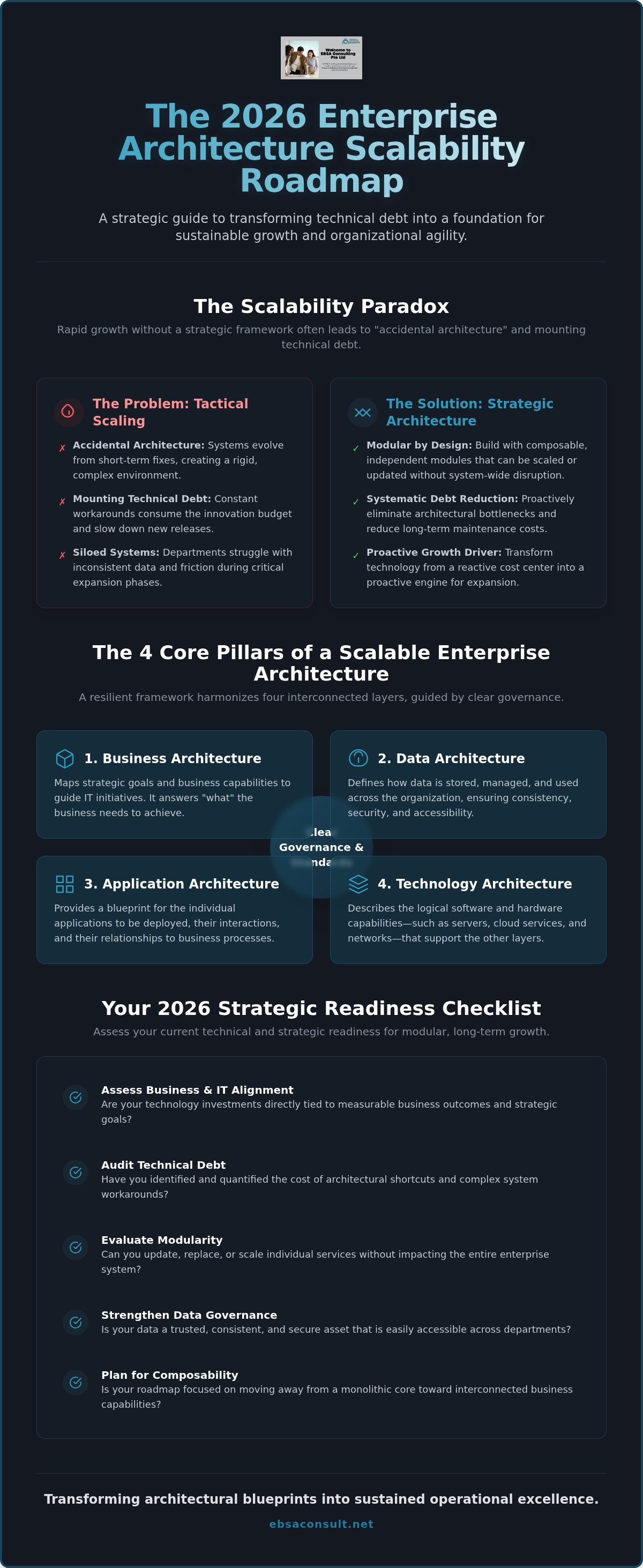
The Scalability Paradox: Why Growth Often Leads to Technical Debt
Growth is rarely a linear journey. As Singaporean enterprises expand to meet new market demands, they often prioritize immediate speed over long-term structure. This creates a friction point where rapid scaling erodes the underlying system integrity. This erosion leads to "accidental architecture," where technical decisions are made in silos to solve urgent problems without considering the broader roadmap. Over time, these quick fixes accumulate, creating a rigid environment that actually prevents the organization from pivoting when it matters most.
The "move fast and break things" philosophy might offer temporary gains for early-stage startups, but it's a significant liability at the enterprise level. For established organizations, breaking things means breaking customer trust and operational stability. Instead, a focus on reducing technical debt with enterprise architecture ensures that speed is sustainable. A well-defined enterprise architecture framework for scalability provides the necessary guardrails to grow without collapsing under the weight of past shortcuts. It transforms technology from a reactive cost center into a proactive driver of expansion.
The Hidden Costs of Tactical Scaling
Tactical scaling often feels like success in the short term. However, the early warning signs of architectural strain quickly emerge. You might notice that simple updates take weeks instead of days, or that data becomes inconsistent as it moves between departments. Technical debt isn't just a metaphor; it functions like high-interest financial debt. If you don't pay it down, the interest payments, in the form of constant maintenance and complex workarounds, eventually consume your entire innovation budget. Enlisting specialized engineering teams like The Code Factory for production readiness reviews and code remediation can help clear this technical debt before it halts momentum. In the Singapore market, where operational efficiency is a competitive necessity, fragmented systems stop being a minor nuisance and become a significant strategic risk that hinders cross-functional collaboration.
Modular Architecture as the Antidote
The solution lies in embracing modularity as a foundational principle. By 2026 standards, an effective enterprise architecture framework must move away from monolithic, rigid structures toward composable business capabilities. This approach treats your organization as a series of interconnected but independent modules. When you need to scale a specific function, such as a new payment gateway or a customer service portal, you can do so without re-engineering the entire enterprise. This modularity allows for targeted investments and ensures your enterprise architecture framework for scalability remains resilient as market conditions shift. It empowers your team to deploy new features with confidence, knowing the foundation is built to handle the load.
Core Pillars of an Enterprise Architecture Framework for Scalability
Scalability is often misidentified as a purely technical challenge centered on server capacity or cloud elasticity. In reality, a resilient enterprise architecture framework for scalability must address four distinct but interconnected layers: Business, Data, Application, and Technology. While the technology layer handles raw processing power, the business layer determines which organizational capabilities actually require expansion. Without this alignment, organizations risk over-engineering systems that don't drive value or under-provisioning critical growth engines.
Establishing clear governance standards is essential to ensure these layers work in harmony. These standards shouldn't be restrictive; instead, they should provide a "North Star" vision that guides every technical implementation. When evaluating popular enterprise architecture frameworks, the focus should remain on how they enable rapid, decentralized decision-making while maintaining enterprise-wide consistency. This structural harmony ensures that as you add new applications or data streams, the integrity of the whole remains intact. If you're looking to synchronize your current infrastructure with your growth goals, an architecture health check can provide the necessary starting point.
Business Capability Mapping as a Growth Engine
Effective scaling begins with understanding what your business actually does. Through business architecture services, you can create capability maps that highlight high-growth areas. These maps link your business processes directly to scalable technical services, ensuring your organization is architected for change at its core. By identifying which capabilities are "differentiators" versus "commodities," you can allocate resources to the areas that provide the most significant competitive advantage in Singapore's fast-paced economy. This mapping ensures that technology investments are always tied to measurable business outcomes.
Solution Architecture: Building the Technical Blueprints
Once the business capabilities are defined, they must be translated into actionable technical plans. This is where solution architecture design plays a pivotal role in executing the broader framework. Solution Architecture acts as the bridge between enterprise vision and technical execution. By designing for interoperability through standard APIs and robust middleware, you ensure that new systems can integrate seamlessly with existing infrastructure. This approach allows for a "plug-and-play" environment where scaling a specific application doesn't require a complete overhaul of the underlying technology stack. It creates a flexible foundation that supports rapid deployment without compromising the stability of the enterprise.
Evaluating Frameworks: TOGAF, Zachman, and Agile EA for Scale
Selecting an enterprise architecture framework for scalability isn't about finding a one size fits all solution. It's about identifying a methodology that matches your organizational maturity while providing the flexibility to pivot. As of late 2026, the landscape has shifted toward modular and hybrid approaches. Traditional frameworks have evolved to meet the demands of rapid digital transformation, ensuring that governance doesn't become a barrier to innovation. Most successful Singaporean enterprises now use a combination of structured processes and agile delivery to maintain their competitive edge.
The TOGAF Standard, 10th Edition, currently leads the market with approximately 46% share. Its modular structure, which separates fundamental content from specific series guides, makes it far more adaptable for modern scaling than its predecessors. While TOGAF provides the process, the Zachman Framework 3.0 offers a vital 360 degree classification model. It ensures that every stakeholder perspective, from the executive office to the server room, is accounted for. This prevents gaps in the architectural vision that often lead to costly rework during expansion phases.
Modernizing TOGAF for 2026 Agility
To remain effective, the Architecture Development Method (ADM) must be streamlined for shorter, iterative cycles. This "Just in Time" approach allows you to deliver architectural guidance at the speed of your development teams. A key focus in 2026 is the use of Architecture Contracts to ensure third party vendors remain aligned with your scaling goals. This is particularly critical in the role of the enterprise architect in legacy modernization, where bridge building between old systems and new cloud native standards is essential for sustained growth.
The Rise of Composable Enterprise Architecture
We've seen a significant move toward "Lego block" architectural styles. Composable architecture relies on microservices and event driven designs to facilitate massive scaling without creating a tangled web of dependencies. This decentralised approach empowers individual teams to innovate rapidly. However, it requires a strong enterprise architecture framework for scalability to provide centralised oversight. Without this balance, decentralisation can lead to fragmented data and inconsistent security standards. By 2026, the focus has shifted to managing value streams rather than discrete projects, ensuring every technical update contributes directly to a business outcome.
The 2026 Scalability Checklist: Building Your Foundation
Moving from theoretical framework selection to operational reality requires a structured assessment of your current state. A successful enterprise architecture framework for scalability serves as a living foundation rather than a static document. To ensure your growth remains sustainable and efficient, you must evaluate your readiness across both technical and strategic dimensions. This checklist provides a roadmap for Singaporean leaders to identify gaps before they become expensive obstacles during expansion.
Regularly revisiting these pillars ensures your architecture evolves alongside your business goals. It's not enough to design for today's load; you must anticipate the complexities of tomorrow's integrated ecosystems. By maintaining a disciplined approach to these readiness factors, you position your organization to capture new opportunities with minimal friction. To begin this journey with clarity, you can schedule an Architecture Health Check to pinpoint exactly where your current infrastructure needs reinforcement.
Technical and Infrastructure Readiness
Your technical foundation must be resilient enough to handle rapid shifts in demand. In 2026, this means moving beyond basic cloud migration toward true cloud native maturity. Systems should be cloud agnostic, allowing you to scale across providers without facing vendor lock in. A robust API strategy is also non negotiable. You need a documented, versioned, and secure API layer that facilitates seamless communication between modular components. Additionally, your architecture must guarantee data consistency and integrity, even as transaction volumes surge across distributed systems. Before implementing a new scaling framework, you must conduct a thorough audit of your existing technical debt. This proactive step is essential for scaling tech without technical debt and ensuring long term stability.
Organizational and Strategic Alignment
Technical readiness is only half the battle; your organizational structure must also support a scalable enterprise architecture framework for scalability. This begins with deep stakeholder buy in. Business leaders must view architectural constraints not as hurdles, but as strategic enablers that protect the company's future agility. Simultaneously, a skill gap analysis helps determine if your current team possesses the expertise required to manage modern, composable systems. Finally, look for opportunities in governance automation. By automating compliance and standards checks, you can maintain high quality without slowing down your delivery cycles. This alignment ensures that your technology and business teams move in lockstep toward shared growth objectives.
Partnering for Success: How EBSA Consulting Synchronizes Growth
Transitioning from a theoretical enterprise architecture framework for scalability to a high performing operational reality requires more than just technical documentation. It demands a partner who understands the intricate balance between organizational culture and system architecture. EBSA Consulting serves as this essential bridge for Singaporean enterprises, moving beyond generic advice to deliver strategic enterprise architecture consulting that reshapes infrastructure for long term resilience. We don't just hand over a manual; we synchronize your growth trajectory with a stabilized, modular technical foundation.
Our methodology focuses on the practical application of proven standards like TOGAF and Zachman, tailored to the specific regulatory and economic conditions of the Singapore market. We help you move from a state of reactive maintenance to one of proactive innovation. By aligning your technology stack with your business strategy, we ensure that every dollar spent on infrastructure contributes directly to your ability to scale. This partnership approach fosters stability and confidence, allowing your leadership team to focus on expansion while we manage the underlying architectural complexity.
The Enterprise Architecture Health Check
The first step toward sustainable expansion is understanding your current baseline. During a professional architectural audit, our team examines your existing systems to identify 'low hanging fruit', which are immediate opportunities to reduce technical debt and improve system interoperability. This assessment isn't a one time event but the starting point for a multi year roadmap. We help you prioritize investments that offer the highest ROI while systematically removing the bottlenecks that slow down your product releases. This structured approach ensures that your enterprise architecture framework for scalability remains robust as your transaction volumes grow.
Aligning Vision with Infrastructure
A technical blueprint is only as valuable as the business results it enables. We work as a visionary partner to ensure your infrastructure directly supports your specific business objectives, whether that's entering new regional markets or launching a composable digital service. Our collaborative approach involves deep engagement with your leadership team to translate high level vision into actionable technical requirements. We believe that true operational excellence is achieved when IT capacity and business growth goals are in perfect harmony. If you're ready to move from assessment to full architectural transformation, contact EBSA Consulting to begin your journey toward a more agile and scalable enterprise.
Building a Resilient Path for Sustainable Expansion
Designing a robust enterprise architecture framework for scalability is a strategic investment that pays dividends through improved agility and reduced maintenance costs. By shifting from a reactive "break and fix" mentality to a proactive, modular design, you ensure that your technology infrastructure accelerates growth instead of hindering it. Success in 2026 requires a deep alignment between your business capabilities and your technical blueprints, supported by a disciplined readiness checklist. This structured thinking allows you to systematically eliminate technical debt while maintaining the speed your market demands.
At EBSA Consulting, we specialize in helping organizations bridge this gap. Our team brings deep expertise in Singaporean enterprise standards, focusing entirely on strategic alignment rather than software sales. We operate as a collaborative partner, working alongside your leadership to transform theoretical frameworks into operational excellence. Whether you're addressing legacy debt or preparing for rapid expansion, we provide the steady guidance needed to navigate complex transitions. Our partnership-driven model ensures your vision remains the priority throughout the transformation process.
Reshape your infrastructure for growth with EBSA Consulting and build the foundation your vision deserves. The path to a more efficient, scalable future starts with a single strategic step toward alignment.
Frequently Asked Questions
What is the best enterprise architecture framework for a high-growth startup?
A hybrid, modular approach is typically the most effective choice for high-growth startups. While the TOGAF Standard 10th Edition provides a modular foundation, many startups prefer an Agile EA model that emphasizes iterative growth. This allows you to build only what's necessary for the current phase while maintaining a long-term vision. It's about balancing speed with enough structure to avoid the accidental architecture that often plagues rapid expansion.
How does enterprise architecture help in reducing existing technical debt?
Enterprise architecture serves as a strategic diagnostic tool for identifying and resolving legacy inefficiencies. By mapping system dependencies and data flows, you can pinpoint redundant applications and outdated middleware that contribute to your debt. This visibility allows for a prioritized decommissioning plan. Instead of reactive patching, you implement a structured enterprise architecture framework for scalability that replaces fragile workarounds with modular, sustainable components that lower long-term maintenance costs.
Can we implement an architecture framework while remaining agile?
You can absolutely maintain agility while utilizing a formal framework. Modern architectural practices focus on creating guardrails rather than rigid rules. By establishing a North Star vision and standardized APIs, you empower decentralized teams to innovate within a secure, interoperable environment. This decentralization actually increases speed because teams spend less time resolving integration conflicts. The framework provides the stability required for teams to move fast without breaking core enterprise functions.
What is the difference between solution architecture and enterprise architecture in scaling?
Enterprise architecture focuses on the high-level strategy and alignment of the entire organization's technology landscape. It defines the standards and roadmaps for the whole business. In contrast, solution architecture design focuses on the specific technical blueprints for a particular project or product. While EA provides the overarching enterprise architecture framework for scalability, solution architecture ensures that individual implementations meet those enterprise standards while solving immediate functional requirements.
How often should an enterprise architecture framework be reviewed for scalability?
You should treat your architectural framework as a living entity that requires continuous adjustment. While minor refinements happen during every development cycle, a comprehensive strategic review is recommended at least once a year. Additionally, you should trigger a formal audit during significant organizational shifts, such as entering a new regional market or a major merger. Regular reviews ensure your infrastructure remains aligned with evolving business goals and current 2026 technological standards.
What are the risks of scaling tech without a formal architectural framework?
Scaling without a structured framework often leads to fragmented systems and inconsistent data silos. Without centralized oversight, departments frequently procure overlapping tools, leading to wasted expenditure and increased security vulnerabilities. This lack of coordination creates a rigid environment where simple updates become complex, high-risk operations. Eventually, the weight of this accidental architecture slows down your product release cycles, making it impossible to respond effectively to new competitive pressures in the Singapore market.
How does business capability mapping influence technical scalability?
Business capability mapping identifies the specific organizational functions that drive your competitive advantage. By understanding which capabilities are critical for growth, you can prioritize technical scaling where it delivers the most impact. This ensures that your technology investments aren't just expanding capacity for the sake of it. Instead, you're building targeted, scalable services that directly support your business objectives, creating a lean and highly efficient infrastructure that grows in lockstep with your revenue.


