

When maintenance costs consume 80% of your IT budget, your organization isn't just standing still; it's falling behind. You likely feel the weight of legacy systems every time a simple feature update takes months instead of weeks. It's a common frustration for leaders who want to innovate but find themselves trapped by the "interest" on past technical shortcuts. You know that simply throwing more developers at the problem won't fix the underlying structural issues that hamper your growth.
We believe that technical debt is fundamentally a business alignment challenge rather than just a series of coding errors. By leveraging enterprise architecture for technical debt reduction, you can transform these hidden liabilities into a clear, actionable roadmap for modernization. This article explores how a structured architectural framework helps you identify high-risk assets and prioritize investments based on actual business value. We'll show you how to synchronize your IT landscape with your strategic vision, ensuring every dollar spent moves you closer to operational excellence and organizational agility. From conducting an initial health check to establishing data-driven investment priorities, you'll learn how to bridge the gap between complex technical requirements and high-level business goals.
Key Takeaways
- Understand how cumulative technical debt acts as a barrier to innovation and how structured thinking provides the clarity needed to regain organizational agility.
- Learn to identify which specific business functions are most hindered by legacy systems through the strategic lens of business capability mapping.
- Discover how to apply the "TIME" model, which categorizes assets to Tolerate, Invest, Migrate, or Eliminate, to make objective and data-driven decisions about your application portfolio.
- Implement a systematic 5-step roadmap that leverages enterprise architecture for technical debt reduction to synchronize IT assets with your strategic vision.
- Recognize the value of a neutral, strategic partner in navigating complex organizational hurdles and ensuring long-term operational excellence.
Understanding Technical Debt Through the Lens of Enterprise Architecture
Many leadership teams mistakenly view technical debt as a purely developer-centric issue. In 2026, we define it more broadly: it's the cumulative cost of sub-optimal architectural decisions that restrict future choices and inflate operational overhead. If you've ever asked What is Technical Debt?, it's helpful to see it as a financial metaphor where shortcuts taken today create a high-interest burden for tomorrow. This burden is the silent killer of organizational agility, siphons off talent, and consumes budgets that should be earmarked for innovation.
The primary challenge is visibility. Without a holistic view, debt remains hidden in silos until it causes a systemic failure. Utilizing enterprise architecture for technical debt reduction allows you to move beyond reactive bug-fixing. It facilitates a shift toward proactive asset optimization. Instead of simply patching holes, you begin to treat your technology stack as a strategic portfolio that must stay synchronized with your business vision.
The Three Tiers of Debt: Technical, Architectural, and Strategic
Not all debt is created equal, and distinguishing between types is essential for effective management. Technical debt often lives at the code level, manifesting as poor documentation or outdated libraries. Strategic debt arises when IT and business goals drift apart over time, leading to systems that no longer serve their intended purpose. Architectural debt is the structural foundation that no longer supports business growth. While a developer can fix a code-level bug, solving architectural or strategic flaws requires a higher level of structural thinking. We help you identify these layers to ensure you aren't just treating symptoms while the core structure remains fragile.
The Enterprise Architecture Health Check: Your First Step
You can't manage what you haven't measured. High levels of debt often show up as a slow time-to-market for new features or an inability to integrate modern digital tools. EBSA Consulting uses a specialized Architecture Health Check to reveal these hidden risks across your infrastructure. We look for redundant applications, fragile integrations, and aging platforms that threaten your long-term stability. By connecting these technical findings to our business architecture services, we ensure your debt reduction roadmap is grounded in actual business capabilities. This process turns vague technical concerns into a data-driven priority list for your next investment cycle.
Mapping Technical Debt to Business Capabilities
Effective management requires moving beyond technical metrics to understand how legacy systems impede specific business functions. Business capability mapping serves as a vital diagnostic tool in this process. It allows you to visualize exactly where technical inefficiencies create friction in your operational workflow. By utilizing enterprise architecture for technical debt reduction, we shift the focus from software quality to business performance. This approach reveals that high technical debt often correlates with low capability maturity; where systems are fragile, the business process they support becomes rigid and unreliable.
Visualizing these relationships through a "Debt Impact Map" provides executive stakeholders with the clarity they need. It translates complex system dependencies into a language of risk and opportunity. When leaders see how a specific architectural flaw directly affects customer onboarding or supply chain resilience, the conversation changes from IT costs to business enablement. This alignment ensures that every modernization effort is a strategic move toward a more agile enterprise.
Prioritizing Debt by Business Value
It's a common mistake to prioritize fixing the oldest code first. Age doesn't always equal impact. Instead, we recommend ranking debt based on its proximity to revenue-generating or mission-critical capabilities. If a legacy database slows down a peripheral reporting tool, it's less urgent than a middleware bottleneck blocking real-time sales transactions. We use professional solution architecture design to bridge these gaps, creating blueprints that prioritize structural integrity where it matters most. If you're unsure where your priorities should lie, our team can help you align your technical investments with your most valuable business outcomes.
The Cost of Inaction: Quantifying the Drag on Innovation
Quantifying the impact of debt is essential for securing investment. We often look at the "Debt Ratio" within key business units to measure how much maintenance effort is stealing from innovation. This measurement is a cornerstone of a successful digital transformation roadmap. High debt ratios act as an anchor, slowing down every new initiative. For instance, a major financial institution might find that a legacy core system prevents them from entering a new digital banking market, giving competitors a two-year head start. Organizations can look to Intel's Technical Debt Reduction Framework as a prime example of how systematic assessment leads to accelerated delivery. By identifying these blockers early, you can clear the path for future growth rather than constantly reacting to the failures of the past.
Application Rationalization: A Framework for Debt Elimination
Application rationalization is the methodical process of evaluating your software portfolio to determine which assets truly contribute to your strategic vision. It's a critical component of enterprise architecture for technical debt reduction because it moves beyond the simple patch-and-repair cycle. Instead, you're making informed, strategic decisions about the survival of every application in your ecosystem. By gathering data on usage patterns, licensing costs, and underlying technical health, you create a transparent, portfolio-wide view that highlights exactly where your resources are being wasted.
This visibility is essential for identifying consolidation opportunities. Many enterprises discover they're paying for multiple project management tools or several legacy databases that perform identical functions. Rationalization provides the evidence needed to decommission these redundant systems. This process effectively lowers the overall debt burden and frees up capital for more impactful investments that drive growth.
The TIME Framework for Technical Debt
The TIME model offers a structured way to categorize your applications based on their business value and technical quality. It helps you decide how to allocate your limited resources for the greatest impact:
- Tolerate: These are systems with low business value but minimal technical risk. They don't require immediate attention, so you continue to use them as they are without further investment.
- Invest: These applications are mission-critical and possess high business value. They are the primary candidates for modernization to ensure they continue to drive competitive advantage.
- Migrate: This category includes high-value applications that are technically obsolete. You move them to more modern platforms to improve performance and scalability.
- Eliminate: These systems provide little value and carry high maintenance costs. Removing them is the most direct way to reduce your technical footprint.
Consolidating Your Technology Stack
Reducing complexity in your technical blueprint leads to immediate operational savings and a more resilient infrastructure. A leaner stack means fewer licenses to manage, fewer security vulnerabilities to patch, and a simpler environment for your IT teams. Utilizing enterprise architecture for technical debt reduction through stack consolidation ensures that your technical blueprint remains manageable. This process isn't a one-time event; it requires ongoing governance to prevent new debt from creeping back into the organization. Professional enterprise architecture consulting provides the external perspective and methodology needed to maintain this balance. By establishing clear standards for new technology adoption, you ensure that your infrastructure remains synchronized with your long-term business goals.
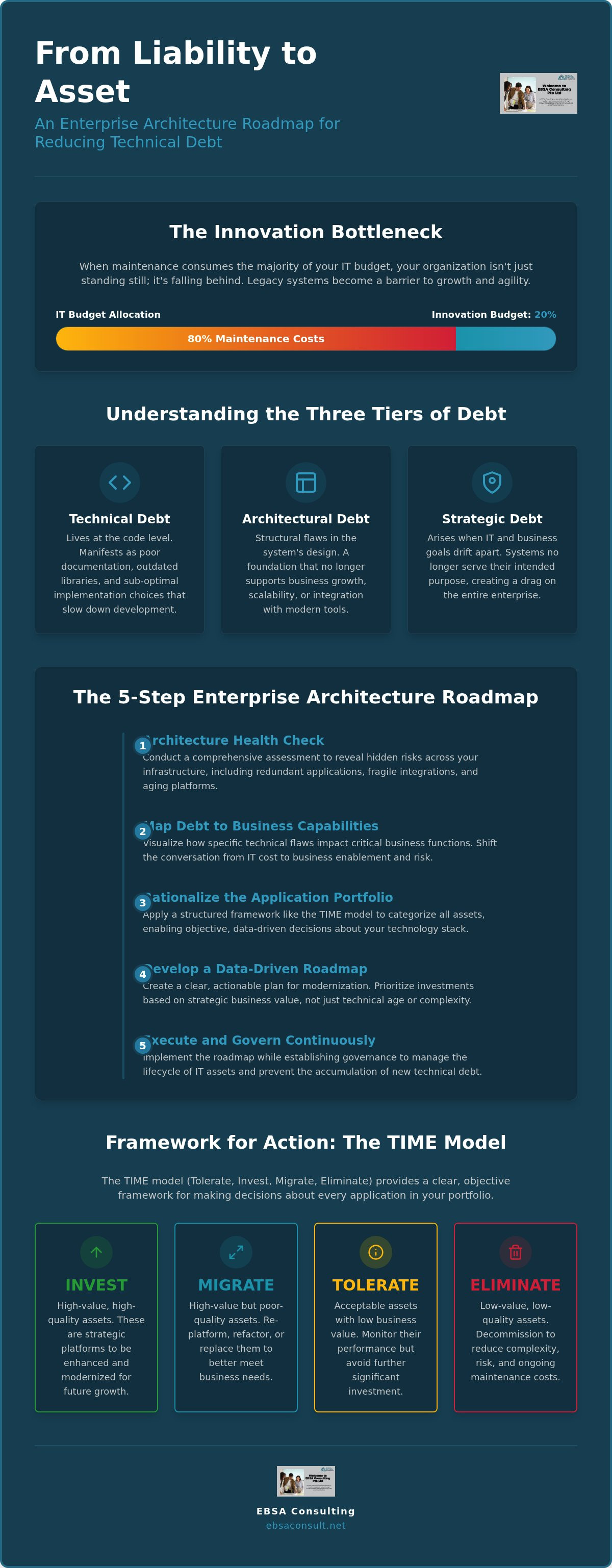
How to Reduce Technical Debt: A 5-Step EA Roadmap
Implementing a structured framework using enterprise architecture for technical debt reduction allows you to move from chaos to control. It's not enough to simply acknowledge that debt exists; you need a methodical path to eliminate it while ensuring your IT assets remain synchronized with your business vision. This roadmap provides a clear sequence of actions designed to transform your legacy landscape into a lean, agile engine for growth.
Step 1 & 2: Visibility and Value Alignment
The journey begins with a comprehensive IT landscape audit to discover the true depth of your debt. This inventory goes beyond a simple list of software; it examines dependencies, licensing costs, and the technical health of every system. Once you have visibility, you must engage business leaders to validate your capability maps. This collaboration ensures that you aren't just fixing technical flaws in isolation, but are instead focusing on the systems that support your most critical business functions. To measure your progress, you'll need to define clear KPIs for success, such as a reduction in emergency maintenance hours or a measurable increase in feature delivery speed. These metrics provide the data-driven evidence needed to maintain stakeholder support throughout the transformation.
Step 3, 4 & 5: Strategy, Design, and Governance
With a clear understanding of your current state, you can apply the TIME model to make strategic decisions about which applications to tolerate, invest in, migrate, or eliminate. This prioritization leads directly into the solution design phase, where you develop the target state architecture for 2026. This blueprint serves as your North Star, guiding every modernization effort toward a cohesive and resilient infrastructure. To sustain these gains, you must establish an Architecture Review Board (ARB) to provide ongoing oversight and ensure all new initiatives align with your long-term standards. Rigorous architectural governance ensures that new projects adhere to established standards, preventing the inadvertent introduction of fresh debt into the environment.
A successful roadmap requires more than just technical expertise; it demands a strategic partner who can bridge the gap between complex requirements and high-level business goals. If you're ready to begin your journey toward a leaner technology stack, our experts can help you develop a customized roadmap for debt reduction today. By following this structured approach, you ensure that your organization remains focused on operational excellence rather than being held back by the weight of past decisions.
Strategic Architecture Consulting for Long-Term Debt Management
Internal IT teams frequently find themselves submerged in the daily demands of maintenance, leaving little room for the high-level structural thinking required to manage systemic debt. This operational "tunnel vision" makes it difficult to objectively assess which legacy systems are truly liabilities. Engaging a neutral, strategic partner provides the clarity needed to break this cycle. We offer an outside perspective that is unburdened by internal politics or historical project biases. By utilizing enterprise architecture for technical debt reduction, we help you transition from a reactive "Project" mindset to a sustainable "Product and Platform" strategy. This shift ensures your technology stack isn't just a collection of siloed tools, but a cohesive foundation that supports continuous evolution.
Fractional enterprise architecture services offer a flexible way for Singaporean enterprises to access high-level expertise without the cost of a full-time executive hire. You gain the benefits of seasoned leadership to oversee complex transformations and maintain architectural integrity. This model allows you to scale your strategic capacity exactly when you need it most. It ensures that your long-term roadmap remains on track despite shifting market conditions, providing the stability needed to manage complex organizational hurdles.
The EBSA Consulting Approach to Modernization
Our methodology prioritizes strategic frameworks over software sales. Because we don't sell off-the-shelf products or managed IT support, our recommendations remain entirely focused on your specific business objectives. We act as the essential bridge between your complex technical requirements and your high-level business vision. This partnership-driven mindset is particularly effective for organizations looking to synchronize their technological infrastructure with national-level strategic goals. We don't just deliver a report; we work alongside your team to ensure every technical implementation drives measurable business value and operational excellence.
Building an Agile, Debt-Light Future
Long-term success requires making continuous architectural improvement a core competency within your organization. This proactive stance prepares your infrastructure for the next wave of innovation, including AI-driven automation and advanced cloud-native architectures. By maintaining a lean, debt-light environment, you ensure your enterprise remains agile enough to pivot as new opportunities arise. The first step toward this future is a clear understanding of your current structural health. We invite you to contact EBSA Consulting for a Strategic Architecture Review to begin identifying the hidden blockers in your landscape. Together, we can reshape your technical foundation into a robust asset that accelerates your journey toward growth and transformation.
Building a Resilient Foundation for Continuous Innovation
Managing technical debt is no longer an optional IT task; it's a strategic necessity for any organization aiming to remain competitive. By utilizing enterprise architecture for technical debt reduction, you move beyond surface-level fixes to address the structural misalignments that hinder business growth. We've explored how identifying high-impact capabilities and applying the TIME model can transform your legacy systems from a burden into a lean, agile portfolio. This systematic approach ensures that every technology investment remains synchronized with your long-term vision.
EBSA Consulting offers specialized Singapore-based expertise to guide you through this transformation. Our professional Solution Architecture blueprints provide the clarity needed to navigate complex organizational hurdles and achieve operational excellence. If you're ready to reclaim your IT budget and accelerate your time-to-market, taking the first step toward a debt-light future is essential. Contact EBSA Consulting to start your Enterprise Architecture Health Check today and begin aligning your infrastructure with your strategic vision. Your path to a more efficient and agile enterprise starts with a single, structured decision.
Frequently Asked Questions
What is the primary cause of technical debt in large enterprises?
The primary cause is often the prioritization of tactical speed over long-term structural alignment. In large enterprises, this manifests as siloed decision-making where individual departments implement localized solutions without considering the broader organizational impact. Over time, these shortcuts accumulate as incompatible technologies and redundant processes. This lack of a unified strategic framework creates a fragmented landscape that's expensive to maintain and difficult to change as business requirements evolve.
How does Enterprise Architecture differ from Solution Architecture in debt reduction?
Enterprise architecture provides the high-level strategic framework for the entire organization's technology portfolio. It focuses on identifying systemic risks and aligning IT assets with business capabilities. In contrast, solution architecture design creates the specific technical blueprints for individual projects or systems. While solution architecture ensures a single implementation is robust, enterprise architecture for technical debt reduction addresses the cumulative impact of all systems across the enterprise to drive overall organizational agility.
Can technical debt ever be a good thing for a growing company?
Technical debt can be a strategic tool when it's incurred intentionally to meet a critical market deadline or validate a new product concept. We call this strategic debt because it allows a company to capture immediate value. However, it's only beneficial if you have a clear plan to repay it quickly. If left unmanaged, the interest on this debt eventually exceeds the initial gains, slowing down innovation and increasing operational costs.
How often should an organization conduct an Architecture Health Check?
We recommend conducting a comprehensive Architecture Health Check at least once a year. This regular cadence ensures that your technical landscape remains synchronized with your evolving business strategy. You should also trigger a review during major organizational shifts, such as mergers, acquisitions, or significant pivots in your digital transformation roadmap. Frequent assessments allow you to catch emerging risks early and adjust your debt reduction priorities before they impact your operational efficiency.
What are the most common mistakes when trying to reduce technical debt?
One common mistake is treating debt reduction as a one-time cleanup project rather than a continuous governance process. Organizations also often focus exclusively on code quality while ignoring architectural or strategic debt. Another error is prioritizing technical fixes without considering their business impact. Without aligning your efforts to high-value business capabilities, you risk spending limited resources on systems that don't contribute to your long-term growth or competitive advantage.
How do you convince the CFO to invest in debt reduction projects?
Convincing a CFO requires framing technical debt in financial terms. Highlight the interest paid through high maintenance costs, which often consume 80% of the IT budget. Show how reducing this debt frees up capital for revenue-generating innovation. Use a data-driven roadmap to demonstrate how enterprise architecture for technical debt reduction improves the ROI of future technology investments. Clear evidence of improved time-to-market for new features usually resonates strongly with executive leadership.
What KPIs should we use to track our technical debt reduction progress?
Effective KPIs include the Debt Ratio, which compares the cost of fixing a system to its replacement value. You should also track the percentage of the IT budget spent on maintenance versus new development. Other valuable metrics include the lead time for new feature delivery and the frequency of system outages. By monitoring these indicators, you can objectively measure how your architectural improvements are enhancing organizational agility and reducing the overall burden on your team.


