

If your cloud environment feels like a collection of expensive silos rather than a cohesive engine for growth, are you actually modernizing or just moving your technical debt to someone else's server? Most enterprise leaders recognize the frustration of rising multi-cloud complexity and the nagging suspicion that cloud costs aren't reflecting true business value. It's a common hurdle when legacy modernization lacks a structured, professional blueprint. You want a system that scales globally without the suffocating weight of vendor lock-in or the drag of inefficient processes.
This article delivers a clear roadmap for your transition, offering a masterclass in cloud architecture strategy design tailored for the 2026 enterprise landscape. By following our strategic architectural template, you'll learn how to reshape your digital foundation into a resilient, business-aligned ecosystem. We'll examine how to synchronize technical requirements with high-level vision, ensuring your infrastructure accelerates growth while systematically reducing technical debt. From initial solution architecture design to long-term scalability, we provide the structured thinking needed to turn complex organizational challenges into operational excellence and long-term reliability.
Key Takeaways
- Adopt an "Architecture-First" mindset to ensure your digital transformation serves as a catalyst for business value rather than a contributor to technical debt.
- Navigate the 2026 Singapore regulatory landscape by integrating data residency and governance requirements directly into your core architectural framework.
- Master a comprehensive cloud architecture strategy design that uses structured gap analysis to align your current infrastructure with future growth objectives.
- Bridge the divide between high-level strategic vision and technical execution through the development of executable solution architecture design blueprints.
- Evaluate the risk-reward profiles of multi-cloud and hybrid models to build a resilient infrastructure that maintains operational stability without vendor lock-in.
The Strategic Foundation of Cloud Architecture Strategy Design
A successful 2026 enterprise doesn't just adopt the cloud; it orchestrates it through structured thinking. A robust cloud architecture strategy design serves as the foundational blueprint for business-aligned digital transformation. It's the difference between a fragmented IT stack and a unified ecosystem that supports global growth. In the current landscape, this strategy must look beyond centralized data centers. It has to account for edge-heavy environments and decentralized workloads that require low latency. Stability comes from planning for these complexities before the first workload is migrated.
Many organizations fall into the "cloud-first" trap, treating migration as a mandate rather than a strategic choice. An "architecture-first" approach, however, prioritizes structural integrity and business outcomes over mere proximity to the cloud. By understanding the core components of cloud computing architecture, leadership can ensure that every virtualized resource directly supports a specific business capability. This synchronization prevents the sprawl of unmanaged services that often plagues unguided transitions. It creates a sense of order that reassures stakeholders of long-term reliability.
Why Architecture Must Precede Migration
Moving legacy systems without a plan often leads to the "lift and shift" trap. This reactive method replicates existing inefficiencies in a more expensive environment, inflating technical debt. It's a costly mistake that many Singaporean enterprises are working to correct. Instead, a deliberate focus on solution architecture design ensures that the infrastructure remains agile. It allows for modularity, enabling the organization to pivot when market demands shift. A well-designed system acts as a bridge, turning rigid legacy code into flexible, cloud-native services.
Aligning Cloud Design with Business Objectives
Cloud resources shouldn't exist in a vacuum. They must align with core business drivers like speed to market or operational cost optimization. Translating a high-level corporate vision into a technical blueprint requires a methodical bridge. This is where the enterprise architect in legacy modernization becomes essential. They map business capabilities, such as real-time inventory tracking or global customer support, to specific cloud configurations. This alignment ensures that every dollar spent on cloud resources yields measurable business value. It creates a roadmap where technology serves the business, not the other way around.
Core Components of a 2026 Cloud Strategy Framework
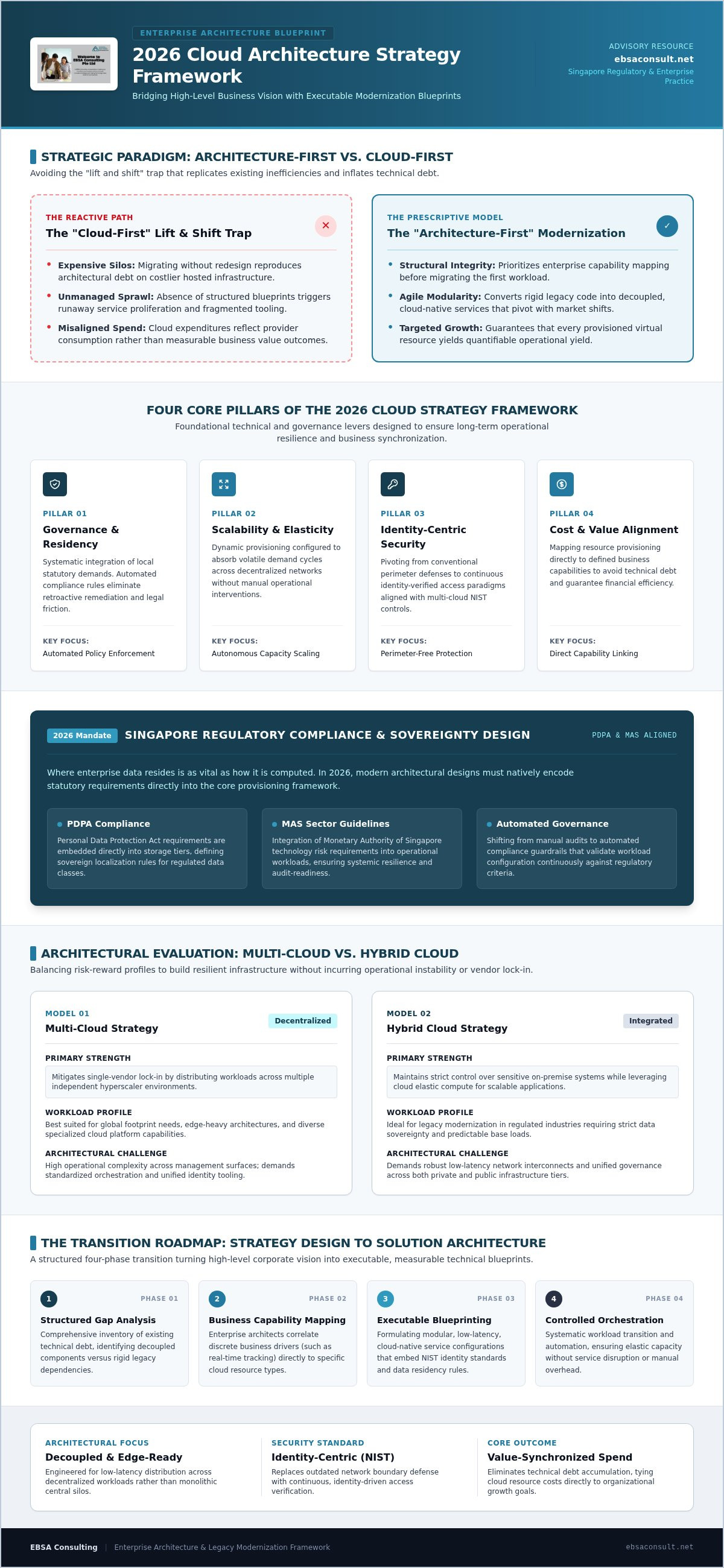
A successful cloud architecture strategy design in 2026 relies on four critical pillars: governance, scalability, security, and cost management. These aren't just technical checkboxes. They are strategic levers that ensure long-term reliability and operational excellence. When these components are synchronized, the resulting infrastructure doesn't just host applications; it accelerates business outcomes. Scalability and elasticity must be designed into the core to handle unpredictable enterprise growth without manual scaling efforts, allowing the system to expand or contract based on real-time demand.
Governance and Data Sovereignty
For enterprises operating within Singapore, navigating the local regulatory environment is a foundational requirement. Data residency rules dictated by the Personal Data Protection Act (PDPA) and sector-specific guidelines from the Monetary Authority of Singapore (MAS) mean that where your data resides is as vital as how it's processed. Integrating these governance frameworks into the cloud design phase prevents costly rework and legal friction later. By automating compliance checks within the architectural blueprint, organizations can maintain a steady, secure posture. This structured thinking ensures that the system remains within legal boundaries while supporting global growth initiatives.
Security architecture has also shifted from perimeter defense to identity-centric models. Modern frameworks should implement a NIST multi-cloud zero trust architecture model at the infrastructure level. This approach assumes no inherent trust, requiring continuous verification of every identity and device. It builds a resilient environment where security is baked into the foundation. This proactive stance reassures stakeholders that complex organizational challenges are managed through proven, secure methodologies.
FinOps: Architecture-Driven Cost Optimization
Many leaders view cloud costs as a finance department problem. However, excessive spend is often a symptom of poor architectural design rather than poor budgeting. When refining your cloud architecture strategy design, designing for cost-transparency from day one allows teams to see the financial impact of technical decisions in real time. It moves the conversation from reactive tracking to proactive optimization. A robust technology stack consolidation strategy helps prune unnecessary services and redundant resources that often accumulate during rapid migration. This alignment ensures that your cloud spend remains directly linked to business value. If you're looking to refine your approach, engaging with enterprise architecture consulting can provide the clarity needed to harmonize your technical and financial goals.
Multi-Cloud vs. Hybrid Cloud: A Strategic Comparison Framework
Selecting the optimal deployment model is a pivotal moment in your cloud architecture strategy design. In 2026, the choice between multi-cloud and hybrid cloud isn't a binary one; it's a spectrum of risk and reward based on your organization's specific maturity level. While some providers push a single-ecosystem approach, a neutral perspective is required to avoid long-term vendor lock-in. We focus on how these structures align with your business goals, ensuring that technical decisions don't create operational hurdles later. This composed approach allows you to build a foundation that is both stable and visionary.
To navigate these complexities, leadership teams often employ the SEI cloud adoption risk assessment method. This structured evaluation helps identify governance and engineering lifecycle risks before committing to a specific provider's native services. It provides the clarity needed to determine if your organization is ready for the complexity of multiple environments or if a more consolidated approach is safer. By assessing these risks early, you can manage complex organizational challenges through structured thinking rather than reactive troubleshooting.
The Case for Multi-Cloud Resilience
A multi-cloud strategy mitigates single-vendor risk, which is crucial for critical infrastructure where downtime has severe repercussions. It allows you to leverage "Best of Breed" services, such as utilizing AWS for its serverless capabilities while running specialized AI workloads on Google Cloud. Success in this area requires a robust enterprise architecture framework for scalability across providers. This approach maintains high availability and gives you the leverage to negotiate better terms, though it does increase management complexity. It requires a high level of architectural discipline to ensure that disparate services work in harmony across a global footprint.
Hybrid Cloud for Legacy Modernization
For many Singaporean enterprises, moving entirely to the public cloud isn't an immediate possibility. Hybrid cloud serves as the essential bridge, connecting on-premises assets to modern services. It manages the reality of data sovereignty and low-latency requirements for sensitive local workloads that cannot yet leave the physical data center. The focus here is on reducing technical debt with enterprise architecture during the transition. By synchronizing your existing data centers with cloud-native features, you create a steady path toward modernization. This ensures that legacy systems don't become anchors, but rather functional components of an evolving, business-aligned ecosystem. Ultimately, your cloud architecture strategy design must balance the speed of native-service adoption with the long-term flexibility of your systems.
The Cloud Architecture Strategy Template: A Step-by-Step Design Guide
Executing a successful transformation requires more than high-level intent. It demands a repeatable, structured methodology. This cloud architecture strategy design template provides the essential framework for 2026 enterprises to move from fragmented legacy setups to synchronized, business-aligned ecosystems. By following a methodical five-step process, leadership teams ensure every technical decision serves a broader organizational purpose. This approach transforms the cloud from a simple hosting destination into a strategic asset that supports long-term reliability and operational excellence.
- Step 1: Current State Assessment and Inventory: Documenting every asset, license, and critical dependency to understand the existing landscape.
- Step 2: Business Capability and Gap Analysis: Identifying what the business needs versus what current technology can provide.
- Step 3: Target State Architecture Definition: Visualizing the ideal cloud environment that supports future growth.
- Step 4: Migration Path and Wave Planning: Prioritizing workloads for transition based on business impact and technical complexity.
- Step 5: Governance and Operational Model Design: Establishing the rules and roles that ensure stability and cost control.
Phase 1: Discovery and Alignment
Modernization begins with a clear-eyed look at the present. Inventorying legacy systems involves more than just counting servers; it requires identifying the hidden technical debt that slows down innovation. You must map existing business processes to cloud-native capabilities to see exactly where efficiency gains are possible. This phase culminates in defining your "North Star" architectural vision. This vision acts as a steady guide. It ensures short-term technical choices don't derail long-term strategic goals, providing a sense of order amid complex organizational shifts.
Phase 2: Technical Blueprinting
Once the destination is clear, the focus shifts to the technical blueprints. This involves selecting the appropriate cloud service models. You might choose IaaS for maximum control, PaaS for development speed, or SaaS for standard business functions. Architects must design the network, identity, and security perimeters with precision, ensuring they are robust enough for 2026 threats. Validating these designs against solution architecture best practices ensures the foundation is resilient and scalable. It's about building a system that doesn't just work today but supports global growth in the years to come. To begin your journey with a tailored roadmap, explore our Enterprise Architecture Consulting services to align your vision with a robust digital foundation.
Navigating the Transition: From Strategy Design to Solution Architecture
Moving from a high-level cloud architecture strategy design to executable solution blueprints requires a disciplined and methodical transition. While the strategy provides the "why" and the "what," solution architecture defines the "how" with technical precision. In 2026, this shift isn't a one-time event; it's a continuous process of refinement and synchronization. Organizations must ensure that the technical decisions made during implementation don't veer away from the original business objectives. This alignment ensures that your technological infrastructure remains a resilient engine for growth rather than a source of future technical debt. It turns a visionary concept into a reliable, high-performing reality.
Continuous architectural health checks are vital to maintaining this alignment over the long term. As project teams begin their work, the risk of "architecture drift" increases significantly. Drift occurs when small, tactical choices accumulate and lead the system away from its strategically designed state. By implementing regular, structured reviews, enterprise leaders can catch these deviations early. This proactive stance maintains the integrity of the ecosystem and reassures stakeholders that the transformation remains on a steady, predictable path. It provides a sense of stability that is essential when managing complex organizational challenges.
Operationalizing the Strategy
The EBSA Consulting Approach to Cloud Strategy
EBSA Consulting serves as a strategic guide through these complex transitions. Our vendor-neutral perspective ensures that your solution design is driven by objective business needs rather than the limitations or biases of a specific software provider. We focus heavily on business architecture to ensure that every technological investment delivers a high ROI and supports your global growth. By bridging the gap between technical requirements and high-level vision, we help you manage organizational hurdles with confidence. If you're ready to ensure your infrastructure is optimized for the future, connect with EBSA for a bespoke cloud architecture health check today. Our collaborative approach provides the stability and structured thinking required to turn your 2026 cloud architecture strategy design into a tangible, high-performing reality.
Building a Resilient Digital Future
Successful transformation in 2026 requires moving beyond simple hosting to a comprehensive cloud architecture strategy design. This framework ensures your digital ecosystem remains synchronized with business capabilities while reducing the long-term drag of technical debt. By prioritizing structural integrity and adopting vendor-neutral frameworks, you can navigate multi-cloud complexities without sacrificing operational stability. The transition from legacy infrastructure to a modern, scalable system is a journey of continuous improvement. It's about turning complex organizational hurdles into a streamlined, business-aligned engine for growth.
At EBSA Consulting, we provide the Singapore-based strategic expertise needed to guide your enterprise-scale legacy modernization. Our consultant-led approach offers objective, vendor-neutral architectural frameworks that prioritize your unique business goals over specific software agendas. We're here to help you bridge the gap between technical requirements and high-level vision. Align your cloud strategy with EBSA Consulting today to build a foundation that supports your vision for years to come. Your organization's path toward efficiency and global growth starts with a steady, well-planned architecture.
Frequently Asked Questions
What is the difference between cloud strategy and cloud architecture?
A cloud strategy defines the high-level business objectives and vendor selection criteria, while cloud architecture provides the technical blueprints for implementation. Strategy focuses on outcomes like market agility or cost optimization. Architecture details the specific arrangement of platforms, infrastructure, and delivery models. Both must be synchronized to ensure that technical decisions don't create operational hurdles that eventually derail your long-term organizational vision and growth potential.
How does a cloud architecture strategy reduce long-term technical debt?
A robust cloud architecture strategy design reduces technical debt by replacing reactive migrations with deliberate, modular planning. It identifies legacy inefficiencies before they're replicated in a cloud environment. By establishing a clear target state and migration roadmap, teams can prune redundant systems and consolidate technology stacks. This structured approach prevents the accumulation of unmanaged services, ensuring your digital foundation remains agile and cost-effective as you scale.
Is multi-cloud necessary for Singapore-based enterprises in 2026?
Multi-cloud isn't a universal requirement, but it's a strategic choice for Singaporean enterprises seeking maximum resilience and vendor neutrality. It mitigates the risk of single-provider outages and provides leverage during contract negotiations. However, it also increases management complexity. Your decision should depend on organizational maturity and whether the benefits of specialized services outweigh the overhead of governing multiple environments. A hybrid approach often serves as a practical middle ground.
How do we align our cloud design with Singapore’s data residency laws?
Alignment begins by integrating local regulatory requirements, such as PDPA and MAS sector-specific guidelines, directly into your architectural blueprints. You must explicitly define where data resides and how it's encrypted during transit and at rest. Automated compliance checks within your cloud environment help maintain this posture without manual intervention. This proactive design ensures your infrastructure meets strict national standards while supporting the seamless data flow required for modern business operations.
Can business architecture services improve our cloud migration ROI?
Yes, professional business architecture services improve ROI by ensuring every technological investment directly supports a core business capability. Instead of spending on redundant or misaligned cloud resources, you focus on high-impact areas like speed to market or operational efficiency. This alignment reduces waste and accelerates the time-to-value for your migration. By synchronizing technical requirements with business vision, you transform your cloud spend from an operational cost into a growth engine.
What are the most common mistakes in cloud architecture strategy design?
The most common mistakes include prioritizing speed over structural integrity and failing to establish a robust governance framework early. Many organizations attempt to move legacy debt into the cloud without refactoring, which leads to inflated costs and poor performance. Other frequent errors involve ignoring FinOps until budgets are exceeded or neglecting the security implications of decentralized environments. Avoiding these pitfalls requires a methodical approach that prioritizes long-term reliability over shortcuts.
How often should we update our enterprise architecture framework?
Your enterprise architecture framework should be treated as a living document, requiring a formal review at least annually. However, in the rapidly evolving landscape of 2026, continuous architectural health checks are more effective for maintaining alignment. You should update your framework whenever there are significant shifts in business strategy, regulatory changes in Singapore, or major technological advancements. This steady rhythm ensures your digital foundation remains resilient and capable of supporting ongoing transformation.
What role does a solution architect play in cloud strategy execution?
A solution architect acts as the essential bridge between high-level strategy and technical execution. They translate the broad goals of a cloud architecture strategy design into detailed, executable blueprints for specific projects. Their role involves selecting the right service models, designing security perimeters, and ensuring implementation doesn't suffer from architecture drift. By maintaining design integrity during the transition, they ensure that the final technical solution remains fully aligned with overarching business objectives.


