

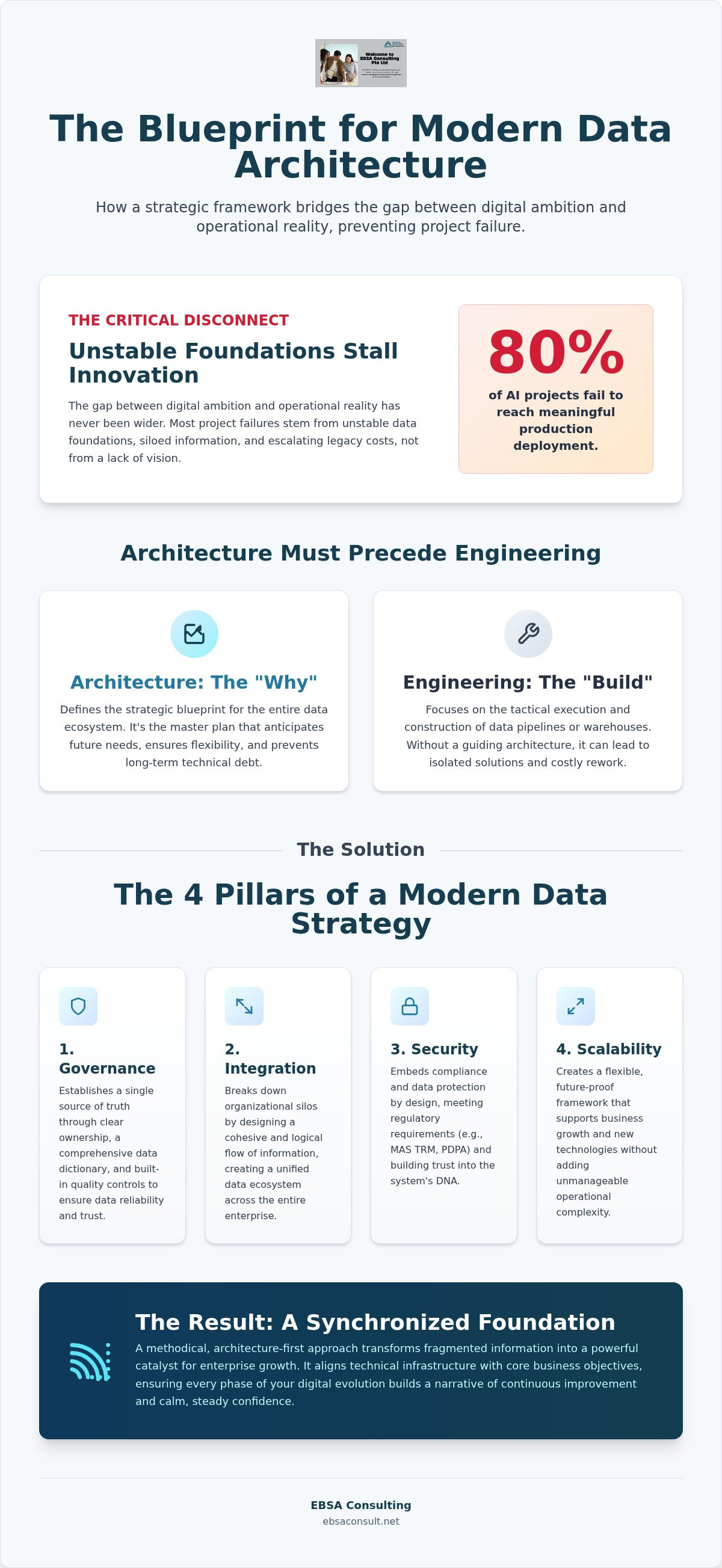
With over 80% of AI projects failing to reach meaningful production deployment, the gap between digital ambition and operational reality has never been wider. This failure often stems from unstable foundations rather than a lack of vision. You have likely felt the friction of siloed data preventing a single source of truth, or perhaps you are navigating the escalating costs of legacy structures that no longer serve your strategic goals. Engaging with professional data architecture consulting services allows you to address these hurdles by treating information as a structured asset rather than a technical burden.
Discover how a synchronized foundation can transform fragmented information into a powerful catalyst for enterprise growth and operational excellence. We will explore a scalable roadmap that aligns your technical infrastructure with core business objectives, ensuring your organization moves forward with a calm and steady confidence. By prioritizing a visionary yet grounded framework, you can reduce the risks inherent in technical planning and finally bridge the gap between complex requirements and your high-level business vision. This methodical approach ensures that every phase of your digital evolution builds upon the last, creating a narrative of continuous improvement and alignment.
Key Takeaways
- Distinguish between tactical database administration and the strategic design required to synchronize enterprise information flow.
- Understand why an architecture-first approach is essential to prevent the accumulation of technical debt and ensure long-term scalability.
- Leverage strategic data architecture consulting services to bridge the gap between complex technical requirements and high-level business vision.
- Identify the four core pillars of modern strategy, focusing on governance and quality frameworks that support reliable AI and analytics.
- Discover how to evaluate potential partners by looking for strategic guides who offer visionary blueprints rather than simple resource augmentation.
What are Data Architecture Consulting Services?
Data architecture consulting services represent the strategic design of an organization's information assets and the logical flow that connects them. This discipline focuses on creating a resilient structure that supports long-term growth and operational stability. When exploring What is Data Architecture?, it's vital to look beyond simple storage or cloud platforms. It involves high-level planning of how data is collected, integrated, and utilized across the entire enterprise. Unlike database administration, which is a tactical function centered on maintenance and performance tuning, data architecture is inherently strategic. It provides the essential blueprint for effective solution architecture design. By defining these standards early, organizations ensure every new application or tool fits into a cohesive, synchronized ecosystem rather than becoming another isolated silo.
The Difference Between Architecture and Engineering
Architecture defines the "Why" and "How" of your data ecosystem, while engineering focuses on the "Build" and execution. Many organizations rush into the build phase, hiring engineers to construct pipelines or warehouses before a master plan exists. This haste often results in significant technical debt. Engineers might solve immediate problems efficiently, but without a strategic guide, those solutions may not interact well with the broader system. A consultant acts as a visionary architect who anticipates future needs, ensuring that the technical infrastructure remains flexible. Starting with engineering might seem faster, but it often leads to costly rework when the foundation can't support new business requirements.
Key Business Drivers for Strategic Consulting
Several strategic drivers necessitate professional data architecture consulting services. First, scaling operations without adding unmanageable complexity is a priority for growing firms. As data volume grows, a lack of structure leads to operational friction. Second, regulatory compliance is a mandatory requirement. In Singapore, for example, the MAS TRM Guidelines and the PDPA require data protection by design and strict governance practices. A well-designed architecture ensures these requirements are built into the system's DNA. Finally, preparing for advanced AI and predictive analytics is essential. Since inadequate data foundations cause over 80% of AI projects to fail, a robust architecture is the only way to ensure these high-stakes investments actually yield a measurable return.
The 4 Pillars of a Modern Data Architecture Strategy
Building an enterprise-grade data foundation requires more than technical proficiency; it demands a methodical approach that aligns every bit of information with the organization's broader vision. Professional data architecture consulting services provide this structure through four essential pillars. These pillars ensure that data doesn't just exist but actively serves as a catalyst for growth. By adhering to Modern Data Architecture Principles, leaders move away from reactive fixes toward a stable, proactive ecosystem. This strategic alignment reshapes how an organization perceives its information, turning a collection of tools into a synchronized strategic asset.
Governance: Establishing the Single Source of Truth
Governance serves as the bedrock of trust within any data system. It involves defining clear ownership and stewardship across the business to eliminate ambiguity and redundancy. A critical component of this process is creating a comprehensive data dictionary. This dictionary must align with broader business architecture services to ensure that technical definitions match business realities. Implementing quality controls at the architecture level prevents "dirty data" from entering the stream. This ensures that analytics and AI models operate on a reliable foundation, which is vital since poor data quality is a primary driver of project failure.
Integration: Breaking Down Organizational Silos
Silos are the primary obstacle to a unified source of truth. Strategic integration focuses on designing a robust technical solution design process for seamless data flow. Many organizations are moving from traditional batch processing toward real-time data synchronization to support faster, data-driven decision-making. Standardizing APIs and data exchange protocols ensures that different systems communicate without friction. This interoperability allows for a harmonious environment where data moves effortlessly between departments, accelerating digital transformation across the enterprise.
The third pillar focuses on scalability and future-proofing system architecture. As data volumes grow, the architecture must expand without requiring a total overhaul. Statistics from 2026 indicate that 64% of enterprises already manage more than one petabyte of data, making scalable design a baseline requirement for survival. Finally, the fourth pillar addresses security and risk management. This involves embedding protection into the structural design, ensuring compliance with regulations like the Singapore PDPA or MAS TRM guidelines. If your organization is navigating these complex requirements, partnering with a strategic architecture consultant can help you define these pillars with precision and confidence.
Strategy vs. Implementation: Why Architecture Must Precede Engineering
The assumption that an organization can simply "fix the data" while building an application is one of the most expensive misconceptions in modern technology management. This reactive approach often leads to a tangled web of integrations that are difficult to maintain and even harder to scale. Unplanned data environments accumulate technical debt at an alarming rate, eventually stalling the very innovation they were meant to support. Professional data architecture consulting services offer a composed and steady demeanor, providing the structured thinking necessary to manage these complex organizational shifts. By prioritizing strategy over immediate engineering, you build a foundation that supports long-term reliability and operational excellence. This methodology establishes a clear case for enterprise architecture for risk management, ensuring that every data-driven decision is backed by a secure and resilient framework.
The Trap of Tool-First Thinking
Selecting a platform like Snowflake or Databricks is an implementation decision, not a strategic architecture. Organizations often fall into the trap of tool-first thinking, assuming that a modern cloud platform will automatically solve their data fragmentation issues. However, without a visionary architect to guide the design, these platforms can become yet another silo. Vendor-neutral consultants ensure that the architecture serves the business rather than the software's specific limitations. This focus on modular design preserves organizational agility, allowing you to adapt your technical stack as new innovations emerge without needing to rebuild your entire information ecosystem from scratch.
Synchronizing Data with Business Capability Mapping
Effective data strategy requires linking information entities directly to specific business functions. This process, known as business capability mapping, ensures that your technical infrastructure actually supports your operational goals. This is exactly where enterprise architecture consulting becomes an essential partner in your journey. By synchronizing data flows with the way your business actually operates, you remove the friction that typically slows down executive decision-making. Architected information flows provide the clarity needed to move from fragmented data to a synchronized foundation for growth.
How to Evaluate Data Architecture Consulting Services
Selecting the right partner to design your information ecosystem is a decision that impacts your organization for years. Executives must distinguish between data architecture consulting services that offer strategic guidance and those that merely provide resource augmentation. While augmentation fills temporary gaps in headcount, a strategic guide provides the visionary blueprints necessary to align technical infrastructure with long-term business goals. This partnership requires a methodology-driven approach, utilizing proven frameworks like TOGAF or Zachman to ensure structured thinking. These frameworks provide a common language and a set of best practices that reduce risk during the planning phase. The ideal consultant acts as a bridge, translating high-level business requirements into precise technical requirements without losing sight of the desired operational outcomes.
Key Criteria for Selection
When vetting a potential partner, prioritize their experience in complex enterprise alignment projects. You need a collaborator who understands how data flows through different business units, rather than one who focuses solely on the technical stack. Look for a firm that emphasizes robust blueprints and frameworks over software sales. A vendor-neutral perspective ensures that the architecture serves your specific needs rather than the interests of a software provider. Finally, assess their collaborative mindset. A successful architect doesn't work in a silo; they integrate with your internal teams to ensure knowledge transfer and cultural alignment, creating a sense of stability throughout the transformation process. This partnership-driven approach ensures that the final design is both technically sound and culturally adopted.
Red Flags in Architecture Consulting
Be wary of consultants who immediately pivot the conversation toward specific software products. If a firm leads with a platform before understanding your business capabilities, they are likely selling a tool rather than a strategy. Another red flag is a lack of focus on business outcomes and ROI. Data architecture shouldn't be an academic exercise; it must lead to reduced operational costs, improved decision-making, or accelerated growth. Finally, avoid generic, one-size-fits-all technical blueprints. Your organization’s challenges are unique, and a partner who offers a cookie-cutter solution will likely leave you with the same technical debt you sought to resolve. For those seeking a partner committed to tailored, strategic blueprints, exploring the architecture consulting services at EBSA can provide the clarity needed to move forward with confidence.
EBSA Consulting: Bridging the Gap Between Data Strategy and Solution Design
EBSA Consulting serves as the essential bridge between high-level business vision and the technical complexities of information flow. Our approach ensures that your infrastructure doesn't just store data but actively accelerates your digital transformation. By choosing our data architecture consulting services, you're partnering with a visionary innovator who understands the unique hurdles of the Singaporean enterprise landscape. We focus on creating robust technical blueprints that allow you to scale without the weight of accumulated technical debt. This steady, architecture-first methodology transforms fragmented systems into a synchronized foundation for operational excellence, allowing your leadership to move forward with confidence.
Our Collaborative Partnership Model
We believe that organizational agility is reshaped through structured thinking. Our collaborative model moves beyond distant vendor relationships, positioning us as a close partner invested in your long-term journey. We translate broad strategic concepts into specific, actionable solution blueprints that your engineering teams can follow with precision. This clarity helps navigate the organizational hurdles that often stall large-scale initiatives. By linking your data strategy directly to your business architecture, we ensure that every technical decision supports a measurable business outcome. This methodical flow maintains a clear path toward efficiency, ensuring that your technical requirements and business goals remain in constant harmony.
Start Your Architectural Journey
Modernizing a legacy data environment requires a steady hand and a proven methodology. Many organizations find immense value in utilizing a fractional enterprise architect to provide high-level oversight without the overhead of a full-time executive hire. This role ensures that your data architecture remains aligned with your evolving business goals as you scale. To begin this transformation, we recommend initiating a comprehensive data architecture health check. This assessment identifies gaps in your current framework and provides a scalable roadmap for future growth. You can connect with EBSA Consulting for a strategic architecture review to secure your foundation and move from data chaos to a state of operational excellence.
Reshaping Your Enterprise for Synchronized Growth
A resilient data foundation isn't built by chance; it's the result of intentional, structured design that prioritizes long-term stability over short-term fixes. Adopting an architecture-first approach ensures your organization scales without the friction of technical debt or misaligned silos. We've explored how professional data architecture consulting services provide the visionary blueprints needed to bridge the gap between technical requirements and high-level business goals. This methodology-driven path allows you to transform fragmented information into a powerful asset for operational excellence.
EBSA Consulting brings a deeply collaborative mindset and specialized expertise in Singapore's national enterprise landscape to every engagement. Our focus on Enterprise and Solution Architecture ensures that your digital transformation remains grounded in proven methodologies. Partner with EBSA Consulting to align your data strategy with business vision and move forward with a steady, composed confidence. The journey from complexity to clarity begins with a single strategic decision. We're ready to help you navigate the path toward a more efficient and synchronized future.
Frequently Asked Questions
What is the primary role of a data architecture consultant?
A consultant acts as a strategic guide who bridges the gap between high-level business vision and technical requirements. They design the structural framework for how an organization collects, integrates, and governs its information. By providing a clear blueprint, they ensure that data flows seamlessly across departments. This process synchronizes technical infrastructure with operational goals, allowing leaders to make decisions based on a unified source of truth.
How does data architecture consulting reduce technical debt?
Professional data architecture consulting services reduce technical debt by establishing a scalable roadmap before engineering begins. Many teams build reactive, siloed solutions that eventually require expensive rework. An architecture-first approach ensures that new systems are modular and interoperable from the start. This structured thinking prevents the accumulation of quick fixes that stall innovation, ultimately lowering the long-term costs of maintaining complex legacy data structures.
Is data architecture consulting only for large enterprises?
Strategic architecture is essential for any organization experiencing growth or complexity, not just large enterprises. While global firms manage petabytes of data, scaling startups often face the highest risk of accumulating technical debt. Engaging a consultant early allows smaller organizations to build robust foundations that support rapid expansion. This proactive planning ensures that technical infrastructure remains an asset rather than a bottleneck as the business evolves.
What is the difference between data architecture and data strategy?
Data strategy defines the high-level goals and the "what" of your information roadmap, while data architecture provides the structural "how." Strategy focuses on business outcomes, such as improving customer insights or meeting regulatory requirements. Architecture translates those goals into technical blueprints, defining the standards, models, and integration protocols required. Both are necessary to ensure that technical implementations stay aligned with the broader enterprise vision.
How long does a typical data architecture consulting engagement take?
The duration of an engagement varies based on the scope of the organizational challenge. A targeted architecture audit or platform blueprint might take 10 to 12 weeks to complete. More comprehensive enterprise overhauls or pipeline modernizations typically span 20 to 24 weeks. This methodical pace allows for deep collaboration with internal stakeholders, ensuring that the final framework is both technically sound and culturally adopted.
Can data architecture consulting help with AI and Machine Learning readiness?
Professional architecture is a baseline requirement for successful AI and machine learning initiatives. Since inadequate data foundations cause over 80% of AI projects to fail, a robust structural framework is essential. Consultants focus on improving data quality, lineage, and integration to ensure that models receive reliable, high-quality inputs. This preparation reduces the risk of project abandonment and ensures that advanced analytics provide meaningful production value.
What deliverables should I expect from a data architecture consultant?
You should expect a suite of strategic blueprints and frameworks tailored to your organization's needs. Typical deliverables include a comprehensive data dictionary, integration maps, and a scalable data roadmap. These documents serve as the essential guide for your engineering teams, ensuring that every build aligns with established standards. A seasoned partner also provides governance frameworks and security protocols to manage risk across the entire information ecosystem.
How do I measure the ROI of data architecture consulting services?
The ROI of data architecture consulting services is measured through improved operational efficiency and reduced technical risk. Key metrics include decreased time to market for new analytics products and a significant reduction in maintenance costs for legacy systems. Improved data quality leads to more accurate executive decision-making and higher success rates for AI projects. Ultimately, a well-architected system provides the stability needed for long-term enterprise growth.


