

Why is your organization’s security spend increasing while your actual technical risk remains stubbornly high? Many Singaporean enterprises find themselves caught in a cycle of purchasing more software to solve problems that are inherently structural. You've likely felt the friction as security requirements slow down business agility, or perhaps you're managing a ballooning portfolio of tools that don't seem to talk to each other. It's a common struggle to balance immediate protection with the long-term health of your digital ecosystem.
A robust approach to enterprise architecture for risk management offers a way out of this reactionary loop. We'll show you why strategic architectural design, rather than software accumulation, is the only sustainable path to a resilient infrastructure. You'll discover how to reshape your technical blueprints to reduce hidden debt and synchronize security with your core business strategy. This guide breaks down the myths of modern security, moving your focus from buying products to building a stable, high-performance foundation for 2026 and beyond.
Key Takeaways
- Move beyond the "tool-first" mentality to understand how fragmented security suites can unintentionally expand your organization’s attack surface.
- Learn why systemic vulnerabilities are best addressed during the design phase rather than through reactive run-time responses.
- Shift from a cycle of reactionary patching to a model of design-led resilience that supports rapid organizational scaling without compromising safety.
- Implement a strategic 2026 framework for enterprise architecture for risk management by mapping business capabilities directly to technical vulnerabilities.
- Discover how unbiased solution architecture design serves as the essential bridge between high-level business vision and a secure, stable technical infrastructure.
Debunking the "Tool-First" Security Myth
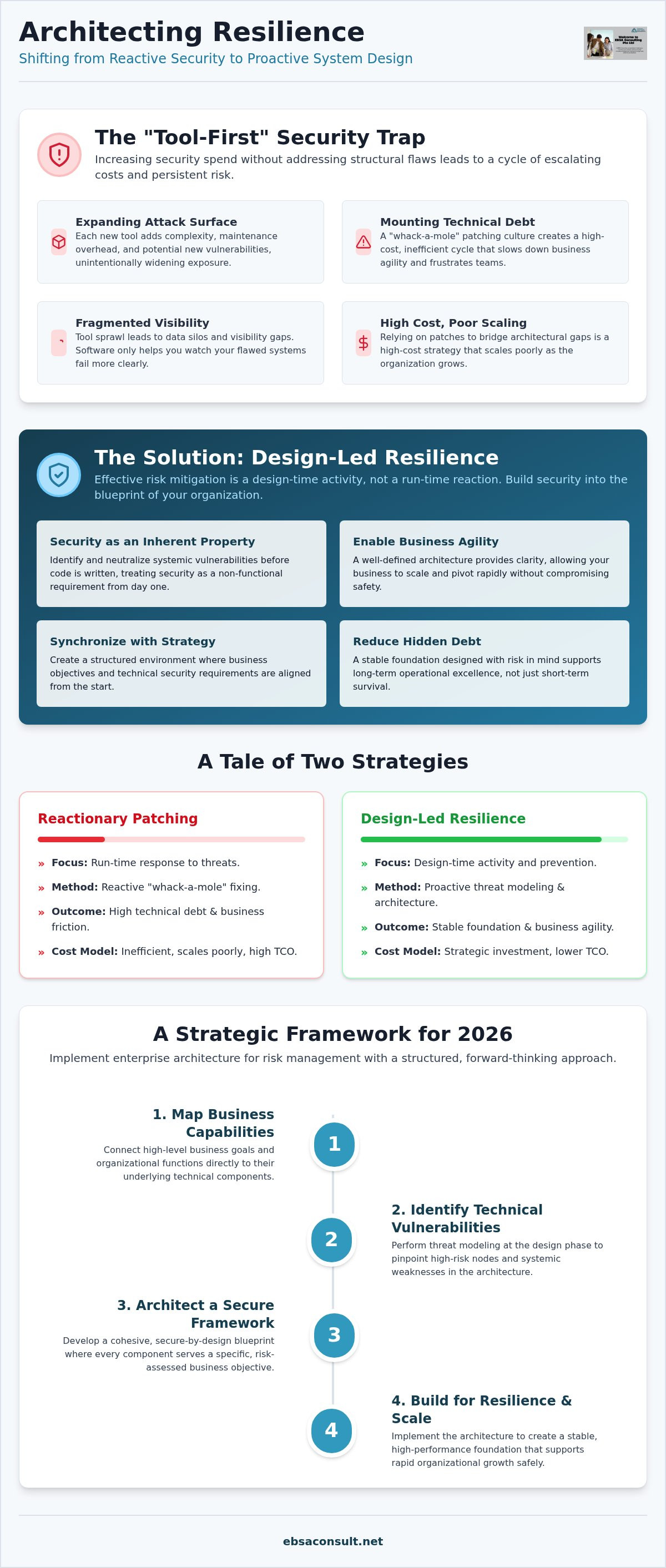
Many leadership teams in Singapore operate under the assumption that a larger security budget directly correlates with a safer organization. This myth suggests that purchasing the latest security suite acts as a universal shield against threats. It doesn't. In reality, the accumulation of software often creates a false sense of security while simultaneously expanding the attack surface. When you add a new tool without a clear structural purpose, you're not just buying protection; you're adding complexity, maintenance overhead, and potential new vulnerabilities. Complexity is the enemy of safety.
True enterprise risk management begins with the blueprint, not the purchase order. Tool sprawl leads to fragmented data and visibility gaps that no amount of monitoring can fully bridge. If your fundamental design is flawed, software only helps you watch your systems fail more clearly. Shifting your mindset means moving away from "buying protection" and toward "architecting resilience." Effective enterprise architecture for risk management ensures that security is a property of the system itself, not an optional add-on.
The High Cost of Reactive Security
A reactionary approach to security creates an exhausting cycle of "whack-a-mole" patching. Every time a new vulnerability emerges, teams scramble to apply a fix, which often leads to mounting technical debt and organizational friction. This bolt-on security culture slows down business agility and frustrates development teams who find themselves constantly retrofitting security measures into poorly designed systems. Architectural risk is the measurable gap between a system's intended security design and its operational reality. Relying on patches to bridge this gap is a high-cost strategy that scales poorly as your organization grows. It's time to stop fixing and start designing.
Why Tool Integration is Not a Strategy
Vendors frequently promise a "single pane of glass" to manage fragmented infrastructures, but this is often a marketing fallacy. Integrating disparate tools is a technical task, not a strategic one. Over-reliance on specific vendor ecosystems can lead to lock-in, where the cost of moving to a more secure or efficient architecture becomes prohibitive. This increases long-term risk by tethering your enterprise to outdated methodologies. A robust solution architecture design acts as the unifying force that ensures every technical component serves a specific business objective. This approach allows you to evaluate tools based on how they fit into a cohesive, secure-by-design framework rather than their standalone features.
Why Architecture is the Foundation of Risk Mitigation
Risk mitigation is often mistakenly viewed as a run-time response to external threats. In reality, the most effective defense is a design-time activity. When you treat security as an inherent property of your system architecture, you can identify and neutralize systemic vulnerabilities before a single line of code is written or a new server is provisioned. This shift in perspective is what separates resilient organizations from those perpetually trapped in a cycle of crisis management. By leveraging enterprise architecture for risk management, you create a structured environment where business objectives and technical security requirements are synchronized from the start.
A well-defined architectural framework doesn't just protect; it enables. Structured frameworks provide the clarity needed for organizational agility, allowing your business to scale and pivot without compromising safety. When your infrastructure is designed with risk in mind, you reduce the likelihood of "hidden" technical debt that often accumulates in legacy blueprints. This creates a stable foundation that supports long-term operational excellence rather than short-term survival.
Identifying Risk at the Blueprint Level
Effective threat modeling should occur during the initial design phase to be truly impactful. When security is integrated as a non-functional requirement within the technical solution design process, every component is evaluated for its potential impact on the broader ecosystem. Business capability mapping is essential here, as it helps identify high-risk organizational nodes that require more robust structural protection. This approach represents the proactive art of strategic defense, ensuring that your technical assets are shielded by design rather than by luck.
The Role of Enterprise Architecture Consulting
Many firms in Singapore struggle with the disconnect between top-down business strategy and bottom-up technical execution. Strategic enterprise architecture consulting provides the necessary visibility to bridge this gap. By aligning your business vision with your technical infrastructure, you move away from siloed security measures toward a cohesive, organization-wide architecture. This alignment reduces friction and ensures that your technical investments are always delivering maximum business value. If you're ready to move beyond reactionary patching, partnering with a specialist in architectural strategy can provide the steady guidance your organization needs to build a resilient future.
Reactionary Patching vs. Design-Led Resilience
Modern technology management is split between two opposing schools of thought. One prioritizes reactionary patching, while the other focuses on design-led resilience. In Singapore's fast-paced market, the reactionary model often seems easier at first. It's the "buy a tool, fix the leak" approach. However, this model inevitably fails during rapid organizational scaling. As your systems grow, the number of patches required increases exponentially, leading to a state of permanent crisis management that drains your team's energy and budget.
Investing in enterprise architecture for risk management offers a significantly higher long-term ROI than simply stacking software licenses. Software licenses are recurring operational expenses that often mask systemic issues rather than solving them. Reshaping your IT budget to prioritize design-led security allows you to address the root causes of vulnerability. This strategic shift moves your organization from a defensive posture to a position of strength, where security is a silent enabler of growth rather than a loud, disruptive obstacle.
The Hidden Costs of the "Fix-it-Later" Approach
Building on insecure architectures is like taking out a high-interest loan. Technical debt compounds over time. Every new feature added to a poorly designed system requires more work to secure, eventually making innovation prohibitively expensive. Design-related downtime also threatens business continuity, leading to lost revenue and damaged reputations. Design-led resilience is the ability to absorb shocks by structure. By designing systems that are inherently robust, you reduce the need for constant, expensive interventions and ensure that your operations remain steady even when external threats evolve.
Accelerating Growth through Stable Foundations
A stable foundation is not a constraint; it's an accelerator. When you focus on future-proofing system architecture, you enable faster feature deployment because your teams aren't constantly fixing old mistakes or retrofitting security into finished products. There's a profound psychological benefit to a "secure by design" culture. Your engineers can innovate with confidence, knowing the underlying framework is robust and aligned with business goals. This makes architectural frameworks a genuine competitive advantage, allowing your enterprise to move faster than competitors who are still bogged down by legacy debt and fragmented security tools.
A 2026 Framework for Mitigating Technical Architecture Risks
Transitioning from a reactive security posture to a design-led one requires a methodical approach. A robust framework for enterprise architecture for risk management ensures that every technical decision aligns with your broader business objectives. This process isn't about a one-time fix but rather about establishing a continuous cycle of improvement and alignment. By following a structured path, Singaporean enterprises can move beyond the noise of tool sprawl and build a truly resilient infrastructure.
- Step 1: Conduct a comprehensive architecture maturity assessment to identify existing gaps and technical debt.
- Step 2: Map business capabilities to technical vulnerabilities to prioritize mitigation efforts based on actual business impact.
- Step 3: Define a "Secure-by-Design" solution blueprint that integrates security principles into the core infrastructure.
- Step 4: Implement a continuous architectural health check process to prevent the re-accumulation of risk over time.
Assessing Your Current Architectural Debt
Auditing legacy systems is the first step in reclaiming control over your technical environment. You can't manage what you don't understand. Methodologies like the Architecture Tradeoff Analysis Method (ATAM) help identify where legacy risks might jeopardize future growth. It's essential to prioritize these risks based on their potential impact on your operations. Engaging professional business architecture services allows you to define exactly which capabilities are critical to your mission. This clarity ensures your risk mitigation efforts are focused on the areas that provide the most value to the organization.
Designing for Scalability and Security
A 2026-ready roadmap must account for emerging threats by integrating zero-trust principles directly into the solution architecture. This means moving away from perimeter-based security toward a model where every request is verified, regardless of its source. We focus on ensuring technical implementations meet specific business objectives without unnecessary bloat. Strategic roadmapping involves looking ahead to potential shifts in the Singaporean regulatory environment and technological advancements. This forward-thinking design prevents technical debt from becoming a security liability later. If you're ready to reshape your infrastructure, you can book a strategic consultation to begin your architectural transformation.
Integrating Security into Your Solution Architecture Design
Managing an organization's digital evolution requires more than just technical skill; it demands a clear vision of how every component interacts with the whole. EBSA Consulting specializes in bridging the gap between high-level business vision and a secure, stable technical infrastructure. By applying principles of enterprise architecture for risk management, we transform complex organizational hurdles into structured, manageable roadmaps. This methodical approach ensures that security isn't a separate concern but a foundational element of your entire operation. We help you move beyond the noise of the market to focus on what truly drives value for your enterprise in Singapore.
The EBSA Approach to Solution Design
Our methodology focuses on translating your unique business requirements into robust, secure technical blueprints that stand the test of time. Because we don't sell off-the-shelf software or offer managed IT support, we remain an unbiased partner in your journey toward operational excellence. This independence is crucial. It allows us to focus exclusively on architectural frameworks that serve your specific interests rather than pushing specific products or vendor ecosystems. We collaborate with your internal teams as a strategic guide, providing the high-level expertise needed to navigate the nuances of modern infrastructure design. This partnership-driven mindset ensures that your team remains empowered and aligned throughout the transformation process, fostering a culture where security and business growth coexist harmoniously.
Securing Your Enterprise Roadmap
Initiating an architectural health check is the most effective way to identify where legacy debt or fragmented systems may be compromising your security. We work closely with your leadership to analyze your current state and design a path forward that balances immediate protection with long-term agility. This process involves a deep dive into how your technical assets support your core business capabilities. By prioritizing design over the accumulation of tools, you reduce your reliance on reactionary patching and create a more stable environment for innovation. This long-term consulting mindset provides a steady presence in an ever-changing technological landscape. Leaders who are ready to modernize their approach can move away from the stress of tool sprawl and toward a more confident, strategic future. If you're looking to align your security strategy with your business goals, contact EBSA Consulting for a strategic architectural review. Visit ebsaconsult.net to learn more about how we can help you build a secure foundation for 2026 and beyond.
Building a Resilient Foundation for 2026
Securing your organization for the future requires a fundamental shift from buying protection to building resilience. The accumulation of security software often creates more complexity than it resolves, while a design-led approach eliminates systemic vulnerabilities at the source. By prioritizing strategic blueprints over reactionary patching, you reduce the long-term burden of technical debt and ensure your infrastructure remains agile. A structured approach to enterprise architecture for risk management ensures your technical assets directly support your high-level business vision while maintaining operational excellence.
EBSA Consulting serves as your strategic partner in this journey. Based in Singapore, we offer specialized expertise in enterprise and solution architecture without the distractions of software sales or managed IT services. This unbiased focus means our recommendations are always centered on your organization's stability and long-term growth. We bridge the gap between complex technical requirements and your strategic goals, providing a steady hand as you navigate organizational change.
Ready to modernize your infrastructure? Align your business strategy with a secure technical infrastructure-Consult with EBSA today. Complex organizational hurdles become manageable when you have a clear framework in place. Let's work together to transform your technical architecture into a powerful engine for growth.
Frequently Asked Questions
What is the difference between security architecture and general technical architecture?
General technical architecture focuses on functionality, performance, and scalability across the entire ecosystem. Security architecture is a specialized discipline that focuses on protecting assets and managing specific threats. In a mature model for enterprise architecture for risk management, these aren't treated as separate silos. Security requirements are integrated into the general design as essential non-functional requirements. This ensures that protection is an inherent property of the system's structure rather than a superficial layer.
How does technical debt contribute to security risks?
Technical debt acts as a significant multiplier for vulnerability by creating complexity that obscures operational visibility. When systems are built with legacy shortcuts or outdated components, they often lack the structural integrity required to support modern security protocols. This debt makes patching more difficult and increases the likelihood of misconfigurations. Over time, these shortcuts become primary entry points for threats, making architectural remediation a more sustainable choice than constant, expensive emergency repairs.
Can risk mitigation be achieved without buying new security software?
Risk mitigation is often more effective when achieved through structural redesign rather than software accumulation. By optimizing your enterprise architecture for risk management, you can eliminate systemic flaws that security software merely monitors. This might involve implementing zero-trust principles at the network level or simplifying data flows to reduce the attack surface. Design-led resilience makes the environment inherently safer, which frequently reduces the reliance on expensive, fragmented security suites that add unnecessary complexity.
How often should an enterprise architecture health check be performed?
A comprehensive health check should be performed at least annually or whenever a major organizational shift occurs. In Singapore's fast-moving business environment, quarterly reviews of specific high-risk nodes are also a prudent practice. These checks ensure your technical infrastructure remains synchronized with your evolving business strategy. Regular assessments help prevent the slow accumulation of technical debt and ensure your security posture stays ahead of emerging 2026 threats and evolving regulatory requirements.
What is the role of solution architecture in digital transformation?
Solution architecture serves as the essential bridge between high-level business vision and successful technical execution. It ensures that digital transformation initiatives don't just add new tools, but actually improve organizational capabilities. By designing robust technical blueprints, architects ensure that new systems are scalable, secure, and fully synchronized with existing infrastructure. This prevents the creation of new technical silos and ensures that transformation projects deliver their intended business value without introducing unforeseen architectural risks.
Why is a design-led approach more cost-effective than reactionary security?
A design-led approach is more cost-effective because it addresses the root causes of vulnerability rather than just the symptoms. Reactionary security involves recurring costs for software licenses, emergency patching, and potential downtime, which are significantly more expensive over time. By investing in strategic architectural consulting, you build a foundation that requires fewer manual interventions. This reduces operational overhead and allows your budget to focus on innovation rather than the high costs of perpetual crisis management.
How does business architecture help in identifying technical risks?
Business architecture identifies technical risks by mapping critical organizational capabilities to the underlying systems that support them. This visibility allows leaders to see which business processes are most vulnerable if a specific technical component fails. It moves the conversation from abstract technical problems to tangible business impacts. By understanding these dependencies, you can prioritize risk mitigation efforts where they matter most, ensuring your technical infrastructure remains a stable and reliable enabler of your corporate strategy.


