

True scalability isn't merely a technical feature; it's a strategic synchronization of business velocity and modular system design. Many leaders find themselves trapped by system crashes during peak traffic or burdened by the high costs of manual scaling that drain resources. You likely recognize that technical debt is no longer just a backend issue, it's a direct inhibitor to your feature release cycles and overall market competitiveness in Singapore. Successfully future-proofing system architecture requires a composed and steady approach to infrastructure growth that anticipates these challenges before they impact your bottom line.
This article provides a comprehensive roadmap for aligning your tech stack with your strategic vision for 2026. You'll learn how to design a resilient framework that synchronizes technical performance with your long-term business growth objectives. We'll explore how to reduce operational costs through intelligent automation and discover the methodologies needed to bridge the gap between high-level business architecture and robust solution architecture design. We'll move from broad strategic concepts to specific focus areas, ensuring your organization remains grounded in proven methodologies while accelerating toward its growth objectives.
Key Takeaways
- Recognize the architectural "wall" where legacy systems fail and learn the financial advantages of transitioning from reactive to proactive scaling.
- Explore why modular, decoupled frameworks are essential for maintaining business velocity and reducing technical debt as your enterprise expands.
- Master the differences between vertical and horizontal scaling to build a cloud-native foundation that handles peak traffic without manual intervention.
- Gain a clear roadmap for future-proofing system architecture by synchronizing your technical infrastructure with long-term business capability mapping.
- Understand how specialized solution architecture design serves as the critical bridge between your high-level business vision and a high-performance technical blueprint.
The Scalability Trap: Why Traditional Architectures Fail in 2026
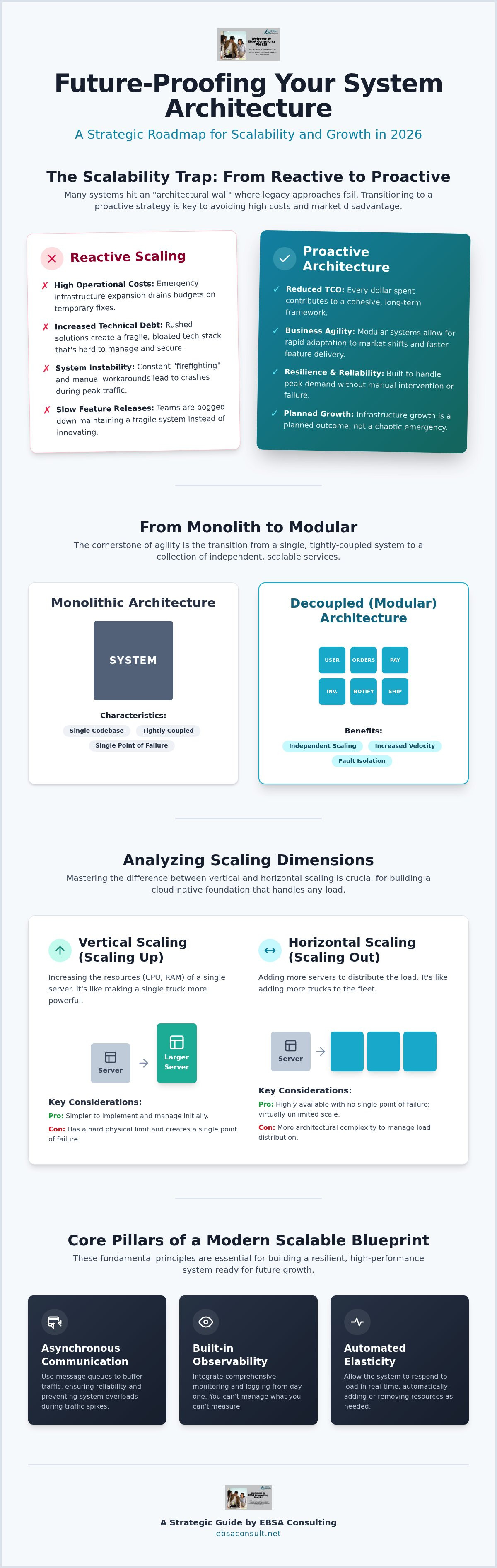
Many organizations in Singapore eventually encounter a point where adding more hardware no longer yields better performance. This is the architectural "wall." It's not just a minor technical bottleneck; it's a structural limitation that prevents your business from capturing new market opportunities. Traditional architectures often rely on monolithic designs that weren't built for the high-velocity, data-heavy requirements of 2026. By shifting your focus toward future-proofing system architecture, you can move away from reactive firefighting and toward a state of operational excellence where growth is a planned outcome rather than a chaotic emergency.
Identifying the Limits of Legacy Infrastructure
Symptoms of an aging system are often subtle before they become disruptive. You might notice longer load times during month-end processing or a growing reliance on manual "workarounds" to keep services online. These band-aid solutions create a fragile environment where the risk of failure during peak demand cycles, such as major regional shopping events or year-end financial reporting, becomes a hurdle that structured thinking must address. True Scalability isn't about surviving the next surge; it's about building a foundation that thrives under pressure without requiring constant, expensive intervention from your technical teams.
The Strategic Cost of Reactive Scaling
Reactive scaling is an expensive habit that drains your budget without providing long-term value. When infrastructure is expanded in an emergency, the focus is on immediate uptime rather than architectural integrity. This approach leads to fragmented data silos and a bloated tech stack that's difficult to manage and even harder to secure. By prioritizing future-proofing system architecture, you ensure that every S$ spent contributes to a cohesive, modular framework rather than a temporary patch. Technical debt acts as an anchor, dragging down your team's ability to release new features while your competitors accelerate past you with more agile systems.
The Scalability Gap represents the widening distance between an organization's actual technical capacity and the infrastructure requirements needed to fulfill its strategic business vision.
Defining a Modern Scalable System Architecture Strategy
Modern scalability isn't about chasing specific cloud vendor tools; it's a vendor-neutral methodology that prioritizes modularity and decoupling. A truly future-proof system is a framework designed to grow without requiring a total overhaul every three years. This requires a robust strategy where technical implementation strictly follows business logic. By focusing on future-proofing system architecture, you create a blueprint that remains resilient even as market demands in Singapore shift. This strategic approach ensures that your infrastructure doesn't just support the business but actively drives it forward.
Core Pillars of a Scalable Blueprint
Building for growth requires addressing data management in high-concurrency environments. Systems must handle simultaneous requests without data corruption or latency spikes, which is critical for Singapore's high-velocity digital economy. We achieve this through statelessness and asynchronous communication, often utilizing message queues to buffer traffic and ensure reliability. Observability must be baked into the design from day one. You can't manage what you can't see; therefore, comprehensive monitoring provides the steady visibility needed to maintain operational excellence. Automated elasticity allows your system to respond to load in real-time, reducing the need for manual intervention and lowering operational costs.
Decoupling for Business Agility
The transition from monolithic structures to modular solution architecture design is the cornerstone of organizational agility. When you decouple services, you allow high-demand business functions to scale independently without affecting the entire ecosystem. This modularity doesn't just improve technical performance; it reshapes your team structure and accelerates development cycles. Development velocity increases because teams can work on isolated components without risking global system failure. This independence is what allows a business to pivot quickly when new opportunities emerge.
A well-defined strategy reduces the inherent complexity of technical implementation. It provides a clear roadmap that synchronizes your tech stack with your business vision. If you're looking to bridge the gap between your current infrastructure and your 2026 goals, a partner like EBSA Consulting can provide the strategic guidance needed to align these moving parts. This approach ensures that future-proofing system architecture becomes a core competency rather than a one-time project. Your technical blueprints will then serve as strategic assets that accelerate your journey toward long-term efficiency and stability.
Analyzing Scaling Dimensions: Vertical, Horizontal, and Elastic
Choosing the right scaling dimension is a pivotal decision that dictates your long-term operational costs and system resilience. While technical teams often focus on raw performance, strategic leaders must evaluate how these choices impact the bottom line and business agility. Successfully future-proofing system architecture requires a nuanced understanding of when to scale up, when to scale out, and how to automate the entire process to match the erratic demands of the 2026 digital marketplace.
Vertical vs. Horizontal Scaling Framework
Vertical scaling, or scaling up, involves adding more power to an existing server. It's a straightforward approach that works well for legacy applications or predictable, low-traffic workloads. However, it inevitably hits a performance ceiling where hardware limits and diminishing returns make it financially unsustainable. In contrast, horizontal scaling, or scaling out, adds more nodes to your system. This model serves as the foundation for modern cloud-native growth because it offers virtually unlimited expansion. It's a core component of a sophisticated technical solution design process, allowing for high availability and fault tolerance that vertical models simply can't match. For most Singaporean enterprises, a hybrid approach works best, utilizing vertical scaling for stable database cores while scaling horizontally for front-facing services.
The Rise of Serverless and Elastic Architectures
Elasticity takes scaling a step further by automating the adjustment of resources in real-time. This is where serverless computing has become a strategic advantage. By shifting the burden of infrastructure management to the provider, businesses can adopt a "pay-as-you-grow" model. This ensures you aren't paying for idle capacity during low-traffic periods, which can save thousands of S$ in annual cloud spend. While these distributed systems introduce new complexities in monitoring and data consistency, the trade-off is a highly responsive architecture that aligns perfectly with fluctuating market conditions. Managing this complexity requires a steady hand and a clear roadmap, but the result is a system that remains robust under any load.
For 2026 budgets, the cost-benefit analysis favors horizontal and elastic models for any high-growth initiative. While the initial setup might require more investment in future-proofing system architecture, the long-term ROI is significantly higher. You avoid the "rip-and-replace" cycles common with vertical scaling and gain the ability to scale down during off-peak hours, directly protecting your margins. This strategic alignment between infrastructure spend and actual usage is essential for maintaining a competitive edge in Singapore's fast-paced economic environment.
Building Your Strategic Architectural Roadmap
Developing a roadmap for growth requires moving beyond immediate technical needs to consider long-term organizational capacity. You must start with a rigorous assessment of your current enterprise and business architecture to identify where bottlenecks reside. By defining a target state based on 3-year growth projections, you create a destination that informs every subsequent technical decision. Successfully future-proofing system architecture isn't about a single "big bang" migration; it's about a disciplined, phased approach that maintains operational continuity while steadily improving performance.
Phase 1: Business Capability Mapping
This phase focuses on identifying which business functions drive the most technical load, such as transaction processing or real-time data analytics. By aligning your IT infrastructure with core business architecture services, you ensure that every technical improvement delivers measurable business value. Prioritizing architectural changes based on business impact allows you to address the most critical vulnerabilities first, ensuring that resources are allocated where they can most effectively support growth. This synchronization prevents the common mistake of over-engineering low-impact systems while critical functions remain under-resourced.
Phase 2: Designing the Technical Blueprint
Once business capabilities are mapped, the next step involves translating these requirements into tangible enterprise architecture consulting outputs. This technical blueprint serves as the master plan for selecting a technology stack that offers long-term sustainability rather than just immediate cost savings. A phased roadmap ensures technical transformation proceeds at a pace the organization can absorb, significantly reducing the likelihood of service interruptions. Selecting the right stack involves evaluating vendor-neutral frameworks that prevent lock-in and provide the flexibility needed for future expansions.
Establishing a governance framework is the final piece of the roadmap, ensuring that architectural integrity is maintained as new features are added. This structured thinking prevents the creep of technical debt and keeps your systems synchronized with your vision. If you need assistance in developing a customized blueprint for your organization, EBSA Consulting provides the specialized expertise to bridge the gap between your current state and a scalable future. This partnership-driven approach ensures that future-proofing system architecture remains a steady, manageable process rather than an overwhelming organizational challenge.
Partnering for Strategic Solution Architecture Design
Scaling an enterprise isn't merely a matter of increasing server capacity; it's a complex organizational evolution that requires a bridge between high-level vision and technical blueprints. EBSA Consulting serves as this essential link, helping organizations in Singapore navigate the intricate process of future-proofing system architecture. By providing a steady, expert presence, we ensure that your technical infrastructure matures in lockstep with your strategic growth objectives. This alignment is what transforms a fragile system into a resilient asset capable of supporting rapid market expansion.
The EBSA Approach to Scalable Systems
Our methodology is rooted in collaborative consulting that reshapes organizational infrastructure through structured thinking. We prioritize vendor-neutral expertise, which allows us to select the most resilient frameworks without being tethered to specific software products. This independence is crucial for maintaining long-term reliability and achieving operational excellence. We focus on reducing the friction of digital transformation by providing expert guidance that translates business capability mapping into high-performance technical designs. This approach ensures that technical debt is systematically addressed rather than allowed to accumulate as an anchor on your innovation velocity.
Navigating Transition Without Disruption
Modernizing a system while maintaining active business operations requires a high degree of composure and meticulous planning. We provide the strategic foresight needed to manage these complex changes without disrupting your current service delivery. Our role as a visionary innovator is grounded in proven methodologies that prioritize business continuity above all else. This steady demeanor reassures your leadership team that future-proofing system architecture is a manageable journey rather than a source of operational stress. We act as your close collaborator, invested in every phase of your transformation from the initial assessment to the final implementation.
For organizations currently facing system crashes during peak traffic or the high costs of manual scaling, the next step involves a shift from reactive fixes to proactive strategy. The path toward a decoupled, modular framework begins with a clear understanding of your target state architecture. You can consult with EBSA on your scalable system architecture strategy to discover how our specialized expertise can synchronize your tech stack with your long-term business vision for 2026 and beyond.
Building a Resilient Foundation for Singapore’s 2026 Digital Landscape
Transitioning from the scalability trap to a modular, decoupled framework is the only way to maintain business velocity as market demands evolve. By focusing on future-proofing system architecture, you ensure that your technical infrastructure remains a driver of growth rather than a source of technical debt. We've explored how a phased roadmap, supported by horizontal and elastic scaling, provides the necessary stability to handle the high-concurrency demands of the modern digital economy. This transition requires a composed approach that balances immediate performance with long-term reliability.
Success requires a strategic synchronization of your enterprise, business, and solution architecture. EBSA Consulting provides the vendor-neutral guidance and Singapore-based expertise needed to bridge the gap between your vision and your technical reality. Our collaborative approach ensures your technical blueprints are precisely aligned with your 3-year growth projections, providing a steady path toward operational excellence. Partner with EBSA Consulting for a Scalable Architecture Strategy to reshape your infrastructure for a more efficient and stable future. Your journey toward transformation starts with a single, structured step toward strategic alignment.
Frequently Asked Questions
What is the difference between scalability and elasticity in system architecture?
Scalability is the system's ability to handle growing workloads by adding resources, while elasticity is the ability to automatically scale those resources up or down in real-time based on actual demand. Scalability represents the potential for growth. Elasticity represents the automated management of that growth. In a high-velocity market like Singapore, elasticity is vital for cost-efficiency, ensuring you only pay for the infrastructure you use during peak traffic periods.
When should a company move from a monolithic to a microservices architecture?
You should consider moving to microservices when your monolithic structure becomes a bottleneck for development velocity or when specific business functions require independent scaling. If a single change to your codebase requires a full system redeploy, it's a sign that decoupling is necessary. This shift allows teams to work on isolated components, accelerating feature releases. However, this transition requires careful solution architecture design to manage the increased complexity of distributed systems.
How does technical debt affect a scalable system architecture strategy?
Technical debt acts as an anchor that slows down your ability to implement a scalable system architecture strategy. It forces your team to spend more time on maintenance and "band-aid" fixes rather than innovation. Over time, the cost of managing this debt can exceed the cost of a strategic rebuild. Successfully future-proofing system architecture involves identifying these high-interest debts and systematically replacing them with modular, decoupled structures that support long-term growth.
Can legacy systems be made scalable without a full rebuild?
Yes, legacy systems can often be made more scalable without a total rebuild through strategies like "strangler patterns" or wrapping them in modern APIs. By slowly offloading specific high-demand functions to new, modular services, you can extend the life of your core systems while improving overall performance. This approach reduces the risk of catastrophic failure and allows for a phased modernization that aligns with your organization's budget and operational capacity.
What role does business architecture play in technical scaling?
Business architecture provides the critical mapping of capabilities that informs where technical scaling is most needed. It ensures that your IT infrastructure is synchronized with your core value streams rather than being scaled in a vacuum. By identifying which business functions drive the most value, you can prioritize architectural investments that yield the highest impact. This strategic alignment prevents over-engineering and ensures that your tech stack directly supports your long-term business vision.
How do you measure the ROI of a scalable architecture strategy?
Measuring the ROI of a scalable architecture involves tracking reductions in operational costs, improved system uptime, and increased development velocity. You should also consider the "cost of inaction," such as revenue lost during system crashes or the high price of manual scaling. In Singapore's competitive landscape, a more agile system allows you to capture market share faster. These improvements in efficiency and reliability directly contribute to a healthier bottom line over a three-year horizon.
What are the most common mistakes in designing for scale?
The most common mistakes include over-engineering for hypothetical loads, ignoring data consistency in distributed systems, and failing to bake in observability from the start. Many organizations also fall into the trap of vendor lock-in by relying too heavily on specific cloud tools rather than vendor-neutral strategies. future-proofing system architecture requires a balanced approach that addresses immediate bottlenecks while maintaining the flexibility to swap components as your business needs or technology options evolve.
Is cloud migration necessary for a scalable architecture?
Cloud migration isn't strictly mandatory for scalability, but it's often the most cost-effective way to achieve high elasticity and horizontal growth. Modern on-premise solutions using containerization and orchestration can also scale effectively. However, the cloud offers a "pay-as-you-grow" model that is difficult to replicate with physical hardware. The decision should be based on your specific security requirements, regulatory constraints in Singapore, and the long-term total cost of ownership for your infrastructure.


