

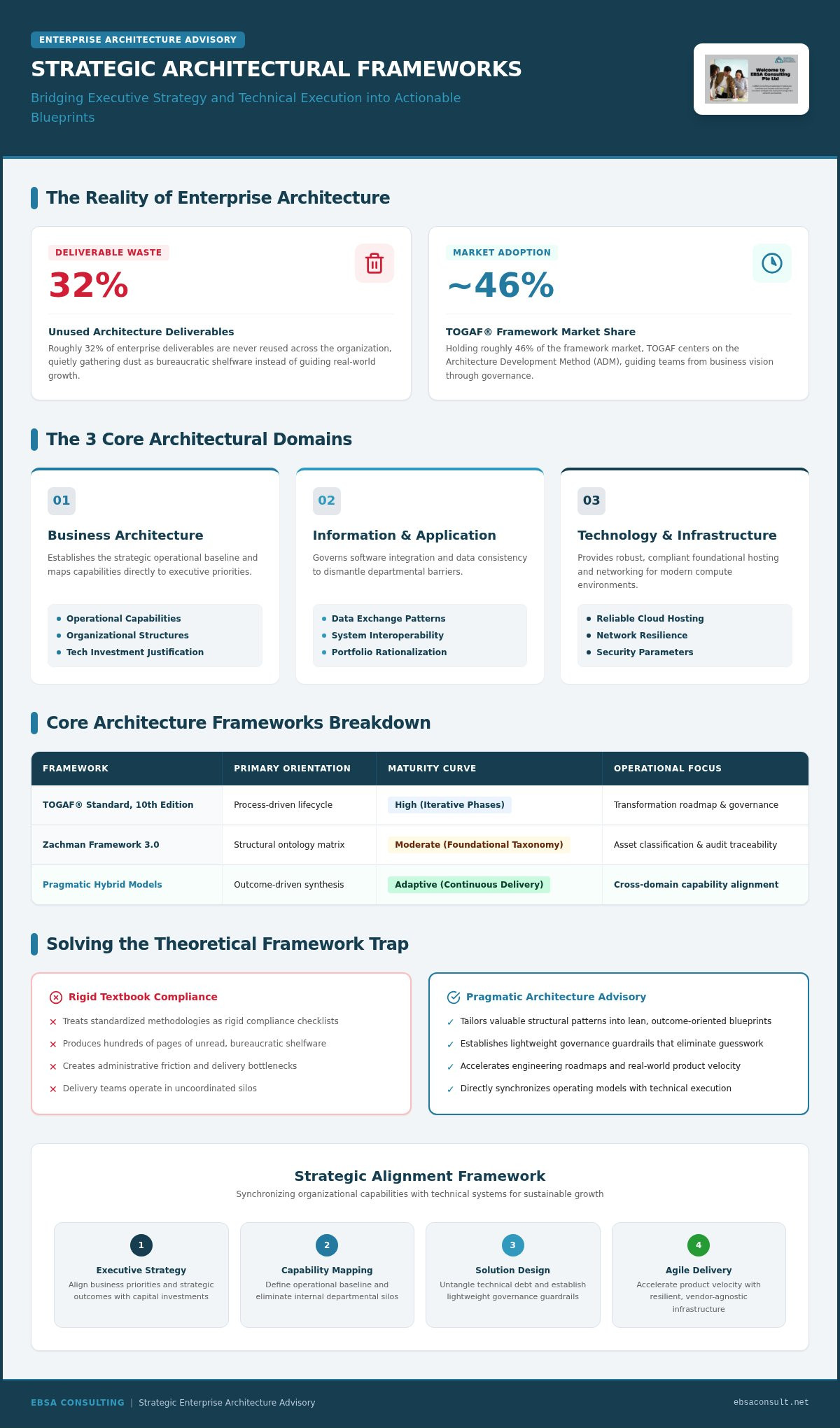
Roughly 32% of enterprise architecture deliverables are never reused across the organization, quietly gathering dust instead of guiding business growth. When standardized frameworks devolve into bureaucratic shelfware, delivery teams work in uncoordinated silos while leadership struggles to track the return on technology investments. You already recognize that your enterprise can't afford this widening disconnect between executive strategy and technical reality. That is why partnering for strategic architectural frameworks consulting has shifted from an exercise in theoretical compliance to a vital driver of real-world operational agility.
Off-the-shelf methodologies frequently introduce administrative friction, yet effective architecture should empower delivery teams rather than obstruct innovation. In this 2026 guide, you'll discover how specialized consulting transforms rigid theoretical models into pragmatic, business-driven enterprise blueprints that directly synchronize operating models with technical systems. We'll examine how forward-looking organizations successfully tailor established industry frameworks, untangle accumulated technical debt, and build collaborative governance roadmaps that deliver immediate strategic clarity.
Key Takeaways
- How partnering for strategic architectural frameworks consulting converts rigid, theoretical methodologies into flexible blueprints designed around distinct business objectives.
- The practical trade-offs between process standards like TOGAF and structural taxonomies like Zachman, and why enterprises thrive on tailored hybrid models.
- Proven methods for neutralizing internal silos between executive strategy and technical implementation to ensure governance accelerates delivery instead of stalling it.
- A structured vetting framework to identify truly vendor-agnostic architecture practices while avoiding firms tied to software reselling or staffing agendas.
- Actionable steps for synchronizing business capabilities, solution architecture designs, and core enterprise systems into a unified roadmap for sustainable growth.
What Is Strategic Architectural Frameworks Consulting?
Strategic architectural frameworks consulting is an advisory practice that bridges executive business strategy and complex technical execution. While general management consulting often delivers high-level theories that don't translate to implementation, true architectural advisory anchors corporate vision directly to operational realities. An enterprise architecture framework provides the foundational structure for defining how an organization's business processes, information flows, and technology components operate as an integrated whole. Rather than viewing technology as an isolated operational cost, specialized consultants evaluate enterprise objectives and translate them into unified blueprints that govern ongoing capital investments.
The Core Domains of Architectural Frameworks
A resilient framework synchronizes several interdependent layers to prevent delivery bottlenecks. Engaging professional business architecture services establishes the strategic baseline, identifying critical organizational capabilities and mapping them directly to executive priorities. This operational foundation links smoothly with downstream technical disciplines:
- Business Architecture: Defines operational capabilities, organizational structures, and strategic outcomes that justify technology investments.
- Information and Application Architecture: Governs data exchange patterns, system interoperability, and enterprise software portfolios to eliminate departmental silos.
- Technology and Infrastructure Architecture: Establishes reliable hosting, network resilience, and security parameters that support modern cloud computing environments.
Overcoming the Theoretical Framework Trap
Textbook framework implementations often fail because organizations treat standardized methodologies as rigid compliance checklists rather than practical decision-making tools. When internal teams attempt to implement every artifact of a textbook methodology verbatim, the initiative collapses into hundreds of pages of unread shelfware. Effective strategic architectural frameworks consulting avoids dogmatic compliance. Instead, it extracts the valuable structural patterns of established methodologies and tailors them into lean, outcome-oriented blueprints. Pragmatic architecture creates lightweight governance guardrails that eliminate guesswork, clarify engineering roadmaps, and accelerate product velocity without adding bureaucratic red tape.
Comparing Core Frameworks: TOGAF, Zachman, and Tailored Hybrids
Selecting an enterprise structure requires balancing comprehensive taxonomy against operational agility. While general cloud accelerators focus narrowly on single-vendor tooling, enterprise-wide transformations demand models that coordinate disparate business units, legacy stacks, and emerging technologies. Professional strategic architectural frameworks consulting evaluates these formal methodologies not as immutable doctrines, but as foundational patterns to adapt for organizational velocity.
| Framework | Primary Orientation | Maturity Curve | Operational Focus |
|---|---|---|---|
| TOGAF® Standard, 10th Edition | Process-driven lifecycle | High (iterative phases) | Transformation roadmap & governance |
| Zachman Framework 3.0 | Structural ontology matrix | Moderate (foundational taxonomy) | Asset classification & audit traceability |
| Pragmatic Hybrid Models | Outcome-driven synthesis | Adaptive (continuous delivery) | Cross-domain capability alignment |
The Open Group Architecture Framework (TOGAF)
Holding roughly 46% of the framework market, the TOGAF® Standard centers on the Architecture Development Method (ADM). This iterative cycle guides teams from business vision through governance. However, organizations often stumble when adopting every ADM phase sequentially. Specialized consulting prunes non-essential deliverable gates, converting an otherwise slow process into dynamic sprints suited for fast iterations.
The Zachman Framework for Enterprise Architecture
The Zachman Framework 3.0 functions as a comprehensive 6x6 classification ontology rather than a step-by-step process. By mapping fundamental questions (what, how, where, who, when, why) against stakeholder views from executive to developer, it provides unmatched asset visibility. This rigorous traceability makes Zachman exceptional for regulatory compliance and audit readiness in complex technical environments.
Industry-Specific Extensions and Modern Hybrid Models
Modern enterprises rarely rely on a single framework. Highly regulated sectors integrate domain extensions, such as BIAN for banking microservices or Frameworx for telecommunications operations. A seasoned strategic partner synthesizes the taxonomic clarity of Zachman with the process discipline of TOGAF, connecting high-level enterprise standards directly to the strategic solution architecture design process. Organizations seeking to establish these harmonized operating blueprints can explore tailored enterprise frameworks with EBSA Consulting to balance rapid innovation with resilient governance.
Why Engage an Architectural Frameworks Consulting Partner?
Internal modernization efforts often stall behind corporate politics, conflicting department priorities, and entrenched historical practices. While internal teams understand existing pain points, they frequently carry institutional blind spots that complicate systemic change. Engaging external partners for strategic architectural frameworks consulting introduces cross-industry benchmarking and fresh clarity. Experienced advisors evaluate enterprise systems against proven market patterns, helping leadership avoid expensive trial-and-error cycles while building structured consensus across executive leadership, line-of-business operators, and engineering teams.
Neutral Perspective and Governance Objectivity
Reporting structures inside large enterprises inevitably introduce bias into technical evaluations. Specialized business units often lobby for point solutions that solve immediate symptoms while splintering long-term enterprise cohesion. An objective, vendor-agnostic architecture partner operates without internal career pressures or vendor reseller quotas. This neutrality ensures every technology investment directly advances corporate strategy:
- Unbiased Technology Audits: Evaluates commercial platforms based strictly on functional capability, total cost of ownership, and interoperability rather than vendor alliances.
- Equitable Capital Allocation: Establishes clear, objective scoring models that justify technical initiatives against measurable executive goals.
- Cross-Department Consensus: Bridges operational divisions, converting conflicting departmental requests into a harmonized transformation roadmap.
Accelerating Strategic Value and Controlling Technical Debt
Uncoordinated technology purchases create massive tool sprawl, duplicated licensing fees, and fragile point-to-point integrations. Over time, the cost of simply maintaining these patchwork systems drains capital away from growth initiatives. A tailored framework creates clear boundaries that curb redundant spending while fostering an adaptable foundation for enterprise architecture for innovation. By rationalizing software portfolios, standardizing shared service boundaries, and retiring legacy bloat, strategic architectural frameworks consulting frees up critical development capacity. This disciplined alignment ensures enterprise capital supports sustainable business agility and measurable revenue performance rather than reactive operational repairs.
How to Evaluate and Select the Right Architecture Consulting Firm
Selecting the right advisory partner determines whether your framework becomes an engine of business acceleration or an expensive exercise in shelfware. Many traditional consulting networks treat enterprise architecture as an avenue to upsell proprietary software licenses, cloud vendor tiers, or large staffing contracts. When vetting practices for strategic architectural frameworks consulting, enterprise leaders need an objective partner focused solely on high-value architectural clarity rather than software reselling or resource leasing.
Consider this five-step framework during your partner evaluation process:
- Verify absolute vendor independence: Confirm the firm doesn't accept reseller commissions, software partner kickbacks, or placement bounties that bias technical recommendations.
- Test dual fluency: Ensure consultants demonstrate equal depth discussing financial operating models with the executive suite and discussing integration patterns with lead software engineers.
- Demand tailored methodologies: Inquire how they prune standard frameworks to fit your specific organizational tempo, rather than accepting generic templates.
- Evaluate operational governance design: Review how their deliverables translate theoretical taxonomies into active, day-to-day decision-making guardrails for engineering teams.
- Prioritize knowledge transfer: Require a transparent handover plan from inception so internal teams build the competency to sustain the architecture independently.
Core Capabilities and Vendor Independence
True architectural integrity demands uncompromised objectivity. When consultancies depend on secondary revenue streams like software resale margins or long-term staffing placements, their architectural blueprints predictably favor complex, costly tech stacks. An authentic architecture firm concentrates purely on advisory value, evaluating legacy mainframe migrations, modern event-driven microservices, and multi-cloud strategies based strictly on your balance sheet and operational requirements.
Engagement Models: Advisory, Fractional, and Embedded Teams
Enterprise requirements dictate different engagement shapes. Milestone-driven sprints work well for establishing initial capability maps and governance baselines, while retainer-based fractional enterprise architects provide continuous strategic guidance during complex digital transformations. In both scenarios, the consulting team must operate as a collaborative mentor rather than an aloof auditor. They should establish transparent exit criteria early, systematically upskilling your staff so long-term governance remains entirely in-house. To establish an adaptable, conflict-free roadmap for your organization, schedule an advisory discussion with EBSA Consulting to align your technical blueprints with core enterprise goals.
Operationalizing Architectural Frameworks with EBSA Consulting
Transitioning from conceptual strategy to real-world operational execution requires a structured, collaborative lifecycle. EBSA Consulting delivers fee-based professional consulting for enterprise, business, and solution architecture, operating nationally as an objective advisory partner. Without the distractions of selling software licenses, staffing contracts, or managed IT services, our focus remains squarely on building unified architecture blueprints. By harmonizing foundational business capabilities with downstream solution designs, our engagements ground high-level vision directly within everyday technical delivery, expanding upon the core principles established in our guide to strategic enterprise architecture consulting.
Phase 1: Architecture Maturity Assessment and Strategic Baseline
Modernization begins with deep structural discovery rather than prepackaged assumptions. Our advisors conduct structured interviews with executive leaders, product owners, and technical directors to evaluate how current systems support overarching commercial goals. We perform comprehensive audits of existing digital assets, data exchange interfaces, and accumulated technical debt. By benchmarking these findings against formal maturity models, we establish an objective baseline that clarifies exactly where governance gaps and architectural bottlenecks impede organizational velocity.
Phase 2: Custom Framework Design and Governance Tailoring
A framework must match an organization's specific delivery cadence. During this stage of strategic architectural frameworks consulting, we extract relevant patterns from established standards like TOGAF and Zachman to synthesize a lean, business-driven operating model. We establish practical governance structures by defining:
- Pragmatic Review Charters: Restructuring the Architecture Review Board (ARB) from an administrative bottleneck into an agile advisory body that accelerates delivery.
- Decision Rights Matrices: Clarifying ownership boundaries between central enterprise architects, domain solution teams, and line-of-business product squads.
- Lightweight Documentation Standards: Replacing encyclopedic manuals with living, modular architecture blueprints focused on technical risk mitigation and capability reuse.
Phase 3: Blueprint Execution and Continuous Capability Transfer
Frameworks prove their value only when applied to active initiatives. We pilot tailored governance guardrails on flagship transformation programs, ensuring new systems align seamlessly with defined capability maps. Throughout the rollout, our senior consultants lead hands-on mentoring sessions with your staff. This deliberate capability transfer instills structured thinking within internal engineering teams, establishing continuous feedback loops and durable governance that protect your architectural health long after the engagement concludes.
Architecting Your Enterprise for Resilient Future Growth
Architectural excellence isn't measured by the volume of diagrams your teams produce; it's proven through actionable, business-driven delivery. When theoretical models are tailored into lean, pragmatic hybrids, enterprise architecture ceases to be an administrative hurdle and becomes a vital catalyst for organizational velocity. Investing in specialized strategic architectural frameworks consulting ensures your enterprise dismantles departmental silos, curbs technical debt, and maintains complete strategic clarity across every digital initiative.
As an objective, vendor-agnostic advisory firm specializing exclusively in enterprise, business, and solution architecture, EBSA Consulting bridges high-level executive vision and technical execution without the conflicting incentives of software reselling or managed IT contracts. You don't have to navigate complex legacy modernizations or governance rollouts alone. Partner with EBSA Consulting to build your tailored architectural framework, and establish the structural confidence your organization needs to thrive in an evolving market.
Frequently Asked Questions
What is the difference between an architectural framework and an architecture methodology?
An architectural framework provides the conceptual structure and taxonomy for organizing enterprise assets, while a methodology defines the sequential process for developing and maintaining them. Think of a framework as the classification schema, such as the Zachman matrix. A methodology, such as the Architecture Development Method within TOGAF, outlines the step-by-step procedures and governance gates required to plan, evaluate, and execute those architectural elements across projects.
Why do so many enterprise framework implementations fail to deliver business value?
Implementations predominantly fail when organizations treat frameworks as dogmatic compliance checklists rather than adaptable decision-making tools. When internal architecture teams prioritize exhaustive documentation over solving immediate business challenges, deliverables become disconnected from engineering reality. Engaging specialized strategic architectural frameworks consulting prevents this trap by pruning non-essential deliverables and calibrating frameworks to prioritize delivery velocity, business outcomes, and active software engineering enablement.
How long does a strategic architectural frameworks consulting engagement typically take?
A typical initial engagement spans three to six months to establish a customized baseline, governance structure, and pilot rollout. The initial architecture maturity assessment generally requires three to four weeks. Designing the tailored operating model and establishing review board charters takes another month. The remaining time focuses on piloting governance across active initiatives and conducting hands-on capability transfer, often followed by fractional advisory support.
Can an architectural framework be integrated with agile and DevOps environments?
Yes, modern architectural frameworks integrate directly with agile cadences by replacing rigid approval gates with automated guardrails and sprint-aligned advisory. Instead of demanding massive technical specifications before coding begins, an adaptive framework establishes high-level architecture principles, modular capability boundaries, and shared interface standards. Architects work alongside squad leads within release trains, guiding decisions in real time to accelerate velocity without sacrificing enterprise stability.
How do consultants decide whether TOGAF or Zachman is best for our organization?
Selection depends on whether your organization primarily requires a transformation roadmap process or an exhaustive structural inventory. Organizations managing multi-year digital modernizations benefit from TOGAF's process-driven lifecycle. Conversely, enterprises facing stringent regulatory audits, complex asset reporting, or extensive data governance requirements lean toward Zachman's rigorous taxonomy. In most enterprise engagements, advisors build a hybrid model that blends Zachman's classification depth with TOGAF's agile delivery workflows.
What key deliverables should our leadership expect from an architectural framework advisory project?
Leadership should expect actionable governance charters, business capability maps, target-state blueprints, and a phased transformation roadmap. High-value deliverables avoid theoretical jargon. They provide an enterprise capability model linking strategic goals to core systems, an Architecture Review Board charter with clear decision rights, lean architecture decision records, and practical transition roadmaps. Reputable advisors also provide structured mentoring sessions so internal teams can sustain governance independently.
How does strategic architecture consulting help reduce long-term enterprise technology debt?
Strategic architecture consulting curbs technical debt by instituting unified platform standards and eliminating redundant technology investments. By mapping systems against business capabilities, advisors uncover overlapping software licenses, obsolete frameworks, and fragile custom integrations. Professional strategic architectural frameworks consulting establishes clear architectural guardrails for new projects, preventing departments from procuring siloed point solutions. This continuous governance ensures existing systems are methodically refactored, preserving capital for commercial innovation.


