

True architecture maturity isn't measured by rigid framework compliance; it's proven by how rapidly and reliably your organization executes strategic change. If your leadership team views architectural governance as a bureaucratic bottleneck rather than an engine for growth, you're not alone. When disparate business units operate with disconnected systems and isolated data, measuring baseline capabilities across every division can feel like an uphill battle. Conducting a structured enterprise architecture maturity assessment changes that dynamic, transforming architectural oversight from an administrative hurdle into a proactive driver of operational agility and sustained innovation.
In this 2026 strategic guide, you'll discover how to evaluate, benchmark, and elevate your architectural capabilities to secure measurable alignment between complex technology investments and high-level business goals. We examine how to establish an objective baseline across all enterprise domains, demystify which modern framework best fits your operating reality, and craft an executive-ready capability roadmap that reduces technical debt while accelerating organizational decision-making. Here is your path to turning enterprise architecture into your organization's clearest competitive advantage.
Key Takeaways
- An enterprise architecture maturity assessment measures real business value delivery and organizational agility rather than superficial compliance with rigid frameworks.
- Established models such as TOGAF ACMM and Gartner EAMM provide critical benchmarking structures, but high-performing teams tailor these frameworks to match their specific operating context.
- Evaluating multiple domains, especially business architecture alignment and solution design, bridges the gap between everyday technology investments and overarching executive goals.
- A structured, collaborative assessment methodology removes organizational blind spots and builds consensus across disparate business units.
- Actionable multi-horizon roadmaps focus on practical, high-impact capability uplifts rather than the unrealistic pursuit of immediate Level 5 perfection across every domain.
What Is an Enterprise Architecture Maturity Assessment?
An enterprise architecture maturity assessment evaluates an organization's structural capability to deliver strategic technology outcomes. Rather than grading static documentation, architectural maturity gauges how effectively an enterprise reduces technical debt, manages architectural risk, and accelerates business agility. It benchmarks your current practices across governance, capability design, and system integration against proven industry standards.
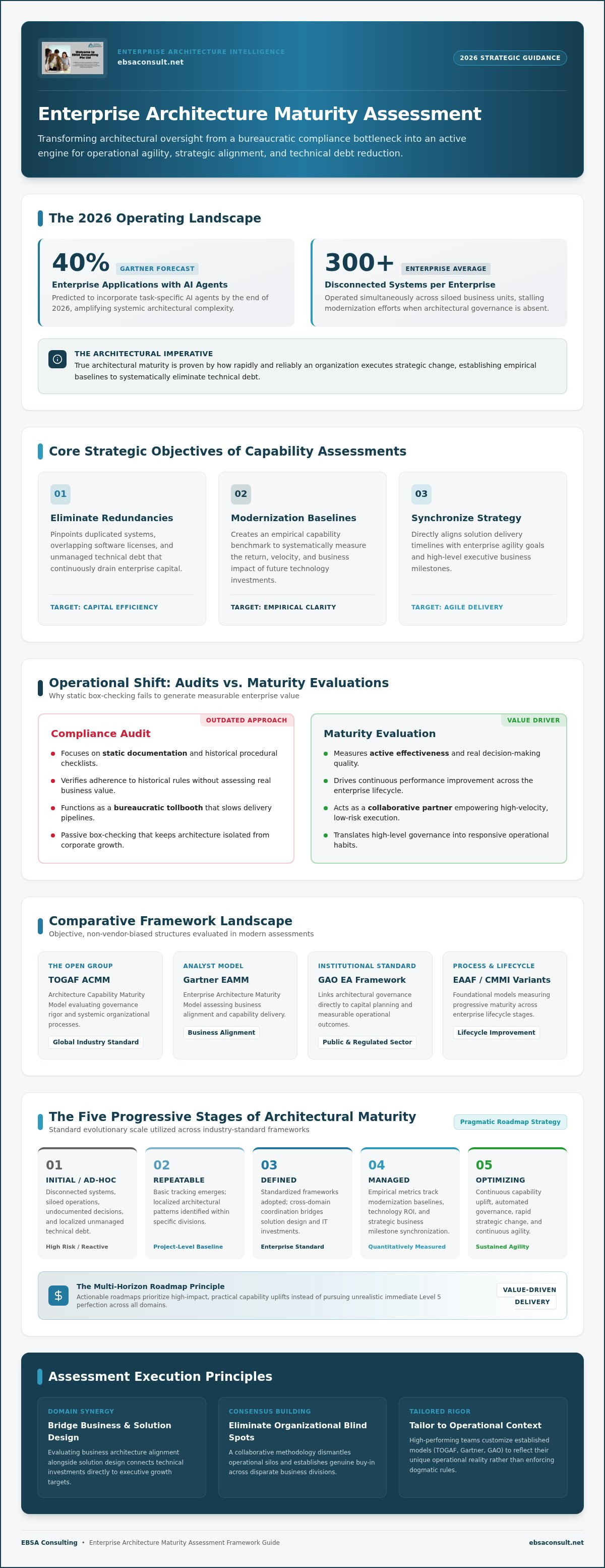
Digital transformation success in 2026 hinges on this capability baseline. Gartner predicts that 40% of enterprise applications will incorporate task-specific AI agents by the end of 2026, yet the average enterprise operates more than 300 disconnected systems. When architecture operates in silos, modernization efforts stall. A comprehensive enterprise architecture maturity assessment provides the empirical clarity leaders need to transform technical design from an isolated IT exercise into an active engine for corporate growth.
Core Objectives of Architectural Capability Assessments
A rigorous assessment delivers direct operational clarity across complex corporate environments by fulfilling three core strategic objectives:
- Eliminating operational redundancies: Pinpointing duplicated systems, overlapping software licenses, and unmanaged technical debt that drain capital resources.
- Establishing objective modernization baselines: Creating an empirical benchmark to measure the return, velocity, and impact of future technology investments.
- Synchronizing execution with strategy: Aligning solution delivery timelines directly with enterprise agility goals and high-level business milestones.
The Distinction Between Compliance Audits and Maturity Evaluations
Too many organizations confuse regulatory box-checking with genuine architectural maturity. A traditional compliance audit inspects adherence to static repository guidelines, historical design documentation, and rigid procedural checklists. These audits tell leadership whether teams followed historical rules, but they reveal almost nothing about whether those rules actually generated enterprise value.
In contrast, a maturity evaluation examines the active effectiveness of architectural decision-making. Early frameworks such as the federal Enterprise Architecture Assessment Framework (EAAF) demonstrated that architectural success relies on continuous performance improvement across the enterprise lifecycle rather than passive documentation. Today, leading organizations leverage strategic architectural frameworks consulting to translate high-level governance into responsive operational habits. Mature architecture programs don't act as bureaucratic tollbooths; they function as collaborative partners that empower teams to make high-velocity, low-risk architectural decisions.
Comparative Breakdown: Established EA Maturity Frameworks
Selecting the right framework is what separates a transformative enterprise architecture maturity assessment from a shelfware exercise. While software vendor models often focus narrowly on cataloging applications, established industry models evaluate systemic organizational capability. Proven frameworks like The Open Group Architecture Framework Architecture Capability Maturity Model (TOGAF ACMM), Gartner's Enterprise Architecture Maturity Model (EAMM), and CMMI-based variants provide objective structures to assess governance rigor, business alignment, and technology standardization without vendor bias.
Public-sector and highly regulated private entities often turn to institutional standards such as the GAO Enterprise Architecture Management Maturity Framework, which links architectural oversight directly to capital planning and measurable operational results. Regardless of the specific framework chosen, each relies on a progressive evolutionary model to diagnose current capabilities and define practical target states.
The Five Progressive Stages of Architectural Maturity
Most industry frameworks structure capability progression across five distinct stages, giving leaders a clear scale for measurement:
- Stage 1 (Initial): Characterized by fragmented, ad-hoc, and undocumented technology decision-making. Individual project teams resolve technical problems in isolation, creating unmanaged technical debt and overlapping tools.
- Stage 2 (Under Development): Localized architecture efforts emerge. Teams create project-specific documentation and standard patterns, but enterprise-wide synchronization remains weak.
- Stage 3 (Defined): A formal enterprise architecture practice exists with standardized governance, repeatable review cycles, and consistent modeling using standards like ArchiMate 3.2 or TOGAF 10th Edition guides.
- Stage 4 (Managed): Architecture metrics directly track business outcomes. Systems portfolio decisions are quantitatively managed, and digital investments map directly to strategic capabilities.
- Stage 5 (Optimizing): The enterprise architecture practice continuously improves through automated feedback loops, driving proactive business innovation and agile operating model shifts.
Selecting the Appropriate Framework for Your Organization
Framework selection must match organizational context rather than theoretical perfection. Highly regulated enterprises facing strict compliance demands often benefit from CMMI or federal models that emphasize rigorous controls. Fast-moving commercial enterprises often prefer Gartner EAMM or adapted TOGAF ACMM models, which prioritize business agility and rapid solution delivery over exhaustive documentation.
The goal isn't to adopt a massive framework in its entirety. High-performing teams adapt and streamline these models to reflect their operating complexity, internal resource constraints, and digital maturity goals. If your team is evaluating the right methodology for an upcoming enterprise architecture maturity assessment, partnering with seasoned specialists in Enterprise Architecture Consulting can help tailor these established frameworks to deliver pragmatic, executive-level clarity.
Essential Evaluation Dimensions for Comprehensive Assessments
A reliable enterprise architecture maturity assessment cannot rely on a single vantage point. Auditing software inventories or server counts in isolation overlooks the organizational mechanisms that translate technology into tangible business outcomes. To construct a defensible baseline, an evaluation must examine three intersecting dimensions: strategic capability alignment, governance discipline, and portfolio vitality.
Strategic Alignment and Business Capability Integration
Blueprints that fail to mirror corporate priorities lead to wasted capital and fragmented tooling. This dimension examines how effectively technical architectures support core operational value streams and organizational goals. Leveraging structured business architecture services helps leaders evaluate capability mapping accuracy with precision. It confirms whether architects actively participate in corporate strategic planning cycles or are simply summoned after major investments are already committed.
Governance, Standards, and Architecture Stewardship
Governance should accelerate sound decision-making rather than impede it. This evaluation dimension scrutinizes the structure, authority, and turnaround velocity of your Architecture Review Board. It inspects how teams document architectural decisions, enforce technology lifecycle policies, and manage standard variance exceptions. According to industry research by Avolution, 32% of enterprise architecture deliverables are never reused by the broader organization. A thorough enterprise architecture maturity assessment inspects whether your governance artifacts actively inform engineering roadmaps or merely gather dust in unread repositories.
Technical Portfolio Health and Modernization Velocity
The final dimension evaluates the health and agility of the underlying technology stack. Assessors inspect technical debt accumulation, obsolescence risks, and API connectivity across disparate business units. Key evaluation areas include:
- Lifecycle dependencies: Tracking software support expirations and critical third-party vendor risks before they trigger outages.
- Interoperability standards: Evaluating API platforms, common data models, and system-to-system connectivity across distributed teams.
- Delivery velocity: Quantifying the drag that legacy architectural debt imposes on new feature rollouts and modernization programs.
How to Conduct an Enterprise Architecture Assessment Step by Step
Executing an enterprise architecture maturity assessment requires a collaborative diagnostic roadmap rather than a top-down audit. When assessments operate merely as academic exercises, organizations end up with dense reports that sit on digital shelves. A phased methodology balances rigorous quantitative evaluation with meaningful stakeholder consensus across business units.
A complete assessment cycle progresses through four distinct operational phases:
- Phase 1 (Scoping): Define organizational boundaries, identify executive sponsors, and articulate strategic goals to align expectations across divisions.
- Phase 2 (Discovery): Gather architecture repositories, design standards, and governance logs while conducting qualitative interviews with leaders.
- Phase 3 (Analysis): Benchmark capability scores against industry peers to pinpoint operational friction points and capability deficits.
- Phase 4 (Strategy): Translate diagnostic conclusions into pragmatic remediation workstreams with measurable business milestones.
Stakeholder Engagement and Qualitative Fact-Finding
Numbers tell only half the story. Qualitative discovery uncovers the real-world friction between strategic intent and everyday implementation. Assessors must conduct structured interviews across business line leaders, engineering heads, and solution designers to uncover where governance feels cumbersome or where architectural guidance arrives too late.
Internal teams often struggle with political blind spots or cognitive bias during self-assessments. Engaging external advisors through strategic enterprise architecture consulting provides an impartial lens. This outside perspective ensures that organizational hurdles are diagnosed objectively, building broad trust among technical leads and corporate executives alike.
Evidence Gathering and Quantitative Architecture Scoring
Qualitative feedback must be balanced with hard technical evidence. During this stage, the assessment team inspects production architectural artifacts, including system interface catalogs, technology radars, architecture decision records, and cloud infrastructure baselines.
Capabilities are evaluated against objective criteria rather than optimistic self-ratings. Scoring rubrics assess consistency, reuse, and automation across every operational domain. Once preliminary scoring is complete, cross-functional validation workshops allow domain leads to review the data together. This collaborative review reconciles perception differences and establishes shared accountability for the findings.
If your enterprise is preparing to establish an objective baseline across complex systems, schedule an Enterprise Architecture Consulting diagnostic to guide your capability uplift with proven, vendor-neutral methodologies.
Translating Assessment Results into an Actionable Roadmap
Diagnostic assessment findings are only as valuable as the operational transformation they inspire. A common pitfall among technology leaders is aiming for immediate Level 5 perfection across every domain at once. Attempting to enforce textbook rigor overnight suffocates innovation, burdens delivery teams with excessive bureaucracy, and triggers organizational resistance. An actionable roadmap focuses on pragmatic, incremental maturity uplifts that yield measurable clarity without slowing engineering velocity.
Achieving lasting momentum requires identifying early governance wins that demonstrate tangible business value. By integrating capability uplift milestones directly into annual corporate planning and capital budgeting cycles, architectural governance transitions from a perceived overhead cost into an essential driver of strategic growth.
Prioritizing Capability Uplift Initiatives for Impact
Translating an enterprise architecture maturity assessment into an executive-ready roadmap demands logical sequencing across multi-horizon phases. Instead of attempting an enterprise-wide overhaul, teams should map diagnostic gaps against high-level corporate goals to identify high-leverage priorities. If accelerating product delivery is leadership's primary objective, initial workstreams should target streamlining architecture review gates and establishing reusable solution patterns.
Clear, objective key performance indicators ensure accountability throughout the capability uplift journey:
- Decision turnaround velocity: Measuring the reduction in business days required to evaluate and approve architectural variances.
- Cross-domain pattern reusability: Tracking the adoption rate of standard reference architectures and shared service components across business units.
- Debt reduction rates: Quantifying the systematic decommissioning of redundant applications and unsupported legacy technologies within delivery pipelines.
Sustaining Maturity Through Strategic Advisory Partnerships
Architectural maturity isn't a one-time project; it's an ongoing organizational discipline. Progressive organizations transition away from episodic annual reviews toward continuous capability tracking embedded directly into delivery lifecycles. This continuous oversight guarantees that technical standards evolve alongside market disruptions rather than falling behind.
Sustaining this evolution often requires external expertise to shepherd complex operating model transitions. Independent advisors bring vendor-neutral clarity to solution architecture design and strategic governance, helping leaders eliminate blind spots and align technical investments with long-term enterprise goals. A structured advisory partnership provides the steady guidance needed to transform maturity diagnostics into continuous operational excellence.
Elevate Your Architectural Capability for Sustainable Growth
Elevating enterprise architecture is no longer about enforcing rigid academic standards; it's about unlocking rapid business execution and systematically reducing operational complexity. Conducting a structured enterprise architecture maturity assessment gives your leadership team the baseline clarity required to prune legacy technical debt, synchronize delivery with corporate goals, and establish agile governance. Moving forward with intention allows your architecture practice to act as an empowering strategic partner across every business domain.
Achieving this shift requires an intentional, multi-horizon transformation plan rather than an overnight overhaul. EBSA Consulting provides a proven methodology aligning business capability modeling with robust technical infrastructure. Through comprehensive architectural framework implementations tailored for scalable enterprise growth, our vendor-neutral advisors help you eliminate organizational blind spots. When you're ready to turn architectural complexity into lasting competitive advantage, partner with EBSA Consulting to assess and elevate your enterprise architecture maturity.
Frequently Asked Questions
What is the primary purpose of an enterprise architecture maturity assessment?
The primary purpose of an enterprise architecture maturity assessment is to evaluate how effectively an organization's architectural capabilities align technology investments with core business strategy. Instead of grading adherence to static diagrams, it establishes an objective baseline across capability modeling, technical governance, and solution design. This visibility highlights operational friction, mitigates enterprise architectural risks, and clarifies the investments required to enhance agility and delivery velocity across business units.
How long does a typical enterprise architecture maturity assessment take to complete?
A comprehensive diagnostic assessment typically spans between six and twelve weeks, depending on the scale and complexity of the enterprise. Scoping and preliminary stakeholder alignment generally require two weeks. In-depth artifact discovery, systems catalog reviews, and cross-functional leadership interviews take another three to five weeks. The remaining weeks focus on comparative data analysis, rubric scoring validation, and crafting the prioritized capability uplift roadmap for executive leadership.
Can an organization conduct an architectural maturity assessment using internal resources alone?
Organizations can perform internal assessments, but self-evaluations frequently encounter internal cognitive bias and corporate political friction. Department leads often score their capabilities generously to protect existing budgets or conceal legacy technical debt. Engaging an external advisory partner brings a vendor-neutral, objective perspective to the evaluation. External practitioners benchmark your maturity against cross-industry realities, ensuring diagnostic conclusions remain credible, impartial, and actionable for C-level decision-makers.
What is the difference between TOGAF ACMM and other maturity assessment models?
TOGAF's Architecture Capability Maturity Model (ACMM) focuses strictly on the internal governance and procedural rigor of the architecture practice itself. Other frameworks, such as Gartner's EAMM or federal models like the GAO framework, evaluate architecture through broader lenses of business impact, digital transformation velocity, and capital planning. While TOGAF ACMM excels at optimizing structural processes, modern models place greater emphasis on whether architectural guidance delivers measurable business value and speed.
How often should an enterprise repeat the architecture maturity assessment process?
Organizations should conduct a formal enterprise architecture maturity assessment every twelve to eighteen months, with continuous tracking between cycles. Annual assessments ensure that multi-horizon roadmap initiatives stay aligned with shifting corporate strategies and emerging technologies. Rather than treating maturity as an isolated review, high-performing teams embed key capability metrics into routine Architecture Review Board meetings. This ongoing discipline ensures that governance standards stay responsive to evolving delivery demands.
What are the most common pitfalls organizations face during maturity assessments?
The most prevalent pitfall is treating an assessment as a policing exercise or an academic framework audit rather than an enablement initiative. Teams often target immediate Level 5 perfection across all domains, which overwhelms delivery engineers with rigid governance. Another critical error is relying solely on tool repositories or software inventories while neglecting qualitative stakeholder interviews. Assessments fail when they produce dense, theoretical slide decks that lack practical implementation steps.
How does higher architecture maturity contribute to reducing enterprise technical debt?
Mature architecture practices establish proactive lifecycle governance that identifies and decommissions redundant software before costs compound. At higher maturity stages, organizations implement standardized solution blueprints and architectural decision records that prevent arbitrary technology choices. Development teams leverage approved, reusable service patterns rather than building disparate custom integrations. This structured visibility allows leaders to allocate modernization budgets toward high-risk legacy bottlenecks, steadily increasing overall software engineering velocity.


