

What if your technology stack wasn't a bottleneck, but the very engine driving your next market pivot? Most Singaporean leaders understand the frustration of a slow time-to-market for digital products. You've likely felt the weight of rising technical debt after a period of rapid scaling, or noticed a growing gap between your strategic vision and technical execution. It's challenging to maintain momentum when your underlying systems feel like they're working against your goals. Embracing enterprise architecture for business agility is the key to turning these hurdles into a competitive advantage.
We'll show you how to master the architectural discipline required to synchronize your technology with business intent, allowing you to accelerate agility while systematically eliminating technical debt. This article provides a comprehensive 2026 strategic checklist to help you build a responsive technology stack that supports rapid pivots. You'll gain clear visibility into how your tech supports business capabilities and learn how to secure a measurable ROI on every IT investment. From the latest ArchiMate 4 standards to composable structures, we're outlining the path to a harmonious, high-performing organization.
Key Takeaways
- Learn why modern enterprise architecture serves as the nervous system of a responsive organization. It's time to move beyond the rigid models that don't serve today's high-velocity economy.
- Discover how to leverage enterprise architecture for business agility by synchronizing your business architecture with your technical infrastructure.
- Identify if your current systems are hindering growth through a diagnostic checklist. You'll evaluate strategic alignment and technical debt levels to find hidden bottlenecks.
- Master a five-step implementation process to link your IT performance indicators directly to business revenue.
- Understand how professional consulting creates actionable blueprints. These bridge the gap between high-level vision and technical execution.
Redefining Enterprise Architecture for Business Agility in 2026
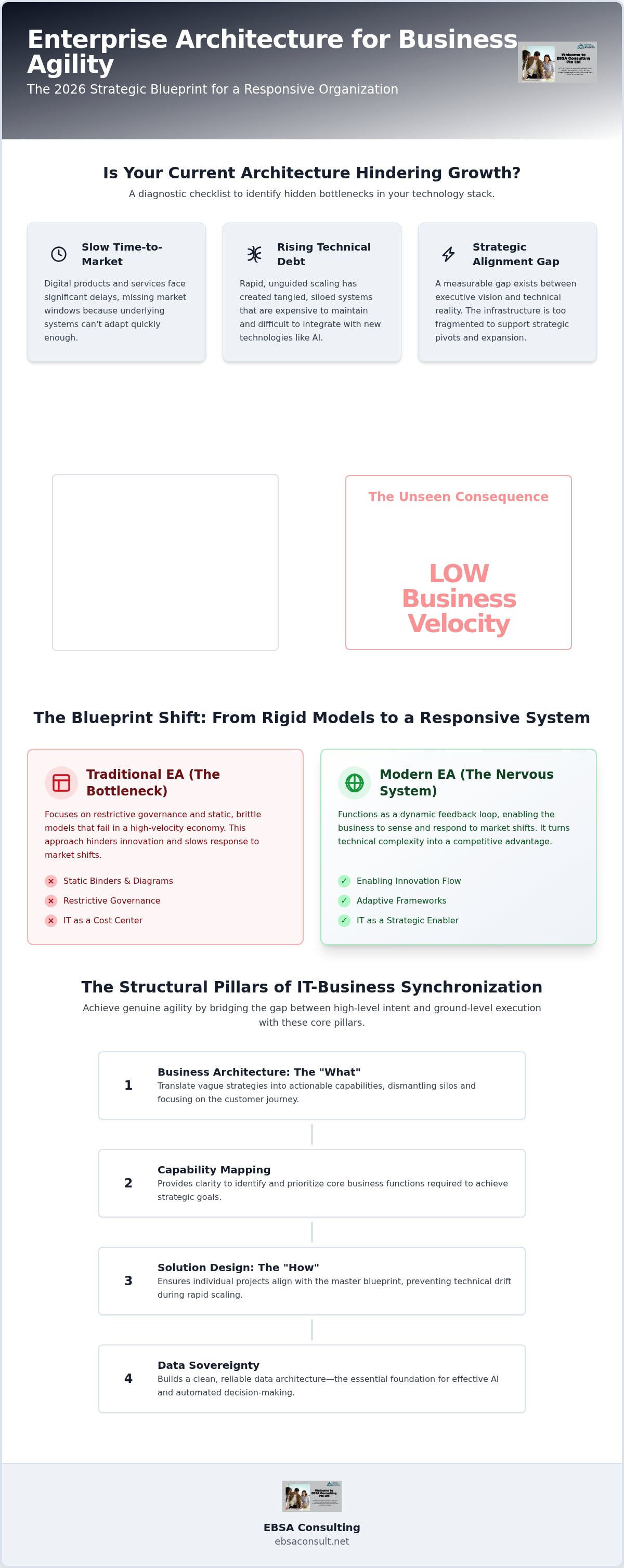
In 2026, enterprise architecture has evolved far beyond static binders and dusty diagrams. It now functions as the 'nervous system' of a responsive business, providing the essential feedback loops required to sense and respond to market shifts. Traditional, rigid EA models often fail in our high-velocity digital economy because they focus on restrictive governance rather than enabling flow. When the architecture is too brittle, the organization cannot pivot, leading to missed opportunities and wasted capital.
Many leadership teams struggle with a persistent 'Alignment Gap.' This is the measurable distance between executive vision and technical reality. While a CEO might plan for a rapid expansion into new digital services, the underlying infrastructure may be too fragmented to support it. Architectural Agility is the ability to reshape technical infrastructure without incurring prohibitive debt.
The Agility Paradox: Why Fast Coding Leads to Slow Businesses
Speed is often mistaken for progress. Many organizations find that unguided 'agile' development actually creates deep-seated silos and fragmented data sets. While individual teams might ship features quickly, the lack of a cohesive structure means these features don't talk to each other. By 2026, the hidden cost of this technical debt has become clear; it's the primary barrier to AI-readiness and data integrity. Effectively aligning IT with business goals requires a top-down structural view that ensures every line of code contributes to the broader corporate intent.
Enterprise Architecture as a Growth Accelerator
Modern organizations are shifting their perspective, moving from 'IT as a utility' to 'IT as a strategic enabler.' Utilizing enterprise architecture for business agility allows a company to reduce internal bureaucracy while maintaining necessary governance. It creates a framework where innovation can happen within safe boundaries. A strategic guide helps navigate these complex organizational pivots, ensuring that technical blueprints are always synchronized with market demands. When you implement enterprise architecture for business agility, you create a roadmap that turns technical complexity into a competitive advantage. This approach transforms IT from a cost center into a powerful engine for business agility, providing the stability needed to scale without the friction of legacy constraints.
The Structural Pillars of IT-Business Synchronization
Agility is frequently discussed as a cultural aspiration, yet culture alone cannot overcome a fragmented technical landscape. To achieve genuine enterprise architecture for business agility, an organization must move beyond abstract goals and invest in structural synchronization. This process requires a robust framework for transformation that bridges the gap between high-level intent and ground-level execution. Without these structural pillars, even the most ambitious digital strategies will eventually stall against the friction of legacy systems.
Business Architecture: The Missing Link to Agility
Professional business architecture services serve as the primary driver of this synchronization. By applying business architecture for operational excellence, leaders can translate vague strategies into actionable capabilities. This transition allows firms to dismantle functional silos, replacing them with cross-functional models that prioritize the customer journey over departmental boundaries. It's about identifying the "what" before the "how," ensuring that every process change serves a specific strategic goal rather than just a local efficiency gain.
Capability mapping provides the clarity needed to identify these core functions. Once the "what" is defined, solution design ensures that every individual project aligns with the master blueprint. This prevents the technical drift that often plagues rapid scaling. Finally, data sovereignty provides the foundation for AI and automated decision-making. In 2026, without a clean data architecture, AI initiatives become liabilities rather than assets. These components work together to create a unified view of the enterprise.
Solution Architecture: Turning Strategy into Blueprints
Effective solution architecture design acts as a safeguard against "feature creep." Utilizing enterprise architecture for business agility ensures that every technical investment has a clear line of sight to a specific business outcome. In complex environments, this discipline is essential for maintaining a lean, responsive stack. If your current projects feel uncoordinated, exploring professional Solution Architecture Design can provide the necessary clarity. By anchoring every technical choice in a business requirement, you ensure that your technology serves your strategy, not the other way around. This structural discipline is what allows a business to pivot rapidly without breaking the underlying systems.
Diagnostic Checklist: Is Your Current Architecture Hindering Agility?
Transformation begins with a candid assessment of your current state. While many organizations claim to value enterprise architecture for business agility, their operational reality often tells a different story. If your technical infrastructure isn't actively enabling your strategy, it's likely acting as an anchor. Use the following diagnostic benchmarks to evaluate whether your architecture is a bridge or a barrier to your 2026 growth goals.
- Strategic Awareness: Can your IT leadership clearly articulate the specific milestones of your three-year business growth plan? Misalignment often starts with a simple lack of shared vision.
- Technical Debt: Is more than 40% of your IT budget dedicated to maintaining legacy systems? High maintenance costs starve innovation and prevent the adoption of modern, responsive technologies.
- Change Velocity: Does it take more than six months to launch a significant new digital capability? In a high-velocity market, a half-year lead time often means arriving after the opportunity has passed.
- Data Accessibility: Can your business units access real-time data for decision-making without manual IT intervention? Data silos are the natural enemy of rapid organizational pivots.
Identifying Red Flags in Your Infrastructure
Shadow IT is a common symptom of architectural failure. When business units purchase software without oversight, they aren't trying to be rebellious; they're trying to be fast. However, this creates a fragmented landscape where new tools fail to "talk" to existing core systems, leading to severe integration fatigue. This often results in the "Black Box" syndrome, where business leaders don't understand why IT projects are delayed or why costs continue to rise. These red flags indicate that your current approach to enterprise architecture for business agility requires a structural reset to regain control and transparency.
The Need for a Maturity Assessment
An honest health check often requires a neutral external perspective to cut through internal biases. Utilizing professional business capability mapping services allows you to audit your current strengths and weaknesses objectively. This assessment helps evaluate the ROI of alignment by quantifying how much value is currently lost to duplication and misalignment. By visualizing your enterprise as a set of interconnected services rather than a collection of hardware, you can identify exactly where the friction lies. A maturity assessment isn't just about finding flaws; it's about creating a baseline for sustainable, strategic evolution that ensures every S$ spent on technology moves the business forward.
5 Steps to Implementing Enterprise Architecture for Business Agility
Implementing enterprise architecture for business agility requires a methodical shift from rigid oversight to strategic enablement. This transition ensures that your technical infrastructure doesn't just keep the lights on, but actively powers your market responsiveness. Follow these five steps to build a framework that synchronizes your technology with your business intent.
- Step 1: Define the North Star. Link your IT KPIs directly to business revenue and specific agility goals. Technology metrics must reflect their impact on the bottom line and market speed.
- Step 2: Map the Capability Landscape. Visualize your enterprise as a set of interconnected services. This helps identify which capabilities are core to your competitive advantage and which are ripe for optimization.
- Step 3: Establish Lightweight Governance. Create guardrails instead of gatekeepers. This approach empowers development teams to innovate quickly while ensuring they remain within the bounds of the master blueprint.
- Step 4: Modernize with Intent. Use enterprise architecture for growth to guide your legacy replacement strategy. Every upgrade should move you closer to a leaner, more responsive stack.
- Step 5: Iterate and Scale. Treat your architecture as a living product. It requires regular updates to reflect changing market conditions and emerging technical opportunities.
Leveraging Architecture for Organizational Change
Successful implementation involves more than just technical adjustments; it requires a cultural shift. Incorporating business architecture for organizational change into your roadmap helps foster a design-first culture across both technical and business teams. This transition often involves moving from project-based funding, which creates silos, to capability-based funding. By funding outcomes rather than individual tasks, you align financial resources with long-term strategic value and operational excellence.
Building for 2026: AI and Scalability
The 2026 landscape demands architectures that can absorb AI and machine learning without requiring total rebuilds. By prioritizing enterprise architecture for business agility, you ensure your tech stack is modular enough to integrate these advanced capabilities rapidly. Modularity is the secret to achieving rapid market pivots, allowing you to scale your technology without increasing the burden of technical debt. This structural readiness ensures your organization remains a visionary innovator, grounded in proven methodologies yet ready for the next wave of digital transformation. To begin your journey toward a synchronized enterprise, explore our Enterprise Architecture Consulting services.
Sustaining Synchronization: The EBSA Consulting Approach
Achieving long-term harmony between corporate intent and technical execution requires more than just a change in software; it demands a fundamental shift in structural thinking. Professional consulting provides the objective clarity needed for these complex transformations, offering a perspective that internal teams, often bogged down by legacy politics or operational silos, might miss. By leveraging enterprise architecture for business agility, we help you move beyond abstract theory toward actionable architectural blueprints that serve as a reliable guide for every technical investment.
Singaporean enterprises face unique pressures in 2026. As a global hub, the need to compete on an international stage means that speed and efficiency aren't just goals; they're survival requirements. This high-velocity environment necessitates specialized strategic guidance to ensure that rapid scaling doesn't lead to fragmented systems. We prioritize a partnership-driven mindset, working closely with your leadership to dismantle deep-rooted structural silos. This collaborative approach ensures that the resulting architecture is not a distant mandate, but a shared vision for operational excellence.
Your Strategic Guide in a Complex Landscape
Engaging a seasoned partner provides a clear path to stability. EBSA Consulting acts as the essential bridge between your technical requirements and your broader business vision. We focus on long-term reliability, ensuring that your infrastructure can absorb new innovations without breaking. By grounding our methodologies in proven frameworks, we provide the steady presence needed to navigate organizational pivots. Our enterprise architecture for business agility strategies are designed to create a calm, orderly environment where technology serves as a catalyst for growth rather than a source of friction.
Next Steps: From Strategy to Execution
The journey toward a synchronized enterprise begins with a clear understanding of your current state. Initiating a comprehensive architecture health check is the first step toward identifying immediate opportunities for increased agility and waste reduction. From there, we develop a strategic technology roadmap tailored specifically to your corporate intent and market position. This roadmap ensures that every S$ invested in your digital ecosystem moves you closer to your goals. Ready to reshape your infrastructure for growth? Contact EBSA Consulting for a Strategic Architecture Consultation today to begin your transformation.
Securing Your Organization’s Future through Architectural Harmony
Building organizational resilience in 2026 requires more than just faster development cycles; it demands a structural foundation that links every technical choice to a strategic outcome. We've explored how redefining enterprise architecture for business agility allows leaders to eliminate technical debt while building a stack that's ready for the next wave of AI innovation. By focusing on capability mapping and lightweight governance, your organization can move from a state of reactive maintenance to one of proactive, strategic growth.
Achieving this level of synchronization is a complex journey that benefits from an objective, expert perspective. As Singapore-based strategic consulting specialists, we offer deep expertise in Enterprise and Business Architecture alongside specialized Solution Architecture Design for your most complex requirements. We're here to act as your strategic guide, bridging the gap between high-level vision and technical reality.
The transformation from a fragmented infrastructure to a unified, responsive ecosystem is within your reach. We look forward to supporting your journey toward operational excellence and sustainable success.
Frequently Asked Questions
How does enterprise architecture actually improve business agility?
Enterprise architecture improves agility by creating a modular foundation where business capabilities are mapped to technical services. This allows leadership to reconfigure operations rapidly without the risk of breaking brittle, monolithic systems. By utilizing enterprise architecture for business agility, organizations reduce their time-to-market for digital products. It ensures that every technical investment is a direct response to a strategic need, preventing the accumulation of uncoordinated technical debt during periods of rapid scaling.
What is the difference between IT alignment and architectural synchronization?
IT alignment typically involves ensuring that technology projects support general business goals. Architectural synchronization goes deeper by ensuring the technical design and business operational models are structurally identical. This creates a responsive nervous system for the enterprise. When strategy shifts, the synchronized architecture allows for an immediate, coordinated technical response. This reduces the alignment gap often found in traditional organizations, where execution lags behind executive vision due to technical constraints and legacy friction.
Can mid-sized firms benefit from enterprise architecture consulting?
Mid-sized firms benefit significantly because they often face a scaling wall where initial growth creates unmanageable complexity. Consulting helps these organizations transition from ad-hoc technical fixes to a structured, capability-based model. This prevents the fragmented data and siloed processes that typically plague rapid expansion. By investing in professional guidance early, mid-sized enterprises can build a scalable foundation that supports global competition while retaining the speed and responsiveness associated with smaller, high-growth startups.
How do we measure the ROI of business agility initiatives?
ROI is measured through metrics like Change Velocity, which tracks the time from strategy approval to digital product launch. Other indicators include a reduction in Run costs, where less of the IT budget is spent on legacy maintenance and more on innovation. By applying enterprise architecture for business agility, firms can also track the ROI of avoided technical debt. This visibility ensures that every IT investment has a clear line of sight to a revenue-generating business capability.
What are the most common barriers to achieving IT-business alignment?
Functional silos and a lack of common vocabulary between business leaders and IT teams are the most frequent obstacles. Integration fatigue also plays a role, where new tools fail to communicate with core systems, leading to process waste. These barriers often lead to a lack of transparency, where leadership loses visibility into how technical delays impact growth. Overcoming these challenges requires a structural reset that prioritizes cross-functional capability models over rigid departmental boundaries.
How often should an enterprise architecture roadmap be updated?
A modern roadmap should be a living document reviewed on a quarterly basis. While the high-level business vision might span three years, the technical implementation must remain flexible enough to absorb rapid shifts in the 2026 digital landscape. This iterative approach ensures that the architecture doesn't become a static binder on a shelf. Regular updates allow the firm to integrate new AI capabilities and respond to competitor moves without requiring a massive, disruptive strategic pivot.
Does achieving agility require a complete overhaul of legacy systems?
Achieving agility is a journey of incremental modernization rather than a single, high-risk overhaul. The goal is to move from monolithic structures to a composable architecture where legacy components are wrapped in modern interfaces. This allows your existing systems to support new business capabilities while you systematically replace the most restrictive parts of the stack. It's about modernizing with intent, ensuring that every update contributes to a leaner and more responsive organizational state.
How can we address 'Shadow IT' through better architectural frameworks?
Shadow IT is addressed by moving from a command and control model to one of enablement through guardrails. By providing business units with a set of pre-integrated, modular services, IT leadership can allow for local innovation while maintaining central visibility. This approach ensures that data sovereignty and security standards are met without slowing down the business. It turns IT into a strategic partner that provides the platform for agility rather than a bottleneck to be bypassed.


