

Most strategic failures aren't born in the boardroom; they're the result of a structural disconnect that happens long before the first project begins. It's a common frustration for leadership teams to watch a visionary strategy dissolve into fragmented efforts, where operational silos and technical debt act as invisible barriers to progress. You likely recognize the friction of duplicated efforts and the missed opportunities that stem from a lack of clarity between what you want to achieve and how your organization actually functions. Leveraging business architecture for operational excellence provides the necessary bridge to close this gap, transforming abstract goals into a synchronized reality.
In this guide, you'll discover how a structured architectural framework synchronizes your high-level strategy with daily execution to drive sustainable growth. We'll explore the blueprint for organizational clarity that improves decision-making through better visibility while aligning your business and IT functions. This methodical approach moves beyond temporary fixes, offering a path toward continuous improvement and the long-term reliability your organization requires to scale successfully. By treating operational excellence as a journey rather than a destination, we can reshape your organizational landscape into a resilient and agile system.
Key Takeaways
- Learn how to bridge the gap between high-level strategic intent and daily execution by establishing a unified framework for your organization.
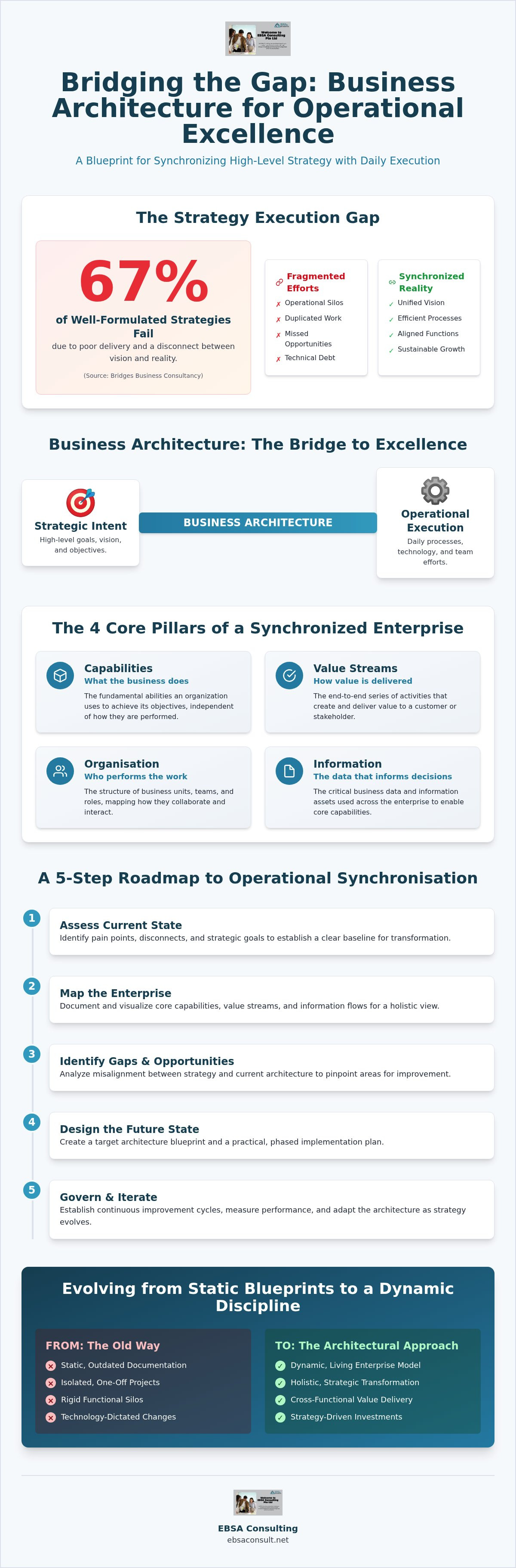
- Understand the four core pillars of business architecture for operational excellence, including capabilities, value streams, organization, and information, to create a holistic enterprise view.
- Identify why traditional process improvement initiatives often fail when they're isolated from broader organizational capabilities and how to eliminate recurring friction.
- Gain a practical five-step roadmap to assess your current state and begin synchronizing your operations for greater agility and scaling.
- Discover the importance of shifting from static documentation to a dynamic discipline that leverages expert architectural partnerships for sustainable growth.
Defining the Intersection: How Business Architecture Fuels Operational Excellence
Business architecture serves as the vital bridge between a company's strategic intent and its operational reality. While strategy defines the destination, architecture provides the map that ensures every department, process, and technology asset moves in the same direction. Operational excellence, in this context, isn't a static goal; it's a state of continuous improvement and strategic synchronization. It's the ability to deliver value consistently while remaining agile enough to pivot when market conditions shift. Without this structural foundation, even the most brilliant visions can become lost in a sea of departmental silos and misaligned priorities.
The need for this alignment is critical for survival. Research from Bridges Business Consultancy highlights a staggering "Execution Gap," where 67% of well-formulated strategies fail due to poor delivery. This failure rarely stems from a lack of effort. Instead, it's usually caused by a lack of visibility into how different parts of the business interact. By implementing business architecture for operational excellence, organizations can transform from rigid hierarchies into what's known as a Composable Enterprise. This modern ideal allows leaders to treat business functions as modular building blocks, making it easier to reconfigure operations quickly without disrupting the entire system.
The Strategic Imperative for Modern Enterprises
Traditional top-down management often struggles to keep pace with today's dynamic markets. When an organization scales rapidly without a clear blueprint, it risks creating "accidental" structures that lead to waste, duplicated effort, and confusion. Professional business architecture services provide the transparency needed for high-stakes transformation. They offer a steady, expert hand to guide leaders through complexity, ensuring that stability is maintained even as the company accelerates its growth. This transparency allows teams to see how their daily work contributes to the broader vision, fostering a culture of accountability and purpose.
Key Principles of Architecting for Excellence
To achieve true operational harmony, several core principles must be applied consistently. First, strategy-to-execution alignment must be treated as a disciplined practice rather than a one-time event. This requires a holistic, enterprise-wide scope that looks across silos rather than just down into them. Leaders must also focus on "what" the business does, its core capabilities, before deciding "how" those tasks are performed. This sequence is vital. It ensures that technological investments and process changes serve the strategy, rather than dictating it. By focusing on these principles, a business can ensure that its resources are always allocated to the areas that drive the most significant strategic value.
The Core Pillars: Synchronising Strategy with Organisational Structure
True organizational harmony requires more than a shared vision; it demands a shared structure. To achieve business architecture for operational excellence, leaders must look beyond individual departments and focus on four primary pillars that define the enterprise. These pillars include Capabilities (what the business does), Value Streams (how value is delivered), Organisation (who performs the work), and Information (the data that informs decisions). When these elements are synchronized, they create a unified view of the enterprise that allows for precise adjustments rather than guesswork.
This structural approach facilitates a vital shift from functional silos to cross-functional value delivery. In many organizations, departments operate as isolated islands, often inadvertently working against one another. By mapping how these four pillars interact, you can see exactly how a change in one area impacts the rest of the system. Business Capability Mapping serves as the strategic anchor for all architectural efforts, providing a stable reference point that remains constant even as underlying processes and technologies evolve. This stability is what allows a business to remain resilient during periods of rapid growth or market volatility.
Business Capability Mapping: The Foundation of Strategy
Capability mapping defines what your business must do to succeed, independent of your current processes or organizational chart. It focuses on the core "building blocks" of the company, such as "Product Development" or "Customer Relationship Management." Utilizing professional business capability mapping services helps identify critical gaps in strategic readiness before they lead to operational failure. By using capability heatmaps, leadership teams can prioritize investments and resources toward the areas that will have the greatest impact on the bottom line. This ensures that your transformation efforts are always grounded in strategic necessity.
Value Stream Optimisation: Delivering Consistent Results
While capabilities describe what you do, value streams map the end-to-end journey of how value is actually created for the customer. This pillar focuses on the flow of activities, from the initial trigger to the final delivery of a product or service. Optimizing these streams allows you to identify bottlenecks and redundancies that hinder business architecture for operational excellence. When you align internal processes with external customer expectations, you eliminate waste and ensure a consistent experience. Professional Business Architecture Services provide the objective perspective needed to reshape these streams for maximum efficiency and agility.
Eliminating the 'Friction Gap': Why Traditional Process Improvement Often Fails
Many leaders turn to methodologies like Lean or Six Sigma to drive efficiency within their organizations. While these tools are excellent for refining specific workflows, they often operate in a vacuum. Without the broader context provided by business architecture for operational excellence, these efforts frequently lead to "local optimization." This happens when one department becomes highly efficient at the expense of another, creating a friction gap that slows down the entire enterprise. Fixing a process without understanding the underlying capability is like repainting a car with a broken engine; it looks better, but it won't get you where you need to go.
When you focus purely on process, you're treating the "how" without validating the "what." If the core capability itself is misaligned with your strategic goals, no amount of process refining will solve the fundamental issue. Architecture provides the structural insight needed to ensure that every improvement serves the global enterprise rather than a single silo. This holistic approach prevents the accumulation of organizational debt, where quick fixes today become the rigid barriers of tomorrow. By addressing the structure first, you create a foundation where continuous improvement can actually take root and scale.
The Limits of Isolated Process Improvement
Improving a single department in isolation often shifts the bottleneck rather than removing it. This creates a "Whack-a-Mole" effect where solving a problem in sales creates a crisis in fulfillment. In un-architected organizations, leadership remains trapped in a cycle of reactive troubleshooting. Shifting to a proactive structural design ensures that every improvement is evaluated against its impact on the total system. This global perspective is what separates high-performing organizations from those that merely survive. It's about moving from "fixing things" to intentionally designing for success.
Architecture as the 'Glue' Between Business and IT
One of the most persistent sources of friction is the gap between business requirements and technical implementation. It's common for IT to deliver a solution that meets every technical spec but fails to drive the intended business outcome. Professional enterprise architecture consulting bridges this divide by ensuring that technical infrastructure is intentionally designed to support operational goals. This creates a shared language between business and technology leaders, reducing the accumulation of technical debt that typically hinders agility. When these functions are synchronized, every digital investment directly fuels your journey toward excellence.
A Practical Roadmap to Operational Synchronisation and Agility
Developing a robust framework for business architecture for operational excellence requires a disciplined, multi-phase approach. It isn't about overnight transformation, but rather an intentional evolution of the enterprise structure. By following a structured roadmap, leaders can move from fragmented operations to a state of total synchronization. This journey ensures that every project, investment, and process change moves the organization closer to its strategic goals.
The 5-step framework includes:
- Baseline Assessment: Understanding the current "As-Is" state of your capabilities and processes.
- Strategic Alignment: Defining the "To-Be" vision and long-term organizational goals.
- Capability Gap Analysis: Identifying the specific deficiencies that prevent you from reaching excellence.
- Roadmap Development: Prioritizing initiatives based on strategic value and return on investment.
- Governance and Evolution: Establishing the oversight needed to ensure long-term adherence and agility.
Phase 1: Discovery and Strategic Alignment
The journey begins by engaging key stakeholders to define your strategic North Star. This phase isn't just about technical audits; it's about understanding the human and organizational elements of your business. You must inventory existing assets, processes, and capabilities to see where the current structure supports or hinders your vision. During this discovery, it's vital to identify immediate operational pain points. Addressing these early provides "quick wins" that build momentum and demonstrate the value of the architectural approach to the wider organization. This initial clarity is the foundation upon which all future improvements are built.
Phase 2: Designing the Future-State Blueprint
Once the baseline is clear, the focus shifts to creating a target architecture that supports long-term operational excellence. This future-state blueprint serves as the definitive guide for all subsequent investments. A transition plan is essential here to manage risk and minimize disruption to daily operations. Success is measured through specific KPIs that go beyond IT metrics, focusing instead on business outcomes like reduced cycle times or improved resource utilization. If you're ready to begin this journey, our Business Architecture Services provide the expert guidance needed to navigate each phase with confidence.
Beyond Blueprints: Reshaping Your Enterprise with Strategic Partnership
A blueprint is only as effective as the hands that guide its implementation. While a roadmap provides a path, the true shift occurs when an organization moves from viewing architecture as a one-time document to embracing it as a continuous discipline. Achieving business architecture for operational excellence requires a cultural shift that prioritizes structural thinking over temporary workarounds. This transition is often where the most significant challenges arise, as it requires navigating internal politics and entrenched departmental interests that can stall even the best-laid plans.
This is where a strategic partnership becomes invaluable. An external consultant offers an objective, expert perspective that internal teams, often constrained by day-to-day operations, might overlook. At EBSA Consulting, we don't just deliver a static report; we act as a collaborative partner invested in your long-term success. We provide the steady presence needed to bridge the gap between complex technical requirements and high-level business vision, ensuring that every architectural decision remains grounded in strategic value and operational reality.
The Role of the Strategic Architectural Guide
Internal teams often struggle to maintain a holistic enterprise view because they're too close to the existing silos. A seasoned partner understands the nuances of the Singapore business landscape and brings a wealth of experience from diverse industries. By utilizing proven methodologies, such as the latest TOGAF 10th Edition standards, a strategic guide can accelerate your transformation journey. This expertise helps avoid common pitfalls, such as technical debt or misaligned infrastructure, allowing your organization to scale with confidence and stability. It's about having a visionary innovator who remains grounded in methodologies that are proven to work.
Securing Long-Term Operational Agility
Operational excellence isn't a destination you reach and then stop; it's an ongoing journey of refinement. Architecture must become a core organizational capability rather than a project with a fixed end date. By building a culture of alignment, you ensure that your enterprise remains agile enough to respond to market changes without losing its structural integrity. EBSA Consulting focuses on reshaping enterprises for sustainable growth, helping you build the internal muscles needed to maintain synchronization across all functions. This commitment to long-term reliability is what turns a strategic framework into a lasting competitive advantage for your business.
Reshaping Your Enterprise for Sustainable Performance
Operational excellence isn't a final destination but a continuous state of synchronization between your vision and your daily actions. By establishing a robust business architecture for operational excellence, you move beyond the cycle of reactive process fixes and begin building a resilient, composable enterprise. This structural clarity ensures that every technical investment and organizational change directly serves your strategic North Star, reducing waste and eliminating the friction that often stalls growth. It's about moving from fragmented silos to a unified system that's designed for long-term reliability.
Transitioning to this state requires a steady, expert hand and a proven methodology. We invite you to partner with EBSA Consulting to synchronise your enterprise for operational excellence. Our team brings deep expertise in aligning business strategy with technology through Singapore-based strategic architectural frameworks and a deeply collaborative consulting approach. It's time to bridge the gap between your strategy and its execution, ensuring your organization is built for stability and agility. Let's work together to turn your strategic blueprint into a lasting competitive advantage.
Frequently Asked Questions
What is the primary difference between business architecture and business process management?
Business architecture focuses on the "what" of an organization, defining core capabilities and value streams that align with strategy. Business process management (BPM) deals with the "how," focusing on the specific workflows and activities that execute those capabilities. Architecture provides the high-level structural context that ensures BPM initiatives serve the entire enterprise rather than just optimizing a single, isolated department.
How long does it typically take to see results from a business architecture initiative?
While a total transformation is a long-term journey, initial results often appear within three to six months. These early wins usually involve identifying redundant processes or clarifying misaligned capabilities during the discovery phase. These successes build the necessary momentum for the broader business architecture for operational excellence roadmap, leading to sustained efficiency gains and better resource allocation as the framework matures.
Can business architecture be applied to small and medium-sized enterprises (SMEs)?
Yes, SMEs benefit significantly because they often face rapid growth that creates accidental, inefficient structures. Architecture provides a clear blueprint that helps lean teams prioritize their limited resources effectively. It ensures that a smaller company can scale its operations without accumulating crippling organizational debt. By establishing clear capabilities early, an SME maintains the agility needed to compete with much larger rivals.
How does business architecture help in reducing technical debt?
Architecture reduces technical debt by ensuring every IT investment directly supports a specific business capability. This prevents the fragmented accumulation of redundant software and incompatible systems that typically hinder scaling. By creating a shared language for business and technology leaders, organizations can retire legacy infrastructure that no longer serves a strategic purpose. This proactive design ensures your technological foundation remains as agile as your vision.
Who should lead the business architecture effort within an organisation?
A successful initiative requires a collaborative effort led by a dedicated business architect or an external strategic guide, backed by strong executive sponsorship. It's not strictly an IT function; it requires input from across the enterprise to ensure total alignment. Leaders from operations, finance, and technology must work together to define core pillars. This cross-functional leadership ensures the architecture stays grounded in the actual needs of the business.
Is business architecture only for IT-heavy companies?
No, architecture is essential for any organization that wants to bridge the gap between strategic intent and daily execution. While it helps align IT infrastructure, its primary focus is on organizational structure, value streams, and human capabilities. Any business dealing with operational silos can use business architecture for operational excellence to improve performance. It's a discipline for managing complexity, regardless of your specific technology stack.
What are the first steps to take if our strategy and operations are misaligned?
The first step is conducting a baseline assessment to understand your current "As-Is" state. You must inventory existing capabilities and identify exactly where current processes fail to support your strategic goals. Engaging stakeholders early to define a shared "North Star" is critical for creating organizational buy-in. Once you have this transparency, you can perform a gap analysis to prioritize the changes that offer the most immediate ROI.


