

What if the primary obstacle to your organization's growth isn't a lack of vision, but a fundamental disconnect between your high-level strategy and your daily operations? Many leaders find that even the most innovative plans often falter during execution, leaving behind a trail of redundant technology investments and siloed departments. It's a common struggle to determine exactly which capabilities drive the most value, especially when technical debt begins to stifle agility. Professional business capability mapping services provide the structural clarity needed to bridge this gap, ensuring that every investment and process aligns perfectly with your long-term objectives.
We understand that navigating complex organizational change requires more than just a static diagram; it demands a dynamic, strategic asset. In this guide, you'll learn how to transform your operational reality into a clear roadmap for digital transformation. We'll explore how a structured approach to mapping helps you optimize efficiency and create a stable framework for scaling without the burden of technical debt. By the end, you'll have the insights necessary to synchronize your technology with your business vision, turning complexity into a distinct competitive advantage.
Key Takeaways
- Distinguish between your business processes and core capabilities to establish a stable, "DNA-level" foundation for your organizational strategy.
- Master the hierarchical structure of a high-impact map to ensure your framework is both mutually exclusive and collectively exhaustive.
- Realize the strategic value of professional business capability mapping services in providing an objective lens that bridges the gap between high-level vision and operational reality.
- Implement a step-by-step execution framework that prioritizes stakeholder engagement and clear scoping to avoid redundant technology investments.
- Learn how to leverage expert architecture consulting to transform static diagrams into dynamic blueprints for continuous innovation and digital transformation.
The Role of Business Capability Mapping in Modern Enterprise
A business capability map serves as the structural DNA of an enterprise. It provides a stable, high-level view of what an organization must do to fulfill its mission, separate from how those actions are currently executed. While business processes describe the specific flow of tasks, capabilities define the fundamental abilities required to deliver value. Leaders are increasingly pivoting away from siloed planning, which often results in fragmented technology stacks and overlapping efforts. By adopting a capability-based approach, organizations can synchronize their internal strengths with their external goals. This methodology is a core component of professional business architecture services, offering a framework that remains relevant even as market conditions shift.
Capability-based planning allows for a more holistic view of the enterprise. Instead of looking at departments as isolated units, it treats them as contributors to shared organizational goals. This perspective is vital for modern leaders who need to manage complex digital landscapes without losing sight of the broader business vision. When strategy is anchored in capabilities, the organization gains a sense of stability that transcends individual projects or temporary organizational charts.
The Strategic Value of Identifying "What" You Do
Identifying the "what" allows leaders to uncover hidden redundancies that often lurk within large organizations. When multiple departments invest in similar technologies to solve the same functional need, efficiency plummets. Utilizing business capability mapping services helps highlight these overlaps, allowing for the rationalization of resources. This clarity significantly improves organizational agility. When a business understands its core building blocks, it can respond to market disruptions with precision rather than panic. This structured thinking enables executives to prioritize high-value investments that directly strengthen the most critical parts of the enterprise.
Through this lens, organizations can better manage their technical debt. By focusing on capabilities, teams can identify which legacy systems are truly essential and which ones are merely holding the organization back. This leads to a more streamlined and responsive operational state, ensuring that technology serves the business rather than dictating its limits.
Bridging the Strategy-to-Execution Gap
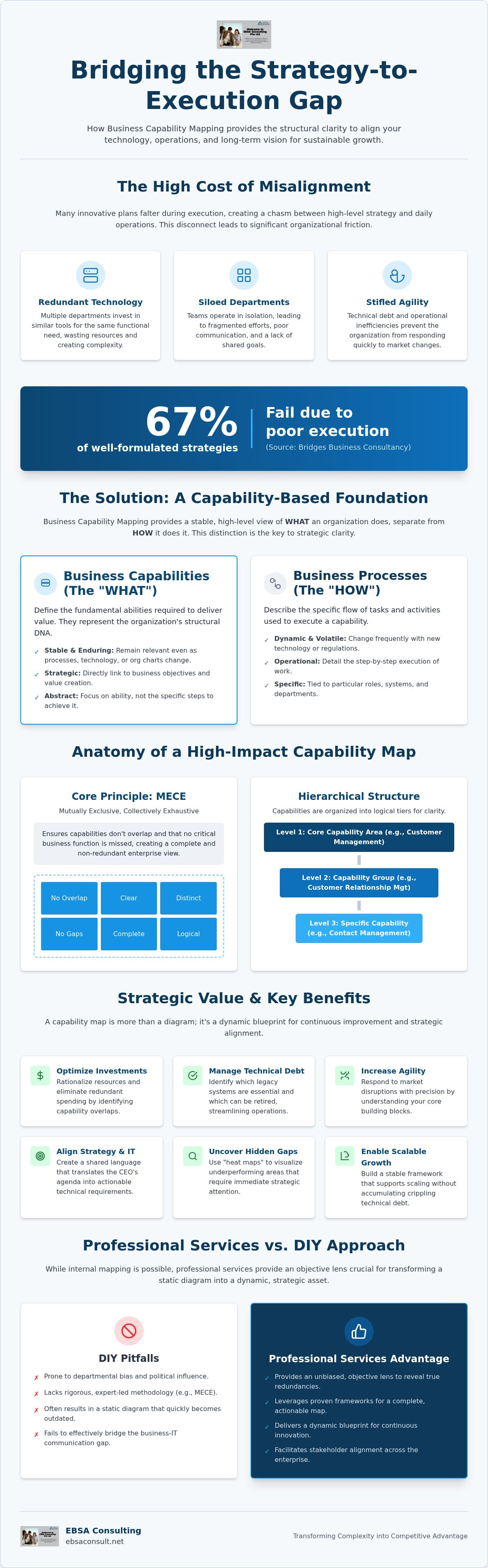
Execution remains the graveyard of many ambitious plans. Research by Bridges Business Consultancy indicates that approximately 67% of well-formulated strategies fail because of poor execution. This disconnect often stems from a lack of shared language between the boardroom and the technical teams. The capability map functions as a Rosetta Stone, translating high-level vision into actionable technical requirements. It ensures that IT leaders aren't just building systems; they're reinforcing the specific capabilities that drive the CEO's agenda.
A business capability is a stable, cross-functional building block of an enterprise that represents a unique ability required to achieve a specific outcome. By rooting transformation in these stable blocks, organizations create a more resilient path toward operational excellence. This alignment ensures that every project, whether it involves process redesign or infrastructure upgrades, serves the overarching strategic intent.
The Anatomy of a High-Impact Capability Map
Designing a high-impact capability map requires more than just listing organizational functions. It demands a rigorous, hierarchical approach that ensures every part of the enterprise is accounted for without overlap. A cornerstone of effective business capability mapping services is the MECE principle: Mutually Exclusive and Collectively Exhaustive. This design philosophy guarantees that capabilities don't conflict or repeat, while also ensuring that no critical business function is omitted. By integrating business drivers like revenue growth, cost reduction, and customer retention directly into the framework, leaders can visualize how specific abilities contribute to the bottom line. This visualization often culminates in a "heat map," which uses color-coded indicators to identify underperforming areas or critical capabilities that require immediate strategic attention.
Tiers of Capability: From Strategic to Operational
A well-structured map organizes information into logical tiers to serve different stakeholders. Level 1 capabilities represent broad domains like Finance, HR, or Operations; they provide the high-level view necessary for executive decision-making. Level 2 breaks these domains down into specific service areas, such as Talent Acquisition or Accounts Payable, offering a clearer picture of functional requirements. Finally, Level 3 reaches the granular level required for effective solution architecture design. At this depth, the map identifies the specific activities that technology must support, ensuring that technical implementations are always grounded in business necessity.
Attributes and Metadata: Beyond the Diagram
The true power of a capability map lies in the metadata attached to each node. Assigning maturity scores on a scale of 1 to 5 allows organizations to objectively assess their current strengths and weaknesses. When you map your existing technology stacks to these specific capabilities, you can quickly identify technical debt and redundant software investments. This process links strategic importance to operational performance, highlighting where the business is over-invested in low-value areas or under-supported in critical ones. Partnering with a seasoned architecture partner ensures these technical layers are correctly synchronized with your long-term business vision, transforming a simple diagram into a powerful decision-making engine.
Evaluating Business Capability Mapping Services vs. DIY
Choosing between internal DIY efforts and professional business capability mapping services represents a pivotal crossroads for organizational strategy. While the DIY route appears cost-effective, it frequently succumbs to the "Ivory Tower" trap where architecture remains disconnected from actual business operations. These internal maps often reflect how departments wish they functioned rather than documenting the cross-functional reality. The cost of this misalignment is high, manifesting in wasted software licenses and failed digital transformation initiatives that never quite bridge the strategy-to-execution gap. Engaging external enterprise architecture consulting ensures your map is grounded in proven methodologies and objective analysis.
Internal teams often find it difficult to see past their own organizational charts. When you rely solely on internal resources, you risk reinforcing existing silos rather than breaking them down. Professional consultants bring a fresh perspective that identifies hidden inefficiencies that internal staff might overlook or accept as "just the way things are." This objectivity is essential for creating a map that truly serves the entire enterprise.
The Facilitation Factor: Managing Stakeholder Politics
Stakeholder politics often cloud internal definitions. Department heads naturally protect their turf, viewing capabilities through the narrow lens of their own team's importance. This bias makes it difficult to move from a mindset of "my department" to "our capability." A professional consultant serves as a neutral arbiter. They facilitate difficult conversations and help leaders identify where true value is created, regardless of current reporting lines. This collaborative approach turns a potential political battle into a unified strategic exercise that prioritizes the health of the organization over individual departmental interests.
Methodology and Framework Alignment
Professional services provide the critical advantage of framework alignment. Instead of starting with a blank page, experts utilize established standards like the BIZBOK Guide or TOGAF. These reference models provide a steady foundation, allowing you to bypass the initial struggle of defining basic structures. Most importantly, a professional approach ensures the map is built for long-term maintenance. It shouldn't be a one-off workshop artifact that gathers digital dust. Instead, it becomes a living blueprint that evolves alongside your organization, providing a stable framework for future growth and continuous operational excellence.
How to Execute a Capability Mapping Project: A Step-by-Step Strategic Framework
Executing a capability mapping project is a disciplined exercise in organizational alignment. It requires more than just technical skill; it demands a deep understanding of how different business units interact to produce value. By utilizing professional business capability mapping services, organizations can move through a structured framework that avoids the common pitfalls of internal bias and scope creep. This journey begins with a clear definition of purpose and ends with a living asset that guides every future investment.
Phase 1: Discovery and Scoping
Before any mapping occurs, leaders must identify the primary "anchor" drivers. Is the organization preparing for a major merger, or is the goal to drive innovation through cost rationalization? Clearly defining these objectives ensures that the effort remains focused on high-impact areas. Selecting the right participants is equally critical. You need voices from both the business and IT sides of the house to ensure the map reflects operational reality. Setting strict boundaries at this stage prevents the project from expanding into irrelevant areas, keeping the focus on what truly matters.
Phase 2: The Iterative Drafting Process
The drafting phase is inherently iterative and collaborative. Success depends on workshops that prioritize outcomes over existing organizational charts. By focusing on what the business does to deliver value, teams can strip away the noise of current reporting lines. This process helps refine terminology, establishing a common language that both executives and technical leads can use without confusion. The ultimate goal of this process is to achieve organizational clarity without descending into exhaustive complexity.
Phase 3: Analysis and Implementation
Once the initial map is drafted, it undergoes a "reality check" through validation and heat mapping. This analysis visualizes gaps in technology or talent, highlighting where the enterprise is most vulnerable. These insights are then integrated into a strategic technology roadmap design, ensuring that every IT project directly supports a business capability. Finally, establishing a governance cadence ensures that the map doesn't become a static document. It must be updated regularly to reflect the evolving nature of the business. If you are ready to move from vision to execution, our team can provide the expert architecture consulting required to synchronize your operations with your strategy.
Leveraging Professional Architecture Consulting for Long-Term Alignment
EBSA Consulting acts as the essential bridge between high-level executive vision and the technical realities of modern infrastructure. By utilizing professional business capability mapping services, we help organizations move beyond simple diagrams toward robust, actionable blueprints. Our approach is rooted in a partnership mindset, ensuring that every architectural decision is made in close collaboration with your internal teams. This collaborative strategy doesn't just produce a map; it fosters a shared understanding of organizational value, allowing for a more resilient and agile enterprise. We focus on reshaping your current structures to synchronize with your future goals, providing the stability needed to navigate complex change.
Moving beyond the initial mapping phase allows an organization to embrace enterprise architecture for innovation. This transition is critical for leaders who want to ensure their transformation efforts are not just temporary fixes, but long-term strategic improvements. By applying structured thinking to complex organizational hurdles, we help you avoid the accumulation of technical debt. This methodical approach provides a steady path toward operational excellence, positioning your business to accelerate growth without the friction of misaligned systems.
Synchronizing Business and IT Blueprints
A well-defined capability map is the foundation upon which effective solution architecture design is built. It provides the necessary context for IT teams to develop systems that truly serve the business's core needs. This clarity reduces the friction often associated with digital transformation, as every stakeholder understands how a specific technology project supports a broader capability. For the COO and CTO, the capability map becomes a living asset; it serves as a common point of reference for prioritizing investments and managing resource allocation across the entire enterprise. It turns abstract strategy into a concrete guide for technical implementation.
Next Steps: From Mapping to Mastery
The journey toward architectural mastery begins with an honest assessment of your current maturity. We work with you to identify the first high-impact capability that requires modernization, ensuring that early efforts yield visible and measurable results. In the Singapore market, where agility and precision are paramount, having a seasoned partner is essential for maintaining a competitive edge. Engaging with a professional architecture firm allows you to leverage proven methodologies that have been refined through diverse organizational challenges. If you're ready to synchronize your business strategy with a stable technical framework, the path forward starts with a structured, expert-led engagement that prioritizes long-term reliability.
Reshaping Your Enterprise for Sustainable Growth
Bridging the gap between a high-level vision and operational reality requires more than just intent; it demands a structured, architectural approach. By identifying the stable building blocks of your organization, you create a foundation that resists the friction of technical debt and departmental silos. Professional business capability mapping services provide the objective lens necessary to synchronize your technology investments with your most critical business drivers. This process ensures that every project contributes directly to long-term operational excellence rather than adding to organizational complexity.
EBSA Consulting brings deep expertise in Singapore’s enterprise landscape to help you manage these challenges with confidence. We specialize in strategic technology roadmap design, acting as your guide through the intricacies of organizational transformation. Whether you're scaling for growth or optimizing current efficiencies, a collaborative architectural partnership is the key to lasting success. Align your strategy with execution, explore EBSA Consulting’s Business Architecture Services today. Your journey toward a more agile, synchronized enterprise is well within reach.
Frequently Asked Questions
What is the difference between a business process and a business capability?
A business capability describes "what" an organization does to deliver value, whereas a business process defines "how" that work is performed. Capabilities remain stable over time, providing a consistent architectural foundation even as processes change to improve efficiency. While a process might involve specific steps like "approve invoice," the underlying capability is "Accounts Payable." This distinction helps leaders focus on long-term strategy rather than getting lost in temporary operational workflows.
How long does a typical business capability mapping engagement take?
The duration of an engagement typically ranges from four to twelve weeks, depending on the organizational size and the desired level of detail. A high-level Level 1 map for a mid-sized firm can often be completed in a month. However, deep-dive Level 3 mapping that informs specific business capability mapping services and technical blueprints requires more extensive stakeholder interviews and validation workshops to ensure accuracy across every department.
Can business capability mapping help reduce our technical debt?
Yes, capability mapping is one of the most effective ways to identify and eliminate technical debt. By mapping your existing technology stack to specific business capabilities, you can easily spot redundant software licenses and systems that don't support core business goals. This visibility allows architects to decommission legacy applications that no longer provide value, streamlining the technical landscape and reducing the ongoing costs of maintaining unnecessary infrastructure.
Who should be involved in the capability mapping process?
Successful mapping requires a collaborative group of participants from both the business and IT sides of the organization. This usually includes executive sponsors, department heads who understand operational needs, and enterprise architects who can translate these needs into technical requirements. Involving a broad range of stakeholders ensures that the map reflects the true cross-functional reality of the enterprise rather than a narrow, siloed perspective from a single division.
Is business capability mapping only for large enterprises?
While large enterprises frequently use these frameworks, business capability mapping is equally valuable for mid-sized organizations planning for rapid growth. Any company facing digital transformation or significant operational changes can benefit from the structural clarity these services provide. For smaller firms, mapping helps ensure that every new hire and technology investment aligns with the core mission, preventing the accidental creation of silos or technical debt as they scale.
How often should a business capability map be updated?
You should treat your capability map as a living asset and review it at least once a year or during major strategic pivots. While the core capabilities themselves don't change often, the maturity scores and technical mappings associated with them frequently evolve. Major events like a merger, a shift in market focus, or the launch of a new product line should always trigger a refresh to maintain alignment between strategy and execution.
What tools are best for managing a business capability map?
The best tools for managing a map range from dedicated enterprise architecture software to simpler visual modeling tools for initial drafts. The choice depends on your organization's architectural maturity and the complexity of the data you need to track. Regardless of the software used, the focus should remain on the methodology and the quality of the data rather than the specific features of an off-the-shelf product.
How does capability mapping support mergers and acquisitions?
Capability mapping accelerates mergers and acquisitions by providing a clear, objective comparison of the two organizations' functional strengths. It allows integration teams to quickly identify overlapping systems and redundant departments, facilitating a smoother transition. By understanding the "what" of both entities, leaders can make informed decisions about which capabilities to keep, merge, or retire, ensuring that the combined enterprise achieves its synergy targets without operational disruption.


