

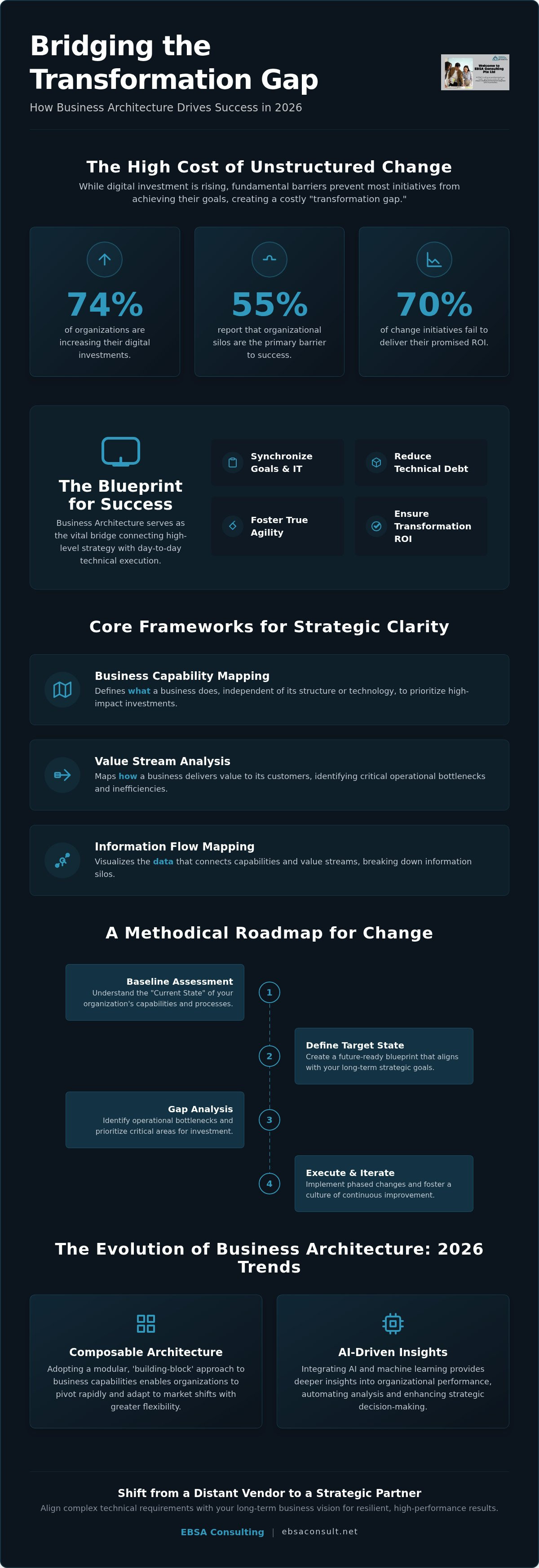
While 74% of organizations are increasing their digital investments in 2026, a staggering 55% of these leaders report that organizational silos remain the primary barrier to success. It's a common challenge that many executives face; you have the vision and the capital, yet the bridge between your high-level strategy and technical execution remains fragile. You've likely experienced the frustration of transformation efforts that look perfect on paper but fail to scale across the enterprise. It's clear that throwing more technology at the problem won't fix a disconnected foundation.
This is where a structured approach becomes your most valuable asset. We'll show you how business architecture for digital transformation provides the essential blueprint for navigating complex change while driving sustainable growth. By synchronizing your operational goals with your IT capabilities, you can finally reduce technical debt and foster true organizational agility. We'll explore the strategic trends shaping the industry this year and provide a clear framework to ensure your transformation delivers the ROI you expect. Let's look at how a partnership-driven architectural mindset can turn your strategic vision into a resilient, high-performance reality.
Key Takeaways
- Bridge the gap between high-level strategy and IT execution to ensure change initiatives don't stall due to a lack of structure.
- Utilize business capability mapping and value stream analysis to gain a transparent view of your organization and identify critical operational bottlenecks.
- Adopt a composable approach to business architecture for digital transformation to enable rapid pivoting and better integration of AI-driven insights in 2026.
- Follow a methodical roadmap that transitions your organization from its current baseline to a future-ready target state aligned with your strategic goals.
- Shift from a distant vendor model to a strategic partnership that aligns complex technical requirements with your long-term business vision.
The Architecture of Transformation: Why Change Initiatives Stagnate Without Structure
In 2026, the speed of market evolution has made traditional, linear change management models largely obsolete. Most leaders find themselves caught in a cycle of reactive adjustments rather than proactive transformation. This lack of cohesion creates a "transformation gap" that is difficult to bridge with technology alone. Research suggests that 70% of change initiatives fail to deliver their promised ROI because they lack a foundational structure. Business architecture serves as the vital bridge that connects high-level strategy with day-to-day execution, ensuring that every digital investment aligns with a specific business outcome.
When we explore What is Business Architecture?, we see a discipline designed to map an organization's capabilities, value streams, and information flows. Unlike traditional change management, which often focuses solely on the cultural aspects of a pivot, an architecture-led approach provides the operational clarity needed to ensure the organization can actually support its new vision. It identifies hidden silos that prevent data from flowing freely across the enterprise, stopping them before they derail your progress. Using business architecture for digital transformation means you aren't just changing your tools; you're reshaping how your business creates value.
The High Cost of Unstructured Change
Without a clear blueprint, digital transformation often results in mounting technical and operational debt. This occurs when individual departments implement local solutions that don't integrate with the broader enterprise, creating a tangled web of redundant processes. This misalignment wastes significant capital and creates friction that slows down your response to market shifts. Business architecture is the blueprint for organizational synchronization. By visualizing the entire enterprise through a single lens, leaders can identify where resources are being drained by legacy structures and redirect them toward high-growth initiatives. This clarity helps to reduce the "noise" of transformation, allowing teams to focus on activities that drive measurable impact.
Business Architecture vs. Enterprise Architecture
It's common to confuse business architecture with enterprise architecture, but the distinction is critical for leaders driving change. While enterprise architecture oversees the entire technical and operational stack, business architecture focuses specifically on the "what" and "how" of business value. It's the strategic engine room of organizational evolution. This specific focus makes it the primary driver for successful business architecture for digital transformation. Engaging specialized business architecture services ensures that your technical roadmap remains subservient to your strategic outcomes. This collaborative approach turns a complex technical shift into a structured, manageable journey that delivers long-term stability and operational excellence.
Core Frameworks: Leveraging Business Capability Mapping for Strategic Change
Frameworks provide the structure needed to move from vague ambitions to concrete execution. In 2026, successful business architecture for digital transformation relies on three specific pillars: capabilities, value streams, and information. These aren't just academic exercises; they create a shared reality for executives and engineers alike. When everyone looks at the same map, the path to change becomes much clearer. By establishing this foundation, organizations can avoid the confusion that typically leads to stalled projects and wasted resources.
The Power of Business Capability Mapping
Capability mapping defines what a business does, independent of its organizational structure or the technology it uses. By categorizing capabilities into core, strategic, and support levels, leaders can prioritize investments where they'll have the most significant competitive impact. Utilizing professional business capability mapping services allows organizations to visualize their "to-be" state with precision. A typical maturity assessment involves scoring each capability on a scale from 1 (ad-hoc) to 5 (optimized). This data-driven approach highlights exactly where digital interventions are required to reach the target state, ensuring that capital is allocated to the areas of highest need.
Value Streams and Operational Excellence
While capabilities represent what you do, value streams describe how you deliver that value to the customer. Mapping these streams identifies specific bottlenecks that frustrate users and drain resources. This approach is central to business architecture for operational excellence, as it allows for the surgical redesign of processes rather than broad, unfocused changes. When employees see how their work contributes to a streamlined value stream, change adoption rates improve significantly. It turns a complex transformation into a series of logical, value-adding steps that the entire workforce can support.
Information mapping completes this triad by ensuring data consistency across the enterprise. It prevents the "multiple versions of the truth" problem that often plagues large-scale shifts by establishing a unified vocabulary for critical data points. Together, these frameworks build a common language that eliminates the friction between business strategy and IT implementation. This alignment is the secret to moving fast without breaking essential systems. If you're ready to align your team under a unified vision, consider how a strategic architectural partner can help you map your path toward a more agile future.
2026 Trends: The Evolution of Business Architecture in an AI-First World
By 2026, the concept of a static strategic roadmap has largely vanished, replaced by dynamic, real-time architectural models that adapt as quickly as the market. Organizations no longer treat their structure as a rigid monolith. Instead, they view it as a fluid system capable of continuous reconfiguration. This shift is a cornerstone of business architecture for digital transformation, allowing leaders to pivot their operations based on live data rather than historical reports. It's about moving from a state of "planning for change" to "being designed for change."
Composable Enterprise and Agility
The "Composable Business Architecture" has become a necessity for organizations aiming for global growth in 2026. This trend involves breaking down complex business functions into modular, interchangeable units. When a market shift occurs, these modular units allow for faster organizational change because leaders can replace or upgrade specific capabilities without disrupting the entire enterprise. The architect's role has evolved into that of a strategic orchestrator, ensuring these independent modules remain synchronized and aligned with the overarching vision. This modularity doesn't just improve speed; it reduces the risk of systemic failure during large-scale transitions.
AI-Augmented Strategic Planning
AI is no longer just a tool for automation; it's a partner in strategic decision-making. Predictive analytics are now used to simulate the ripple effects of proposed change initiatives across the entire value stream. These simulations provide a "digital twin" of the organization, allowing executives to see potential bottlenecks or misalignments before a single dollar is spent. However, the success of these AI-led transformations depends heavily on a robust data architecture. Without high-quality data foundations, AI insights lose their reliability and can lead to misguided strategic pivots.
Ethical AI governance has also moved to the forefront of the architectural agenda. As agentic AI begins to act on behalf of the organization, the business framework must include clear guardrails for autonomy, trust, and accountability. EBSA incorporates these advanced, forward-looking perspectives into their enterprise architecture consulting. We help organizations bridge the gap between their current state and an AI-first future, ensuring that every technological leap is grounded in proven architectural methodologies and strategic value. This collaborative approach ensures that your transformation isn't just fast, but also stable and ethically sound.
Executing the Pivot: A Roadmap for Business-Led Organizational Change
Success in 2026 requires more than a technology roadmap. It demands an integrated, business-led execution strategy that prioritizes organizational readiness. Many transformation efforts stagnate because they rush into implementation without a clear understanding of the existing landscape. A structured roadmap for business architecture for digital transformation turns high-level vision into a series of manageable, value-driven milestones. This methodical approach ensures that your organization doesn't just change; it evolves into a more resilient, high-performance version of itself.
The journey begins with a Baseline Assessment. You can't reach a new destination without knowing your starting point. This phase involves mapping current capabilities and identifying the gaps that hinder growth. Once the baseline is clear, we move to Target State Definition, where we align the "to-be" architecture with your specific 2026 business goals. This provides the north star for all subsequent activities, ensuring every technical shift serves a strategic purpose. Following this, an Impact Analysis identifies how the proposed changes ripple through your people, processes, and tools, allowing for proactive friction management.
Execution is most effective when handled through Incremental Execution. By using agile architecture, you can deliver quick wins that demonstrate ROI early and build the momentum needed for larger shifts. Finally, Continuous Governance ensures that the new structure remains aligned over time. Transformation is never truly finished; it requires a steady hand to maintain harmony as market conditions shift.
Bridging the Strategy-Execution Gap
Translating a visionary strategy into an actionable blueprint requires deep collaboration between business leaders and technical teams. It starts with identifying specific business outcomes and mapping them directly to the necessary technical capabilities. Stakeholder buy-in at every level is essential. If the people on the ground don't understand the "why" behind the change, the "how" will inevitably fail. Before starting a major pivot, consider this readiness checklist:
- Are strategic objectives clearly quantified and communicated?
- Do you have a dedicated cross-functional governance board in place?
- Is there a transparent map of current technical and operational debt?
- Have you secured a budget that accounts for both technology and cultural change?
Measuring Change Success
High-performing organizations track more than just project completion dates. They focus on KPIs that reflect true architectural effectiveness, such as accelerated time-to-market for new capabilities and measurable cost reduction through process optimization. Tracking ROI on architectural investments is vital to justify ongoing transformation efforts and ensure long-term executive support. We also emphasize the concept of "architectural health" as a metric for long-term stability. This measures how well your current systems support agility and how easily they can be reconfigured for future needs without incurring massive debt. If you're ready to move beyond theory and start executing your vision, our team is here to act as your strategic architecture partner.
Partnering for Agility: EBSA Consulting’s Business Architecture Services
Navigating the complexities of organizational change in 2026 demands more than just a technological shift; it requires a fundamental reshaping of how your business operates. EBSA Consulting stands as a seasoned partner for Singaporean enterprises, providing the clarity and structure needed to turn ambitious visions into operational realities. We believe that true agility is built on a foundation of harmony between your strategic goals and your technical infrastructure. By leveraging business architecture for digital transformation, we help you move beyond the stress of technical debt and toward a state of continuous improvement.
Our approach is deeply collaborative, distinguishing us from distant vendors who offer generic, off-the-shelf advice. We work as a close collaborator, invested in your journey and committed to your long-term success. Our core offerings are designed to address every layer of the enterprise:
- Business Architecture Services: Reshaping your capabilities and value streams for maximum impact.
- Enterprise Architecture Consulting: Synchronizing your entire technical stack with your overarching business vision.
- Solution Architecture Design: Creating precise, actionable blueprints for specific organizational challenges.
We encourage leaders to move from reactive troubleshooting to proactive architectural planning. Instead of fixing problems as they arise, our methodologies allow you to design systems that prevent those problems from occurring in the first place.
Why Choose a Strategic Architecture Partner?
Internal silos are often invisible to those within them, yet they represent a significant barrier to scaling change. A strategic partner provides an external, objective perspective, identifying these bottlenecks before they derail your progress. EBSA focuses on long-term reliability and operational excellence, ensuring that your transformation isn't just a temporary boost but a permanent evolution. We act as the essential bridge that aligns your technical infrastructure with your high-level business vision, allowing you to move with confidence in a rapidly shifting market.
Your Next Steps Toward Transformation
The path toward a resilient future begins with understanding where you stand today. We invite you to assess your current architectural maturity and identify the gaps that are holding you back from true agility. Our initial consultation process is designed to result in a tailored transformation roadmap that respects your unique organizational culture while driving measurable results. It's time to move toward a state where your structure supports your growth rather than hindering it. Synchronize your business strategy with EBSA Consulting and ensure your organization is designed to thrive in an AI-first world.
Designing for Continuous Evolution
The strategic landscape of 2026 demands more than just reacting to market shifts; it requires an organization built specifically for change. We've explored how a structured approach eliminates the high cost of unstructured transformation and why modular, AI-augmented frameworks are now the standard for global leaders. By moving from static roadmaps to dynamic architectural models, you ensure that every digital investment translates into measurable business value and long-term stability.
Adopting business architecture for digital transformation isn't a one-time project but a continuous state of alignment. EBSA Consulting provides the expert Enterprise and Business Architecture specialists needed to navigate this journey with confidence. With our strategic focus on strategy-to-execution alignment and a deep national Singaporean presence, we act as the bridge between your complex technical requirements and your high-level business vision.
Reshape your organizational future with EBSA Consulting. You have the vision to lead; we have the proven methodologies to ensure your structure can keep pace. Let's build a more resilient, high-performance future together.
Frequently Asked Questions
How does business architecture differ from traditional change management?
Business architecture focuses on the structural alignment of capabilities and value streams, while traditional change management often centers on the cultural and human elements of a pivot. Architecture provides the essential blueprint for what changes and how systems interact. It ensures the organization's technical and operational foundation can actually support the behavioral shifts that change management aims to instill, creating a stable environment for continuous evolution.
Is business architecture only necessary for large-scale digital transformations?
No, business architecture is valuable for any organization facing complexity, regardless of its size. While it's a cornerstone of business architecture for digital transformation in large enterprises, smaller companies use it to prevent technical debt before it becomes unmanageable. It provides a scalable framework that grows with the business, ensuring that even incremental changes remain aligned with the long-term strategic vision and operational goals.
What is the first step in implementing business architecture for organizational change?
The first step is conducting a baseline assessment to map current capabilities and identify existing gaps. This phase involves documenting how the organization currently creates value and where operational silos exist. By establishing this clear starting point, leaders can define a realistic target state. It ensures that subsequent transformation efforts are grounded in reality rather than high-level assumptions, paving the way for a more structured execution.
How long does it typically take to see results from business architecture services?
Initial structural clarity is often achieved within the first three to six months of an engagement. While full-scale organizational shifts take longer, quick wins are identified during the early capability mapping phases. These early insights allow for immediate process optimizations that reduce costs and improve efficiency. Long-term stability and full ROI typically materialize as the organization matures into its new architectural state over 12 to 18 months.
Can business architecture help reduce technical debt during a merger or acquisition?
Yes, business architecture is critical for identifying redundant systems and overlapping capabilities during a merger or acquisition. It allows leaders to visualize the combined entity's landscape through a unified lens, highlighting where technical debt can be eliminated. By mapping value streams across both organizations, architects can design a streamlined target state that integrates the best of both worlds while removing the friction of legacy silos and duplicate infrastructure.
What role does AI play in business architecture frameworks in 2026?
In 2026, AI acts as a dynamic engine within the framework, moving from simple automation to agentic decision support. It enables real-time architectural models that simulate the impact of strategic shifts before they occur. This predictive capability allows architects to maintain a digital twin of the organization, ensuring that business architecture for digital transformation remains proactive. AI also helps govern the ethical guardrails required for autonomous systems across the enterprise.
How do you measure the ROI of business architecture consulting?
ROI is measured through specific performance metrics such as reduced time-to-market for new services and significant decreases in operational overhead. Organizations also track architectural health to quantify how easily systems can be reconfigured for future needs. By reducing the capital wasted on redundant processes and failed projects, business architecture consulting provides a clear financial benefit that far outweighs the initial investment in strategic planning and structural design.
Why is capability mapping essential for organizational agility?
Capability mapping provides the modular view necessary for rapid market pivoting. It allows leaders to see the organization as a collection of independent yet synchronized functions rather than a rigid monolith. When market conditions shift, you can update or replace a specific capability without disrupting the entire value chain. This modularity is the essence of agility, enabling a composed and steady response to disruption while maintaining overall operational excellence.


