

What if an architecture health check revealed more than a maturity score? A useful enterprise architecture health check connects evidence across teams and systems to the decisions leaders need to make. Yet architecture concerns are often fragmented, and assessment frameworks can feel too abstract to guide practical choices.
Leaders need a clear view of strengths, gaps, dependencies, and risks, as well as a way to decide what to address first. A structured assessment brings these perspectives together without becoming another static report. Its findings should be proportionate to business priorities and translated into action.
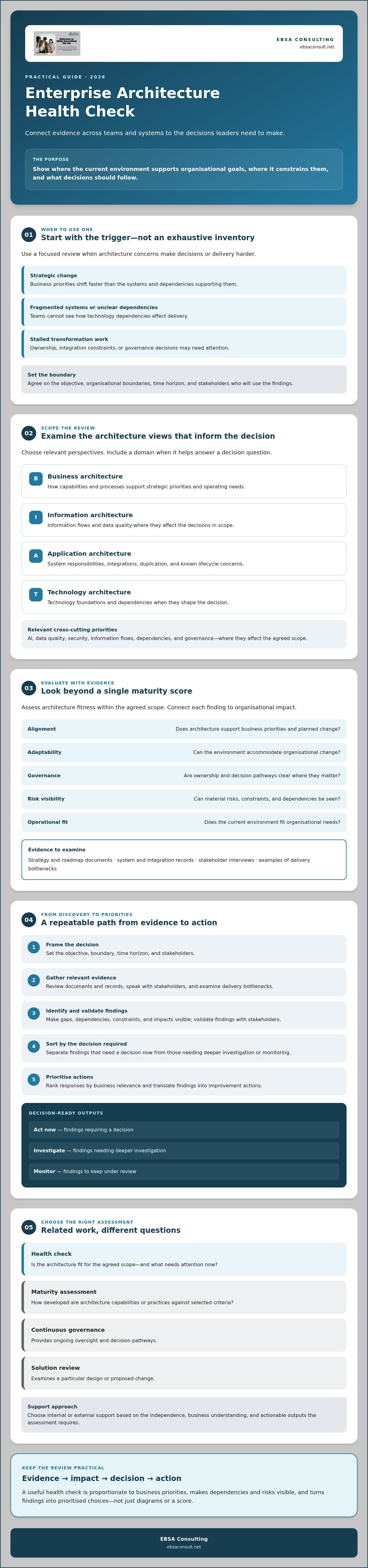
This practical 2026 template outlines what to assess across business, information, application, and technology architecture, including priorities such as AI, data quality, and security. It explains how to gather evidence, identify material gaps and dependencies, assess their business impact, and turn findings into prioritized decisions and improvement actions. The result is a health check that supports business alignment, organizational agility, and operational efficiency.
Key Takeaways
- Use an enterprise architecture health check when strategic change, fragmented systems, or unclear dependencies make decisions harder.
- Set the scope around the decisions leaders need to make, then examine the architecture perspectives that inform those decisions.
- Assess alignment, adaptability, governance, risk visibility, and operational fit using evidence, not a single maturity score.
- Follow a repeatable process to gather evidence, validate findings with stakeholders, and rank actions by business relevance.
- Choose internal or external support based on the independence, business understanding, and actionable outputs the assessment requires.
What an Enterprise Architecture Health Check Reveals, and When to Use One
Strategy can change faster than the systems and dependencies that support it. An enterprise architecture health check is a time-bounded, evidence-led review of whether the current architecture fits the organisation’s needs. It draws on relevant business and technology stakeholders, then connects the evidence to decisions about priorities, risks, and next steps.
A health check turns architecture evidence into prioritised business and technology action by showing where the current environment supports organisational goals, where it constrains them, and what decisions should follow. It can be useful when strategic change shifts business priorities, systems have become fragmented, transformation work is stalled, or teams can’t see how technology dependencies affect delivery. Set the scope in response to the trigger rather than defaulting to an exhaustive inventory.
A health check differs from continuous governance, which provides ongoing oversight and decision pathways. It also differs from a solution review, which examines a particular design or proposed change. A health check takes a broader view of architecture fitness within an agreed boundary and time horizon. Its purpose is not simply to draw diagrams or assign a score, but to distinguish findings that require a decision from those that need further investigation or monitoring.
What questions should an enterprise architecture health check answer?
Anchor the review to questions leaders can act on. Can the current architecture support stated business priorities and planned change? Where do duplication, dependencies, constraints, or unclear ownership affect delivery? Which findings call for a decision now, which need deeper investigation, and which should be monitored?
Evidence might include strategy and roadmap documents, system and integration records, stakeholder interviews, and examples of delivery bottlenecks. Connect each finding to its organisational impact so decision-makers can see why it matters and what response may be appropriate.
How is a health check different from an EA maturity assessment?
A health check examines fitness and actionable concerns within a defined scope. A maturity assessment evaluates how developed architecture capabilities or practices are against selected criteria. The two can complement each other, but they answer different questions: one focuses on what needs attention now; the other helps show how architecture practices may develop over time. For a deeper look at the latter, see this enterprise architecture maturity assessment guide.
Formal frameworks can provide useful context without dictating the scope of a practical review. The Enterprise Architecture Assessment Framework describes a structured approach to assessing enterprise architecture maturity. Use frameworks as reference points, then shape the assessment around the organisation’s decisions and evidence.
Set the Scope: The Architecture Domains and Evidence to Examine
A focused enterprise architecture health check starts with the decisions it needs to inform. Agree on the objective, organisational boundaries, time horizon, and stakeholders who will use the findings. For example, a review supporting an operating-model change may need to connect business capabilities to applications and technology dependencies. A review of a stalled transformation may focus instead on ownership, integration constraints, and governance decisions.
Keep the scope proportionate. Enterprise architecture helps align with business goals, but not every assessment needs to examine every domain. Include a perspective only when it helps answer a decision question.
Which architecture domains belong in the assessment?
Choose views that connect organisational needs to delivery realities. Business architecture can show how capabilities and processes support strategic priorities and operating needs. Application architecture can clarify system responsibilities, integrations, duplication, and known lifecycle concerns. Include information flows, technology foundations, dependencies, or governance when they affect the decisions in scope.
For each domain, record the question it helps answer. If no decision question connects to a domain, leave it out or note it for a later review. This keeps the assessment manageable while preserving links between business architecture, enterprise architecture, and solution design where the scope calls for them.
What evidence should teams gather before the health check?
Request existing architecture views, roadmaps, standards, application inventories, and decision records. Then test those materials through conversations with business and technology stakeholders. A documented integration may not reflect how teams experience a dependency in practice. Interviews can reveal workarounds or ownership gaps that formal records don’t capture.
Assess evidence quality as well as content. Record when it was produced, who owns it, and how confidently it represents the current state. Separate documented facts from stakeholder assumptions, and make material gaps visible rather than treating them as confirmed findings.
Scope worksheet
- Decision questions: What choices should the assessment support?
- Boundary and time horizon: Which business areas, systems, and planning period are included?
- Perspectives and evidence: Which domains are relevant, what evidence is needed, and who owns it?
- Dependencies and exclusions: What relies on what, and what is intentionally outside scope?
- Evidence confidence: What are the source, date, owner, confidence level, and known information gap?
When an independent perspective could help align the scope with business priorities, EBSA Consulting’s enterprise architecture consulting can help structure the assessment and its decision questions.
Evaluate Architecture Health with Clear Criteria, Not a Single Score
Once the scope and evidence are clear, assess each finding against criteria that connect architecture conditions to organisational priorities. An enterprise architecture health check should show what is working and where dependencies, duplication, unclear decision rights, or unsupported assumptions could affect planned change. Consider resilience and adaptability in the organisation’s context rather than treating every concern as equally material.
No single score can represent every architectural trade-off, because a strength in one area may coexist with a constraint or risk in another. A rating can help compare findings, but only if its definitions and evidence thresholds are agreed in advance. For example, “supported” might mean current documentation is corroborated by owners, while “uncertain” signals incomplete or conflicting evidence. Don’t let a rating imply more certainty than the evidence supports.
| Assessment dimension | Example evidence | Decision relevance |
|---|---|---|
| Strategic alignment | Business priorities, capability maps, roadmaps | Shows whether architecture enables or constrains planned capabilities and change. |
| Coherence | Application responsibilities, integrations, duplicated functions | Highlights overlap, dependencies, and opportunities to clarify ownership. |
| Adaptability | Architecture decisions, change patterns, known constraints | Indicates how readily the environment can respond to changing needs. |
| Governance | Decision records, standards, approval responsibilities | Reveals whether decision rights and exceptions are clear. |
| Risk visibility | Dependency records, documented assumptions, known concerns | Identifies issues requiring a decision, validation, or further investigation. |
| Operational fit | Stakeholder input, process views, operational information | Tests whether documented designs reflect how work is carried out. |
Which criteria make findings useful to decision-makers?
Frame each criterion around a practical question: does an architecture choice enable or constrain a stated business capability? Which dependencies or duplicated responsibilities could affect delivery? Are assumptions and decision rights clear enough for teams to proceed? The Enterprise Architecture Assessment Framework (EAAF) offers a formal reference point for structured assessment, while the strategic architectural frameworks consulting guide provides additional framework context. Adapt criteria to the review’s purpose rather than applying a framework mechanically.
How can teams distinguish evidence from opinion?
Label every finding with its source, confidence, scope, and validation status. Where possible, corroborate interview observations with architecture artefacts, operational information, or decision records. If stakeholders disagree, document the difference as a question to resolve, not a conclusion. Keep the record in three parts: observed condition, potential impact, and recommendation. This makes uncertainty visible and helps leaders decide what to act on, investigate, or monitor.
Run the Health Check: A Repeatable Process from Discovery to Priorities
A repeatable process makes findings easier to verify, discuss, and act on. For an enterprise architecture health check, assign an owner to each step and agree on the evidence and outputs needed to move from discovery to decisions.
- Align objectives. Owner: assessment lead, working with accountable business and technology decision-makers. Inputs: strategic priorities, scope boundaries, and known concerns. Activities: agree on assessment questions, decision-makers, and success measures. Output: a brief that defines what the review will inform.
- Gather evidence. Owner: evidence coordinator or relevant domain owners. Inputs: architecture artefacts, roadmaps, inventories, and stakeholder knowledge. Activities: review documents, interview stakeholders, and consistently record sources, gaps, and confidence. Output: an organised evidence set with unresolved questions visible.
- Assess. Owner: assessment lead with relevant architecture and business contributors. Inputs: agreed criteria and gathered evidence. Activities: examine selected domains, connect conditions to business needs, and distinguish root causes from symptoms. Output: findings that separate observed conditions from potential impacts.
- Validate. Owner: accountable business and technology stakeholders. Inputs: draft findings, supporting evidence, and areas of uncertainty. Activities: test accuracy, discuss disagreements, and confirm what requires a decision or further investigation. Output: validated findings with confidence and scope recorded.
- Prioritise. Owner: decision-makers, supported by the assessment lead. Inputs: validated findings, dependencies, and organisational priorities. Activities: rank actions, name accountable owners, and set review points. Output: an agreed action list that can inform a practical roadmap.
How should findings become a practical roadmap?
Prioritise findings by considering business impact, urgency, dependencies, confidence, and effort together. A high-impact concern with strong evidence and a clear owner may need a near-term decision. An uncertain finding may call first for investigation, while foundational work may need to precede a larger architectural change. Treat these criteria as a way to structure discussion and make trade-offs explicit, not as a mechanical score.
Group actions into near-term decisions, foundational work, and longer-term change. Map dependencies and agree on sequencing with the people accountable for delivery. Set review points to revisit progress and assumptions, without promising dates or outcomes before owners have assessed the work. For another perspective on using frameworks to guide architecture decisions, see the strategic architecture frameworks guide.
EBSA Consulting’s architecture consulting services can help teams structure assessment scope and decision needs.
Choose the Right Support and Turn Health Check Findings into Action
The right support depends on the decisions at stake, the skills available internally, and how much neutrality the assessment needs. An internal self-assessment can work when teams have reliable evidence and can discuss findings openly. A focused external review may help test a specific concern or facilitate a decision where perspectives differ. A broader consulting engagement can connect enterprise, business, and solution architecture perspectives when the scope spans several domains.
- Internal self-assessment: Uses existing knowledge and keeps the review close to the organisation. It works best when stakeholders can challenge assumptions constructively and evidence is accessible.
- Focused external review: Brings an independent perspective to a defined question, such as a dependency or governance concern. Confirm that the reviewer understands the business context as well as the technical evidence.
- Broader consulting engagement: May suit an assessment that needs coordinated input across business priorities, architecture views, and organisational decisions. Agree on the scope and expected outputs before work begins.
When should an organization bring in external architecture consultants?
Consider external support when internal perspectives are fragmented, stakeholders need neutral facilitation, or the assessment calls for expertise not readily available within the team. Match that expertise to the scope: enterprise architecture for cross-organisation concerns, business architecture for capabilities and operating needs, or solution architecture for specific design questions. Consultants can structure assessment and decision-making; this is distinct from managed IT support.
Set realistic expectations from the start. A useful review depends on stakeholder participation, access to relevant information, and agreement on what is in and out of scope. Clarify who can validate findings and make decisions. If evidence is incomplete or access is limited, record the resulting uncertainty rather than presenting assumptions as established facts.
What should a useful health check deliver after the assessment?
An enterprise architecture health check should leave decision-makers with more than a presentation or a list of observations. Request a concise, evidence-based view of strengths, concerns, uncertainties, and dependencies, along with their implications for business and technology objectives. Each recommended action should include its priority rationale, accountable owner, and practical next step.
Agree on governance checkpoints to review progress, resolve dependencies, and revisit assumptions as circumstances change. This keeps findings connected to action without treating the assessment as a fixed blueprint. The result is a proportionate path forward, shaped around the organisation’s priorities and capacity.
EBSA Consulting’s architecture assessment consulting can support discussion of assessment scope and decision needs.
Turn Architecture Insight into Lasting Progress
A strong enterprise architecture health check gives leaders more than a snapshot. It brings evidence into focus, connects strengths and risks to business priorities, and clarifies which decisions deserve attention first. Keeping the scope proportionate and validating findings with the people accountable for change helps turn assessment into a practical path forward rather than another static report.
The next step is to connect architecture choices with the outcomes the organisation is working toward. EBSA Consulting offers enterprise architecture consulting, business architecture services, and solution architecture design to align business and technology through strategic architectural frameworks.
Discuss your enterprise architecture assessment with EBSA Consulting to explore the scope, evidence, and decisions that matter to your organisation.
Frequently Asked Questions
What is an enterprise architecture health check?
An enterprise architecture health check is a structured review of how well an organisation’s architecture supports its business priorities and operational needs. It examines selected architecture domains using available evidence and stakeholder input. The scope is agreed in advance, including the questions the review should answer. Findings make strengths, gaps, dependencies, and uncertainties visible, helping decision-makers determine which actions deserve attention and which issues need further investigation.
What should an enterprise architecture health check include?
An enterprise architecture health check should include the business and technology areas needed to answer its agreed decision questions. Depending on the scope, this may cover business capabilities, applications, information flows, technology foundations, governance, and dependencies. Identify evidence sources and owners, and record any limitations. Select domains deliberately rather than assessing every possible area by default, so the review remains focused on findings that can inform business and technology decisions.
How is an enterprise architecture health check different from a maturity assessment?
A health check examines architecture fitness and concerns that affect current or planned decisions. A maturity assessment evaluates how developed selected architecture capabilities or practices are against defined criteria. The approaches can complement each other, but they answer different questions. Choose a health check when leaders need actionable findings about the architecture; choose a maturity assessment to understand capability development. An organisation may use both to assess current fitness and longer-term practice improvement.
How long does an enterprise architecture health check take?
There’s no universal timeframe for an enterprise architecture health check. Duration depends on the scope, organisational complexity, stakeholder availability, evidence quality, and depth of validation required. A focused review of a defined decision question differs from an assessment spanning multiple domains. Before planning, agree on the boundaries, participants, evidence needs, and expected outputs. These details provide a more credible basis for estimating the work than relying on a standard duration.
Who should participate in an enterprise architecture health check?
Include people who can explain the architecture and contribute to the decisions the assessment is meant to inform. Participants may include business leaders, enterprise architects, technology owners, and stakeholders responsible for affected capabilities or systems. Involve people who understand both documented designs and operational realities. Establish who owns decisions early, so stakeholders can validate findings and recommendations can move into planning with clear accountability rather than remaining unassigned.
Can an organization conduct an enterprise architecture health check without a formal framework?
Yes. A formal framework isn’t essential if the organisation defines clear questions, consistent criteria, reliable evidence, and an agreed decision process. Frameworks can offer useful structure, but applying one without adapting it to the assessment may add complexity without improving findings. Keep the method proportionate, document assumptions and limitations, and use a framework or other assessment tools only when they support the objectives and help decision-makers interpret the results.
What deliverables should an enterprise architecture health check produce?
Useful deliverables include an agreed scope, an evidence-based view of current conditions, validated findings, key dependencies, and clear decision implications. The resulting action plan should prioritise options, explain why each action matters, identify accountable owners, and show sequencing considerations. Its format can vary, but leaders should be able to distinguish what needs attention from what remains uncertain. Agreeing how progress will be reviewed helps ensure the findings inform follow-through.


