

The biggest legacy-system bill is often the one your IT budget doesn’t show. The cost of maintaining legacy systems can be spread across technology, operations, security and business teams, while workarounds and delays are harder to capture. That makes a single industry average a poor guide to what your own environment costs.
Looking beyond the maintenance line item is essential. A credible total-cost baseline reflects the systems your organization relies on, their dependencies and the operational impact when they constrain change. Use consistent assumptions and, for financial figures, report in Singapore dollars when that is the organization’s accounting currency.
This guide explains how to identify direct and indirect costs, build a baseline from your own environment, and compare maintaining, containing and modernizing systems on equal terms. It also shows how to use the findings as a business and architecture decision, rather than treating each application as an isolated expense. Enterprise and business architecture can clarify ownership, dependencies and capabilities, connecting cost evidence to investment priorities.
Key Takeaways
- Separate direct spending from internal effort and operational impacts to build a more complete view of legacy-system costs.
- Assess support constraints, specialist skills, integrations and workarounds to understand what drives the cost of maintaining legacy systems.
- Compare maintenance, containment and selective modernization using the same scope, time horizon and business assumptions.
- Track each cost item by owner, evidence source, period, confidence level and accounting treatment to strengthen your baseline.
- Use relationships between systems, capabilities and business priorities to decide what to retain, contain, replace or sequence.
What the Cost of Maintaining Legacy Systems Really Includes
The cost of maintaining legacy systems includes the resources required to keep a system available, supported and fit for its current role. That means more than invoices. Internal teams may spend time applying changes, resolving incidents, managing interfaces or preserving undocumented knowledge. A system’s age alone doesn’t determine its cost or value. Its role in business operations matters too. For a general overview of the term and its implications, see What is a Legacy System?
Definition: Maintenance spend is the recorded and allocated resources used to operate and support a system. Total cost of ownership also considers the wider, attributable effects of relying on it.
Why the visible maintenance budget is only a starting point
Start with expenditure you can trace: infrastructure and hosting, software licences, vendor support and internal labour. These items may sit in different budgets, belong to separate cost centres or be shared across applications. A platform team, for example, may pay for hosting while a business unit funds specialist support and operations staff handle recurring manual work. Without a clear system owner and allocation method, each team sees only part of the cost.
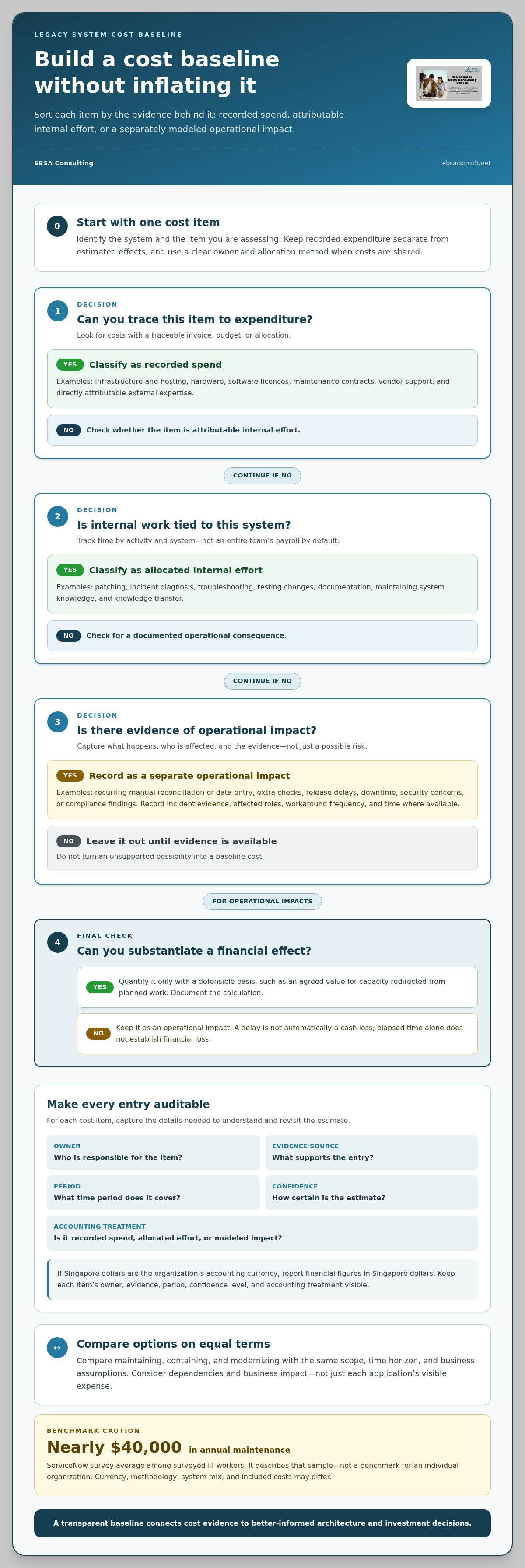
Keep recorded expenditure separate from modeled effects. You can estimate and document the time spent on a workaround, but a delay in launching a feature isn’t automatically a cash loss. Record the delay as an operational impact. Quantify a financial effect only when there’s a defensible basis, such as an agreed value for capacity redirected from planned work. This keeps the baseline auditable instead of inflating it with every possible risk.
Why one industry average cannot price every legacy estate
ServiceNow reports a survey average of nearly $40,000 in annual maintenance among surveyed IT workers. Treat this as a finding about those respondents, not a benchmark for an organization: the figure reflects a particular sample and may not match your accounting scope, system mix or operating model. Don’t convert an external average into a local estimate without understanding its currency, methodology and included costs.
Comparisons also depend on system criticality, transaction scale, architecture, support arrangements and connected services. A stable application with few dependencies has a different cost profile from a business-critical platform that needs specialist attention and supports multiple integrations. Map those relationships before comparing systems. An enterprise architect’s role in legacy modernization includes connecting technology dependencies to business capabilities, making investment assumptions easier to see.
For a credible baseline, label each item as recorded spend, allocated internal effort or modeled impact. Document its owner, source and calculation. This gives decision-makers a transparent starting point without presenting uncertainty as fact.
The Main Cost Drivers Behind Legacy System Maintenance
Once you’ve defined the baseline, classify its cost drivers. Separate recurring direct expenditure from internal effort, then record operational consequences as a distinct category. This prevents unlike items from being blended into one inflated estimate and helps leaders see which costs are controllable, shared or tied to a particular business capability.
Direct costs: support, infrastructure, and specialist effort
Direct costs can include maintenance contracts, hosting, hardware, software licences and external support. Add internal hours spent patching, troubleshooting, testing changes and maintaining system knowledge. These hours may not appear as a separate invoice, but they use capacity that teams could otherwise devote to planned work.
Specialist expertise can add pressure. If only a few people understand a legacy platform or its customizations, routine changes may depend on their availability, and knowledge transfer may take time. Track effort by activity and system rather than assigning an entire team’s payroll to one application.
- Support and platform: contract renewals, infrastructure, hosting and hardware upkeep.
- Internal effort: patching, incident diagnosis, testing, documentation and knowledge transfer.
- External expertise: specialist work or vendor support directly attributable to the system.
Indirect costs: integration friction and constrained change
Operational friction often appears where a system connects to other applications or business processes. A brittle interface may require repeated reconciliation, manual data entry or extra checks. Record how often the workaround occurs, which roles perform it and how much time it takes. This makes recurring effort visible without assigning it an unsupported financial value.
Change constraints can also affect delivery. A team may need extra testing or coordination before modifying a connected service, extending a release timeline. Capture the delay and its business consequence, but distinguish elapsed time from financial loss unless the organization can substantiate the conversion.
Keep downtime, security exposure and compliance concerns separate from routine operating costs. For downtime, use incident records and documented impact rather than treating a hypothetical outage as a loss already incurred. For security, distinguish known remediation work from potential exposure and base estimates on a defined scenario. For compliance, record specific findings, required actions and evidence instead of assuming an older system automatically creates a breach or penalty.
Risk exposure is a possibility to assess, not an incurred loss to add to the maintenance bill. This distinction matters when using external examples. The U.S. Government Accountability Office’s Government Spending on Legacy Systems report offers public-sector context, but its findings should not be treated as an organization’s cost benchmark.
An enterprise architecture perspective can help show how dependencies connect technology effort to business processes. With categories kept distinct, the cost of maintaining legacy systems is easier to explain, validate and compare without counting the same impact twice.
Compare Maintaining, Containing, and Modernizing on Equal Terms
A useful comparison doesn’t assume that keeping a system is cheap or that replacing it is automatically better. Assess three realistic paths: continue maintenance, contain the system’s scope and exposure, or modernize selected components. Each option should address the same business need over the same planning horizon. This lets decision-makers compare trade-offs rather than competing assumptions.
What a fair scenario comparison should hold constant
Define the systems, connected services and business capabilities in scope, then use one planning horizon for all three options. Keep assumptions consistent for internal labour, support, infrastructure, downtime and business impact. For known costs, show the source. For modeled costs, document the method. Where evidence is incomplete, flag the uncertainty instead of presenting a precise figure.
| Scenario | Scope and dependencies | Effort and uncertainty | Business outcome to assess |
|---|---|---|---|
| Continue maintenance | Keep the current system and its interfaces operating. | Include ongoing support, internal effort and known constraints; distinguish forecast assumptions from recorded costs. | Does it reliably meet current needs, and what capacity remains for change? |
| Contain | Limit changes, access or connections while preserving essential functions. | Account for containment work and any extra operational controls, alongside continuing support needs. | Can the system’s role and exposure be managed while other priorities advance? |
| Modernize selectively | Change particular components or capabilities, including affected interfaces. | Include transition effort, testing, data movement and parallel operation where applicable; mark estimates that need validation. | Will the change improve alignment with business needs without disrupting essential operations? |
Don’t treat a modernization estimate as a single implementation figure. Include the work required to move safely, such as mapping dependencies, testing integrations, preparing data and supporting users through changed processes. Some costs may be known, while others remain uncertain until design or discovery clarifies the scope. Show them separately. Also avoid counting the same downtime or staff effort in multiple categories.
When containment or phased modernization may be more practical
Containment can be a deliberate choice when a system still supports a necessary process but its connections or scope for change should be limited. It can create time to understand dependencies and sequence investment, but it doesn’t remove the need to operate and support the system. Track what containment changes, what remains unchanged and how you’ll judge success.
Phasing can make sense when several capabilities depend on the same platform or business change must be coordinated across teams. Prioritize components by their role, dependencies and strategic relevance, then compare each proposed step with the maintenance path it would replace. Age alone isn’t a decision rule. The cost of maintaining legacy systems matters, as do continuity, capability fit, transition effort and the consequences of changing a system now versus later.
How to Measure the Cost of Maintaining Legacy Systems
A useful costing process turns scattered records and operational knowledge into a comparison people can review, challenge and update. Keep observed expenditure distinct from forecasts, potential risk scenarios and opportunity costs. That separation makes the cost of maintaining legacy systems more transparent and helps decision-makers see which evidence supports each conclusion.
A useful baseline pairs traceable inputs with explicit assumptions, so another reviewer can understand and reproduce the calculation.
Build a traceable system-level cost baseline
Begin by linking each system to the business capabilities it supports, its accountable owner, its dependencies and the critical services that rely on it. This sets a practical boundary for the analysis. It helps identify shared platforms and connected services without assigning their full costs to a single application. Gather finance, procurement, operations and delivery inputs for the same reporting period, and record the allocation method for each shared cost.
Use this sequence to build the baseline:
- Inventory systems and boundaries. Record each system’s role, owner, key interfaces and supported business capabilities. Note unclear boundaries or ownership.
- Gather source evidence. Reconcile finance records, procurement details, support information and operational activity for a defined period. Flag gaps rather than filling them with assumptions.
- Classify each cost item. Mark it as observed historical expenditure, forecast operating cost, modeled risk scenario or opportunity cost. Keep these categories separate in reports and scenario totals.
- Make every entry traceable. For each item, record an accountable owner, evidence source, reporting period, confidence level and accounting treatment. If a shared platform supports several systems, document the allocation rule and apply it consistently.
- Validate the comparison. Ask finance and technical owners to review the scope, calculations and assumptions, then compare maintenance, containment and modernization scenarios on the same basis.
Test assumptions and turn findings into priorities
Not every input will be equally certain. Use a reasonable range for estimates that depend on unresolved effort, allocation or future operating conditions, and show how the result changes across that range. Avoid false precision: a modeled outage scenario belongs in a risk view unless evidence establishes an actual loss. Keep opportunity cost distinct from expenditure and explain its basis.
Then rank systems by business criticality, cost drivers, dependency exposure and feasibility of change. This brings financial evidence into an architecture view. A costly system may be difficult to change because several critical capabilities depend on it, while a contained system may be a more practical early candidate. Record what new evidence could change the ranking, such as a verified interface dependency or revised effort estimate. That turns the baseline into a decision tool, not a static spreadsheet.
EBSA Consulting’s enterprise, business and solution architecture services can help translate a traceable baseline into architecture priorities. Discuss your legacy-system cost assessment.
Turn Legacy-System Cost Findings into an Architecture Decision
A cost baseline becomes useful when it informs a choice about business capabilities, not just applications. An architecture view shows which services depend on each system, how information moves across interfaces and where a change could affect other parts of the organization. This makes the cost of maintaining legacy systems one input among several, alongside service importance, strategic fit and feasibility of change.
Connect cost evidence to business capabilities and dependencies
Trace each system to the business services it enables and the interfaces those services rely on. A platform may appear costly in isolation yet support a critical process with few practical alternatives. Another system may duplicate capabilities already available elsewhere. Mapping these relationships helps distinguish the cost of essential continuity from the cost of avoidable complexity.
Look for concentrated knowledge, too. If essential system knowledge rests with a small number of individuals, that dependency may constrain the organization’s ability to change or sustain the capability. Treat it as an evidence-based planning consideration, not a hypothetical loss. Prioritize by business value and operational importance, rather than system age alone.
Create a sequenced decision roadmap
Translate the evidence into clear options for each system: retain, contain, replace or sequence change. For every option, name the decision owner, affected capabilities, dependencies, assumptions and review point. This makes dependencies between decisions visible, such as replacing an interface before changing the application that relies on it.
- Business leaders clarify which capabilities and service outcomes matter most.
- Finance partners validate cost boundaries, allocation assumptions and how scenarios are compared.
- Technology leaders assess dependencies, feasibility, transition needs and architectural implications.
These stakeholders should review the same evidence, while a named decision owner brings their perspectives together. Sequence analysis and change so critical services remain visible throughout. Define what must be understood before moving to the next step, and revisit priorities when assumptions or business needs change. A roadmap might begin with further dependency analysis, proceed to a contained change or defer action where the evidence supports continued operation.
Enterprise, business and solution architecture connect technology choices with organizational processes and strategic intent. If you’re shaping that decision path, explore enterprise architecture consulting to align business vision with infrastructure. A structured architecture discussion can help turn cost findings into coordinated priorities.
Make Your Next Architecture Decision with Confidence
Your next step is to turn cost evidence into a decision the organization can act on. You don’t need to resolve every uncertainty first. You do need clarity about what the business needs, which assumptions still need testing and who will revisit the decision as conditions change. With that discipline, the cost of maintaining legacy systems becomes part of a forward-looking investment conversation, not just a record of past spending.
Architecture connects decisions across levels. Enterprise architecture aligns technology infrastructure with business strategy, business architecture examines effects on processes and operational efficiency, and solution architecture translates requirements into technical blueprints. Together, these perspectives help stakeholders move from a system-level assessment to a coordinated path for change.
Ready to align your technology decisions with business priorities? Explore EBSA Consulting’s enterprise, business and solution architecture services to turn cost findings into a coordinated set of priorities.
Frequently Asked Questions
Is the cost of maintaining a legacy system the same as its total cost of ownership?
No. Maintenance expenditure covers recurring resources used to keep a system operating and supported, while total cost of ownership takes a broader view. It may include allocated infrastructure, internal effort, integration work and evidence-based operational impacts. For example, an organization might include staff time spent reconciling data between systems. State the estimate’s scope, period, assumptions and treatment of shared costs so readers can interpret it consistently.
Can a legacy system remain cost-effective even when it is difficult to integrate?
Yes, if its business value, operating costs and risks remain acceptable. Integration friction matters in proportion to its actual effect: a manual check required once a month may have a different consequence from a recurring delay in a critical service. Map the affected processes and dependencies, then compare feasible containment with modernization. Difficulty integrating is a reason to investigate, not sufficient evidence on its own that replacement is necessary.
Does the age of a system determine how much it costs to maintain?
No. Age is an incomplete indicator, not a cost calculation. Two systems of similar age can differ because one is simple and stable while the other has complex interfaces, frequent changes or limited support expertise. Review actual spending and recorded staff effort over a defined period, then note risks and estimates separately. For example, a recent rise in troubleshooting hours may signal a cost driver more directly than the system’s original launch date.
How often should an organization refresh its legacy-system cost baseline?
Refresh it when a material change affects the system’s scope, support arrangements, dependencies, usage or planned investment. Set a regular review cadence that matches budgeting and decision cycles, and record the date of each review. Updating every input continuously can consume effort without changing a decision. Leaving assumptions untouched after a major interface or service change can make comparisons unreliable. Keep data owners and source records visible so the next review is easier to validate.
Can legacy-system maintenance costs be compared across departments?
Yes, if departments use consistent cost definitions, reporting periods, scope boundaries and allocation rules. Raw totals may mislead if one department supports a critical service while another has fewer users or responsibilities. Present context alongside each figure, such as systems covered and services supported. If a shared database serves several teams, record its expenditure once and explain how the cost is allocated rather than counting the full amount in every department’s total.
What happens if an organization cannot separate legacy costs from shared IT spending?
The estimate can still support decisions if shared expenditure and allocation assumptions are explicit. Finance and technology owners can map major cost pools, such as shared hosting or platform support, and identify which systems use them. Apply one consistent allocation method, mark uncertain values as estimates and avoid presenting them as exact. Improve the baseline as ownership or usage data becomes clearer, prioritizing better evidence for costs likely to affect a decision.


