

What if the most useful consulting engagement isn’t the one with the most familiar framework, but the one that helps your organisation make clearer decisions? For leaders assessing business architecture consulting Singapore options, the challenge is often familiar: strategy, operating processes and technology choices don’t quite connect, while proposals can sound alike despite covering different work.
That makes the basis for comparison important. You need an engagement tied to business priorities, not architecture terminology alone. This guide explains how to define the outcomes you need, distinguish business architecture from enterprise and solution architecture, and assess whether proposed work will support practical decisions. It also shows how business architecture can connect organisational needs with broader enterprise architecture and technical design. With a clearer view of scope and outcomes, you can prioritise change with greater confidence and choose an approach aligned with your organisation’s direction.
Key Takeaways
- Recognise when fragmented priorities, unclear ownership and disconnected change initiatives call for a shared business view.
- Understand how business architecture differs from enterprise architecture and solution architecture, and where the disciplines connect.
- Compare business architecture consulting Singapore options by how clearly they address your organisation’s priorities and support decisions.
- Prepare a focused brief by stating the business question, identifying decision owners and separating known concerns from assumptions.
- See how EBSA Consulting connects business architecture with enterprise architecture and solution design when organisational needs call for it.
When business architecture consulting in Singapore can clarify strategic priorities
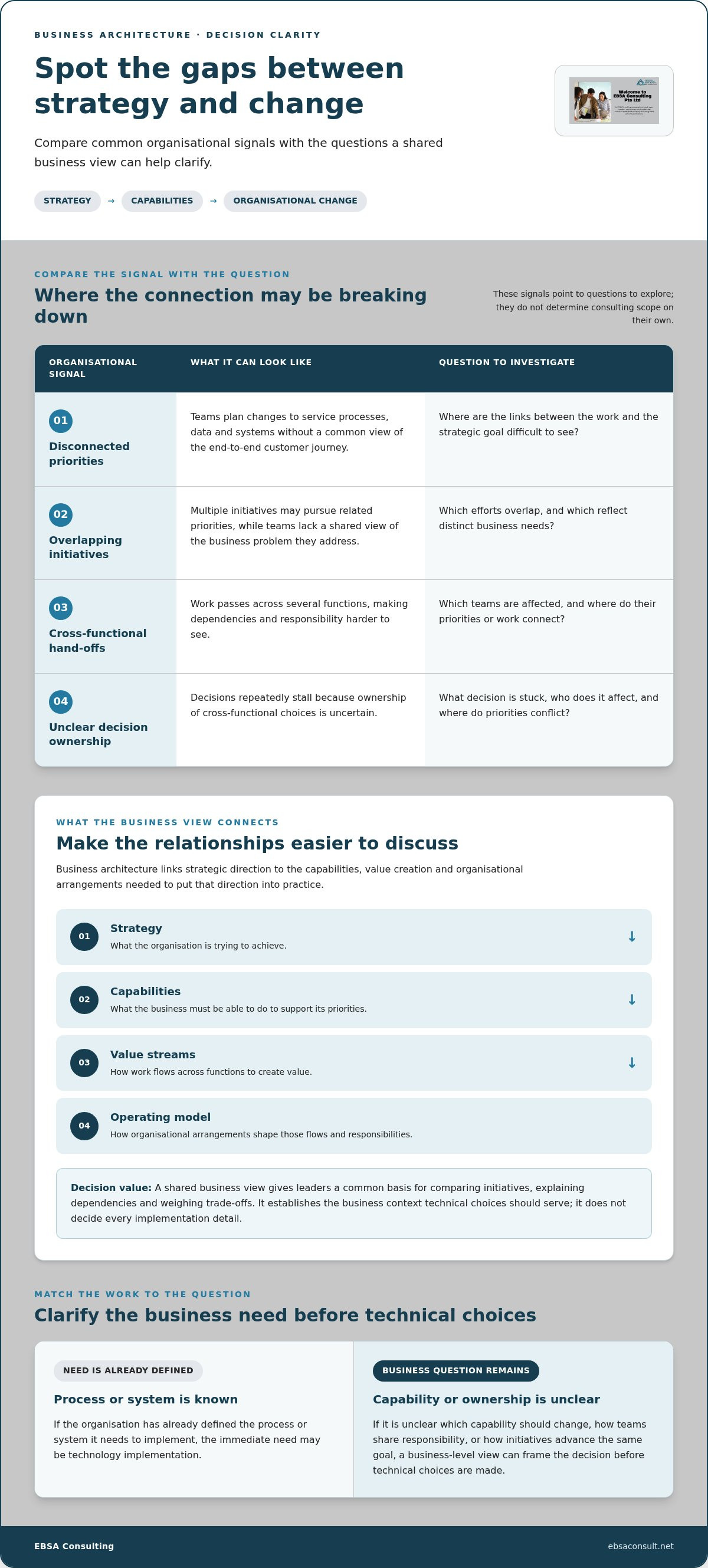
Strategic priorities can become fragmented as they move from leadership discussions into budgets, processes and technology decisions. Teams may pursue overlapping initiatives, ownership of cross-functional decisions may be unclear, and change programmes may lack a shared view of the business problem they are meant to address. Another technology project might resolve a local issue without clarifying how the organisation should prioritise broader change.
Business architecture connects strategy to the capabilities, value and organisational design needed to put that strategy into practice. It gives leaders and teams a structured way to examine how priorities relate to the work the organisation performs and the way it is set up to deliver value. For a broader overview of definitions and approaches, see What is Business Architecture?
Start with the business question. If the organisation has already defined the process or system it needs to implement, the immediate need may be technology implementation. If it is still unclear which capability needs to change, how teams share responsibility, or how competing initiatives advance the same goal, a business-level view can help frame the decision before technical choices are made. The distinction helps match the work to the question.
What organisational signals suggest a business architecture need?
Look for recurring gaps between strategic goals, business capabilities and day-to-day operating decisions. A company may prioritise a smoother customer experience, for example, while separate teams plan changes to service processes, data and systems without a common view of the end-to-end customer journey. The issue may not be a lack of activity. It may be that the links between the work and the strategic goal are difficult to see.
Duplicated initiatives, hand-offs across several functions, or decisions that repeatedly stall because ownership is uncertain can also make prioritisation harder. To investigate, name the decision that feels stuck, list the teams it affects, and note where priorities appear to conflict. These signals help identify questions to explore, but they do not by themselves determine the right consulting scope. The cause may be strategic, operational, technological, or a combination.
What should the organisation expect business architecture to clarify?
Business architecture makes the relationships between strategy, capabilities, value streams and the operating model easier to discuss. In practical terms, that means examining which capabilities support a priority, how work flows across functions to create value, and what organisational arrangements shape those flows. A shared business view gives leaders a common basis for comparing initiatives and helps teams explain dependencies and trade-offs.
For example, if several functions are proposing changes to improve a customer journey, a shared view can help distinguish overlapping efforts from distinct needs and show where decisions involve more than one team. It won’t determine every implementation choice. Instead, it establishes the business context those choices should serve. Explore professional business architecture services for more on how this work supports enterprise alignment.
For organisations considering business architecture consulting singapore, the useful question is not simply whether a framework is named. It’s whether the work will clarify the organisational relationships behind a priority, so leaders can make more coherent decisions about what to change and why.
What business architecture consulting covers, and where adjacent disciplines fit
Business architecture consulting connects an organisation’s direction to the structure and capabilities required to deliver it. It helps leaders examine how strategic objectives relate to what the business must be able to do, how value is created, and how responsibilities and work are organised. The aim is to make those relationships clear enough to guide decisions, not to produce a technology design before the business need is understood.
For organisations assessing business architecture consulting singapore, distinguishing adjacent disciplines helps define a useful scope. The terms are related, but they answer different questions. Understanding Business Architecture offers further context on the discipline and its relationship to strategy and enterprise architecture.
How business architecture differs from enterprise architecture
Business architecture focuses on the organisation’s business structure: its capabilities, value creation, and how work and responsibilities support strategic direction. Enterprise architecture takes a broader view, considering alignment across business and technology architecture domains. The disciplines complement one another. Business architecture can clarify what the organisation needs to achieve; enterprise architecture can connect that view to the wider technology landscape.
To shape the scope, identify the decisions the engagement should inform. If the question concerns which business capabilities need to evolve or how functions contribute to a value stream, the business perspective should be central. If it also concerns how applications, data or technology choices align across the organisation, enterprise architecture may be relevant. Defining these boundaries keeps the work focused without treating either discipline as a substitute for the other.
When solution architecture connects to the business view
Solution architecture translates defined business requirements into a technical blueprint for a particular solution or implementation. It addresses how that solution should be designed, while business architecture considers the organisation-wide structures and capabilities that give the requirements context. A solution design can be well specified and still miss the right business need if that context hasn’t been understood.
For example, a requirement to improve a service process may lead to a specific system change. Business architecture helps clarify the capability and value the change is meant to support; solution architecture then focuses on how the chosen implementation can meet the defined requirements. The perspectives connect when business needs are translated into technical design, while retaining distinct scopes.
For implementation-design context, explore the strategic solution architecture design process. This helps distinguish organisation-level questions from design decisions associated with a particular solution.
EBSA Consulting provides business architecture services alongside enterprise architecture consulting and solution architecture design. Explore EBSA Consulting’s architecture services to see how these disciplines relate to organisational priorities.
How to compare business architecture consulting options
Consulting proposals can use similar language while addressing different organisational questions. Compare the logic of the engagement: does it connect the business challenge to decisions leaders need to make, and is the proposed scope clear enough to guide the work? A framework name may describe an approach, but it does not show by itself whether that approach fits your priorities.
A useful consulting scope links analysis to the decisions the organisation must make. Use the criteria below to assess whether a proposal makes that connection clear.
| Criterion | What to look for |
|---|---|
| Business alignment | The challenge and intended decisions are expressed in clear, non-technical language and connected to stated business priorities. |
| Scope clarity | The proposal explains what it will examine, what is outside scope, and how the work relates to the organisational question. |
| Stakeholder collaboration | The approach includes relevant business and technology perspectives and makes clear who contributes to decisions. |
| Usefulness for decisions | Proposed outputs are intended to help leaders align, prioritise or communicate choices, rather than simply document analysis. |
Which criteria reveal whether the engagement fits?
Start with the organisation’s question, not the consultant’s terminology. For example, “Which capabilities should we strengthen to support our growth priorities?” calls for a different scope from “How should we design this system?” The first is a business-level question; the second is more implementation-focused. A proposal should make its connection to the relevant question easy to follow.
Check whether the proposed work includes the business and technology stakeholders whose perspectives shape the decision. Then trace the scope back to the priorities you have stated. If a workstream appears without a clear reason, its relevance needs explanation. These checks help compare fit without expecting one engagement to address every organisational concern.
How to evaluate frameworks and proposed outputs
Treat a framework name as context, not evidence of fit. What matters is how the approach will be applied to the organisation’s question, what the work is expected to examine, and how its outputs will support decisions. A map, model or assessment is useful when leaders can apply it to clarify relationships, compare priorities or communicate implications across functions.
Separate what the proposal explicitly states from what you might be assuming. Note whether the method, scope, stakeholder involvement, timing, outputs and measures of success are described, or simply inferred from broad language. Don’t treat a possible deliverable or result as confirmed unless the proposal defines it. This keeps comparisons grounded and makes it easier to identify where expectations need clearer alignment.
If the organisational question spans business and technology architecture, enterprise architecture consulting can help frame the wider remit. For business architecture consulting singapore, compare each proposed scope against the decisions it is designed to inform, rather than relying on labels alone.
How to prepare a business architecture consulting brief
A focused brief turns a broad organisational concern into a productive consulting scope. It doesn’t need to prescribe a framework or technical solution. Instead, explain what the organisation is trying to understand, which decisions need support, and what context is already known. For organisations considering business architecture consulting singapore, a clear brief also separates confirmed constraints from assumptions the engagement should investigate.
Use this sequence to shape the request:
- Define the business question. State the strategic priority and the challenge behind it. For instance, explain that teams have different views of which capabilities support a planned service improvement, rather than beginning with a request for a particular system.
- Identify decision owners. Name the leaders or functions responsible for choices the work should inform. Include stakeholders who understand how the current operating model works and where decisions cross organisational boundaries.
- Map known constraints. Note relevant dependencies, existing initiatives, operating considerations and boundaries, such as which functions or parts of the organisation are in scope. Mark unresolved points as questions, not facts.
- Prioritise outcomes. Describe what should become clearer or easier to decide. Separate essential outcomes from useful secondary insights so the proposed scope can focus on the organisation’s most important needs.
What information makes the initial scope more useful?
Summarise the strategic priority, the organisational challenge and the decisions the engagement should inform. Identify affected functions and stakeholders who can explain the current operating context, including where responsibilities or dependencies intersect. Include relevant organisational context when it affects the question, and distinguish established constraints from issues that still need to be explored.
Keep evidence distinct from interpretation. For example, “two functions are planning similar process changes” is a reported concern; “the teams have overlapping capabilities” may be an assumption to explore. This gives the work room to test the situation rather than treating an early interpretation as settled.
How to define outcomes without prescribing the answer
Describe the change in decision clarity or alignment you want, not the tool or platform you expect to produce it. An outcome might be a shared understanding of which capabilities support a priority, or clearer ownership of choices that affect several functions. The engagement can then examine what needs to change without being steered toward a solution before the business need is understood.
Keep preferred implementation choices in a separate section of the brief, labelled as current thinking rather than fixed requirements. This lets stakeholders explain why a particular option appeals to them while leaving space to assess the underlying need. It also helps connect business outcomes to later enterprise or solution architecture work when relevant.
To shape a brief around your organisational priorities, explore EBSA’s business architecture services. A well-framed starting point supports a focused discussion about scope, stakeholder involvement and decision-ready outcomes.
How EBSA Consulting connects business architecture to organisational priorities
Business architecture is most useful when it helps an organisation understand how its priorities relate to capabilities, responsibilities and the way work is organised. EBSA Consulting provides business architecture services as part of its strategic architecture consulting practice, bringing a structured, collaborative perspective to organisational alignment and operational efficiency. The work starts with the organisation’s priorities and the decisions it needs to address, rather than an assumed framework or predetermined technical answer.
That focus also helps establish whether related architecture work is relevant. Some business questions can be addressed at the organisational level; others connect to enterprise-wide technology alignment or the design of a specific solution. Keeping those needs distinct grounds the discussion in the business challenge while recognising where architecture disciplines can work together.
Where EBSA’s architecture capabilities connect
EBSA’s business architecture services focus on organisational alignment and operational efficiency. Enterprise architecture consulting connects business strategy with technology infrastructure, while solution architecture design translates business requirements into technical blueprints. EBSA provides these services so the work can address the organisation’s question without assuming that every business architecture need requires a technology design.
For example, a question about how capabilities and responsibilities support a strategic priority begins with a business view. If the organisation also needs to understand how technology aligns across the wider enterprise, enterprise architecture brings that perspective into the discussion. If requirements are ready to be translated into a technical blueprint for a particular solution, solution architecture design provides the more specific view.
What a considered next step looks like
Begin with a concise description of the business challenge and the decisions it affects. Bring the priority behind the issue, the functions involved, the constraints already understood and the questions that remain open. This gives the discussion useful context without requiring you to prescribe a framework, implementation or detailed solution in advance.
Use the guide’s comparison criteria to keep the discussion clear: connect the scope to business priorities, make boundaries understandable, include relevant stakeholders and consider how the work can inform decisions. These are practical ways to frame an initial conversation. The scope should reflect the organisation’s needs.
EBSA Consulting works across business architecture services, enterprise architecture consulting and solution architecture design. The relationship between these areas depends on the question at hand: business architecture frames organisational needs, enterprise architecture connects business and technology perspectives, and solution design translates defined requirements into technical blueprints.
If your organisation is considering business architecture consulting singapore, bring the priority you’re working toward and the decisions that need greater clarity. Discuss your business architecture priorities with EBSA Consulting.
Turn organisational questions into purposeful change
The value of business architecture consulting singapore lies in giving leaders a clearer basis for action, not simply adding another layer of documentation. Choose one organisational question that matters now, identify the decision it affects, and consider what shared understanding would help people move forward.
That focus creates a steadier starting point for change. It keeps conversations anchored in business priorities while leaving room to explore how organisational design and technology choices should support them. The scope can then grow in response to what the organisation needs to understand, rather than assumptions made before the real question is clear.
EBSA Consulting works collaboratively with organisations to connect business priorities with architecture considerations. To discuss the challenge your organisation is facing, discuss your business architecture priorities with EBSA Consulting.
A clear question is a practical beginning. With the right focus, your organisation can approach its next decisions with greater alignment and confidence.
Frequently Asked Questions
How is business architecture consulting different from management consulting?
Business architecture consulting concentrates on structuring business elements such as capabilities, value streams and organisational design so their relationships to strategic aims are clear. Management consulting is broader and may address strategy, operations, organisational change or other management questions. For example, a review of service delays could examine capability ownership from an architectural perspective, or wider performance and cost questions through management consulting. Scopes can overlap, so compare the business question and proposed work, not labels alone.
Is business architecture consulting suitable for a mid-sized organisation?
It can suit an organisation when its complexity and decisions justify a structured business view, regardless of employee count. A mid-sized organisation coordinating a new service across several functions, for instance, may need to understand which capabilities and responsibilities are involved. Before scoping work, define the challenge, the decision it affects and who owns that decision. This helps determine whether consulting fits the need without assuming a guaranteed return.
When should an organisation engage a business architecture consultant?
Consider an engagement when leaders need a shared view of capabilities, priorities or how strategic intent connects to operations to inform a specific decision. This might arise while reviewing how responsibilities should support a planned business change, but no transformation stage automatically calls for consulting. Timing depends on the decision and the organisation’s readiness to involve relevant stakeholders. Frame the business question first, then use it to shape a proportionate scope.
Who should participate in a business architecture consulting engagement?
Include people whose knowledge and authority reflect the decisions in scope. Business leaders can explain strategic direction; functional stakeholders can describe how work operates across teams. Technology leaders add important context when the question includes business and technology alignment. The right group depends on the organisation, not a fixed team template. Make decision ownership clear and ensure participants can explain how the current operating model works in practice.
What deliverables can business architecture consulting produce?
Outputs depend on the agreed scope and the decisions they need to support. They may describe business structures and relationships in a form leaders can use to discuss alignment, dependencies or priorities. Before work begins, state how those outputs will be used, such as informing a planning discussion or clarifying responsibilities across functions. Then assess proposed outputs against that purpose. Don’t assume any particular artefact is standard across engagements.
How can an organisation assess the success of business architecture consulting?
Assess whether the engagement clarified its central business question, built shared understanding among relevant stakeholders and supported the decisions named in the brief. Agree on these indicators before work starts, so participants have a consistent basis for review. Financial or operational effects may depend on later implementation and other factors, so distinguish them from the consulting work itself. Avoid unsupported benchmarks; measures should reflect the organisation’s intended use of the engagement.
Does business architecture consulting require a specific framework?
No single framework name establishes that an engagement is right for an organisation. Frameworks can offer useful vocabulary and structure, but their relevance depends on the business question, scope and decisions involved. For example, a framework should help stakeholders communicate about a capability or organisational relationship they need to understand. Start with the practical need, then consider whether a proposed framework supports clear communication and alignment with organisational priorities.


