

Architecture isn’t valuable because it produces more diagrams, standards, or review documents. Its value shows when it improves a business decision or outcome. That can be difficult to demonstrate: architecture work is visible, but its contribution to growth, delivery speed, cost control, or risk reduction may be indirect or take time to emerge. Measuring the business value of architecture means connecting decisions to outcomes, not forcing every benefit into a simple financial calculation.
Useful measures are clear to stakeholders, consistent to track, and practical to use without creating a reporting burden. This guide explains how to choose indicators for strategic alignment, portfolio health, cost, agility, and risk; establish a baseline; and review progress over time. It also shows how to describe architecture’s contribution alongside other influences, and how to communicate evidence and limitations clearly. The result is a repeatable approach that connects enterprise, business, and solution architecture to outcomes that matter.
Key Takeaways
- Start with a business decision or priority, then define the outcome architecture should help advance.
- Use measuring the business value of architecture to connect relevant indicators to financial, operational, customer, risk, and enabling outcomes.
- Make results more credible by recording baselines, assumptions, dependencies, and other factors that may have influenced change.
- Give decision-makers a concise view of the evidence and its limitations so they can decide whether to continue, reshape, sequence, or stop related work.
What Does Measuring the Business Value of Architecture Mean?
Measuring the business value of architecture means assessing its observable contribution to outcomes the organisation has agreed matter. The question isn’t whether a team completed a model or published a roadmap. It’s whether architecture-informed decisions helped move a business priority forward. This gives leaders a practical basis for deciding what to continue, refine, or learn from, without implying architecture was the only influence on the result.
Architecture can support financial outcomes, such as reducing duplicated effort; operational outcomes, such as making a process more consistent; customer outcomes, such as reducing friction; and risk outcomes, such as identifying dependencies earlier. It can also clarify strategic choices by making options, constraints, and trade-offs easier to assess. The Enterprise Architecture Overview explains how enterprise architecture connects organisational structures and technology. Measurement makes that connection testable against a specific business priority.
How architecture outputs differ from business outcomes
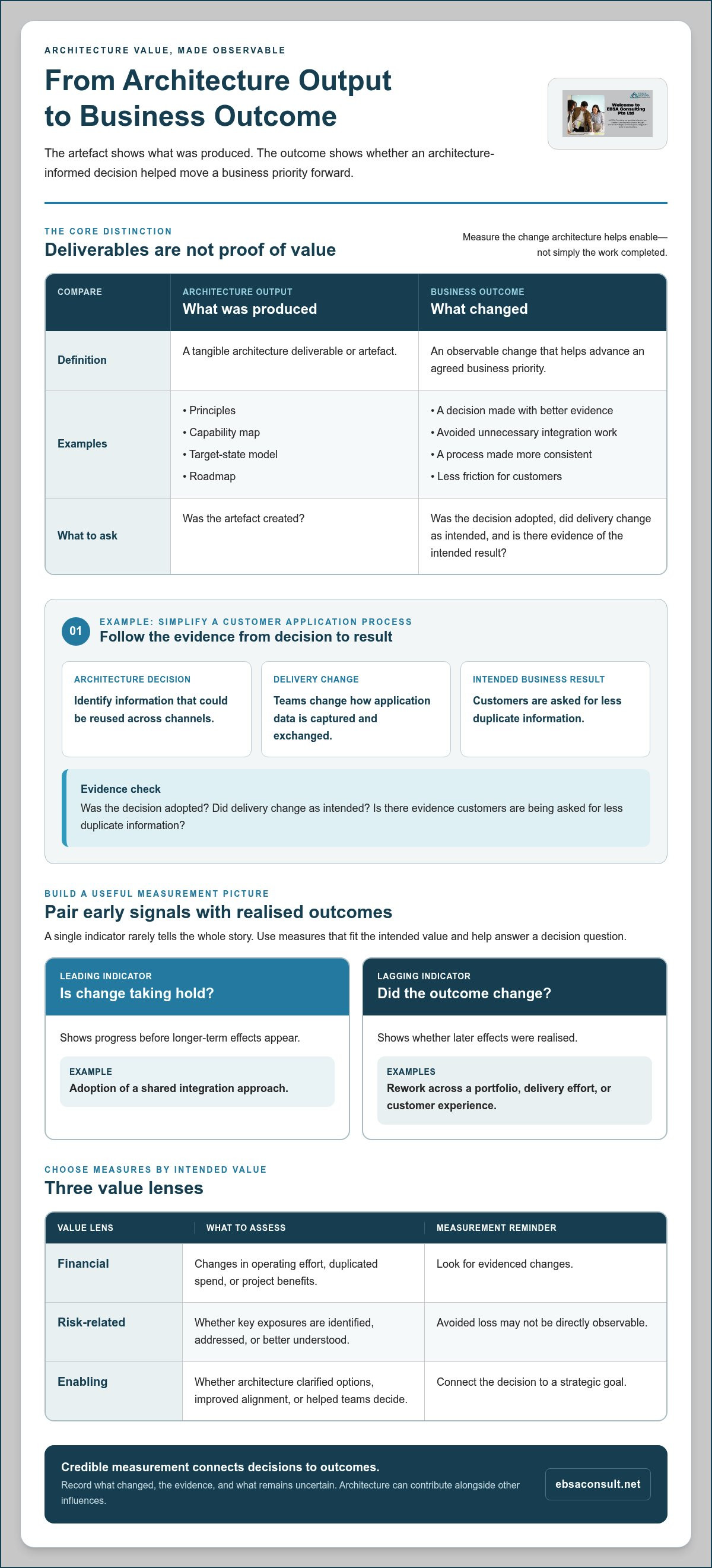
An architecture output is something produced: principles, a capability map, a target-state model, or a roadmap. An outcome is a change those outputs help enable, such as a decision made with better evidence or a delivery team avoiding unnecessary integration work. The artefact may be useful, but its existence alone doesn’t show that the organisation has realised value.
Consider a hypothetical initiative to simplify a customer application process. An architecture decision identifies information that could be reused across channels. Delivery teams then change how application data is captured and exchanged. The intended business result might be fewer repeated requests for information. Examine each link: Was the decision adopted? Did delivery change as intended? Is there evidence that customers are being asked for less duplicate information?
Why architecture value needs more than one measure
A single indicator rarely tells the whole story. Leading indicators show whether a change is taking hold before longer-term effects appear. For example, teams can track adoption of a shared integration approach before assessing whether it reduces rework across a portfolio. Later, lagging indicators can show whether delivery effort or customer experience changed. Together, these measures connect early progress with realised outcomes.
Choose measures based on the value the initiative is intended to create, not simply on which data is easiest to collect. Distinguish direct financial benefits from risk reduction and strategic enablement:
- Financial: Look for evidenced changes in operating effort, duplicated spend, or project benefits.
- Risk-related: Track whether key exposures are identified, addressed, or better understood. Avoided loss may not be directly observable.
- Enabling: Assess whether architecture clarified options, improved alignment, or helped teams make a decision that supports a strategic goal.
Measurement is most useful when it informs a decision and supports learning. Record what changed, what evidence supports the conclusion, and what remains uncertain. This keeps the assessment credible and helps stakeholders decide what to investigate or adjust next.
How to Measure the Business Value of Architecture Step by Step
A useful measurement process starts with a business decision, not a dashboard. Use the same sequence for a single initiative or a wider architecture portfolio, adjusting the detail to suit the decision at stake. The goal is enough evidence to guide action, not a second reporting programme.
Set outcomes, scope, and a credible baseline
Before choosing indicators, agree on the decision the evidence should inform and the business outcome architecture is intended to support. Strategic alignment is stronger when business priorities, organisational processes, and technical choices are considered together, as outlined in this enterprise architecture consulting guide.
- Name the decision. Identify the choice leaders may need to make, such as whether to scale a capability, change its sequence, or address a constraint first.
- Define the intended outcome. Describe the business change in observable terms, such as reducing avoidable hand-offs or enabling a new service capability. Keep the outcome distinct from the architecture deliverable.
- Set boundaries. Specify which initiative, capabilities, teams, or applications are in scope, along with the review period. For portfolio measurement, state which parts of the portfolio are included so comparisons remain meaningful.
- Capture the baseline. Record the starting condition using available evidence, such as current process steps, delivery lead time, or duplicated integrations. Note the source and any gaps instead of implying more precision than the data supports.
- Document assumptions and dependencies. Identify factors outside architecture’s control that could affect the outcome, including business adoption, delivery capacity, or a parallel process change. These provide context when results are reviewed.
Select indicators, owners, and review points
Pair a lagging outcome measure with a leading indicator that can show whether progress is developing. If the intended result is fewer repeated hand-offs, for example, an early indicator might be whether teams have adopted a shared process design. Choose evidence that fits the initiative and answers the decision question. Don’t add measures simply because data is readily available.
- Assign ownership. Name who provides each data point, who checks its quality, and who interprets it at the review. Clear ownership makes measurement part of normal decision-making rather than an architecture-only exercise.
- Agree on collection and cadence. Use existing reports or project reviews where practical. Set review points that match the pace of change, and record the baseline, current result, and evidence source consistently.
- Interpret and adjust. Compare progress with the intended outcome, discuss unexpected changes, and decide whether to continue, refine the approach, or revise the measure. Keep the method proportionate. Tracking indicators supports learning; a separate ROI calculation is needed when leaders specifically require a financial return assessment.
A tailored approach can connect enterprise, business, and solution architecture measures to the decisions your organisation needs to make. Explore how architecture consulting can support business alignment when shaping that measurement approach.
Which Measures Best Show Architecture's Business Value?
The right measure depends on the decision architecture is meant to inform. A change to a solution design may be assessed through delivery performance, while an enterprise-wide capability initiative may call for evidence of strategic alignment and business readiness. Quality, cost, revenue, and timeliness are useful dimensions, but they don’t make a universal scorecard. Select only measures that reflect the initiative’s intended outcome and the evidence available.
Use the categories below to frame the measurement question before choosing a specific indicator. A measure is useful when its evidence can be interpreted in context, compared with an appropriate starting point, and connected to a decision.
- Financial: Does the initiative appear to reduce expenditure, avoid duplicated investment, or support revenue? Evidence may include documented changes in operating costs, project spend, or revenue associated with the affected capability. Connect benefits and costs only when the relationship is reasonably clear.
- Operational: Is work becoming more efficient, predictable, or reliable? Consider cycle time, rework, duplicated effort, or process quality. Project records and operational reports can help show whether a change is emerging.
- Customer: Is the change improving an experience the initiative can plausibly influence? Evidence might include customer feedback, service completion patterns, or reported friction in the relevant journey. Avoid attributing broad customer trends to architecture alone.
- Risk: Is the organisation better positioned to identify or manage a relevant exposure? Use evidence such as documented dependencies, resolved design concerns, or changes in control exceptions. Risk reduction may be valuable even when avoided loss can’t be counted directly.
- Enabling: Has architecture made a future business choice or initiative more achievable? Evidence could include a capability gap addressed, a decision unblocked, or a shared design adopted by dependent teams. Treat this as a contribution to future outcomes, not a realised return.
Match financial and operational measures to the decision
Financial measures are most informative when initiative benefits and costs can be linked with reasonable confidence. For example, if a target design consolidates overlapping services, examine actual spend and the cost of implementing the change. Don’t count projected savings as achieved benefits until evidence supports that conclusion.
Operational indicators can reveal value without forcing every effect into dollars. Rework, delivery cycle time, and duplicated effort may show whether an architecture decision changed how teams deliver. Use organisation-specific baselines and verified data, not generic benchmarks. Business architecture can connect these indicators to capabilities and intended outcomes, linking operational measures to business architecture services and enterprise alignment.
Capture customer, risk, and enabling value responsibly
Choose customer or risk measures only when there’s a credible pathway from the architecture decision to the result. State the evidence source and limitations, especially where other changes may influence the outcome. Qualitative evidence can suit early-stage or strategic work: record the decision enabled, who adopted it, and why it matters. This makes judgement visible and reviewable instead of presenting an opinion as a precise score.
How to Handle Attribution, Time Lags, and Uncertain Results
Architecture rarely changes a business outcome on its own. A design decision may shape delivery, but results can also depend on implementation quality, adoption, leadership choices, market conditions, and other initiatives. Measuring the business value of architecture means showing a credible contribution, not claiming sole causation. Explain what changed, how it connects to the intended outcome, and what else may have influenced the result. That gives decision-makers stronger evidence than an overstated success claim.
Make contribution credible without claiming sole causation
Trace the path from architecture decision to intermediate change and then to the business outcome. For example, a solution design may clarify how systems exchange information; delivery teams implement that pattern; and a business process may then require fewer manual hand-offs. Look for evidence at each step, and describe the final outcome as a contribution when other influences are involved.
Combine operational data with stakeholder evidence. Delivery records might show whether a design was adopted, while team or business-owner feedback can explain how that decision affected work. Neither source is complete by itself. Together, they help distinguish a documented change from an assumption about why it occurred. A solution architecture design process can make dependencies between design choices and implementation steps easier to examine.
Keep a short evidence note alongside each reported result. Include the original assumption, relevant dependencies, alternative explanations, and the strength of the available evidence. Use plain language: “The shared design was adopted by the delivery teams, and rework declined during the same period. Other process changes may also have contributed.” This is more useful than claiming certainty or dismissing a result because attribution isn’t perfect.
Measure benefits that emerge over time
Some architecture work creates the conditions for later initiatives, so a project closeout may come too early to assess its full contribution. Set review points for when the expected change could reasonably become observable. At each review, check whether implementation and adoption have progressed, whether the outcome indicator remains relevant, and whether business conditions have shifted.
Keep enabling work visible without counting potential benefits as realised returns. A reusable capability, clarified dependency, or agreed target design can be reported as progress toward a later outcome. Once a dependent initiative uses it, assess the resulting change with evidence suited to that outcome. This preserves the distinction between readiness and realised value.
Measurement should evolve with the work. If delivery changes direction or an external factor makes an indicator less meaningful, record why the measure is being revised and retain earlier results for context. This creates a learning record rather than a moving target. A tailored architecture measurement approach can connect decision dependencies, evidence, and review points to your organisation’s intended outcomes.
Turn Architecture Measurement into Better Business Decisions
Measurement earns its place when it helps leaders choose what to do next. A concise review should state the business question, show what has changed, and explain what decision the evidence supports. Focus on the initiative’s intended outcome rather than the number of architecture artefacts produced. This keeps the discussion relevant to business, architecture, delivery, and data stakeholders.
Communicate evidence in a decision-ready format
Use a consistent reporting view so decision-makers can understand progress without working through a lengthy measurement pack. A short summary can cover:
- Intended outcome: The business change the architecture work is meant to support.
- Baseline: The starting condition and the source of that information.
- Indicators: The measures used to assess progress and results.
- Evidence: What has been observed, when, and from which source.
- Limitations: Known gaps, assumptions, dependencies, or other influences on the result.
- Next decision: The action leaders are being asked to consider.
Separate realised results from early signals and expected future benefits. An implemented design is evidence of delivery, while adoption by teams may be an early signal. A business benefit that depends on later work remains a forecast until it can be observed. This distinction keeps the report credible and shows leaders where progress is established and where more evidence is needed.
Make the recommendation explicit. Depending on the evidence, leaders may continue the work, reshape its scope, sequence a dependency before proceeding, or stop an approach that no longer supports the priority. If results are mixed, explain what is known and what remains uncertain. A decision-ready report doesn’t need to remove uncertainty; it needs to show how that uncertainty affects the choice.
Create a measurement practice that evolves with the organization
Start with a small set of measures tied to real decisions. Review them with business owners, architects, delivery teams, and data stakeholders to confirm that the evidence is understood and useful. If an indicator no longer informs a decision, revise or retire it. As priorities and initiatives change, measures should adapt while retaining enough context to compare progress over time.
This collaborative practice connects architecture choices to business priorities without turning measurement into a reporting exercise of its own. Enterprise Architecture Consulting, Business Architecture Services, and Solution Architecture Design each support a different part of that connection, aligning strategy, processes, and technical implementation with business objectives. To shape an approach around your organisation’s priorities, Discuss an architecture measurement approach with EBSA Consulting.
Make Measurement Part of Your Next Strategic Decision
Make measuring the business value of architecture a practical habit by starting with one decision your organisation needs to make. Use what you learn to sharpen how future initiatives define success, surface dependencies, and bring business and technology perspectives together. Over time, this builds a more informed basis for prioritising architecture work and adapting it as organisational goals evolve.
EBSA Consulting’s enterprise architecture consulting connects business strategy with technology infrastructure. Its business architecture services and solution architecture design keep organisational processes and technical implementation oriented toward business objectives. A tailored measurement approach can make those connections clearer for leaders and delivery teams.
Shape your architecture measurement approach with EBSA Consulting and take a considered next step toward decisions grounded in shared priorities and useful evidence.
Frequently Asked Questions
How do you measure the business value of architecture?
Connect architecture work to a business outcome and a decision leaders need to make. Establish the starting condition, choose a small set of relevant indicators, assign people to provide the data, and review evidence as the work progresses. For example, an initiative to improve information sharing might track adoption of a common data design. Explain how architecture contributed, and disclose dependencies or limitations that affect the interpretation.
What metrics can be used to measure architecture value?
Useful metrics depend on the initiative and may include financial, operational, customer, risk, quality, cost, revenue, or timeliness indicators. A process redesign could track completion time and customer feedback, while a platform change might examine operating expenditure and service interruptions. No universal scorecard fits every organisation. Pair an outcome measure with a leading indicator, such as implementation readiness, when it helps show whether the intended result is developing.
Can the value of enterprise architecture be measured financially?
Some enterprise architecture benefits can be assessed financially when costs and outcomes can reasonably be connected. For example, an organisation may compare documented costs before and after consolidating overlapping capabilities while accounting for implementation effort. Other value may be operational, customer-focused, risk-related, or enabling. State the assumptions behind any financial estimate, and distinguish observed savings from forecasts so indirect benefits aren’t presented as guaranteed returns.
How do you measure architecture benefits that are difficult to quantify?
Define observable evidence and clear criteria, even when a benefit can’t reliably be expressed as a dollar value. For improved decision quality, for instance, record which decision was enabled, what information architecture made available, and how stakeholders assessed its usefulness. Document the evidence source, stakeholder input, and assumptions. Assess the benefit consistently over time, describing uncertainty honestly rather than assigning an unsupported monetary estimate.
How often should architecture value be measured?
Review architecture value when evidence can inform a decision, with timing shaped by delivery stages and how long the intended outcome takes to emerge. Establish a baseline before work changes the current state, review progress during delivery, and follow up after implementation if benefits need time to appear. A review before a funding or sequencing decision may be more useful than a fixed calendar schedule that arrives too late to influence action.
How can you attribute business outcomes to architecture work?
Trace how an architecture decision influenced intermediate changes and how those changes relate to the business outcome. Architecture usually works alongside delivery choices, organisational change, market conditions, and other influences. For example, if a new design supports faster service delivery, check adoption and delivery evidence while noting process or staffing changes that may also matter. Combine relevant data with stakeholder perspectives, and describe a credible contribution rather than claiming sole causation.
What is the difference between architecture outputs and architecture outcomes?
Architecture outputs are work products, such as principles, models, or roadmaps; outcomes are changes those products help enable. A completed roadmap can be counted, but that alone doesn’t show whether teams used it or made better investment choices. To assess value, connect the output to its intended effect, such as a decision that avoids duplicating a capability. This distinguishes completed architecture work from a business change stakeholders can observe.


