

If your organization is struggling with mounting technical debt and misaligned IT infrastructure, is the solution really a S$250,000 annual recruitment commitment that takes six months to finalize? It's frustrating to watch product releases slow down while business goals and technology systems drift further apart. You likely feel the pressure to innovate, yet the "Architecture Gap" keeps your team reactive rather than strategic. Engaging a fractional enterprise architect offers a way to bridge this gap, providing high-level expertise without the long lead times or excessive costs of traditional executive hiring.
This guide provides a clear roadmap for scaling your infrastructure, reducing technical debt, and implementing professional governance at a fraction of the traditional cost. We'll examine how this strategic bridge allows your firm to maintain the agility of a startup while benefiting from the structured thinking of a global enterprise. By the end, you'll understand how to synchronize your technology stack with your long-term vision to drive sustainable operational excellence in the 2026 Singapore market. You don't need to choose between growth and stability; you just need the right framework to connect them.
Key Takeaways
- Identify the "Architecture Gap" where technical debt begins to outpace your organization's ability to scale and innovate.
- Understand how a fractional enterprise architect delivers high-level strategic governance and technical roadmaps without the long-term commitment of a full-time executive hire.
- Evaluate the total cost of ownership and operational agility gained by choosing a fractional model over traditional "Big 4" consultancy firms in the Singapore market.
- Learn a structured implementation approach that begins with an architecture maturity assessment to pinpoint critical misalignments in your current systems.
- Explore how business architecture services can synchronize your operational processes with your technology stack to ensure long-term stability and growth.
The Architecture Gap: Why Scaling Firms Need Strategic Oversight
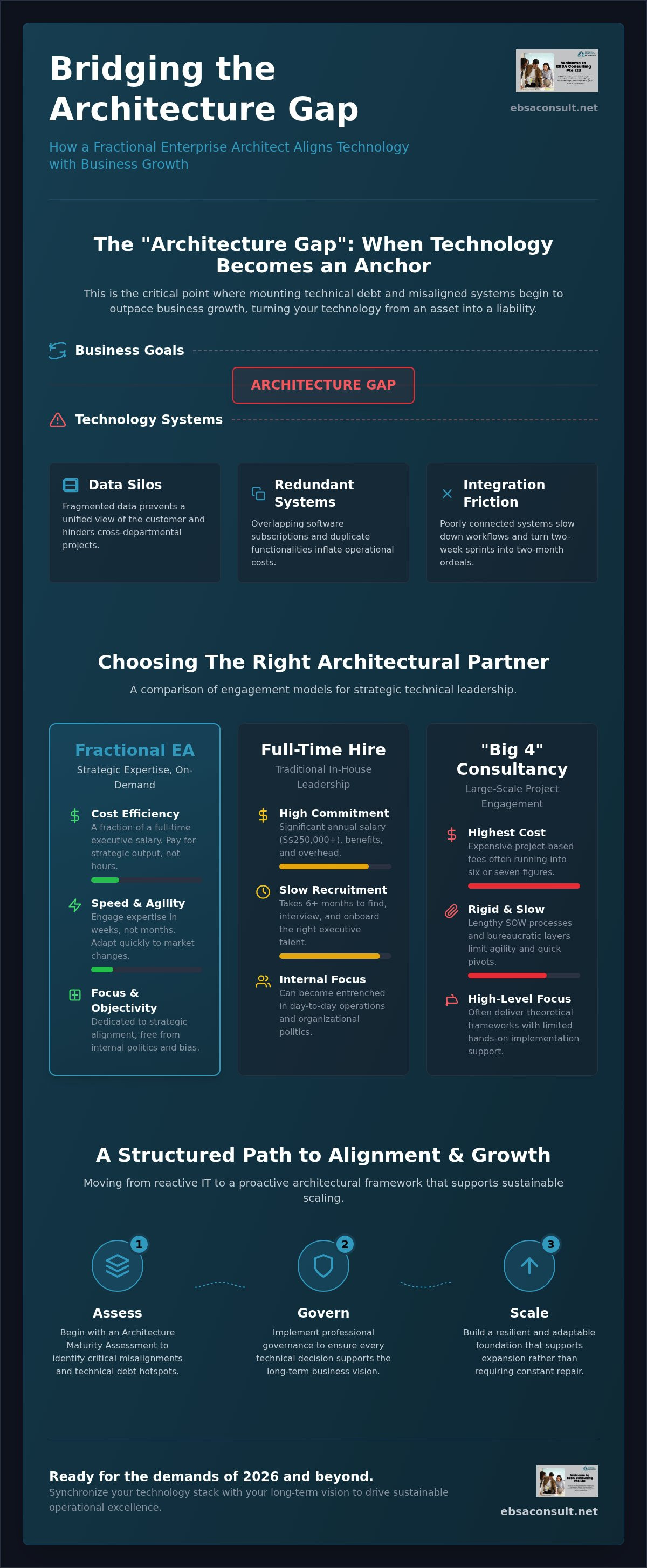
Many Singaporean firms reach a stage where their technology stack stops being an accelerator and starts becoming an anchor. This transition marks the "Architecture Gap." It's the specific point where the accumulation of technical debt begins to outpace business growth. While your engineering team might be exceptionally talented at shipping features, they often lack the breathing room to consider how those features align with your five-year roadmap. In the high-pressure environment of the local tech ecosystem, neglecting this alignment leads to structural fragility that can stall even the most promising expansion.
Traditional IT management usually focuses on operational stability, ensuring servers stay up and employees remain connected. However, this reactive stance fails to address long-term structural alignment. Without a dedicated focus on Enterprise architecture (EA), organizations suffer from "accidental architecture." Common symptoms include:
- Data silos that prevent a unified view of the customer.
- Redundant systems and software subscriptions that inflate operational costs.
- Integration friction that slows down critical cross-departmental projects.
- Difficulty managing multiple data types and employer information, for which you might check out GulfBridge Africa.
Engaging a fractional enterprise architect provides the senior-level oversight needed to bridge this gap without the overhead of a full-time executive salary. This professional solution allows scaling firms to access high-level strategy exactly when they need it most.
The Cost of Misalignment
When systems aren't synchronized, the hidden costs are staggering. Technical debt doesn't just create messy code; it directly impacts your speed-to-market. Every new feature requires complex workarounds to bypass legacy constraints, turning a two-week sprint into a two-month ordeal. In the competitive Singapore business environment, these delays result in lost market share and diminished investor confidence. Professional enterprise architecture consulting prevents these expensive pivot costs by ensuring that every technical decision serves a broader business objective. It's about building a foundation that supports expansion rather than one that requires constant repair.
Moving from Reactive IT to Proactive Architecture
Scaling at a national level requires a shift in mindset from maintenance to strategy. Day-to-day IT operations are essential, but they don't drive organizational agility. A fractional enterprise architect shifts your focus toward a proactive framework. Instead of asking "how do we fix this?" the conversation becomes "how do we structure this to support 10x growth?" This role acts as a strategic guide, ensuring that your IT infrastructure isn't just a cost center, but a scalable asset that evolves alongside your business goals. By implementing structured thinking now, you avoid the structural collapses that often plague rapidly growing firms. This approach ensures your systems are resilient, adaptable, and ready for the demands of 2026.
What is a Fractional Enterprise Architect?
A fractional enterprise architect is a senior executive who provides high-level technical strategy and architectural governance on a part-time or mandate basis. This model isn't about hiring a "hands-on-keyboard" developer or a temporary staff member to clear a backlog. Instead, it's about embedding a seasoned strategist into your leadership team to ensure your technology investments align with your commercial objectives. They operate at the intersection of business architecture and solution design, ensuring that every technical decision supports the long-term health of the organization.
One of the primary advantages of this model is the inherent neutrality of the expert. Internal hires can sometimes become entrenched in organizational politics or develop a bias toward existing systems. A fractional consultant maintains an objective perspective, allowing them to provide honest assessments of your infrastructure's maturity. They act as a steady hand. They guide your firm through complex transitions without the overhead or long-term commitment of a full-time executive hire. If you're ready to stabilize your technical trajectory, exploring professional architecture services can provide the clarity your leadership team needs.
Core Responsibilities and Deliverables
The output of a fractional EA is highly structured and results-oriented. They don't just offer advice. They build the frameworks that allow your team to execute with confidence. Key deliverables often include target architecture blueprints that visualize your future state and detailed technology roadmaps that outline the steps to get there. They also establish IT governance frameworks, which are essential for maintaining regulatory compliance in the Singapore market. By leading vendor selection and high-level solution architecture design, they ensure that new additions to your stack are compatible, scalable, and cost-effective from day one.
The Fractional vs. Consultant Distinction
While a traditional consultancy might deliver a report and move on, a fractional EA acts as an internal partner. They possess an "insider-outsider" advantage, combining a fresh, objective perspective with a deep commitment to your organization's success. They understand your culture and constraints. This allows them to focus entirely on high-impact strategic work rather than daily administrative tasks. Ultimately, the fractional enterprise architect serves as a long-term strategic guide for the C-suite, ensuring that technical complexity never hinders business vision.
Comparison: Fractional EA vs. Full-Time Hire vs. Consultancy Firms
Choosing the right leadership model for your technology strategy requires a cold-eyed look at both your balance sheet and your growth velocity. In the Singapore market, the Total Cost of Ownership (TCO) for a full-time senior enterprise architect often exceeds S$300,000 annually when factoring in base salary, CPF contributions, bonuses, and executive benefits. Beyond the financial commitment, the recruitment cycle for such specialized talent typically spans four to six months. For a scaling firm, waiting half a year to address structural technical debt is rarely a viable option. A fractional enterprise architect bypasses these hurdles, offering an immediate start with a cost structure that scales alongside your needs.
Contrast this with the "Big 4" consultancy approach. While large firms bring prestige, they often rely on standardized frameworks and junior-level execution. This leads to a lack of deep organizational context. A fractional expert functions as a senior partner who understands your specific constraints. They provide the agility of a startup with the governance of a global firm. This model ensures that your architecture isn't just a theoretical report but a living, breathing part of your operations. Deciding between these paths depends on your current scale and the complexity of your upcoming projects.
When to Hire Full-Time
There is a definite tipping point where a permanent hire makes sense. Usually, this occurs in multi-national enterprises with 1,000 or more employees where architectural change is constant and all-encompassing. At this scale, the sheer volume of daily governance and cross-departmental coordination justifies the high fixed cost and long lead times of executive recruitment. However, for mid-market firms or those in rapid transition, the flexibility of a fractional model provides superior ROI. It allows you to stabilize your foundation before committing to a permanent C-suite role.
The "Consultancy Trap" and How to Avoid It
Large consultancy firms often fall into the "billable hour" trap. Their incentive is to extend engagements by delivering generic, high-level templates that lack internal buy-in from your engineering team. These off-the-shelf solutions frequently fail because they don't account for your unique technical culture or legacy constraints. EBSA Consulting avoids this by prioritizing customized solution architecture design. We focus on outcomes rather than hours. We ensure that every framework we build is tailored to your specific business architecture, creating a sense of ownership within your internal teams that generic consulting simply cannot replicate.
Implementation Guide: How to Engage a Fractional Architect
Engaging a fractional enterprise architect is a deliberate process that prioritizes strategic alignment over immediate operational capacity. It's not about simply filling a seat; it's about installing a steering mechanism for your technical evolution. To begin, your organization should conduct an initial architecture maturity assessment. This identifies immediate gaps between your current state and your business goals. Once these gaps are clear, you must define time-bound strategic objectives, such as modernizing a legacy stack or preparing for international expansion. Establishing a steady cadence for stakeholder communication is vital. Your architect should provide board-level reporting that translates technical progress into business value. They must be integrated into key decision-making committees, ensuring they have influence without creating operational bloat. Finally, schedule a formal review of the technology roadmap every quarter to adjust for market shifts. If you're ready to begin this transition, you can schedule a strategic consultation to assess your current maturity.
Key Use Cases for Fractional Engagement
The need for high-level oversight often peaks during major organizational shifts. During Mergers and Acquisitions (M&A), a fractional architect performs technical due diligence and plans the integration of disparate systems. For firms facing legacy system modernization, they design the path to move forward without disrupting live services. Many Singaporean startups find this model essential after a major funding round, such as Series B or C. It's the moment when the "move fast and break things" approach must evolve into a scalable, governed infrastructure. This model allows you to bridge the gap between startup agility and enterprise stability. If these shifts include international expansion to the U.S., you may want to check out Best Immigration Services, Inc. for assistance with work permits and visa paperwork.
Measuring ROI and Success
Success in architecture is measured through both quantitative and qualitative lenses. Key performance indicators (KPIs) include a measurable reduction in technical debt and significantly faster deployment cycles for new features. You should also see cost savings through the consolidation of redundant software licenses. Beyond the numbers, evaluate the "soft" benefits of architectural clarity and improved team alignment. The ultimate goal is to foster a self-sustaining architectural culture where your internal teams understand the "why" behind the "how." As your organization matures, you might eventually require a permanent executive. The fractional enterprise architect serves as an ideal bridge. By building the governance frameworks and documentation early, they ensure that when you do hire full-time, that person inherits a structured environment rather than a chaotic rescue mission. This transition strategy minimizes risk and ensures long-term stability.
Accelerating Growth with EBSA Consulting
EBSA Consulting operates on the belief that technology should never be a bottleneck for ambition. Our collaborative approach to providing a fractional enterprise architect ensures that your leadership team isn't just buying hours, but investing in a permanent shift toward structural excellence. We don't just deliver a document; we embed ourselves as a strategic partner to reshape your technical trajectory. By synchronizing your operational efficiency with high-level technical blueprints, we ensure that your infrastructure remains one step ahead of your growth requirements. We position ourselves as the essential bridge between complex technical requirements and high-level vision, allowing you to focus on market leadership while we manage the architectural complexity.
Our focus on professional solution architecture design ensures that every technical blueprint is robust and ready for the demands of the Singapore market. We understand that scaling requires more than just adding servers; it requires a fundamental alignment of your business architecture with your digital stack. This synchronization is what allows a firm to maintain its agility while implementing the governance necessary for long-term stability. It's a steady, methodical process that turns IT from a cost center into a strategic asset.
The EBSA Framework for National Leaders
Our methodology is rooted in proven standards like TOGAF, yet we've adapted these frameworks specifically for the agility required by modern firms. We focus on national-level strategic consulting, positioning ourselves as a seasoned partner rather than a distant vendor. We encourage you to explore our business architecture services to see how we can optimize your organizational structures for deeper operational efficiency. We're invested in your journey, and our goal is to ensure that your internal capabilities grow alongside your systems. This commitment to proven methodologies ensures that your transformation is grounded in logic and reliability.
Next Steps: Securing Your Architectural Future
Securing your future starts with a clear-eyed look at the present. We recommend a strategic health check to identify hidden technical debt that might be eroding your margins or slowing your feature releases. This discovery phase provides the clarity needed to build a robust technology roadmap for 2026 and beyond. Our initial consultation process is methodical and logical, designed to move you from a state of reactive maintenance to one of visionary innovation. Let's start a conversation about how a fractional enterprise architect can provide the calm, steady presence your organization needs to scale with confidence.
Building a Scalable Technical Foundation for 2026
Scaling an organization in Singapore's competitive landscape requires more than just operational speed; it demands a synchronized technical strategy. We've explored how bridging the "Architecture Gap" prevents technical debt from hindering your long-term vision. By engaging a fractional enterprise architect, you gain the executive-level governance and structured thinking necessary to manage complex growth without the overhead of a full-time recruitment cycle. This model ensures your technology stack evolves as a strategic asset rather than a legacy burden.
EBSA Consulting acts as your strategic guide, utilizing proven TOGAF and Zachman-aligned frameworks to harmonize your business goals with your IT infrastructure. Our Singapore-based expertise focuses on creating self-sustaining architectural cultures that empower your internal teams. It's time to move from reactive maintenance to visionary innovation. Align your vision with infrastructure-Consult with EBSA today and take the first step toward a resilient, future-ready organization. Your journey toward operational excellence is within reach.
Frequently Asked Questions
What is the difference between a fractional enterprise architect and a CTO?
A CTO typically manages the entire technology department, including people management and product delivery, whereas a fractional enterprise architect focuses specifically on the structural integrity and strategic alignment of the IT landscape. The architect acts as a specialized guide who ensures that systems are scalable and synchronized with business goals. While the CTO executes the vision, the architect provides the blueprint that prevents technical debt from accumulating during that execution.
How many hours a week does a fractional enterprise architect typically work?
Engagement levels vary based on your organization's complexity, but most fractional roles involve eight to sixteen hours per week. This mandate-driven approach focuses on high-impact strategic deliverables rather than daily administrative tasks. By dedicating one or two days a week to architectural governance, a fractional enterprise architect can establish the necessary frameworks without the cost of a full-time executive. It's about precision and efficiency rather than total hours spent.
Can a fractional EA help with vendor selection and contract negotiations?
Yes, a fractional architect is instrumental in ensuring that new technology investments align with your long-term roadmap. They lead vendor selection by evaluating technical compatibility and scalability rather than just feature sets. While they don't handle recruitment or staffing, they provide the technical due diligence required for contract negotiations. This ensures that your organization avoids vendor lock-in and selects solutions that integrate seamlessly with your existing business architecture.
Is the fractional model suitable for small startups or only mid-sized enterprises?
The fractional model is highly effective for both small startups and mid-sized enterprises facing different challenges. Startups often use this expertise to build a "clean" foundation before a Series B or C funding round. Mid-sized firms, conversely, utilize the role to resolve mounting technical debt and silos that slow down their operations. Any organization reaching the "Architecture Gap" where complexity begins to outpace growth can benefit from this strategic oversight.
How does a fractional architect handle internal resistance to change?
Handling resistance requires a collaborative mindset and a focus on demonstrating tangible business value. A fractional architect uses structured thinking to show how architectural changes reduce daily friction for engineering teams. By introducing frameworks like TOGAF in an approachable way, they help stakeholders understand that governance isn't a hurdle but an accelerator. This steady, partnership-driven approach builds trust and ensures that new structures are adopted naturally across the organization.
What qualifications should I look for in a fractional enterprise architect?
Look for a professional with senior-level experience and a deep understanding of recognized frameworks such as TOGAF or Zachman. They should possess strong business acumen to link technical requirements with commercial outcomes. In the Singapore market, look for experts who understand national-level scaling and local regulatory environments. A successful candidate acts as a strategic guide who can communicate complex concepts to both technical leads and C-suite executives with equal clarity.
Can a fractional architect help prepare our organization for a full-time hire later?
Absolutely, one of the most valuable outcomes of a fractional engagement is the preparation for a permanent hire. The architect establishes the documentation, governance standards, and technology roadmaps that a full-time successor will need. This ensures that when your firm is ready for the S$300,000 annual commitment of a permanent executive, that person inherits a structured environment. This transition reduces the risk of a new hire failing due to inherited technical chaos.
Does EBSA Consulting provide fractional services for specific industries like Fintech?
EBSA Consulting provides strategic architectural frameworks that are applicable across various sectors, including highly regulated industries like Fintech. While we don't offer managed IT support or software sales, our business architecture services focus on the rigorous compliance and security requirements inherent in financial technology. We ensure your infrastructure is resilient enough to meet MAS guidelines while remaining agile enough to support rapid innovation and national-level scaling within the Singapore ecosystem.


