

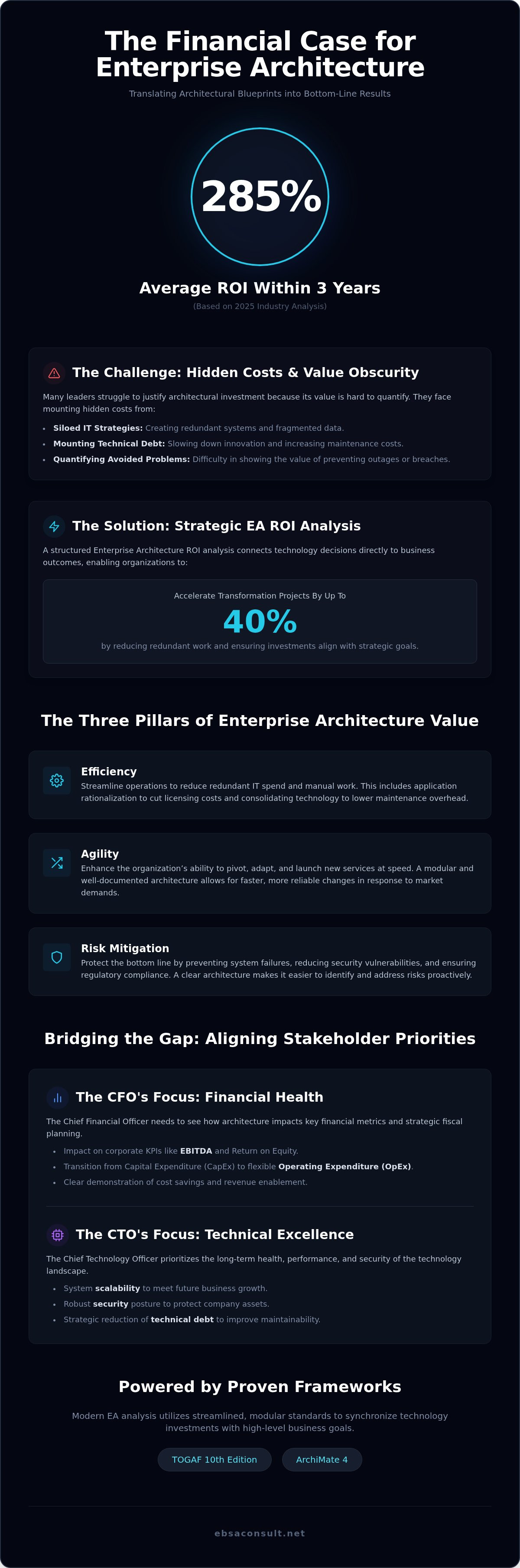
Did you know that organizations leveraging a structured enterprise architecture roi analysis can generate an average return of 285% within just three years? While this figure from 2025 industry analysis is compelling, many Singaporean leaders still struggle to translate architectural blueprints into the language of the balance sheet. You likely recognize the hidden costs of siloed IT strategies and the mounting weight of technical debt, yet quantifying the value of a "problem avoided" remains a complex hurdle when presenting to the board.
We understand that you're balancing the need for immediate agility with the requirement for long-term stability. This 2026 strategic guide provides a clear, actionable framework to help you justify architectural transformation and secure the necessary buy-in from key stakeholders. We'll examine how to utilize the modular TOGAF 10th Edition and the streamlined ArchiMate 4 standards to synchronize your technology investments with high-level business goals. By the end of this article, you'll have the tools to reduce redundant IT spend and accelerate your transformation projects by up to 40%, ensuring your organization remains resilient in an evolving market.
Key Takeaways
- Shift your perspective from architecture as a cost center to a strategic value driver by adopting modern financial evaluation methods suited for the 2026 business landscape.
- Identify tangible cost savings by measuring the direct impact of application rationalization on software licensing and maintenance expenses across your Singapore operations.
- Quantify the financial value of strategic agility and risk mitigation to demonstrate how architectural resilience protects the bottom line from system outages and data breaches.
- Implement a structured framework for enterprise architecture roi analysis to establish a clear baseline and identify the specific value levers that drive organizational growth.
- Discover how professional architectural consulting synchronizes technical infrastructure with high-level business objectives to ensure long-term stability and operational excellence.
What is Enterprise Architecture ROI Analysis?
An enterprise architecture roi analysis is a rigorous financial and strategic evaluation designed to quantify the value generated by specific architectural interventions. It moves beyond basic accounting to examine how structural changes in your organization's technology and business processes translate into measurable fiscal outcomes. To understand the foundation, one might ask: What is Enterprise Architecture? At its core, it is the discipline of aligning business vision with IT execution. In its most direct terms, enterprise architecture ROI is the delta between an optimized future state and current technical debt.
As we move through 2026, the perception of EA is shifting from a restrictive cost center to a critical value driver. Organizations in Singapore are realizing that architectural planning isn't just about drawing diagrams; it's about making informed investment decisions that protect the bottom line. This value is typically categorized into three primary pillars:
- Efficiency: Streamlining operations to reduce redundant IT spend and manual work.
- Agility: Enhancing the organization’s ability to pivot and launch new services at speed.
- Risk Mitigation: Protecting the balance sheet by preventing system failures and ensuring regulatory compliance.
Moving Beyond Simple Cost-Benefit Ratios
Traditional ROI formulas often struggle to capture the full scope of enterprise systems because they overlook the interconnected nature of modern technology. While a simple cost-benefit ratio might track the price of a new server against its expected uptime, it misses the systemic impact of a more resilient architecture. A robust enterprise architecture roi analysis incorporates qualitative benefits, such as improved developer morale or better brand reputation, into a quantitative business case. By focusing on outcome-based value rather than just output-based metrics, leaders can see the true financial impact of their transformation efforts.
The Stakeholder Perspective: What CFOs vs. CTOs Care About
Building a successful business case requires speaking multiple languages simultaneously. For a Singaporean CFO, the focus is often on how architectural changes impact corporate KPIs like EBITDA or Return on Equity. They need to understand how EA ROI supports the transition from heavy Capital Expenditure (CapEx) to more flexible Operating Expenditure (OpEx) models. This is similar to how specialized engineering firms like Engineered Tax Services help businesses optimize cash flow by identifying tax incentives and cost segregation opportunities within their physical infrastructure. Conversely, CTOs prioritize scalability, security, and the reduction of technical debt. We help bridge the gap between the server room and the boardroom by aligning these technical milestones with high-level financial objectives, ensuring every architectural decision serves the broader corporate strategy.
Quantifying Tangible Returns: IT Efficiency and Cost Rationalization
Tangible returns often serve as the cornerstone of a successful enterprise architecture roi analysis. While strategic vision is essential, the board typically requires a clear demonstration of how architectural changes impact the bottom line. One of the most immediate value drivers is application rationalization. By evaluating the entire software portfolio, organizations can identify overlapping licenses and redundant maintenance contracts that drain capital. In the Singapore market, where operational costs remain high, consolidating these assets can lead to significant annual savings in S$ for the IT budget.
Beyond licensing, we must account for the labor savings realized through reduced duplicate analysis. When architectural documentation is fragmented, teams spend countless hours rediscovering existing system behaviors. Structured frameworks, such as the Federal Enterprise Architecture (FEA) framework, demonstrate how standardized models allow organizations to reuse assets rather than rebuilding them. This efficiency prevents expensive mid-project course corrections, ensuring that your initial investment leads directly to a stable, scalable outcome.
Application and Technology Stack Consolidation
Consolidating your technology stack involves more than just deleting unused apps. It requires identifying redundant capabilities across disparate business units. A common scenario involves multiple departments purchasing separate data visualization tools without realizing a corporate license already exists. Our experience shows that a 10% reduction in stack complexity often yields exponential maintenance savings. This happens because IT teams spend less time on integration patches and more time on high-value development, effectively lowering the "surface area" of potential system failures.
The Financial Drain of Technical Debt
Technical debt functions much like a high-interest loan. Every unoptimized architectural decision adds to a "Legacy Tax" that your organization pays daily through slower deployment cycles and increased vulnerability. We quantify this by measuring the speed-to-market loss caused by rigid legacy systems. If a competitor can launch a new digital service in three months while your infrastructure requires nine, the six-month gap represents a direct loss in potential revenue. Professional solution architecture design allows you to "refinance" this debt into strategic assets, transforming a sluggish foundation into a responsive engine for growth. This shift ensures your technology supports, rather than hinders, your long-term business objectives.
The Strategic Multiplier: Measuring Risk Mitigation and Business Agility
A comprehensive enterprise architecture roi analysis must account for "Strategic Optionality," which is the quantifiable financial value of being able to pivot technology infrastructure at the speed of business. In Singapore's competitive financial and technology sectors, the ability to rapidly adapt to market shifts isn't just a technical advantage; it's a fiscal necessity. By building modular systems, organizations avoid the "all-or-nothing" investment traps that often lead to stranded assets. This flexibility allows leaders to scale services up or down based on real-time demand, ensuring that capital is always deployed toward the most productive outcomes.
Risk avoidance provides another critical layer of ROI that is often overlooked because its success is marked by the absence of crisis. Calculating the potential cost of system outages or data breaches in S$ reveals the true value of architectural resilience. For instance, a single hour of downtime for a major digital service can result in hundreds of thousands of dollars in lost revenue and long-term brand damage. Proactive architectural planning synchronizes security protocols with business workflows, effectively lowering the probability of these high-impact events while ensuring that recovery times are minimized through robust business continuity planning.
Higher levels of architectural maturity directly correlate with an organization's ability to respond to market shifts with precision and speed.
Real Options Analysis in Architecture
Real options analysis simplifies technology investment by treating architectural decisions as financial hedges. Instead of committing to a rigid, five-year on-premise roadmap, enterprise architects design for modularity. This approach creates the "option" to switch to cloud-native services or integrate new AI capabilities without rebuilding the entire foundation. By pricing this flexibility, we can demonstrate how a slightly higher initial investment in a modular framework prevents the massive costs of total system replacement when business requirements inevitably change.
Quantifying Risk and Compliance Readiness
Proactive governance reduces what we call "Regulatory Friction," which is the cost associated with meeting compliance standards like Singapore's Personal Data Protection Act (PDPA). When architecture is well-documented and standardized, the effort required for audits drops significantly. Organizations with mature architectural blueprints often report a 40% to 60% reduction in audit preparation time. By integrating these factors into your enterprise architecture roi analysis, you transform compliance from a reactive burden into a streamlined, automated process that protects both the organization's reputation and its bottom line.
A Step-by-Step Framework for Conducting an EA ROI Assessment
A structured approach is essential to move from theoretical benefits to a credible business case. Conducting a professional enterprise architecture roi analysis requires a methodical progression that transforms raw data into a narrative of organizational growth. This process doesn't rely on software automation alone; it demands a deep understanding of how technical structures support specific business objectives. By following a logical path, you can ensure that your findings are both defensible and aligned with corporate strategy.
- Step 1: Establishing the Baseline. You can't measure progress without a clear starting point. This involves inventorying current IT spend and identifying operational friction points where technical debt slows down delivery.
- Step 2: Identifying Value Levers. Focus on the three pillars discussed earlier: efficiency, agility, and risk. Determine which areas offer the most immediate financial impact for your specific organization.
- Step 3: Applying Financial Models. Translate these levers into hard numbers using traditional metrics like Net Present Value (NPV) and Internal Rate of Return (IRR).
- Step 4: Factoring in Qualitative Strategic Alignment. Acknowledge how the architecture supports the broader mission, such as improving customer experience or entering new Singaporean market segments.
- Step 5: Presenting the Business Case. Synthesize the data into a compelling story for executive leadership, focusing on long-term stability and ROI.
Establishing Your Architectural Baseline
The first phase centers on transparency. You must map business capabilities to existing technology costs to see where your S$ are actually going. Are you over-investing in legacy systems that provide minimal competitive advantage? By setting realistic benchmarks based on industry standards, you create a defensible foundation for your ROI claims. This step uncovers the hidden costs of fragmentation that automated tools often miss, providing a clear picture of the "cost of inaction" that precedes any major transformation.
Financial Modeling for Architectural Initiatives
Once the baseline is set, we apply rigorous financial models to the proposed roadmap. Calculating the Net Present Value (NPV) for a three-year plan helps leadership understand the long-term value of the investment in today's terms. We also determine the Internal Rate of Return (IRR) to compare modernization projects against other potential corporate investments. Defining the "Payback Period" is equally vital; it shows exactly when the savings from reduced complexity will cover the initial costs. If you're ready to move beyond generic metrics, our team can help you develop a customized enterprise architecture consulting strategy that aligns with your specific financial goals.
Maximizing Architectural Value through Strategic Consulting Partnerships
While sophisticated SaaS platforms provide valuable data visualization, tools alone cannot navigate the cultural and strategic complexities of a large-scale transformation. A truly effective enterprise architecture roi analysis requires the seasoned judgment of experts who understand how to interpret technical data within the context of your specific business goals. Without expert-led Business Architecture services, organizations often find themselves with "automated chaos"-perfectly documented systems that remain fundamentally misaligned with the corporate vision. Professional consulting provides the critical human element needed to synchronize these blueprints with high-level objectives.
For mid-to-large organizations in Singapore, the ROI of "fractional" Enterprise Architecture is becoming increasingly clear. This model allows businesses to access principal-level expertise without the fixed overhead of a permanent executive team. By engaging a strategic partner on a flexible basis, you can accelerate complex projects and ensure that every technology investment is backed by a rigorous business case. This collaborative approach reshapes organizational agility, moving the needle from reactive firefighting to proactive, structured thinking that drives long-term stability.
The EBSA Consulting Approach to Value Realization
We focus on achieving operational excellence through customized solution architecture design that prioritizes your unique hurdles. Our methodology bridges the gap between strategy and execution, ensuring that new initiatives don't inadvertently create fresh technical debt. By providing a steady, authoritative presence, we help your internal teams stay focused on high-value outcomes rather than technical minutiae. This professional guidance significantly reduces the "Time to ROI" for architectural shifts, allowing your organization to realize the financial benefits of consolidation and efficiency much sooner than would be possible through internal efforts alone.
Accelerating Growth through Architectural Maturity
Architectural maturity is a essential prerequisite for successful mergers, acquisitions, and global expansion. When your systems are modular and well-documented, integrating a new business unit or scaling into a new market becomes a predictable process rather than a high-risk gamble. EBSA’s collaborative methodology ensures that your infrastructure remains reliable and resilient throughout these periods of rapid change. We act as the essential bridge between your complex technical requirements and your high-level business vision, ensuring that your organization is always positioned for growth. Discover how EBSA Consulting can reshape your enterprise architecture for maximum ROI.
Securing Your Organization's Future Through Architectural Excellence
As the 2026 business landscape continues to evolve, the ability to translate technical structures into financial performance becomes a vital competitive advantage. A rigorous enterprise architecture roi analysis does more than just justify spend; it uncovers the hidden costs of complexity while quantifying the immense value of strategic agility. By proactively addressing technical debt and prioritizing modularity, you protect your balance sheet against system outages and the friction of shifting regulations.
You don't have to manage these complex organizational hurdles in isolation. Our collaborative approach focuses on driving organizational agility and efficiency through proven methodologies. Partner with EBSA Consulting for a Strategic Architecture Health Check to leverage our deep expertise in Solution Architecture Design and expert Enterprise and Business Architecture alignment. We're here to act as your steady guide, ensuring your technology remains a responsive engine for long-term growth and operational excellence. Your path toward a more synchronized and resilient future starts with a single, structured step.
Frequently Asked Questions
While enterprise resilience protects the business, personal financial planning protects the individual; for those interested in securing their own future through expert retirement planning in Canada, check out Evergreen Wealth Management.
How long does it typically take to see a return on investment from Enterprise Architecture?
Initial tangible savings usually appear within 12 to 18 months, though long-term strategic value compounds over a three-year period. Quick wins often come from application rationalization within the first six months. By the 18-month mark, reduced operational friction and improved project delivery speeds start to impact the balance sheet significantly. It's a journey of continuous improvement where the most substantial gains appear as the architectural maturity of the organization increases.
Can Enterprise Architecture ROI be measured solely in cost savings?
No, measuring strictly through cost reduction ignores the strategic multiplier effect of agility and risk mitigation. While cutting redundant licenses provides immediate S$ savings, the ability to pivot technology at the speed of business provides a higher long-term value. A complete enterprise architecture roi analysis must also account for avoided costs from system outages and the financial benefit of faster time-to-market for new digital services in Singapore's competitive landscape.
What are the most common mistakes when calculating EA ROI?
The most frequent error is focusing exclusively on IT metrics rather than business outcomes. Many leaders fail to establish a verifiable baseline before starting, making it impossible to prove subsequent improvements. Other mistakes include ignoring the qualitative value of strategic alignment and failing to speak the financial language of the CFO. Without a structured framework, ROI claims often appear anecdotal rather than data-driven, which can undermine executive confidence in architectural initiatives.
How does Business Architecture contribute to the overall ROI of an enterprise?
Business Architecture ensures that every technical investment directly supports a specific corporate capability or strategic objective. By mapping the "why" behind the "what," it prevents the waste of S$ on projects that don't move the needle for the organization. This alignment reduces the risk of project failure and ensures that resources are allocated to the highest-value initiatives, effectively acting as a filter for operational efficiency and growth-oriented investment.
Is it possible to quantify the value of reduced technical debt?
Yes, you can quantify technical debt by measuring the interest paid in the form of slower deployment cycles and increased maintenance labor. By tracking the time-to-market for new features before and after architectural cleanup, you can assign a direct financial value to the gained speed. Additionally, reducing the complexity of the technology stack lowers the probability of expensive emergency patches, providing a measurable reduction in unplanned operational expenditure over time.
What role does Solution Architecture play in project-specific ROI?
Solution Architecture Design ensures that individual projects are built correctly the first time, preventing expensive mid-cycle course corrections. By aligning a specific technical solution with broader enterprise standards, it guarantees interoperability and long-term maintainability. This reduces the total cost of ownership for the asset and accelerates the payback period. It's the bridge that ensures high-level strategic blueprints are successfully translated into functional, high-performing reality without creating new technical silos.
How do I justify the cost of an external Enterprise Architecture consultant?
External consultants provide an objective perspective and specialized expertise that often doesn't exist in-house, accelerating the time to value. Their experience with proven methodologies allows them to identify savings opportunities, such as redundant S$ spend, much faster than internal teams. By hiring a strategic guide, you avoid the trial-and-error costs of architectural transformation. The investment is typically offset by the rapid identification of efficiency gains and the successful mitigation of high-impact technical risks.
What metrics should I report to the board regarding architectural health?
Boards respond best to metrics that link architectural health to financial stability and growth. Report on the percentage of IT spend dedicated to "run" vs. "grow" activities, the reduction in application portfolio complexity, and the lead time for new service delivery. Including a summary of your enterprise architecture roi analysis helps them see the direct correlation between structural integrity and the organization’s ability to remain resilient against market disruptions and regulatory changes in Singapore.


