

What if a strategy that looks sound on paper isn’t directing technology investment towards the business priorities that matter most? A third-party assessment of IT strategy can bring an independent, evidence-based perspective to that question, especially when internal teams have limited capacity to challenge established assumptions or compare assessment proposals.
Choosing an assessment means looking beyond scope and credentials. You need to know what evidence will be examined, which decisions the work should inform, and what practical outputs your organisation will receive. With those points clear, an external perspective can help turn complex findings into a focused agenda for action.
This guide explains how to scope an assessment, compare approaches using consistent criteria, and use the findings to prioritise architecture and investment decisions. It also shows how enterprise and business architecture connect strategic objectives with organisational capabilities and technology choices, helping leaders turn recommendations into a coherent direction for change.
Key Takeaways
- Define the decisions an independent review should inform, and distinguish an IT strategy assessment from a supplier risk evaluation.
- Assess alignment across business priorities, organisational capabilities, technology choices, and decision governance using relevant evidence.
- Compare a third-party assessment of IT strategy by its scope, evidence sources, stakeholder involvement, outputs, and decision value.
- Prepare by clarifying objectives, gathering strategy and architecture materials, engaging stakeholders, and planning how findings will be acted on.
- Use enterprise and business architecture to connect assessment findings with organisational priorities and practical technology decisions.
What a Third-Party Assessment of IT Strategy Actually Evaluates
A third-party assessment of IT strategy is an independent review of an organisation’s technology direction, choices, and alignment with business priorities. It asks whether the current approach supports the outcomes leaders are pursuing, and whether planned investments, capabilities, and architecture fit together. The focus is the organisation’s own IT strategy, not a supplier’s risk profile.
Technology strategy is more than a list of systems or projects. It connects technology decisions to business goals and sets a direction for developing capabilities. For wider context, Understanding IT Strategy can help frame the relationship between technology choices and organisational objectives. An independent review tests how that relationship works in practice, using the organisation’s context rather than a generic checklist.
The central value is decision clarity. A review can reveal where priorities align, where assumptions need more evidence, and where competing initiatives may be pulling resources in different directions. It can help leaders decide what to pursue, sequence, or revisit. It doesn’t guarantee savings, successful transformation, or the elimination of risk. Those outcomes depend on the decisions made and how they’re carried through.
IT strategy assessment versus third-party risk assessment
The distinction starts with what’s being reviewed. An IT strategy assessment examines internal technology direction and its connection to business priorities. A third-party risk assessment examines an external vendor relationship and the risks of relying on that supplier.
The evidence differs too. Strategy reviews draw on business priorities, technology choices, and architecture views. Vendor risk reviews typically consider supplier controls and risk information, such as cybersecurity, financial, or operational factors. Organisations may need both, but they answer different questions and inform different decisions: one guides internal direction, while the other supports oversight of an external relationship.
When an independent review can add strategic value
An external perspective can be useful when an organisation’s direction is changing or upcoming choices are difficult to reconcile. Growth may bring new capabilities and operating needs; transformation may prompt decisions about which systems or processes to reshape. A major investment can also benefit from a clearer view of how the proposal supports business priorities.
Organisational change, increasing complexity, and competing initiatives can create similar conditions. For example, several teams may have credible proposals, but leaders may lack a shared view of dependencies or strategic fit. A third-party assessment of IT strategy can structure that discussion around evidence and explicit choices. It’s most useful when leaders have decisions to make and are ready to consider the findings, rather than treating an assessment as a routine exercise for every organisation.
What an IT Strategy Assessment Should Examine
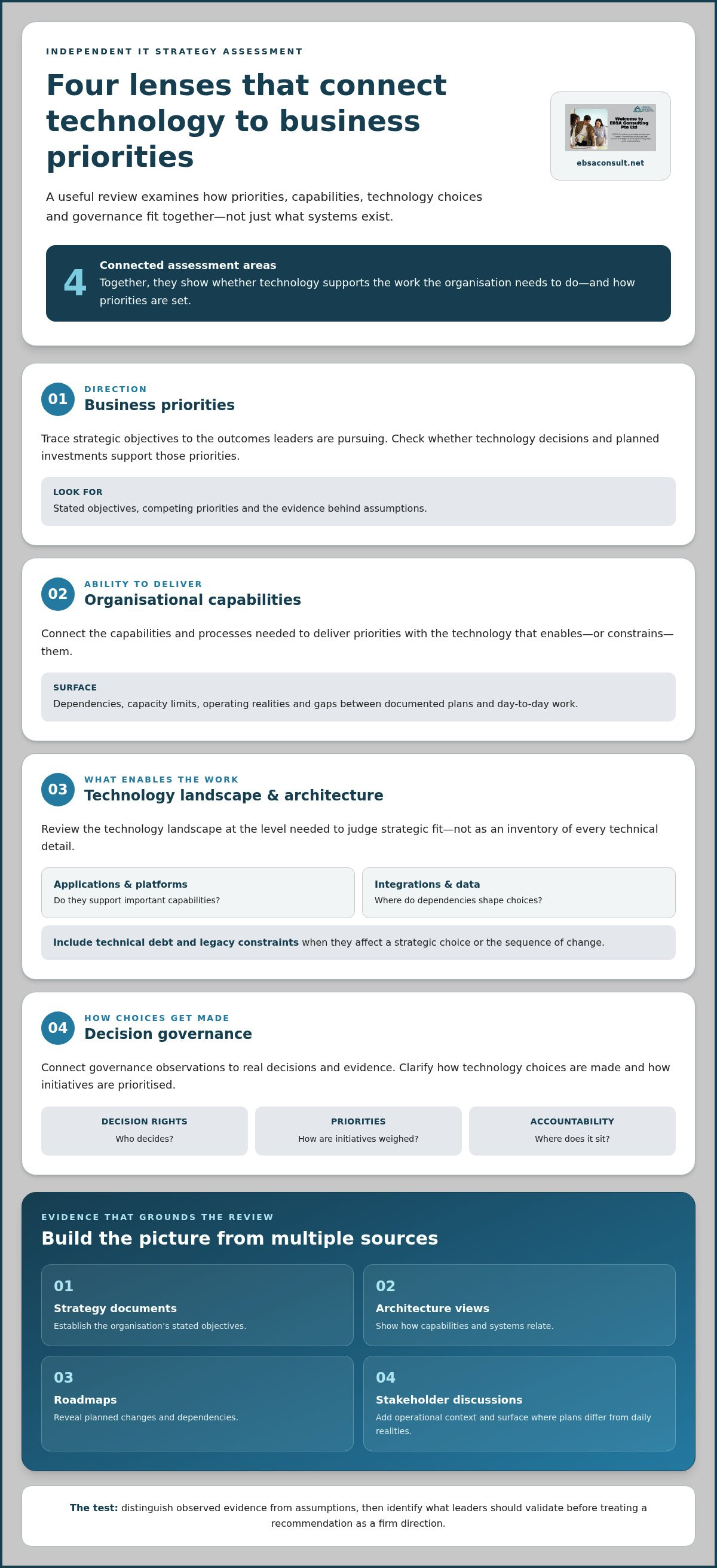
A useful review connects four areas: business priorities, current organisational capabilities, the technology landscape, and decision governance. Together, they show whether technology choices support the work the organisation needs to do and whether leaders have a clear way to set priorities. A third-party assessment of IT strategy should examine these connections at a level suited to the decisions in scope, rather than produce an inventory without strategic context.
Business alignment, capabilities, and operating priorities
Start by tracing strategic objectives to the capabilities and processes needed to deliver them. If an organisation plans to improve customer service, for example, the review can explore which processes depend on timely information, which capabilities support those processes, and where technology choices enable or constrain them. It should also surface dependencies, capacity limits, and competing priorities that may affect the intended direction.
Evidence matters. Strategy documents establish stated objectives; architecture views show how capabilities and systems relate; roadmaps reveal planned changes and dependencies. Stakeholder discussions add operational context, including where documented plans differ from day-to-day realities. A sound assessment distinguishes observed evidence from assumptions, then identifies questions leaders should validate before treating a recommendation as a firm direction.
Technology landscape, architecture, and decision governance
The technology review can consider applications, platforms, integrations, and data dependencies at the level needed to assess strategic fit. The aim isn’t to catalogue every technical detail. It’s to understand whether the landscape supports important capabilities, where dependencies shape available choices, and whether proposed changes fit the organisation’s architecture direction.
Governance is part of that picture. The assessment should clarify how technology decisions are made, who holds decision rights, how initiatives are prioritised, and where accountability sits. If these arrangements are unclear, competing projects may proceed without a shared view of their strategic contribution. Findings should connect governance observations to actual decisions and evidence, not rely on general claims about what an organisation ought to do.
Technical debt and legacy constraints belong in scope when they affect a strategic choice. For instance, a dependency on an older application may limit the sequence or design of a proposed capability change. The assessment should explain that relationship and its implications for decisions, rather than label a technical issue a priority without business context.
Set boundaries before work begins. A strategy assessment can evaluate direction, alignment, architecture considerations, and decision processes. It isn’t the same as a detailed operational audit, implementation engagement, or managed support arrangement. Clear boundaries help stakeholders understand what the evidence can support and what requires separate work. EBSA Consulting’s enterprise architecture consulting connects business strategy with technological infrastructure, linking objectives to technology choices.
How to Compare Independent IT Strategy Assessment Approaches
Assessment proposals can use similar language while describing very different work. Compare them against the decisions you need to make, not just the number of interviews or pages in the final report. A third-party assessment of IT strategy should connect evidence about business priorities and technology direction to clear options for leaders.
Use consistent criteria to compare proposals. The table below contrasts a tailored strategic review with narrower approaches.
| Decision criterion | Tailored strategic review | Checklist or technology inventory |
|---|---|---|
| Scope | Relates business priorities, capabilities, architecture, and governance to the decisions in scope. | Applies standard questions or records systems, often with limited business context. |
| Evidence sources | Draws on relevant strategy documents, architecture views, roadmaps, and stakeholder perspectives. | May rely mainly on questionnaire responses, existing lists, or a narrow set of documents. |
| Stakeholder involvement | Includes perspectives from business and technology leaders whose decisions or processes are affected. | May involve a limited group or focus on gathering technical facts. |
| Outputs | Explains findings, options, priorities, and implications for architecture or roadmaps. | May produce scores, observations, or an inventory without connecting them to choices. |
| Decision usefulness | Shows how conclusions follow from evidence and supports defined leadership decisions. | Can provide a snapshot, but may leave interpretation and prioritisation to the organisation. |
Assessment scope and evidence quality
Look for a scope that reflects your organisation’s objectives and covers the relevant business context, capabilities, architecture, and governance. A proposal should identify its evidence sources, stakeholder involvement, and analytical approach. A familiar framework or checklist is not a substitute for analysis.
Make exclusions and assumptions visible too. If a review relies on an existing application inventory or a limited set of stakeholder interviews, that will shape what its findings can establish. The right scope depends on the decisions at hand, organisational complexity, and available evidence, not on making the assessment as broad as possible.
Deliverables, independence, and practical usefulness
Compare proposals by what leaders will be able to do with the outputs. Strong deliverables make the reasoning traceable: they distinguish evidence from interpretation, set out decision options, explain prioritisation logic, and identify implications for architecture or roadmaps. Recommendations should connect to business priorities, not simply label technology as outdated or propose change without explaining why.
Independence is demonstrated through objective challenge and evidence-based analysis. Consider whether the approach tests assumptions, represents different stakeholder perspectives, and makes limitations clear. A technology inventory can help establish what exists, and a checklist can support consistency, but neither necessarily explains strategic fit on its own. Choose an approach that gives decision-makers a grounded view of what to sustain, change, or investigate further.
How to Prepare for an IT Strategy Assessment and Use Its Findings
Preparation helps an independent review focus on decisions rather than document collection. Before work begins, align leaders on what they need to decide, make relevant context available, and agree how findings will be considered. This gives the assessment a clear purpose and helps stakeholders understand their roles.
Prepare the decision context and involve the right stakeholders
Use this four-step sequence to establish a practical foundation:
- Define the decisions. Identify the choices the assessment should inform, such as how to sequence a transformation, evaluate a proposed investment, or resolve competing initiatives. Turn broad concerns into questions the review can investigate.
- Assemble the context. Gather relevant strategy documents, architecture views, technology roadmaps, and governance materials. Share them through appropriate channels, managing access and confidentiality in line with your organisation’s practices.
- Engage stakeholders. Include business and technology perspectives, particularly people who understand the affected processes, capabilities, dependencies, and decision pathways. Their input helps distinguish formal plans from operational realities.
- Plan the follow-through. Decide who will review findings, how decisions will be recorded, and when priorities will be revisited. The assessment informs choices; it doesn’t implement them.
Keep the material focused on the agreed questions. If a roadmap has changed or a strategic assumption is still under discussion, make that clear rather than presenting it as settled. A well-prepared evidence base helps the assessor explain what can be concluded, where perspectives differ, and which points need leadership validation.
Translate assessment findings into an actionable agenda
Once findings are available, separate them into categories: strategic choices for leaders, architecture implications, dependencies that affect sequencing, and issues requiring further validation. This prevents an open question from being mistaken for a firm recommendation and helps decision-makers see how evidence relates to action.
Prioritise proposed actions based on business relevance, feasibility, sequencing, and organisational constraints. For example, an initiative may support an important objective but depend on a capability or decision that isn’t yet in place. Record that dependency and identify what must happen first, rather than placing every recommendation on the same timeline.
Assign an accountable owner to each decision or follow-up action, then set a review point to assess progress or revisit assumptions. Architecture work can translate approved direction into choices about capabilities and technology. For example, a strategic solution architecture design process can connect business requirements with technical blueprints once leaders have clarified the direction. This follow-through is separate from the assessment itself.
If your organisation is turning assessment insights into architecture and investment decisions, explore EBSA Consulting’s architecture consulting to connect business priorities with technology direction.
How EBSA Consulting Connects Assessment Findings to Architecture Decisions
An assessment can identify where technology direction and business priorities need closer alignment. The next step is to make those findings useful for decision-making: clarify which capabilities matter, understand how processes depend on them, and shape technology choices around organisational objectives. EBSA Consulting brings enterprise, business, and solution architecture perspectives to this work, connecting strategic direction with practical architecture decisions.
Connect business direction with enterprise and business architecture
Enterprise architecture relates business strategy to technological infrastructure, making it easier to reason about the connections between objectives, capabilities, systems, and planned change. It can help leaders see whether the technology landscape supports their chosen direction and identify architectural considerations that should inform priorities.
Business architecture adds an organisational view. Examining capabilities, processes, and how work is arranged can clarify the operational priorities and dependencies behind assessment findings. For example, a proposed technology change may affect several connected processes. Understanding those relationships helps stakeholders assess its wider implications before committing to a direction.
Together, these perspectives help create a shared picture of the organisation: what it aims to achieve, which capabilities support that aim, and how technology choices relate to the work. The right emphasis depends on the organisation’s objectives and context, so architecture work is tailored to the questions leaders need to resolve.
Move from strategic priorities to solution architecture design
Once leaders have selected priorities, solution architecture design translates business requirements into technical blueprints. It can outline how a proposed solution should meet agreed needs, how it relates to existing architecture, and which dependencies or design decisions need further consideration. This gives business and technology stakeholders a concrete basis for evaluating options.
Collaboration matters throughout. Business stakeholders bring knowledge of objectives, operating processes, and constraints; technology stakeholders contribute their understanding of systems, integrations, and technical dependencies. Working through the reasoning together helps surface trade-offs and keeps design decisions connected to the purpose behind the change.
Architecture design defines direction and technical blueprints; implementation and operational responsibility are separate decisions. A third-party assessment of IT strategy can inform which decisions deserve attention, while architecture helps translate chosen priorities into business-aligned designs. Leaders remain responsible for deciding what to proceed with and how to carry it forward.
If you’re considering how assessment findings should shape your organisation’s architecture direction, discuss your architecture consulting needs with EBSA Consulting. The conversation can focus on your strategic context and the decisions you’re looking to make.
Turn Strategic Clarity Into Your Next Decision
The value of a third-party assessment of IT strategy is realised when its insights shape the choices your organisation makes next. Use the findings to guide focused conversations: which priorities should shape architecture decisions, what trade-offs need leadership input, and where is further validation needed? A deliberate next step helps keep business direction and technology planning connected as plans evolve.
Architecture consulting can support this progression by helping leaders interpret assessment insights in their organisational context and develop a practical direction for upcoming decisions. The work can be shaped around strategic priorities and the questions your teams need to resolve, creating a shared basis for moving forward.
Discuss how EBSA Consulting’s architecture consulting can support your IT strategy decisions. A clear direction and collaborative decision-making can help your organisation move ahead with confidence.
Frequently Asked Questions
Is a third-party assessment of IT strategy the same as a third-party risk assessment?
No. A third-party assessment of IT strategy examines an organisation’s own technology direction, while a third-party risk assessment focuses on an external supplier and the risks of that relationship. For example, reviewing whether a proposed platform supports planned business capabilities is a strategy question; evaluating a vendor’s security controls is a supplier-risk question. The reviews may inform different decisions, even if some of the same technology stakeholders are involved.
Who should request an independent assessment of IT strategy?
It’s often useful for an executive sponsor, CIO, or business leader who needs an objective view before making a consequential technology decision. A business unit leader may also initiate one if a proposed change affects several functions. The most productive sponsor can bring decision-makers together, provide organisational context, and ensure findings reach the people with authority to act on them. An assessment can focus on a specific decision rather than the entire technology estate.
Can an IT strategy assessment evaluate cloud decisions?
Yes, if cloud choices are within the agreed scope. The review can consider whether a proposed cloud direction supports business requirements, how it fits with existing applications and integrations, and which dependencies or capability gaps could shape the decision. It can also compare the strategic rationale for different options without assuming that moving to cloud is the right answer. Detailed technical implementation planning would need its own defined scope.
How long does an independent IT strategy assessment take?
There isn’t one standard duration. Timing depends on the breadth of the questions, the organisation’s complexity, how readily relevant information can be accessed, and stakeholder availability. A focused review of a defined investment decision may require a different effort from examining direction across multiple business areas. Before work starts, agree milestones for evidence gathering, stakeholder input, findings review, and leadership decisions.
What should an IT strategy assessment deliver?
It should leave leaders with usable findings, not just a description of current technology. Useful outputs may include evidence-backed observations, strategic options with trade-offs, areas requiring validation, and implications for priorities or architecture. A decision log can record what leaders choose, why they chose it, and which assumptions remain open. Agreeing the expected format and audience in advance helps ensure the deliverables support governance discussions.
Can an external assessment replace internal IT strategy ownership?
No. An external reviewer can bring analysis and challenge, but internal leaders remain accountable for setting direction and making decisions. They understand the organisational objectives, constraints, and trade-offs that shape what is feasible. For example, an assessment may outline options for sequencing a major change, while executives and technology leaders decide which option fits the organisation’s priorities and commit to follow-through. Internal ownership keeps strategy connected to ongoing business decisions.


