

What if your enterprise architecture wasn't a rigid set of governance rules that slowed down innovation, but the very engine that allowed your Singaporean firm to outpace the competition? Many leaders in the region's competitive landscape feel the sting of IT spending that doesn't move the needle on core business goals. You've likely experienced the frustration of technical debt that prevents rapid scaling or faced resistance from tactical teams who view architecture as a bottleneck. It's a common challenge where the desire for speed often clashes with the need for structural stability.
By adopting modern enterprise architecture best practices, you can shift this dynamic from friction to flow. This 2026 guide provides the essential frameworks and leadership strategies required to align your technological infrastructure with long-term business objectives. We'll provide a clear roadmap for architectural maturity, helping you improve organizational agility and establish a structured framework for making better technology investment decisions. From synchronizing business capabilities to accelerating execution, you'll learn how to turn your architecture into a strategic guide for sustainable growth and operational excellence.
Key Takeaways
- Shift your focus from static diagrams to dynamic strategic steering since it's the only way to prioritize business capabilities effectively.
- Learn how to adapt traditional frameworks like TOGAF so they don't lead to analysis paralysis in decentralized organizations.
- Secure executive buy-in by aligning your roadmap with the CEO's top priorities and solving visible business problems within 90-day cycles.
- Master modern enterprise architecture best practices to bridge the gap between complex technical requirements and high-level business vision.
- Identify the value of an external perspective to uncover hidden technical debt and synchronize your solution architecture with long-term growth objectives.
Redefining Enterprise Architecture for the Modern Organization
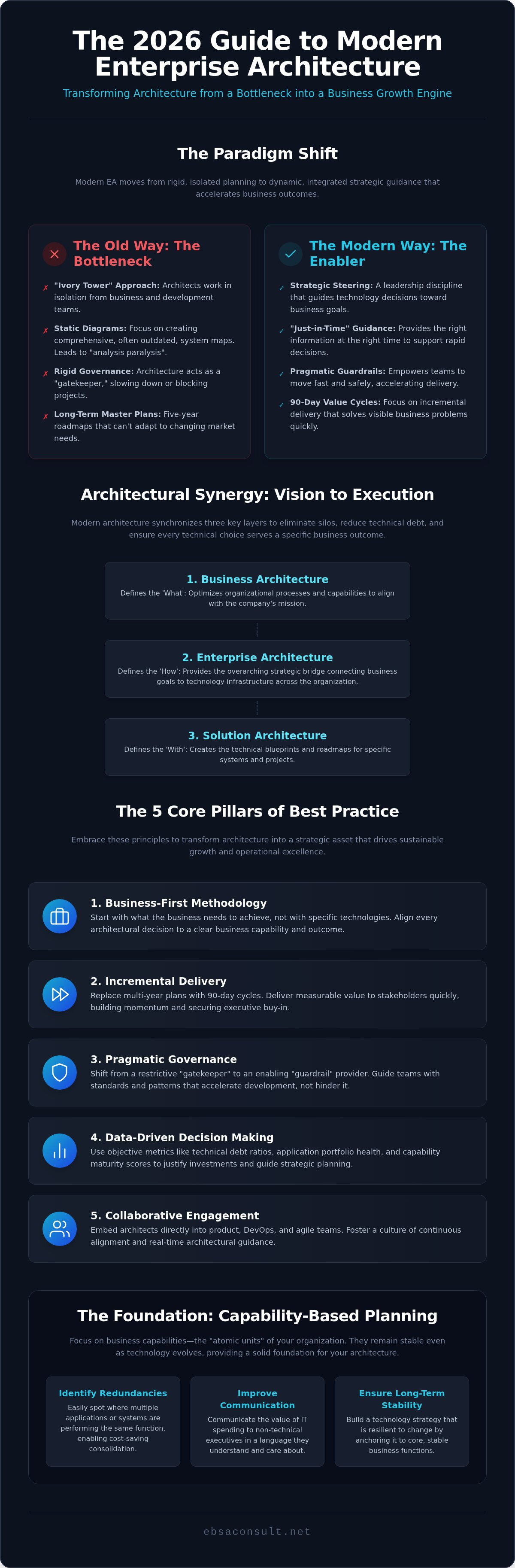
The concept of Enterprise architecture has undergone a radical transformation. In 2026, it's no longer a collection of static diagrams tucked away in a digital folder. Instead, it's a dynamic instrument for strategic steering. Modern enterprise architecture best practices require a shift from the "Ivory Tower" approach, where architects worked in isolation, to "Just-in-Time" architectural guidance that supports rapid decision-making. This evolution turns architecture into a leadership discipline. It ensures that every technical choice serves a specific business outcome rather than simply adding to a list of IT assets.
To succeed, organizations must understand the hierarchy of architectural layers. Business Architecture focuses on optimizing organizational processes and capabilities to ensure they align with the firm's mission. Enterprise Architecture provides the overarching strategy across the entire organization. Solution Architecture creates the technical blueprints for specific systems. When these three disciplines synchronize, they eliminate silos and prevent the accumulation of technical debt. This collaborative approach positions architecture as a growth enabler rather than a compliance hurdle.
The Strategic Bridge: Connecting Vision to Execution
Leadership teams often struggle to translate high-level vision into actionable technical steps. Without a structured bridge, digital transformations frequently fail or exceed their budgets. In the Singapore market, where agility is a competitive necessity, the cost of misalignment is high. Enterprise architecture serves as the essential synchronization mechanism that ensures business strategy and technology infrastructure operate in perfect harmony. It provides the clarity needed to turn abstract goals into concrete execution plans, allowing teams to move with confidence and precision.
From Documentation to Strategic Value
Many firms fall into the trap of trying to map every legacy system before making a move. This "map everything" mindset often leads to analysis paralysis. Instead, focus on a Minimum Viable Architecture. This approach identifies the core structures needed to support immediate growth without over-engineering for a distant future. By prioritizing high-impact domains like data flows, application portfolios, and business capabilities, you create value faster. Implementing enterprise architecture best practices means focusing on what moves the needle today while maintaining a steady path toward long-term operational excellence.
5 Core Pillars of Enterprise Architecture Best Practices
Building a resilient organization requires more than just technical expertise. It demands a structured approach that prioritizes long-term stability and business growth. To move beyond the traditional IT-centric view, leaders must embrace a set of core principles that transform architecture into a strategic asset. These enterprise architecture best practices ensure that every technology investment is justified by its contribution to organizational goals.
- Business-First Methodology: Focus on what the business needs to achieve rather than the specific software tools available.
- Incremental Delivery: Replace five-year master plans with 90-day cycles that provide immediate, measurable value to stakeholders.
- Pragmatic Governance: Shift the role of architecture from being a "gatekeeper" that stops projects to a provider of "guardrails" that accelerate them.
- Data-Driven Decision Making: Use objective architectural metrics, such as technical debt ratios and capability maturity scores, to guide investment.
- Collaborative Engagement: Integrate architects directly into the DevOps and product development lifecycles to ensure real-time alignment.
Capability-Based Planning: The Foundation of Success
A business capability represents a specific ability an organization possesses to achieve its objectives. It serves as the "atomic unit" of modern architecture because capabilities remain stable even when the underlying technology changes. By mapping your technology stack to these capabilities, you can easily identify redundancies where multiple tools perform the same function. This clarity allows you to communicate the value of IT spending to non-technical stakeholders in a language they understand. If you're looking to refine this alignment, strategic architecture consulting can help bridge the gap between your current state and your business vision.
Governance Without Bureaucracy
Modern governance shouldn't be a bottleneck. By implementing automated checks within the CI/CD pipeline, you can ensure compliance with architectural standards without manual intervention. This approach empowers project teams to make local decisions within established "Architectural Principles," reducing the need for constant oversight. The Architecture Review Board (ARB) then evolves into a consultative partner that helps teams solve complex problems rather than a hurdle they must clear. This shift is essential for maintaining agility in the fast-paced Singapore market, where speed to market is a critical differentiator.
Adopting these enterprise architecture best practices allows your organization to respond to market shifts with precision. It creates a culture of continuous improvement where technology and business strategy are synchronized. By focusing on these pillars, you ensure that your infrastructure is a catalyst for innovation rather than a weight that holds you back.
Frameworks vs. Reality: Navigating TOGAF, Zachman, and Agile EA
Frameworks provide the essential structure for any architectural initiative, yet rigid adherence often leads to the very bureaucracy leaders try to avoid. While TOGAF remains a global standard, many organizations fall into "analysis paralysis" by attempting to follow its comprehensive processes to the letter. In a fast-moving environment, enterprise architecture best practices suggest a shift toward flexibility. This means using frameworks as a reference library rather than a mandatory checklist. By adapting tools like the Zachman Framework, decentralized organizations can maintain a clear taxonomy of their assets without stifling the autonomy of individual product teams.
Maintaining architectural integrity in a world of microservices and rapid releases requires a new approach called Agile EA. Instead of long-range planning, architects focus on enabling flow and reducing friction. This is particularly relevant for the Singaporean mid-market, where firms must balance growth with lean operations. One emerging solution is the "Fractional Architect" model. This approach allows businesses to scale high-level expertise without the permanent overhead of a massive internal department, providing strategic guidance exactly when it's needed most.
Choosing the Right Framework for Your Maturity Level
Assessing your current maturity is vital before selecting a framework. Organizations operating at an "Ad-Hoc" level, where IT decisions are made project by project, shouldn't attempt a full TOGAF implementation immediately. They should focus on Business Architecture first to stabilize core processes. A bespoke, outcome-oriented approach often serves these firms better than a rigid framework. As the organization moves toward "Strategic Steering," more formal structures can be introduced to manage the increasing complexity of the technological landscape.
Modernizing Legacy Frameworks for Digital Agility
To stay competitive, you must strip legacy frameworks down to their most value-adding components. This involves integrating architectural thinking directly into Agile Sprints and supporting Product Owners in making long-term technical trade-offs. Reframing "Standards" as "Patterns" is a powerful way to encourage innovation while maintaining stability. These patterns provide proven solutions to recurring problems, allowing project teams to move faster while ensuring the final output remains synchronized with the broader enterprise vision. This shift ensures that architecture remains a catalyst for delivery rather than a departmental bottleneck.
The Leadership Checklist for Implementing EA Best Practices
Implementing enterprise architecture best practices isn't just a technical exercise. It's a leadership challenge that requires cultural alignment and a clear vision. To move beyond the perception of architecture as a bottleneck, leaders must approach it as a strategic discipline that accelerates business value. This checklist provides a structured path for transforming your architectural function into a powerful engine for growth.
- Step 1: Secure Executive Sponsorship - Your initiatives must align directly with the CEO's top three priorities. If architecture doesn't support the core mission, it won't receive the necessary investment.
- Step 2: Identify Immediate Pain Points - Gain early buy-in by solving a visible, high-impact business problem. This builds credibility and demonstrates the practical value of your approach.
- Step 3: Establish a Capability Map - Create a shared language across the enterprise. This map serves as the foundation for all future discussions, ensuring everyone understands how technology supports specific business functions.
- Step 4: Define Architectural Guardrails - Set non-negotiable standards for security, data privacy, and scalability. These guardrails empower teams to innovate within safe boundaries.
- Step 5: Measure and Communicate ROI - Track metrics that matter to the business, such as technical debt reduction and improvements in speed-to-market.
Securing Buy-In Across the C-Suite
Executive leaders often view architecture as a cost center rather than a growth enabler. To change this perspective, you must translate technical concepts into the language of risk, cost, and revenue. Focus on how architecture reduces the risk of project failure and lowers long-term operational costs. Building a coalition of "Architectural Champions" within various business units helps spread this message. In Singapore's competitive landscape, demonstrating how architecture enables faster pivots is the most effective way to address objections. If you're ready to start this journey, partner with an enterprise architecture consultant to build your strategic roadmap.
Measuring Success: EA Metrics That Matter
The days of measuring success by the number of diagrams produced are over. Modern leadership demands metrics that reflect actual impact on business agility. Track the reduction of application sprawl and the percentage of technical debt retired each quarter. Another vital metric is the "Architecture Contribution" to project success rates. This measures how projects following architectural guidance perform compared to those that don't. By focusing on these outcomes, you provide clear evidence that enterprise architecture best practices lead to a more resilient and responsive organization. This transparency builds trust and ensures continued support for future transformation phases.
Reshaping the Future with Strategic Architecture Consulting
An external perspective provides the clarity needed to identify hidden technical debt that internal teams might overlook due to tactical pressures. Just as property owners in Singapore discover Prime Defectors to identify hidden physical flaws in their buildings, business leaders must use architectural audits to uncover structural weaknesses in their digital systems. When you're focused on day-to-day delivery, it's easy to miss the gradual accumulation of complexity that eventually prevents rapid scaling. A strategic partner acts as a guide, helping you see the gaps between your current state and your future objectives. For complex financial and investment programmes, swissalphamatrix.org offers the specialized due diligence and project management needed to ensure these high-stakes initiatives remain robust. By adopting enterprise architecture best practices, you can transition from reactive IT management to a model of proactive, architecturally-led growth that anticipates market shifts before they happen.
EBSA Consulting focuses on Business Architecture as the primary catalyst for operational excellence. We believe that technology should never be the starting point. Instead, we begin by optimizing your organizational processes and capabilities. This ensures that every technical blueprint we create is grounded in actual business needs. Our team specializes in creating custom Solution Architecture designs that translate even the most complex requirements into robust, actionable plans.
We position ourselves as the essential bridge between your high-level business vision and the technical requirements needed to achieve it. This collaborative mindset ensures that your leadership team and your technical staff are synchronized. In the competitive Singapore market, this alignment is a critical differentiator. It allows your firm to move with precision and confidence, knowing that your architectural foundation is built for both stability and agility. We don't just provide a service; we act as a seasoned partner invested in your long-term journey.
Next Steps: Accelerating Your Architectural Journey
The path toward architectural maturity begins with a clear understanding of where you stand today. Starting with an Enterprise Architecture Health Check allows you to identify critical gaps and prioritize the areas that will deliver the most immediate value. This assessment provides the data-driven foundation needed to develop a digital transformation roadmap that prioritizes long-term stability over short-term fixes. By focusing on these enterprise architecture best practices, you can reshape your future and ensure your organization is ready for whatever 2026 brings.
Are you ready to synchronize your business vision with a high-performing technical infrastructure? Enquire about our strategic architecture consulting services to discover how we can help you accelerate your journey toward operational excellence and sustainable growth.
Building a Future-Ready Enterprise
Navigating the complexities of organizational change requires more than just a list of technical requirements. It demands a vision that synchronizes your business goals with your underlying infrastructure. By embracing enterprise architecture best practices, you move away from reactive IT spending toward a model of sustainable growth. We've explored how capability-based planning and agile frameworks provide the guardrails needed for rapid scaling in the Singapore market. These structures ensure that your technology investments deliver measurable value in 90-day cycles. Alignment is the key.
EBSA Consulting acts as your strategic guide for national organizational transformation. With deep expertise in Business Architecture and Solution Architecture, we focus on driving operational excellence and digital agility across your entire enterprise. We help you bridge the gap between high-level vision and technical execution so your systems remain resilient. Partner with EBSA Consulting to align your strategy and technology and turn your architecture into a powerful engine for innovation. The path toward a more synchronized and responsive organization is clear, and we're ready to help you take the next step with confidence.
Frequently Asked Questions
What are the three most important enterprise architecture best practices?
The three most important enterprise architecture best practices include adopting a business-first methodology, prioritizing incremental delivery, and establishing pragmatic governance. By focusing on business capabilities rather than just technology stacks, you ensure IT investments drive actual value. Incremental delivery allows for 90-day cycles that provide immediate wins. Pragmatic governance shifts the architect's role from a gatekeeper to a provider of guardrails, which accelerates innovation while maintaining organizational stability.
How does enterprise architecture help in reducing technical debt?
Enterprise architecture identifies technical debt by mapping current technology stacks to specific business capabilities. This visibility exposes redundant applications and legacy systems that no longer support strategic goals. By creating a clear roadmap for decommissioning outdated assets, architecture prevents the accumulation of quick-fix solutions that lead to long-term costs. This structured approach ensures that new investments are synchronized with the existing infrastructure, reducing complexity and operational risk across the firm.
Is TOGAF still relevant for modern agile organizations?
TOGAF remains a highly relevant reference library, though it requires adaptation for modern agile environments. Instead of following every step of the ADM cycle, successful firms strip it down to the most value-adding components. This lean approach allows architects to provide Just-in-Time guidance during sprints. By using TOGAF as a foundation for common language and taxonomy, organizations can maintain consistency while supporting the rapid release cycles required in today's competitive landscape.
What is the difference between enterprise architecture and solution architecture?
Enterprise architecture focuses on the overarching strategy and alignment of the entire organization's technology with its business vision. It deals with broad capabilities and long-term roadmaps. In contrast, solution architecture creates the specific technical blueprints for individual projects or systems. While enterprise architects define the guardrails and standards, solution architects work within those boundaries to design functional, high-performing systems that solve immediate business problems. Both must synchronize for operational excellence.
How much does it cost to implement an enterprise architecture framework?
The cost of implementing an enterprise architecture framework varies significantly based on organizational size, current maturity, and the scope of the initiative. Instead of fixed industry averages, firms should consider the investment in terms of strategic consulting and internal resource allocation. For Singaporean businesses, the focus is often on the value gained through reduced technical debt and improved agility. Leaders should evaluate potential partners based on their ability to deliver a clear ROI through optimized processes.
How can mid-sized firms benefit from enterprise architecture without a huge team?
Mid-sized firms can leverage the Fractional Architect model to access high-level expertise without the overhead of a large internal department. By focusing on high-impact domains like data and business capabilities, smaller teams can achieve significant results. This approach allows organizations to implement enterprise architecture best practices at a scale that matches their current maturity. It provides the strategic guidance needed for growth while maintaining a lean operational structure that responds quickly to market changes.
What are the common pitfalls to avoid when starting an EA initiative?
Common pitfalls include working in an Ivory Tower isolated from business units and over-documenting legacy systems before delivering value. Another major risk is failing to secure executive sponsorship, which leaves the architecture team without the authority to drive change. To succeed, avoid treating architecture as a purely technical function. Instead, focus on solving visible business pain points early to build credibility and ensure that enterprise architecture best practices are seen as an enabler.
How do you measure the ROI of enterprise architecture consulting?
Measuring the ROI of enterprise architecture consulting involves tracking metrics that reflect business agility and cost optimization. Effective indicators include the reduction of application sprawl, the percentage of technical debt retired, and improvements in speed-to-market for new initiatives. Organizations also measure the Architecture Contribution to project success rates, comparing the performance of guided projects against those that bypass architectural standards. These data points provide clear evidence of how structured thinking leads to better technology investment decisions.


