

What if regulatory change and technology transformation could reinforce operational resilience instead of compete with it? For financial institutions, the challenge is rarely a lack of ambition. Business priorities, data needs and technology programmes often move at different speeds, while architecture can become documentation disconnected from investment decisions. Enterprise architecture for financial services brings these moving parts into a shared view of business capabilities, risk and change.
In Singapore, financial institutions may need to coordinate local priorities with requirements across multiple markets. Architecture can help leaders assess how proposed changes affect critical operations, data and technology, then connect those impacts to investment choices. It gives business, data and technology teams a common structure for adapting while keeping resilience and strategic goals in view.
This article explores the sector-specific role of enterprise architecture and the forces shaping its priorities in 2026, from AI and data foundations to composable modernisation and resilience. It also examines how enterprise, business and solution architecture can work together to turn strategic intent into practical decisions and coordinated change.
Key Takeaways
- Use enterprise architecture for financial services to connect strategy, capabilities, processes, information, applications and technology in one decision-making view.
- Assess AI, data and cloud initiatives against business purpose, governance, integration needs, resilience and clear risk ownership.
- Compare architecture priorities by the capabilities they affect, their dependencies, risk exposure and accountable decision owners.
- Build a practical roadmap by defining outcomes, mapping dependencies, assessing the current state, setting target choices and sequencing change.
- Bring enterprise, business and solution architecture together to translate organizational objectives into coordinated processes and technical decisions.
What enterprise architecture means for financial services
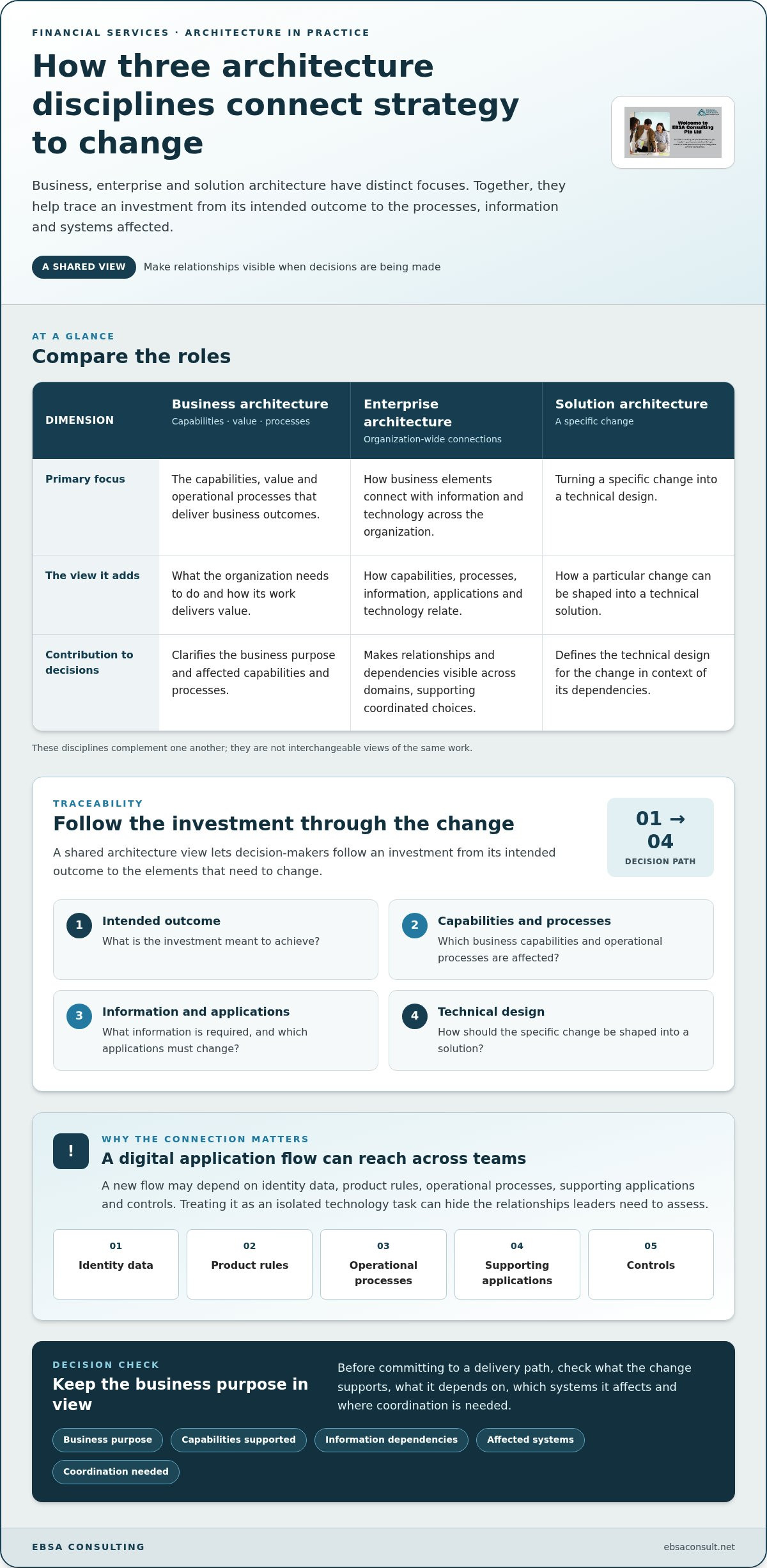
In financial services, a change to a customer journey can affect far more than its visible touchpoint. A new digital application flow, for example, may rely on identity data, product rules, operational processes, supporting applications and controls that span several teams. These connections make change cross-domain: a decision in one area can create dependencies elsewhere. Leaders need a shared view of how the organization works to assess those effects.
Enterprise architecture is a structured view of how an organization’s strategy connects to its business capabilities, processes, information, applications and technology. It helps people understand how these elements relate and use that understanding to guide decisions and change. For a foundational overview of enterprise architecture, consider how its scope brings organizational structure and technology into one perspective.
That view should inform active planning, not sit in a diagram inventory or serve only as a compliance exercise. Decision-makers can use it to examine proposed changes in context: which capabilities they support, what information they depend on, which systems are affected and where coordination is needed. The aim is not to document everything for its own sake, but to make relationships visible when choices are being made.
How enterprise architecture connects business and technology
Business goals become actionable when they’re translated into the capabilities an organization needs, the processes that deliver them, the information those processes require and the systems that enable the work. Business architecture focuses on capabilities, value and operational processes. Enterprise architecture connects those business elements with information and technology across the organization. Solution architecture then shapes a specific change into a technical design. These disciplines complement one another.
Traceability links the chain. Leaders can follow an investment from its intended outcome through affected capabilities and processes to the information and applications that must change. This helps decision-makers test whether a technology choice supports the business purpose and identify dependencies or gaps before committing to a delivery path.
Why financial-services organizations need a sector-specific view
Financial-services organizations bring together varied products, customer journeys, service channels, data domains and shared services. A change to onboarding, for instance, may touch customer information, identity checks, account-opening processes, applications and operational controls. The exact relationships differ by organization, but a sector-aware architecture makes them easier to examine together instead of treating each project as an isolated technology task.
This is why enterprise architecture for financial services should reflect the organization’s own priorities, structure and dependencies, rather than assume one operating model or framework fits all. Mapping connections across domains helps teams see where a change may affect operations, applications and controls, and who needs to contribute to a sound decision. It provides a practical basis for coordinating change while keeping business intent visible.
The 2026 forces reshaping financial-services architecture
In 2026, architecture priorities reflect both established obligations and emerging technology choices. The distinction matters: regulatory requirements need to be addressed within their scope, while trends such as agentic AI or cloud-native evolution call for deliberate assessment, not automatic adoption. For enterprise architecture for financial services, the task is to connect each force to business purpose, service dependencies, information flows and accountable decision-makers.
Resilience, regulation, and changing operating expectations
Digital resilience is an established concern. The EU’s Digital Operational Resilience Act (DORA), which became applicable on 17 January 2025, sets requirements for covered financial entities in areas including ICT risk management, incident reporting, resilience testing and third-party risk. Its direct applicability depends on an organization’s circumstances, but its focus on technology dependencies is relevant to architecture planning. In Singapore, the Monetary Authority of Singapore’s Technology Risk Management Guidelines provide a local reference for technology-risk governance; the Basel Committee’s Principles for Operational Resilience offer international banking context.
Architecture can make critical services, supporting applications, data flows and third-party dependencies easier to see. Teams can use that view to consider recovery needs and decision ownership. Architecture supports governance and risk decisions, but it doesn’t itself guarantee compliance. Organizations still need to interpret applicable requirements, assign accountability and put appropriate controls into practice—an area where advisory firms like Versapien help consumer financial institutions integrate regulatory compliance and risk management into operational change.
AI, data, cloud, and payments as connected architecture decisions
AI is an emerging architecture signal in 2026, not a universal destination. Before scaling a use case, leaders can clarify its business purpose, identify the data it relies on, set expectations for data quality and lineage, and assign ownership for model, information and operational risks. Integration and security matter too: an AI capability that depends on inconsistent records or unclear interfaces may be difficult to govern and maintain.
Cloud and platform decisions deserve the same workload-specific assessment. Consider resilience, security, interoperability and operating requirements alongside the intended business benefit. Migration or platform replacement isn’t automatically the right answer. Architecture should show what a workload needs and how a choice affects connected services.
Payments modernization adds a concrete data-design consideration. ISO 20022 is a financial messaging standard, and the 2026 transition toward structured or hybrid address information makes message quality, validation, screening and downstream reconciliation relevant architecture concerns. Network rules and transition schedules can differ, so teams should base design decisions on the requirements that apply to their payment flows rather than assume one universal timetable.
These forces converge in shared dependencies: data, interfaces, controls and service ownership. EBSA Consulting provides enterprise architecture consulting to connect those considerations to organizational objectives and technology decisions.
How to prioritize enterprise architecture decisions in financial services
Prioritization turns competing change requests into a sequence of decisions leaders can explain and revisit. For enterprise architecture for financial services, assess each initiative against strategic alignment, service criticality, risk exposure, dependency impact and feasibility. Capability maps show which parts of the business an initiative affects; current-to-target views reveal duplication, constraints and the changes that need to happen first. Comparing initiatives against the same criteria helps make trade-offs explicit.
The table offers a starting point. Adapt the decision owners to your organization’s governance and operating structure.
| Driver | Capabilities affected | Architecture implications and dependencies | Typical decision owners |
|---|---|---|---|
| Customer experience goal | Customer interaction, product servicing | Review channel journeys, shared customer information and links to operational processes | Business and channel leaders, data and technology leads |
| Service resilience concern | Critical operations, service management | Map application, data and third-party dependencies; assess recovery and continuity needs | Operations, risk and technology leaders |
| Information quality need | Data management, reporting, decision support | Clarify ownership, lineage, definitions and integration points across information flows | Data owners, business leaders, technology leads |
| Platform constraint | Product delivery, transaction processing | Compare modernization with integration, consolidation or retention; consider interoperability and delivery risk | Business sponsors, architects, technology leaders |
Translate sector pressures into business capabilities
Trace a business outcome through the capabilities that enable it. A hypothetical goal to make account servicing clearer might involve customer interaction, case handling, information management and the applications that support staff and digital channels. Keep the outcome separate from the proposed technology response: first define what needs to improve, then assess possible ways to support it. This leaves room to compare alternatives. For broader alignment context, see this enterprise architecture consulting strategy guide.
Compare architecture responses without defaulting to one technology
For each constraint, compare whether to modernize, integrate, consolidate or retain, using consistent criteria: contribution to strategy, effect on service criticality and risk, dependency impact, resilience, complexity, interoperability, delivery risk and organizational readiness. Modernization may address constraints but introduce transition risk; integration may preserve existing investments while adding interface complexity. Consolidation can reduce duplication, while retention may be sensible when a system remains fit for purpose. From enterprise choices, move into solution design with a strategic solution architecture design process.
A practical roadmap for applying financial-services enterprise architecture
A useful roadmap connects business outcomes to the capabilities, dependencies and decisions needed to deliver them. It should guide investment and change while remaining open to revision as strategy, regulation, technology and operational evidence evolve. For enterprise architecture for financial services, the process works best when business and technology stakeholders share responsibility for cross-domain choices.
- Clarify outcomes. Define the business or operational result sought, such as strengthening a service, addressing a risk or improving a process. Agree how progress will be assessed before implementation begins.
- Map capabilities and dependencies. Identify the capabilities involved, then trace important relationships across processes, information, applications, technology and third parties.
- Assess the current state. Document relevant strengths, constraints, duplication and risks. Focus on the areas that influence the outcome rather than creating an exhaustive inventory.
- Define target choices. Describe the intended business and technology changes, including key design principles, options considered and trade-offs that require a decision.
- Sequence change. Build a roadmap around dependencies and enabling capabilities. Show decision owners, key assumptions and how initiatives relate, rather than presenting a disconnected list of projects.
Build a roadmap around dependencies and decision ownership
Assign accountable business and technology stakeholders to decisions that cross domains. For example, a choice affecting a customer-facing process, its information flows and supporting applications may require joint input from the business owner, data stakeholders and technology leadership. Governance should establish decision rights, design principles, an approach to handling exceptions and a review cadence proportionate to the organization. For guidance on framework selection and governance context, see this strategic architectural frameworks guide.
Measure progress and adapt architecture choices
Set a baseline for selected outcomes and specify how evidence will be gathered, who will review it and when. Depending on the goal, indicators might relate to service performance, risk exposure, delivery progress or process efficiency. Keep the measures tied to the original business need so teams can distinguish completed design work from meaningful progress.
Architecture measures are valuable when they connect design decisions to observable business outcomes. Use reviews to revisit assumptions, risks, approved exceptions and shifting priorities, then adjust the roadmap as needed. No fixed timeline fits every organization; sequencing should reflect dependencies, readiness and the evidence available. EBSA Consulting provides enterprise architecture consulting to help shape roadmaps around organizational objectives.
How enterprise architecture consulting can support financial-services transformation
Architecture consulting can be useful when a strategic change spans multiple business domains, dependencies are difficult to see, decision ownership is unclear or project roadmaps aren’t aligned. In these situations, enterprise architecture for financial services helps create a shared view of business priorities and the processes, information and technology choices involved. That view supports better-informed decisions without replacing the organization’s accountability for risk, investment or delivery.
What a collaborative architecture engagement can address
EBSA Consulting brings enterprise, business and solution architecture together around organizational objectives. Its work can be tailored to business alignment, architecture assessment, target-state design and roadmap development. The focus is collaborative: decision-makers and technical teams make assumptions, constraints and dependencies visible, then use that shared understanding to shape practical choices. The work is strategic architecture consulting, not day-to-day technology operations, software sales or staffing.
The three architecture perspectives complement one another. Enterprise architecture connects strategy with business and technology across the organization. Business architecture clarifies capabilities and operational processes. Solution architecture translates business requirements into technical direction. Together, they connect a transformation’s purpose to the processes it affects and the systems that may need to change.
Turn strategic intent into coherent architecture decisions
A priority such as improving a customer service journey can be traced through the capabilities involved, the operating processes that support it, the information required and the technical direction under consideration. This helps teams identify dependencies, consider alternatives and make sequencing choices with a clearer view of their implications. It doesn’t guarantee a particular financial or regulatory outcome; it supports decisions grounded in organizational context.
Architecture consulting can also bring disconnected plans into a coherent view. Leaders can see where initiatives depend on shared capabilities, where ownership needs clarification and which choices should be resolved before related work proceeds. The result is a stronger basis for coordinating business and technology change while keeping investment discussions connected to strategic intent.
Start with the priorities you need to address, the outcomes you want to support and the transformation context your organization is working within. Explore EBSA Consulting to learn how architecture can help bring those priorities into alignment.
Align Your Next Architecture Decisions
Financial-services transformation depends on more than selecting new technology. Connected services, data, processes and systems mean that decisions in one area can shape priorities across the organization. Enterprise architecture for financial services gives leaders a structured way to make those relationships visible and connect strategic intent to investment and change.
Three principles can guide the work: assess initiatives by their business purpose and dependencies; prioritize according to strategic alignment, service criticality, risk and feasibility; and keep roadmaps adaptable as priorities and evidence evolve. Architecture is most useful when it informs decisions, clarifies ownership and links design choices to outcomes the organization can observe.
EBSA Consulting brings enterprise, business and solution architecture together to align business strategy, organizational processes and technology infrastructure. Whether you’re refining priorities or coordinating a broader transformation, a shared architecture view can help create a more coherent path forward.
Discuss your enterprise architecture priorities with EBSA Consulting and explore how your desired outcomes and transformation context can shape the next steps. With clear alignment, your organization can approach change with greater confidence and direction.
Frequently Asked Questions
What is enterprise architecture in financial services?
Enterprise architecture in financial services is a structured view of how an organization’s strategy connects to its capabilities, processes, information, applications and technology. It helps leaders understand how these elements depend on one another and assess proposed changes in context. Rather than serving only as documentation, enterprise architecture can inform planning and investment decisions by showing how business priorities relate to operational processes and technology choices.
Why is enterprise architecture important for financial-services organizations?
It helps financial-services organizations coordinate change across connected products, customer journeys, channels, data and shared operations. A decision affecting one service may also affect supporting applications, information flows and controls. Architecture makes those relationships easier to examine, helping business and technology leaders surface dependencies, clarify ownership and compare choices against organizational priorities. Its value lies in supporting informed decisions, not prescribing one operating model or technology approach.
How does enterprise architecture support regulatory change?
Enterprise architecture can help teams trace a regulatory change to the business capabilities, processes, information, systems and decision owners it may affect. This creates a clearer basis for assessing dependencies, coordinating work and identifying where responsibilities or design choices need review. The relevant obligations depend on the organization and its activities. Architecture supports governance and planning, but it doesn’t interpret requirements on its own or guarantee compliance.
Can enterprise architecture improve operational resilience?
Enterprise architecture can support resilience planning by making relationships among important services, processes, applications, data and external dependencies more visible. Teams can use that view to discuss how disruption might affect connected operations, where recovery considerations need attention and who should take part in decisions. The architecture itself doesn’t ensure continuity or prevent incidents. It provides a structured input to resilience and risk decisions that the organization must put into practice.
What role does enterprise architecture play in financial-services digital transformation?
Enterprise architecture connects transformation goals with the capabilities, processes, information and technology changes needed to pursue them. It can help teams assess whether a proposed digital initiative fits the broader environment, identify dependencies and sequence work with greater context. In Singapore, as in other markets, organizations should shape transformation around their own strategic objectives and obligations. Architecture supports those decisions without assuming that every initiative requires cloud migration, AI or platform replacement.
How should a financial-services organization start an enterprise architecture roadmap?
Start by agreeing on the business outcomes the roadmap should support, then map the capabilities and dependencies involved. Assess the relevant current state, identify constraints and compare target choices before sequencing initiatives. Assign decision owners across business and technology, and define how progress will be assessed. A focused roadmap can begin with a priority area rather than attempting to document the entire organization, then evolve as strategy and evidence change.
What is the difference between enterprise architecture and solution architecture?
Enterprise architecture takes an organization-wide view, connecting strategy, capabilities, processes, information, applications and technology. Solution architecture focuses on the design of a particular solution or change, translating business requirements into a technical blueprint. They work together: enterprise architecture provides context and direction, while solution architecture develops a design for a specific need within that context. Business architecture adds a complementary focus on capabilities and operational processes.


