

A solution can be technically sound and still miss the business need. Strong solution design for business requirements connects agreed outcomes to scope, processes, systems, data, integrations and quality needs such as security and performance. It also clarifies how each requirement will be validated before the design moves to implementation.
That connection matters: business stakeholders need to see their priorities reflected in the design, while delivery teams need enough detail to build and test the intended solution. Making requirements and decisions visible to both groups helps them resolve gaps and trade-offs before these become implementation issues.
This article explains what a solution architecture design document includes, how functional and non-functional requirements shape it, and how teams assess feasibility and alignment with business goals. It also covers stakeholder collaboration, validation against requirements and the information a clear handover provides implementation teams. You’ll gain a practical understanding of how to move from business needs to a structured, testable design that can guide delivery.
Key Takeaways
- Connect each business outcome to the processes, systems, data and integrations that will deliver it.
- Define functional needs alongside quality expectations such as performance, security, scalability and resilience.
- Trace requirements to solution components, then validate the design against business goals and technical constraints.
- Involve business, technology and operations stakeholders early to align priorities and surface trade-offs.
- Prepare implementation handover with clear design decisions, interfaces, dependencies and validation criteria.
What does a solution architecture design document include?
A design document links business outcomes to processes, systems, data and technology choices. Solution design for business requirements makes these decisions understandable, testable and ready to guide delivery.
Solution Architecture and Business Requirements
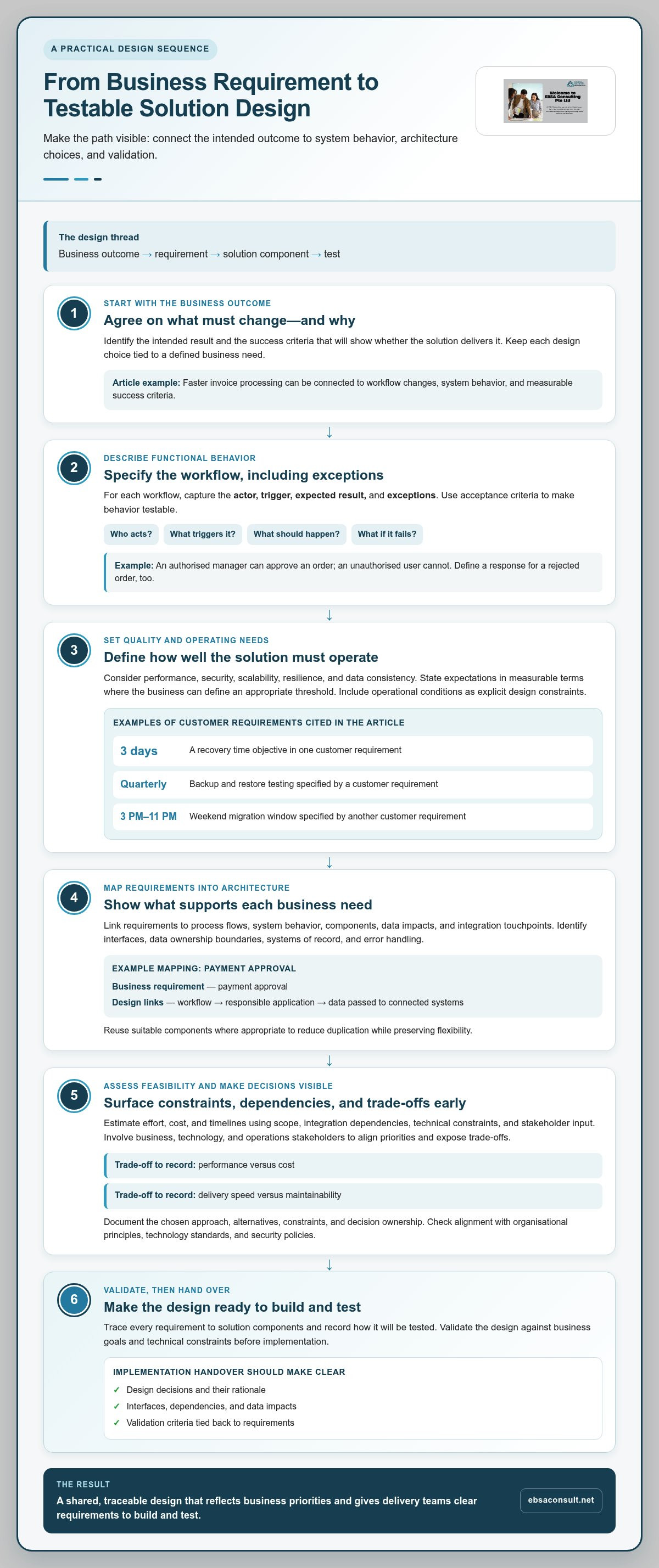
Solution architecture translates business requirements into a technology approach that fits the organisation’s wider enterprise architecture. This matters because each component should support a defined outcome instead of adding complexity without clear value. If a business needs faster invoice processing, the design can connect that goal to workflow changes, system behaviour and measurable success criteria.
Estimate effort, cost and timelines using the scope, integration dependencies, technical constraints and stakeholder input. Changing one workflow calls for different design work than a solution spanning applications and teams. Solution design for business requirements makes these dependencies visible before implementation decisions become fixed.
Architecture Documentation and Traceability
Architecture documentation shows how requirements connect to solution components and design decisions. A traceability view can link each business need to process flows, system behaviour, data impacts and integration touchpoints. This helps business and delivery teams follow the rationale, spot gaps and understand what the implementation must achieve.
Visual models can clarify relationships among capabilities, processes, applications, data and technology. ABACUS can support architecture views that organise and communicate these relationships. For example, a process view can show which application supports a business activity and where information moves. Keep documentation focused on decisions, dependencies and the information stakeholders need.
Validation, Governance, and Design Decisions
Enterprise architecture validation checks alignment with organisational principles, technology standards and security policies. Governance clarifies who owns decisions and when reviews take place. Record the chosen approach, alternatives, constraints and trade-offs, such as performance versus cost or delivery speed versus maintainability. This gives stakeholders a shared basis for approving the design and managing later changes.
Common risks include unclear scope, undocumented compromises and decisions deferred until development. Fragmented designs can duplicate components and complicate integration; late decisions can create technical debt. Identify risks in the design, assign ownership and address dependencies early, before they disrupt delivery.
Integration Patterns and Requirements Mapping
Integration patterns describe how systems exchange information and respond to changes or failures. Before implementation, a design should identify interfaces, data ownership boundaries, systems of record and error handling. For example, a payment approval requirement maps to a workflow, the responsible application and the data passed to connected systems. Reusing suitable components can reduce duplication while preserving flexibility.
Map each business requirement to a functional need, then define the supporting system behaviour and technical conditions. Link these to components, data and interfaces, and record how each requirement will be tested. This makes solution design for business requirements actionable, connecting the original business need to implementation and validation.
Functional and non-functional requirements
Requirements describe both the work a platform must perform and the conditions for dependable operation. Separating these needs helps teams make structured decisions and maintain alignment throughout delivery.
Functional Requirements
Functional requirements specify the actions, rules and responses a system must support. They help stakeholders recognise their real work in the proposed behaviour. For example, an order-management platform might let staff create an order, apply an approval rule and view its status. For each workflow, capture the actor, trigger, expected result and exceptions. A rejected order needs a defined response, not just a successful path.
Use acceptance criteria to make each behaviour testable. A requirement might state that an authorised manager can approve an order, while an unauthorised user cannot. Business teams clarify the rule, technology teams translate it into system behaviour, and operations teams identify hand-offs and exception handling. This helps the solution support a consistent process rather than a set of isolated features.
Non-Functional Requirements
Non-functional requirements define how well a solution must operate, including performance, security, scalability, resilience and data consistency. They matter because a feature can work correctly yet fail users during peak demand or recovery. State each expectation in measurable terms where the business can define an appropriate threshold. One customer requirement in this article’s source material sets a recovery time objective of 3 days.
Operational conditions also shape design choices. A customer requirement may specify backup and restore testing quarterly, while another may require migrations on weekends between 3 PM and 11 PM. Treat these as explicit constraints in the design, not informal preferences. For systems within scope, include GDPR requirements; according to the European Union, GDPR is a relevant consideration for applicable solution architectures. Security boundaries and failure modes should also be assessed before implementation.
Cross-Functional Collaboration
Cross-functional collaboration brings business, technology and operations perspectives into requirements decisions. Each group sees different consequences: business owners define acceptable outcomes, technology teams assess platform constraints, and operations staff identify support and recovery needs. For a customer-facing service, a business owner may prioritise uninterrupted transactions, while operations staff identify what to do if a dependency fails.
Resolve conflicting expectations through explicit trade-offs. If users need faster responses but a connected system processes updates in batches, document the constraint and its business impact. Ask stakeholders to distinguish essential requirements from preferences, then record the decision owner and rationale. This gives delivery teams a shared basis for scope and helps prevent late changes from undermining alignment.
A structured requirements record can capture the need, owner, acceptance criteria, quality attribute, dependency and validation method. For example, link a security requirement to affected user roles and test evidence demonstrating appropriate access. Keep the record current as stakeholders refine their needs, so each design change can be assessed against the original business outcome.
For organisations aligning business processes with technology needs, cross-functional requirements alignment can help connect stakeholder priorities with solution decisions.
Requirements analysis and design validation
Analysis turns stakeholder needs into requirements that a proposed design can address and teams can test. Validation checks whether the design supports the intended business objectives, not merely whether it documents technical choices.
To gather and validate business requirements, combine stakeholder interviews with job shadowing, then compare the findings with existing workflows and design documents. Enterprise Singapore identifies interviews and job shadowing as diagnosis methods. For example, observing invoice handling can reveal approval steps that an interview alone might miss.
Start by reviewing functional and technical design documents, then identify the business outcome behind each requirement. Separate a proposed solution from the underlying need: “add an approval screen” describes a feature, while “prevent unauthorised payments” expresses a business control. This distinction helps the organisation assess whether the proposed feature is necessary and sufficient.
Check each requirement for clarity, consistency, feasibility and testability. Ask its owner to define the expected result, relevant users, exceptions and dependencies. For payment approvals, document who can approve, what happens when approval is rejected and which records must be retained. Resolve conflicting expectations before they become design assumptions.
Requirement verification asks whether a requirement is written correctly and consistently. Requirement validation asks whether it represents a genuine business need. A review workshop can test both: operations staff confirm that a documented workflow reflects daily work, while business owners confirm that its outcome supports their objectives. Record decisions and open questions in the requirements set.
Design validation compares the proposed solution with approved requirements and relevant functional and technical design documents. Trace each requirement to the process, system behaviour, data impact and integration involved. Then assess whether the design can achieve the stated outcome. For an invoice process, reviewers could check that the design supports invoice processing, payment approvals and applicable compliance requirements.
Testing provides evidence for design claims. Use walkthroughs to assess end-to-end workflows, interface reviews to examine system interactions, and test scenarios to cover expected and exceptional behaviour. A payment scenario should include an approved transaction and a rejected one. This can expose missing decisions before implementation leads to rework.
Keep validation proportionate to the design’s scope. A change affecting one workflow needs a focused review of its users, rules and system dependencies. A design spanning several applications needs broader checks across interfaces, ownership boundaries and failure responses. In both cases, define the evidence that will demonstrate the solution meets its requirements.
Document findings, decisions, owners and required changes alongside the design. A clear record helps implementation teams distinguish approved requirements from open issues and trace future changes to their business rationale. Revisit validation when requirements or dependencies change to keep the design aligned with the outcomes it is meant to support.
Business requirements and stakeholder collaboration
Business requirements identify the problem, intended outcome and boundaries a solution must address. Business owners, users, technology teams and operations staff each contribute perspectives that shape the design.
Business Requirements
A business requirement defines the value an organisation needs, not simply a requested feature. This helps teams choose solutions based on outcomes. For example, a request to automate invoice entry may reflect a deeper need: reducing manual handling while preserving review controls.
Make each requirement specific enough for stakeholders to discuss and assess. Describe the current process, the point of friction, the desired future state and any constraints. If finance staff re-enter supplier details across systems, document where duplication occurs and what a successful process should change. These details help teams avoid automating an inefficient workflow without addressing its cause.
Stakeholder Roles and Collaboration
Stakeholders are people who define, use, build, govern or operate the solution. Business owners set priorities, users explain real tasks, architects connect needs to system design, and operations teams surface support and continuity concerns. Security and compliance representatives add relevant controls. Their involvement matters because a design must work across roles, not just within one department.
Enterprise Singapore identifies stakeholder interviews and job shadowing as diagnosis methods. Interviews reveal priorities and exceptions, while observing a task can expose workarounds users may not mention. For an order process, a team might interview sales staff, then observe how they resolve incomplete customer records. Combining both methods grounds requirements in operational reality.
Give collaboration a clear structure. Start with a shared problem statement, then ask each stakeholder group to describe its desired outcome and constraints. A workshop can compare those views with the current process model. For example, sales may prioritise faster order creation, while finance needs accurate billing data. Make both needs visible before choosing automation or system changes.
Use models to make different perspectives easier to compare. A process model can show hand-offs between customer service, finance and operations, while a capability view can connect those activities to the systems involved. Review the models with the people who do the work, then record corrections. This makes abstract discussion a shared view of how work actually flows.
When stakeholders disagree, capture the decision, rationale and owner. Suppose users request immediate updates but an existing platform processes changes in batches. The group can weigh the business impact against the technical constraint and define an acceptable approach. Recording the decision helps keep implementation aligned and prevents the same issue from reopening without new evidence.
Treat collaboration as ongoing decision-making, not a single approval meeting. Revisit stakeholder input when scope or process assumptions change. This helps solution design reflect defined business priorities and gives delivery teams a coherent basis for implementation.
What are the key steps from business requirements to a solution design?
Moving from a business need to an implementable design requires a clear sequence of decisions. Each stage connects the problem to processes, systems, data and delivery choices.
- Frame the business problem. Describe the current difficulty, intended outcome and affected stakeholders. For example, if staff re-enter customer details, define the operational impact before proposing automation. This keeps the design focused on the cause, not just a requested feature. Record boundaries too, such as which teams or processes fall within the initiative.
- Translate outcomes into requirements. Turn the desired result into functional behaviours and quality expectations. A need to reduce invoice handling effort could involve a revised approval workflow, clear exception handling and defined data ownership. Make each requirement traceable to an outcome, so teams can see why it matters and how it contributes to success.
- Understand the current environment. Map relevant capabilities, processes, applications, data and technology. Identify systems of record, integration points and dependencies that could affect the proposed change. For example, a new customer workflow may rely on information held in a separate billing application. This view helps teams reuse suitable components and avoid creating duplicate functions.
- Assess solution options. Compare feasible approaches against business value, technical constraints, cost considerations and operational needs. One option may extend an existing platform; another may introduce a separate component. Document the advantages, compromises and dependencies for each. A decision record helps stakeholders understand why the selected approach best fits the requirements and enterprise context.
- Shape the target design. Describe the chosen components, workflows, data movement, interfaces and governance controls. Specify how systems interact, what happens when an interface fails, and which team owns each decision or data boundary. Modular design can allow components to evolve independently, while reusable patterns can support consistency across related work.
- Validate and prepare the handover. Check the design against requirements, enterprise principles, technology standards and security policies. Use walkthroughs and test scenarios to examine normal and exception paths. Then align the final documents with the implementation plan, including dependencies, transition states, open decisions and acceptance criteria. This gives delivery teams a usable basis for building and testing.
The sequence is iterative, not a one-way pipeline. If validation exposes a missed dependency, return to the relevant requirement or option and revise the design. For complex initiatives, align business requirements with solution architecture through a structured design process.
EBSA Consulting: Enterprise Architecture Consulting
EBSA Consulting provides Enterprise Architecture Consulting to connect business priorities with technology direction. This support is useful when requirements span teams, applications or processes and design decisions need to fit the wider enterprise structure.
Business Architecture Services clarify how capabilities and processes support desired outcomes. Solution Architecture Design translates those requirements into a coherent technical approach, including components, dependencies and integration considerations. Together, these disciplines help teams move from business needs to a design that delivery teams can assess and implement.
If your organisation is shaping a new solution or aligning existing systems with changing business needs, contact EBSA Consulting to discuss your architecture requirements. You can also visit ebsaconsult.net.
Keep Architecture Aligned as the Business Evolves
The next step is to keep architecture work connected to business priorities after delivery begins. Assign ownership for revisiting assumptions as teams learn from implementation, user feedback and operational performance. This makes design maintenance a deliberate management practice rather than an occasional response to change.
Disciplined solution design for business requirements also gives leaders a way to assess whether new requests support the intended direction. Before accepting a change, consider its effect on business outcomes, existing systems and decisions already made. This helps teams distinguish valuable adaptation from change that adds complexity without advancing organisational goals.
For your next design challenge, identify the decision that needs the clearest alignment, such as scope, system boundaries or ownership. EBSA Consulting can help you shape a considered path forward through its architecture and business-focused work. Discuss your needs with EBSA Consulting and take the next step with greater clarity.
Frequently Asked Questions
What is solution design in business requirements analysis?
Solution design turns an analysed business need into a feasible approach to changing processes, systems or both. It bridges the gap between describing a problem and deciding how to address it. For example, if staff struggle to find current supplier information, analysis identifies the users and tasks involved; design considers how data access and workflow changes could address the need within the organisation’s existing environment.
What should a solution design document include?
A solution design document should give reviewers enough information to understand the proposed approach and its delivery implications. Include business outcomes, scope, assumptions, affected systems, major components, data flows, interfaces, security considerations and operational dependencies. For a customer onboarding change, show where information enters, which system holds the authoritative record and how exceptions are handled. Include decisions and open issues so teams can distinguish agreed direction from outstanding work.
How do you compare solution design options and assess feasibility?
Compare options against the same business outcomes, technical constraints and operating needs. For example, assess extending an existing application against introducing a separate component by examining integration impacts, data ownership, maintainability and delivery dependencies. Identify the requirements each option meets, where compromises arise and which assumptions need testing. The preferred option is more feasible when it fits the organisation’s standards and can be supported by the teams responsible for operating it.
What are the best practices for solution design in Singapore businesses?
Engage business, technology and operations stakeholders early, using interviews and job shadowing to gather and validate needs. Define measurable outcomes and scope, map each requirement to processes, systems, data and interfaces, and validate the design against business goals, technical constraints and security policies. Reuse suitable components, document trade-offs and prepare clear implementation handover materials.


