

IT alignment works when technology choices support business priorities, are measured against shared outcomes, and are reviewed as those priorities change. Aligning IT with business goals means business and technology leaders plan together, connect systems and processes to important work, and clarify accountability. This gives the organization a focused basis for deciding what to invest in and how to assess its value.
Alignment matters because teams working to different priorities can direct effort in competing directions, even when their people and systems are capable. Shared governance and clear measures help turn business strategy into coordinated decisions. Connected applications and data make collaboration across functions more practical.
This article explains how business and IT alignment works, what it can improve, and how shared planning, accountability, and connected systems support focus and productivity. It also shows how departmental goals fit into the wider strategy, so technology decisions can address local needs while supporting the organization’s overall direction.
Key Takeaways
- Translate strategic priorities into measurable outcomes so technology investments have a clear business purpose.
- Use shared governance and business-relevant measures to clarify who makes decisions and how progress is assessed.
- Connect processes, applications, people, and data to reduce friction across teams and support informed decisions.
- Bring departmental goals into joint planning, balancing local needs with the organisation’s wider direction.
- Use architecture expertise to connect business strategy with processes and solution design when alignment challenges span multiple areas.
What does it mean to align IT with business strategy?
IT aligns with business strategy when technology decisions advance defined organizational objectives. For example, a growth goal should shape sales systems, customer processes, and investment priorities together.
Business Priorities and IT Vision
An IT vision translates business priorities into a coherent direction for technology, capabilities, and change. It gives departments a shared basis for deciding which needs come first.
Consider strategic alignment: leadership sets a growth objective, then sales, marketing, operations, and IT agree on supporting capabilities. Operational alignment connects those capabilities to everyday workflows. Cultural alignment accounts for how teams collaborate and adopt change, while technology alignment considers whether systems can support the intended work. Henderson and Venkatraman’s Strategic Alignment Model, developed in 1990, can frame this conversation without serving as a fixed blueprint.
Connecting IT Investment to Outcomes
Investment alignment links each technology initiative to a business outcome and a way to measure progress. It helps an organization distinguish essential capability-building from spending that does not address a priority.
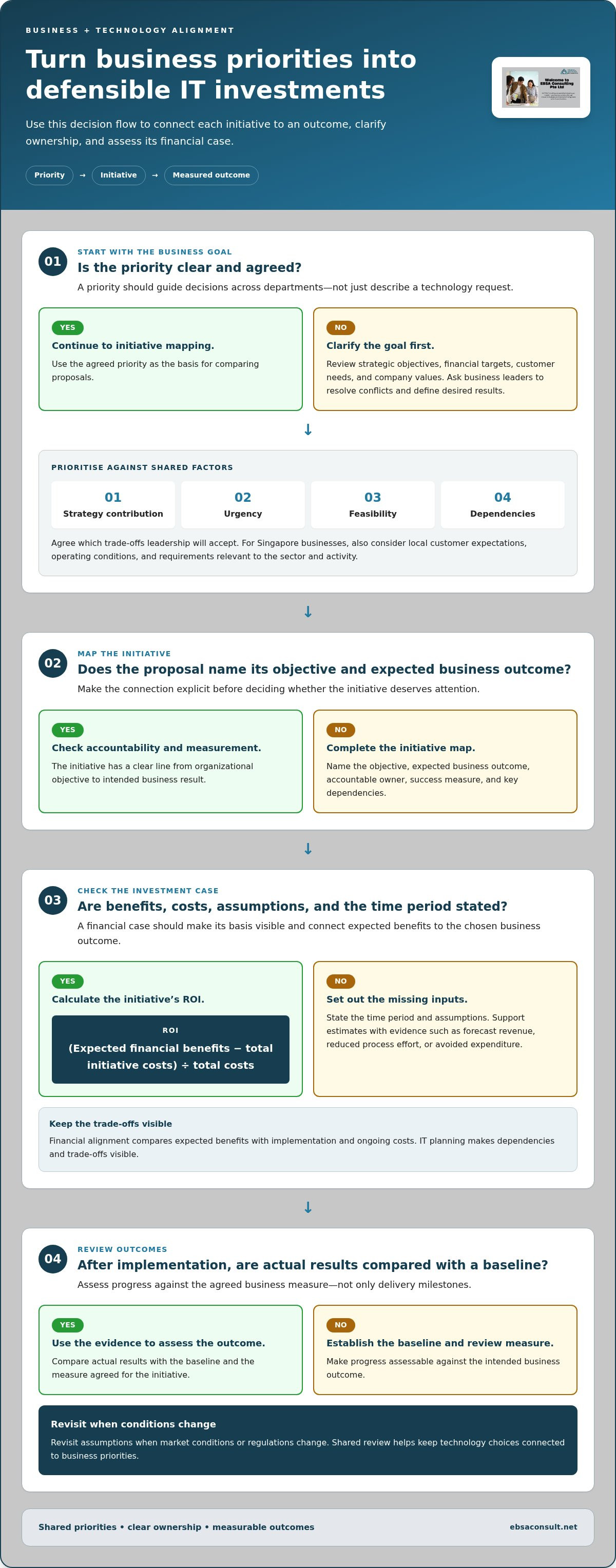
For example, if the objective is to improve customer retention, define the intended customer or service outcome before selecting a system. Then identify the investment, operating changes, and responsible teams needed to support it. Financial alignment compares expected benefits with implementation and ongoing costs, while IT planning makes dependencies and trade-offs visible. Track performance against the agreed measure, not just delivery milestones.
Identifying and Prioritising Business Goals
Goal prioritization turns the organization’s strategy into a focused set of outcomes that guide decisions across departments. Start by reviewing strategic objectives, financial targets, customer needs, and company values. Then ask business leaders to clarify conflicts and desired results.
How do you identify and prioritize business goals? Compare each objective by its contribution to strategy, urgency, feasibility, and dependencies, then agree on which trade-offs leadership will accept. For Singapore businesses, consider local customer expectations, operating conditions, and requirements relevant to the sector and activity. Assign an accountable business owner to each priority, and revisit assumptions when market conditions or regulations change.
Mapping Initiatives and Calculating ROI
Initiative mapping connects projects to objectives through explicit outcomes, owners, measures, and dependencies. This makes the portfolio easier to assess and helps teams explain why each project deserves attention.
How do you map projects and initiatives to business objectives? For each proposal, name the objective, expected business outcome, accountable owner, success measure, and key dependencies. How can you calculate the ROI of an initiative aligned with business goals? Subtract total initiative costs from expected financial benefits, then divide by total costs. State the time period and assumptions. Use evidence such as forecast revenue, reduced process effort, or avoided expenditure, and compare actual results with the baseline after implementation.
Benefits for focus, collaboration, accountability, and productivity
Alignment helps leaders turn strategic priorities into coordinated work across teams. Its value shows up in daily decisions: which requests receive attention, who owns outcomes, and how technology supports service delivery. For example, a customer-retention objective can guide product, sales, and IT teams toward compatible measures rather than separate activity targets.
Sharper focus on shared priorities
When teams understand the same outcomes, they can direct time and investment toward work that advances them. A shared portfolio view also makes competing requests easier to compare: leaders can assess expected business impact, dependencies, and required effort before committing resources.
LSA Global’s research covering 410 companies reported that well-aligned companies had 58% faster revenue growth and 72% higher profitability than unaligned companies. These figures describe the study’s findings, not a guaranteed result for every organization. They illustrate why connecting projects to priorities matters beyond IT delivery.
Stronger collaboration and accountability
Shared objectives give business and technology teams a common basis for discussing trade-offs. For instance, a customer-experience initiative may require marketing to define customer journey needs, operations to adjust processes, and IT to connect supporting systems. Clear dependencies help teams coordinate decisions instead of passing unresolved issues between departments.
Accountability improves when each initiative has a business owner, a delivery lead, and a measure tied to the intended outcome. A regular review can compare progress with the agreed measure, surface blockers, and identify who can resolve them. This makes ownership visible without making IT solely responsible for business results.
More productive work and measurable progress
Aligned processes reduce duplicated effort by clarifying how work moves between teams. If sales and finance use consistent customer and transaction definitions, staff spend less time reconciling mismatched records. Standard measures also help leaders distinguish completed technical tasks from changes that improve business performance.
SIG benchmark data indicates that organizations with strong alignment practices can improve time-to-market by 4-5x. Faster delivery can help teams respond to changing priorities, provided governance keeps scope and outcome measures clear. Track cycle time alongside quality and business impact, so speed does not become the only measure of success.
For organizations that need to clarify how business processes support shared outcomes, Business Architecture Services can help structure that connection.
Communication and governance between IT and business
Governance connects business priorities with technology decisions through shared participation and clear decision rights. For example, a cross-functional committee can review a customer-service initiative, resolve ownership questions, and agree on how teams will measure progress.
Make the company vision actionable
A company vision guides communication when leaders translate it into outcomes teams can recognize in their work. An executive might describe a goal of improving customer service, then explain which capabilities, processes, and technology changes support it. IT leaders can connect proposed work to those outcomes, while business leaders explain operational needs and constraints.
Use a concise strategy statement, named initiative owners, and business-facing metrics to make the vision practical. For example, a service improvement programme could track response quality alongside system delivery. Share the same definitions with leadership and delivery teams, so a completed technical milestone is not mistaken for the business result. Gartner reports that 67% of organizations discuss mapping IT spend to business outcomes, while 22% have a formal process that boards can understand and act on.
Build cross-departmental communication
Regular forums give departments a place to coordinate decisions before separate plans create conflicting requirements. A governance committee with representatives from IT, operations, finance, sales, and marketing can examine dependencies and discuss trade-offs. Record each decision, accountable owner, affected teams, and next review point.
For a product launch, marketing may need campaign data, sales may need customer information, and IT may need integration requirements. A joint discussion reveals these connections early. Representatives from participating departments can meet every two weeks to share progress, identify obstacles, and coordinate efforts. That cadence creates a reliable feedback path without turning every operational decision into an executive escalation.
Set shared accountability and review rhythms
Shared accountability means business and IT leaders jointly own whether an initiative achieves its intended outcome. A governance structure should define who approves priorities, who manages delivery, and who evaluates business impact. Clear decision rights prevent delays caused by unclear ownership and make unresolved conflicts easier to escalate.
Use weekly check-ins for active delivery issues and quarterly reviews for strategic fit. In each review, compare agreed metrics with current performance, explain variances, and decide whether priorities or capabilities need adjustment. Present portfolio information in terms executives can act on, such as business outcome, cost category, dependency, and decision required. This makes governance a working management practice, not merely a reporting exercise.
For organisations clarifying process ownership across departments, Business Architecture Services can help connect responsibilities with operational workflows.
Connecting processes, people, applications and data
Frameworks help teams understand company objectives and how they apply to individual roles. The People, Process, Technology framework links staff capabilities, operating methods, and systems. Sharrock’s Four Management Agendas and Gartner’s IT Strategic Planning Model can also guide alignment discussions.
Start with the work, not the software
Select IT systems by tracing a key process from its trigger to its business result. For an online order, map how a customer purchase moves through inventory, payment, fulfilment, and service. Identify delays, duplicate data entry, and missing information before choosing applications. This reveals whether the main need is integration, process redesign, clearer ownership, or a new capability.
A system supports business priorities only when people can use it within a workable process. For example, connecting an e-commerce site with back-office systems can reduce repeated order entry and give fulfilment teams consistent information. Define required data, access roles, hand-offs, and exception paths before implementation. This turns a technology choice into a specific operational action.
Apply the People, Process, Technology lens
Use the framework to examine three connected dimensions. People need defined responsibilities and the capability to perform each task. Processes need clear steps, decision points, and consistent guidelines. Technology should support those steps and make relevant data available to the roles that need it.
Suppose a sales team waits for customer records after a new employee joins. The People lens clarifies who grants access and provides training. The Process lens defines the request and approval path. The Technology lens checks whether the customer relationship system and identity workflow support timely access. Improving only one dimension may leave the underlying delay unresolved.
Transform processes through connected data
Business process transformation redesigns how work moves across functions, rather than simply digitizing existing tasks. Map the current process, identify its outcome and hand-offs, then design a future process with accountable roles and supporting applications. In manufacturing, connecting design and production systems can help teams work from consistent specifications.
Data quality is essential to that connection. Establish shared definitions for core records, identify which application owns each data element, and assign responsibility for maintaining it. Decision-makers can then use more consistent information across reports and operational systems. Review process performance regularly and adjust when customer needs or operating requirements change.
To connect team and individual objectives with company direction, translate strategic outcomes into responsibilities each role can influence. A shared process map shows how those contributions combine to produce the intended result.
Aligning business and departmental goals
Departmental goals turn company strategy into coordinated work, but each team needs to understand how its initiatives contribute to shared business objectives. A sales target, for example, should connect with marketing activity, service capacity, and the systems supporting customer relationships.
Reviewing Goal and Initiative Alignment
Alignment reviews compare active initiatives with current business objectives, assigned owners, and evidence of progress. They matter because priorities can shift while projects and departmental plans continue on their original course.
How often should business goals and initiative alignment be reviewed? Use weekly check-ins to surface delivery issues and quarterly reviews to reassess strategic fit. A major change in market conditions, customer needs, or leadership direction can also prompt an earlier review. For each initiative, ask whether its intended outcome still supports a company priority, whether dependencies have changed, and whether its measures remain relevant.
Sharrock’s Four Management Agendas and Gartner’s IT Strategic Planning Model can help structure planning conversations. Use these frameworks as guides, then translate company objectives into department-level contributions. For example, if customer retention is a priority, marketing might focus on relevant engagement, operations on service consistency, and IT on enabling reliable customer information. Involve teams in shaping those goals, since their input can reveal feasibility concerns before commitments are made.
Risks and Causes of Misalignment
Misalignment occurs when departmental plans, incentives, or technology investments stop supporting the organization’s shared priorities. Identifying its causes helps leaders address decision-making or coordination gaps instead of treating every delay as a delivery problem.
What are common risks and causes of misalignment with business goals? Departments may pursue competing objectives, use different success measures, or make decisions without understanding dependencies. Cultural differences and separate incentives can also reward local results over company-wide outcomes. A technology project may continue after business direction changes, consuming resources without serving current needs.
Information gaps add another risk. An outdated application inventory can make it harder to align business and IT, because teams may miss dependencies or duplicate capabilities. Slow access provisioning can also encourage departments to adopt tools independently, creating shadow IT and fragmented information. These risks make clear ownership, current portfolio information, and open cross-department discussions essential.
Connect objectives to initiatives with a simple traceability view: record the company outcome, department contribution, initiative owner, measure, and dependency. Review exceptions together, then decide whether to continue, adjust, or stop work. This gives leadership a practical way to balance departmental needs with organization-wide priorities. Explore Business Architecture Services to structure how departmental processes and goals connect with broader business objectives.
EBSA Consulting: Enterprise Architecture Consulting
EBSA Consulting helps organizations connect business direction with the architecture, processes, and solutions needed to support it. Turn to its Enterprise Architecture service when priorities span business capabilities, technology choices, and organizational change. Business Architecture focuses on integrating strategic objectives with operational execution to streamline processes, enhance collaboration, and achieve measurable outcomes. Solution Architecture designs customized solutions that meet specific business requirements.
This support is relevant when initiatives cross departments, existing systems complicate delivery, or leaders need a clearer view of how technology enables strategy. EBSA Consulting’s architecture services provide a structured basis for evaluating priorities and shaping solutions around intended outcomes.
To discuss how EBSA Consulting can support your alignment priorities, contact the team or visit ebsaconsult.net.
Make Alignment an Ongoing Management Habit
Treat alignment as an ongoing leadership practice, not a planning exercise that ends when a strategy document is approved. As priorities shift, revisit the assumptions behind major decisions and adjust direction before disconnected efforts become difficult to reconcile. This keeps aligning IT with business goals tied to the organization’s actual needs, rather than yesterday’s plans.
EBSA Consulting provides Enterprise Architecture, Business Architecture, and Solution Architecture services. They connect organizational direction with business processes and technical solutions, giving leaders a structured basis for moving from intent to implementation.
If your teams are ready to strengthen that connection, contact EBSA Consulting to discuss your goals. A clear next step can help turn shared direction into purposeful progress.
Frequently Asked Questions
How can a CIO measure business-IT alignment in practical terms?
A CIO can assess how well technology supports business outcomes and operational experience. To evaluate alignment, track how quickly new hires receive productive access, how quickly access changes after role changes, and what share of applications is governed. Pair these indicators with business feedback: do reported service levels match what teams experience? Reviewing both perspectives can reveal gaps in systems, processes, or expectations.
What are the 4 types of alignment?
A useful four-part view comes from Henderson and Venkatraman’s Strategic Alignment Model, developed in 1990: business strategy, IT strategy, organizational infrastructure and processes, and IT infrastructure and processes. The first two address strategic direction; the latter two address execution and capability. For example, a business strategy to expand digital sales should connect to an IT direction, redesigned sales workflows, and supporting technology infrastructure.
What are the main stages of business-IT alignment?
The main stages are to clarify business direction, assess current capabilities, translate objectives into technology outcomes, prioritize initiatives, and review performance. For example, a service organization could identify customer response as a priority, assess the systems supporting service teams, define the desired operational change, and monitor results. These stages form a repeating cycle because changes in business conditions can alter which capabilities matter most.
What is goal alignment?
Goal alignment means connecting an individual’s or department’s objectives to broader organizational outcomes. A finance team, for instance, might aim to improve forecast usefulness because leadership relies on forecasts to make investment decisions. Make the connection visible in the work, measure, and accountable owner. This helps employees understand how their contribution supports shared priorities, rather than treating team targets as isolated tasks.
What does aligning a strategy or project with business goals mean?
Project alignment means establishing a clear link between the intended result and a business objective before committing resources. A proposal should explain which outcome it supports, who benefits, and what evidence will show progress. For example, a customer portal initiative might support easier self-service, with adoption and service demand reviewed together. If the expected business result cannot be articulated, clarify the project’s purpose before proceeding.
Which KPIs measure alignment with business goals?
Choose KPIs that connect technology delivery with the outcome the business cares about. A customer-service initiative might track resolution quality alongside system availability; a workforce initiative might track how quickly new hires receive productive access. Other practical indicators include the share of governed applications and the time needed to adjust access after role changes. Use a balanced set, since a single IT metric rarely explains business impact on its own.
What steps can leaders take to align technology investments with business goals?
Begin aligning IT with business goals by stating the intended outcome, then mapping the proposed investment to the capabilities, processes, and people needed. Compare initiatives by expected value, dependencies, and resource demands, and assign an owner to each result. Before implementation, define how performance will be assessed. For example, evaluate whether a customer-data integration supports a specific customer or operational objective, not simply whether the technology can be deployed.


