

Strategy only creates value when teams can connect it to the work, processes and technology that put it into practice. Enterprise architecture provides that shared picture, and ArchiMate is an open, independent standard for describing it, hosted by The Open Group and aligned with TOGAF. ArchiMate modeling and consulting can help translate strategic intent into a coherent view of business and technical change.
It’s understandable to want more than diagrams: leaders need to see how decisions affect operations, while architects need enough detail to shape practical solutions. The value lies in using consistent concepts and relationships to make those connections clear, not in modelling every detail.
This article explains enterprise architecture and how ArchiMate views, elements and relationships bring different perspectives into one model. You’ll also learn how ArchiMate can work alongside TOGAF, BPMN and UML, and how to choose the right level of detail for each decision. The result is a clearer way to connect strategy with operational and technical realities.
Key Takeaways
- Use enterprise architecture to make the links between business direction, operations and technology easier to understand.
- Shape each ArchiMate view around its audience and the decision it needs to support.
- Select model elements and relationships that clarify the change, rather than adding detail without purpose.
- Use ArchiMate alongside TOGAF, BPMN and UML to connect enterprise-wide direction with process and solution detail.
- Trace strategic goals into operational capabilities and technical design to create a clearer path from intent to implementation.
1. What is enterprise architecture?
Enterprise architecture describes how an organisation’s strategy, capabilities, processes, information and technology fit together. It gives leaders and delivery teams a structured way to understand change across the enterprise. For example, a new digital service can be traced from its business goal through customer processes to the applications and infrastructure that support it.
ArchiMate is an open, independent enterprise architecture modelling language hosted by The Open Group and aligned with TOGAF. It provides shared concepts and relationships for representing business, application and technology structures. Its technical standard is based on IEEE 1471, connecting architectural descriptions to established concepts for describing systems.
ArchiMate 3.2 is the specification version published by The Open Group in fall 2022. Its language provides a consistent vocabulary for modelling an enterprise, so a capability or application retains the same meaning across different diagrams. The specification supports structured views of architecture, not a single prescribed picture of every organisation.
In practice, an architect first defines the decision or change to explore. They then select relevant elements, such as a business process, application service or technology component, and show how they relate. A model might connect customer onboarding to an application service and the technology that supports it. This makes dependencies visible without turning the diagram into an inventory of everything.
ArchiMate tools include Archi, which is written in Java on the Eclipse Rich Client Platform. The ArchiMate Model Exchange File Format supports model exchange between tools. When comparing software, consider modelling features, collaboration options, exchange support and licensing terms, since prices depend on the product and licensing model.
Organisations in Singapore should account for applicable regulatory obligations, data residency needs and sector requirements when making architecture decisions. Teams can map where data is created, processed and stored, then connect those locations to systems, suppliers and business processes. Relevant constraints depend on the organisation’s data, operating model and industry.
Typical consulting deliverables include a structured ArchiMate model, audience-specific views, documented assumptions and an architecture roadmap. The outputs should reflect the decision at hand, such as documenting current application dependencies or modelling a target-state service.
Organisations in Singapore engage enterprise architecture consultants and specialist firms to connect business direction with technology decisions. Work can include capability mapping, architecture modelling and solution design. The right focus depends on whether the need is enterprise-wide alignment, process change or a defined technical solution.
Treating concepts as reusable building blocks supports consistency across views, with each concept keeping the same meaning in different diagrams.
2. Creating ArchiMate views and viewpoints
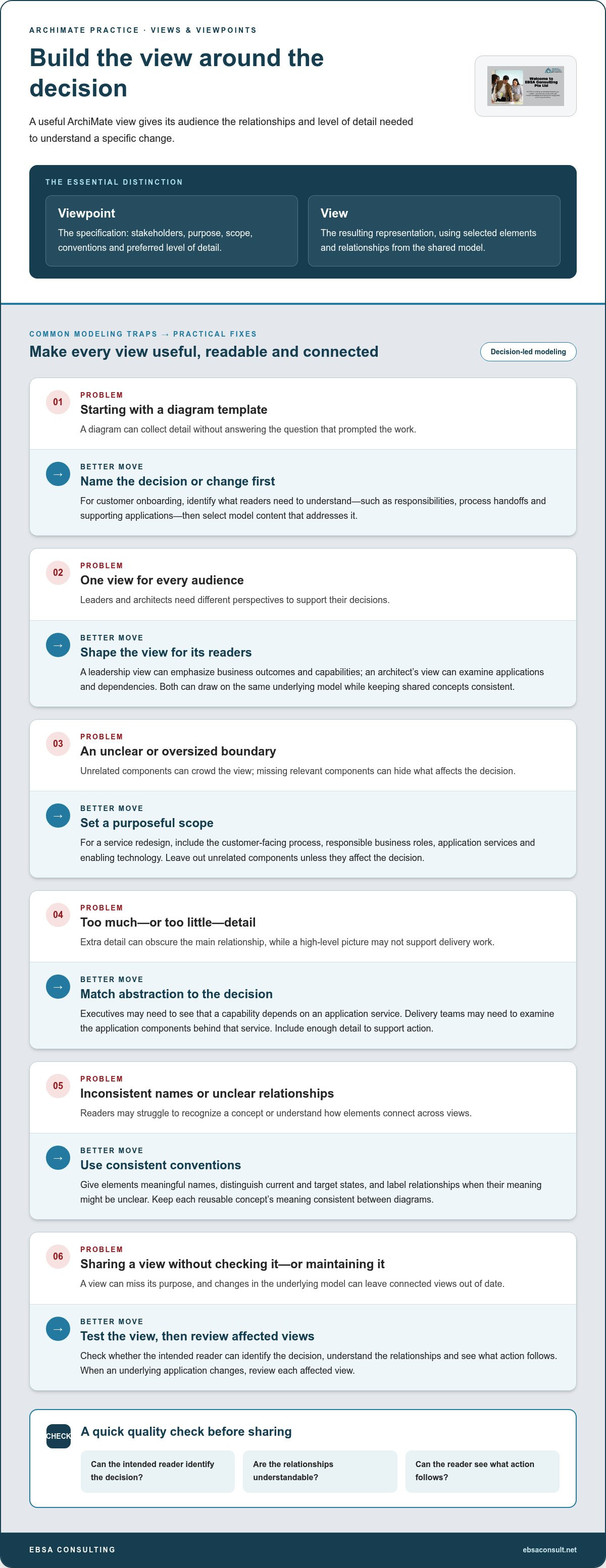
A useful ArchiMate view starts with a decision, not a diagram template. For example, a team planning customer onboarding may need to understand responsibilities, process handoffs and supporting applications. The view selects model content that addresses this concern, while its viewpoint defines how the information is organised and presented for its audience.
Keep the distinction clear: a viewpoint is the specification for a view, and a view is the resulting representation of architecture. A viewpoint can define its stakeholders, purpose, scope, conventions and preferred level of detail. A view applies those choices to selected elements and relationships from the shared underlying model.
Start by identifying the stakeholder and decision. A senior leadership view might focus on business outcomes and capabilities, while an architect’s view examines applications and dependencies. Both can draw on the same model, but each should emphasise information relevant to its audience. This viewpoint-based approach supports different conversations without changing the meaning of shared concepts.
Next, set a boundary. For a service redesign, the scope could include the customer-facing process, responsible business roles, application services and enabling technology. Exclude unrelated components unless they affect the decision. A clear boundary keeps the view readable and makes omissions intentional rather than accidental.
Choose an appropriate level of abstraction. Executives may need to see that a capability depends on an application service, while delivery teams may need to examine the application components behind that service. Include enough detail to support action, but avoid clutter that obscures the main relationship.
Use consistent conventions across views. Give elements meaningful names, distinguish current and target states, and label relationships when their meaning might be unclear. For example, a transition view can show which capability changes, which application supports it, and what work must happen between the current and target states.
Before sharing a view, test it against its purpose. Can the intended reader identify the decision, understand the relationships shown and see what action follows? If a process owner cannot trace a handoff, revise the view. If a leader cannot identify the affected capability, bring that relationship forward.
Maintain views as connected representations, not isolated illustrations. When an application changes in the underlying model, review each affected view so stakeholders continue working from a coherent picture. For organisations shaping this practice, enterprise architecture consulting can help align viewpoints with business decisions and technical planning.
3. Hints for selecting elements and relationships
Begin with the decision your model must support. If a bank is redesigning account opening, identify the affected capability, customer process, roles, applications and technology. Effective ArchiMate modeling and consulting keeps the focus on that business concern instead of turning the model into a catalogue of everything the organisation owns.
Select elements that represent distinct things or behaviours. A business actor can represent a responsible team, while a business process describes the work performed. An application component represents a software structure; an application service describes functionality available to other parts of the enterprise. This distinction helps stakeholders understand how work and technology relate.
Separate active structure from behaviour where the distinction matters. For example, a customer service team may perform an identity verification process that uses an application service. Name each element in terms stakeholders recognise, such as “Verify customer identity,” rather than using an unexplained project code.
Use relationships to express specific connections, not to make a diagram look complete. Assignment can show a role performing behaviour; serving can show an application service supporting a business process. Realization can connect a concrete element to what it implements, while access can represent behaviour that uses or changes data.
Choose relationships by asking what the reader needs to understand. In an onboarding view, serving may clarify how an application supports a process. A flow relationship can represent information or value moving between behaviours. A triggering relationship can show one behaviour initiating another. Avoid generic associations when a more precise relationship explains the architecture.
Keep relationship direction and meaning consistent across views. If the “Verify identity” process uses an application service, preserve that interpretation wherever the same model content appears. Add a short label when a relationship needs context, such as showing that a process sends an application a verification request.
Common risks include overloaded diagrams, inconsistent names, convenient but inaccurate relationships, and models disconnected from stakeholder decisions. Consulting projects can also lose clarity when scope or assumptions remain unclear. Reduce these risks by agreeing on purpose, terminology and ownership before expanding the model.
Review each element and relationship with a practical test: does it answer the stated question? For an application change, trace the relevant process, service, component and data. Remove elements that add no decision value, then ask business and technical stakeholders to validate the remaining connections against their work.
Finally, record the assumptions shaping the model. If a future-state process depends on a planned application service, distinguish it clearly from the current architecture. This makes dependencies visible and helps teams discuss what must change before the target design can operate. Good ArchiMate modeling and consulting keeps these assumptions understandable as decisions evolve.
4. Integrating ArchiMate with TOGAF, BPMN, and UML
ArchiMate, TOGAF, BPMN and UML address different architecture needs. TOGAF provides an architecture development approach, while ArchiMate gives teams a consistent way to represent architectural details. Used with the TOGAF Architecture Development Method (ADM), ArchiMate can support a consistent description across the transformation cycle, linking architecture work to a repeatable process.
Consider a retailer redesigning order fulfilment. During TOGAF ADM, architects can use ArchiMate to connect business goals, capabilities, applications and technology. The model helps stakeholders see how a proposed change affects the wider enterprise. It also provides a shared architecture reference as teams move from assessing the current state to defining and implementing a target state.
BPMN adds process detail when an enterprise view needs closer examination. An ArchiMate model might show an order management capability supported by an application service. A BPMN process can then describe the sequence of order validation, stock allocation and dispatch. Use both to connect the process flow with its architectural context, without duplicating every workflow detail in ArchiMate.
UML serves a different purpose. A solution team can use UML diagrams to describe software structure or behaviour, such as interactions between services in an order platform. ArchiMate keeps those components connected to business capabilities and application services. This separation helps executives discuss strategic impact while developers examine technical design in greater detail.
Integration works best when the team defines model boundaries before creating diagrams. Decide which information belongs in the enterprise model, which process details belong in BPMN, and which software specifications belong in UML. For example, keep the target application’s role in ArchiMate, the order-handling workflow in BPMN, and the service interaction design in UML.
Maintain traceable links between these representations. If a business requirement changes, identify the affected capability, process and software component. A shared glossary can align terms such as “order validation” across ArchiMate, BPMN and UML. Model ownership and change review also help prevent diagrams from describing different target states.
Do not force every method into one notation. Use ArchiMate for cross-domain relationships, BPMN for process sequence and UML for software design. In a TOGAF ADM transformation, these methods can provide complementary views: architecture establishes direction, process models clarify operational change, and software models guide implementation.
Using ArchiMate with TOGAF ADM can provide a consistent description and representation of architectural details throughout the transformation cycle. This keeps those details coherent and their architectural representation aligned as the transformation progresses.
5. Connecting strategic intent to operational and technical realities
A strategy becomes actionable when teams can trace its intent into business change and technical decisions. In ArchiMate, start with an outcome such as faster customer onboarding, then connect it to the capabilities, processes, applications and technology needed to support it. This creates a visible path from executive ambition to changes teams can plan and deliver.
For example, an organisation in Singapore may aim to make account opening easier for customers. Model that outcome alongside the customer onboarding capability, then show which processes deliver it. Connect those processes to the application services and technology components that enable them. The resulting chain helps stakeholders see where a strategic goal depends on operational work or technical change.
Strategic-level models can connect desired outcomes with the capabilities and resources an organisation needs. These concepts help connect desired results to what an organisation can do and what it needs. A capability view can show where an organisation must strengthen its ability, while related process and application views clarify how that capability will operate.
To make the model useful, distinguish the current state from the intended target. For account opening, the current state might involve repeated manual checks; the target could use a more integrated process. Show the affected roles, processes and application services, then identify dependencies to address before the target can work. This turns a broad ambition into a structured change conversation.
Bring operational stakeholders into the modelling. A process owner can explain where customer information is entered, reviewed or handed between teams. An application architect can identify the services and components supporting those steps. Comparing these perspectives can expose gaps, such as a strategic outcome depending on a process no team owns, or a system with no clear role in the target design.
Use the model to connect decisions, not to claim that a diagram alone delivers change. Teams can derive work packages from dependencies, assign ownership through governance, and revisit the model as implementation decisions evolve. For instance, if a planned application change shifts a process handoff, update the affected relationships and assess whether the intended customer outcome remains supported.
A governed architecture repository can also help teams identify processes and systems that depend on an end-of-life platform, approved transition architectures, and accountable owners. These connections give decision-makers a practical basis for sequencing change: they can see which dependencies matter, what the transition must preserve, and who is responsible for moving each part forward.
Connect your strategic goals to operational capabilities and solution decisions through enterprise architecture consulting. A coherent model gives leadership, process owners and technical teams a shared basis for prioritising change and maintaining alignment as delivery progresses.
EBSA Consulting: Enterprise Architecture Consulting
EBSA Consulting helps organisations connect business strategy with technology through Enterprise Architecture Consulting. Turn to this service when strategic priorities need clearer links to capabilities, processes, applications or technical decisions. A structured architecture view can help leaders understand dependencies and give teams a shared basis for planning change.
For operational priorities, Business Architecture Services can help clarify processes and organisational capabilities. When a defined business objective needs a technical design, Solution Architecture Design connects implementation choices with that objective. The appropriate focus depends on whether the challenge spans the enterprise, centres on business operations or concerns a specific solution.
To explore how EBSA Consulting can support your architecture needs, contact the team to discuss the decisions your organisation needs to make.
Turn architecture insight into sustained progress
The next step is to make architecture part of how decisions are shaped, rather than creating a diagram once and setting it aside. Choose a business priority, identify the decisions it depends on, and use the model to keep those decisions connected as plans move into delivery. This gives leadership and delivery teams a practical way to revisit assumptions, surface dependencies and adapt the target as needs change.
ArchiMate modeling and consulting can support that ongoing discipline when the model reflects the questions people need to answer. Start with a focused area of change, agree on shared language, and keep the architecture useful to the people making operational and technical choices. Progress comes from applying the model consistently and learning from how the organisation works in practice.
For a considered next step, contact EBSA Consulting for advice about connecting your strategic priorities with architecture decisions. With a clear starting point and collaborative approach, your organisation can move forward with greater alignment and purpose.
Frequently Asked Questions
What is enterprise architecture?
Enterprise architecture is a way to understand how an organisation’s business and technology fit together to support its objectives. For example, if a Singapore-based organisation combines customer channels, architecture can help clarify which teams own each service and which systems support them. That shared picture helps decision-makers discuss sequencing, dependencies and responsibilities before committing to a change.
What is ArchiMate modeling and what enterprise architecture problems does it address?
ArchiMate modeling uses a shared visual language to represent architectural concepts and their connections. It can help address fragmented documentation, unclear system dependencies and differences between business and technical teams’ understanding of a change. For instance, a model can make it easier to trace how a customer-facing service relies on internal processes and applications, giving teams a common reference for discussing priorities and impacts.
How do ArchiMate consulting services compare with TOGAF and other enterprise architecture frameworks?
ArchiMate consulting applies modelling practices to an organisation’s architecture needs, while TOGAF provides an architecture development approach that can guide the work. ArchiMate offers a way to represent architectural information; it does not replace a framework or consulting engagement. Organisations may select different approaches based on their governance, delivery practices and the decisions they need to support.
How does an ArchiMate consulting engagement typically work, step by step?
The consultant starts by defining the decision or change, then selects relevant model elements and relationships and sets the view’s audience, scope and level of detail. They test the view against its purpose, document assumptions and shape deliverables such as a structured model, audience-specific views and a roadmap.
What are the latest ArchiMate specification and certification requirements?
The Open Group published ArchiMate 3.2 in fall 2022, and that specification is covered by the Part 1 exam. Certification has Foundation and Practitioner levels; the Foundation exam has 40 single-choice questions, lasts 60 minutes and requires at least 24 correct answers to pass.
What tools support ArchiMate modeling, and how do their prices and features compare?
Archi supports ArchiMate modeling and is written in Java on the Eclipse Rich Client Platform. Compare tools by modeling features, collaboration options, model-exchange support and licensing terms. Prices depend on the product and licensing model.


